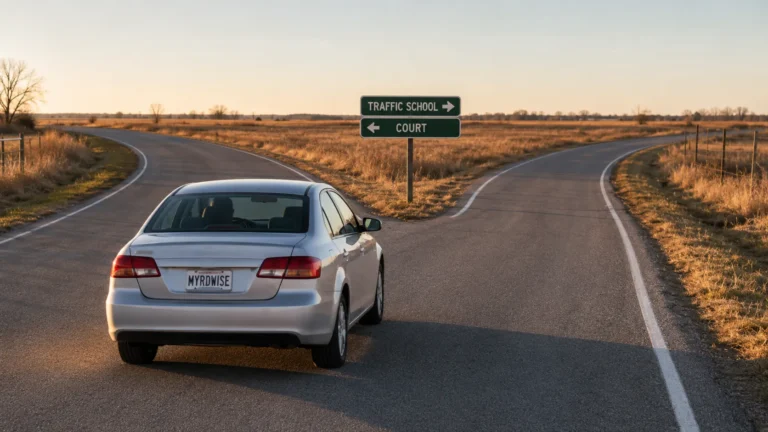


Should I Fight a Speeding Ticket? 5 Signs It’s Worth It

Should I fight a speeding ticket, pay it, or take a driving course? The answer depends on more than the fine printed on the ticket. A speeding conviction can affect your driving record, add points, trigger state surcharges, and raise your insurance rate at renewal.
For many drivers, fighting a ticket is not about “beating the system.” It is about choosing the least damaging legal option before the response deadline passes. This guide gives you a practical decision framework, including when to contest the ticket, when traffic school may be better, and when paying is the simpler choice.
Important: This article is general educational information, not legal advice. Traffic-ticket rules vary by state, court, violation type, and driving record.
Quick Answer: Should You Fight a Speeding Ticket?
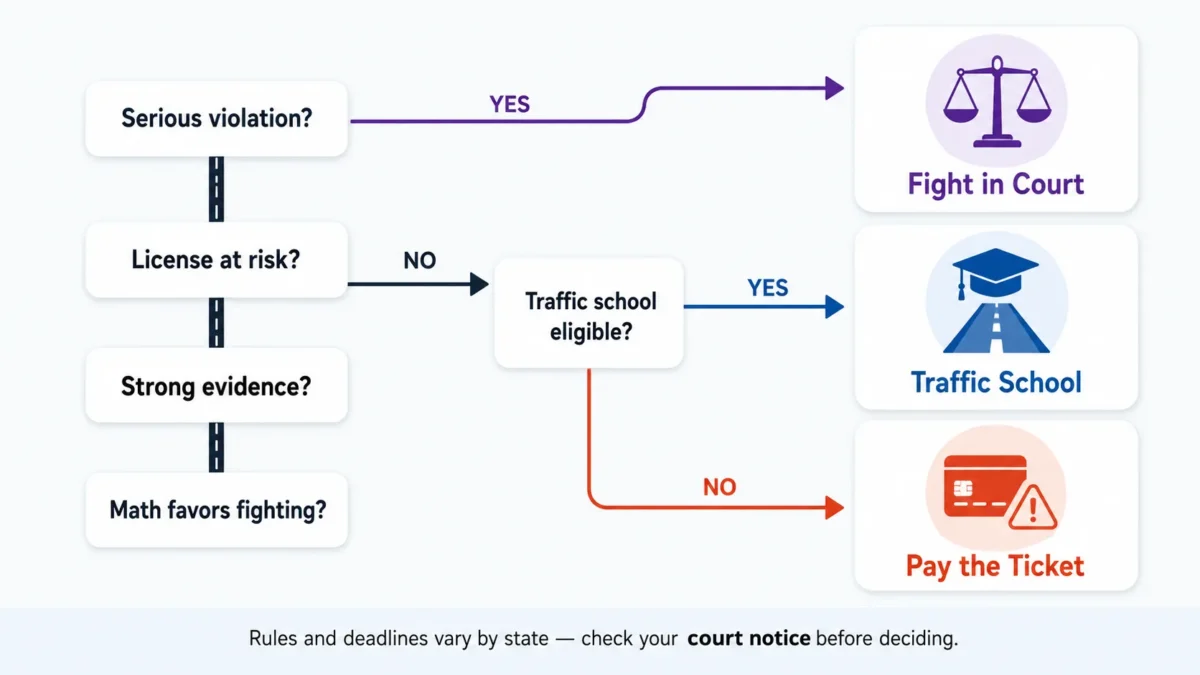
Fight the ticket, or talk to a lawyer, if any of this is true: the violation is serious, it carries several points, your license is at risk, it could be charged as something worse, or you have evidence the ticket is wrong.
You probably do not need to fight if this is a minor first ticket and the court offers traffic school, dismissal, a deferred program, or another way to avoid points. Compare those options before you decide.
| Situation | Better First Move | Why It Matters |
|---|---|---|
| Minor first ticket, clean record | Check traffic school or dismissal eligibility | May avoid points or conviction in some states |
| Speed that may trigger an enhanced charge or mandatory appearance under local law | Check the jurisdiction’s rules and consider legal advice | The same speed can carry very different consequences by location |
| Several points or close to your state’s suspension threshold | Read the ticket and court instructions before paying | Payment can end the case, while some official programs include payment as one of their steps |
| Clear error on the citation | Gather evidence and consider contesting | Wrong vehicle, wrong location, wrong speed, or bad signage may matter |
| Out-of-state ticket | Ask how your home state treats it | Consequences may follow you through record-sharing rules |
| Commercial driver license | Get legal guidance before responding | CDL consequences can be stricter, even in a personal vehicle |
| Eligible for a court-approved dismissal course | Compare the confirmed course outcome with contesting | A court-authorized course may offer a more predictable result, but outcomes vary |
What Happens If You Just Pay the Ticket?
What paying does depends on the court, ticket, and option you choose. It can end the case as a guilty plea, admission, or conviction. Some official course programs also require a fine, fee, cost, or deposit. Read the ticket and court instructions before you pay.
Depending on your state, the consequences may include:
- A moving-violation conviction on your driving record
- Points added to your license or driver record
- State fees, surcharges, or driver responsibility assessments
- Insurance review at your next renewal
- Loss of a clean-driver discount
- Greater risk if you receive another violation soon after
The fine can be only one part of the cost. A conviction can also bring court costs, state fees, points, or a later insurance increase. The amount and timing depend on the insurer, state rules, driving record, discounts, and the result shown on your record.
New York DMV currently states that 11 points accumulated within 24 months may lead to suspension. Points stop counting toward that total after 24 months from the violation date, but they remain visible while the conviction remains on the driving record and may be considered by an insurer. New York also uses separate Driver Responsibility Assessment rules.
The Three Main Options After a Speeding Ticket
Most drivers have three broad options. The exact names and deadlines vary by court.
1. Pay the ticket
Paying is usually the fastest way to close the ticket, but the final result depends on the court and the option you choose. Before you pay, ask whether it creates a conviction, completes a step in an approved course program, or closes other options.
2. Fight the ticket in court
Fighting means pleading not guilty or contesting responsibility. The goal may be dismissal, a not-guilty finding, a reduction to a lower-speed violation, or a reduction to a non-moving violation where available.
This option can be worthwhile, but it is not guaranteed. It takes time, preparation, and sometimes attorney fees.
3. Use traffic school, defensive driving, or deferred disposition
Some states and courts allow eligible drivers to complete a driving course or probation-like program to avoid points, avoid adjudication, or dismiss the charge. Others only allow a course to reduce active points or provide an insurance discount.
This distinction is important. A “defensive driving course” does not mean the same thing everywhere.
When Fighting a Speeding Ticket Makes Sense
1. The violation is serious
Fighting is more reasonable when the ticket is not minor. Serious cases may include:
- Excessive speeding
- Speeding in a work zone or school zone
- Reckless driving or careless driving
- A violation carrying several points
- A ticket that could trigger suspension
- A ticket involving a crash
For context, New York assigns 6 points for speeding 21–30 mph over the posted limit, 8 points for 31–40 mph over, and 11 points for more than 40 mph over. That is only one state example, but it shows why the exact speed range matters.
If the allegation may be treated as reckless driving, another criminal offense, or an enhanced charge—or could affect a CDL, employment, professional license, or immigration matter—obtain jurisdiction-specific legal advice before responding. Do not assume an ordinary civil speeding citation carries the same consequences everywhere.
2. Your record is already at risk
A second ticket can matter more than a first ticket. If you already have points, a recent accident, a prior moving violation, or a pending ticket, another conviction can push you into a higher-risk category.
In that situation, fighting may be worth considering even if the current ticket looks minor by itself.
3. You have evidence that the citation may be wrong
A ticket is easier to contest when you have something specific to challenge.
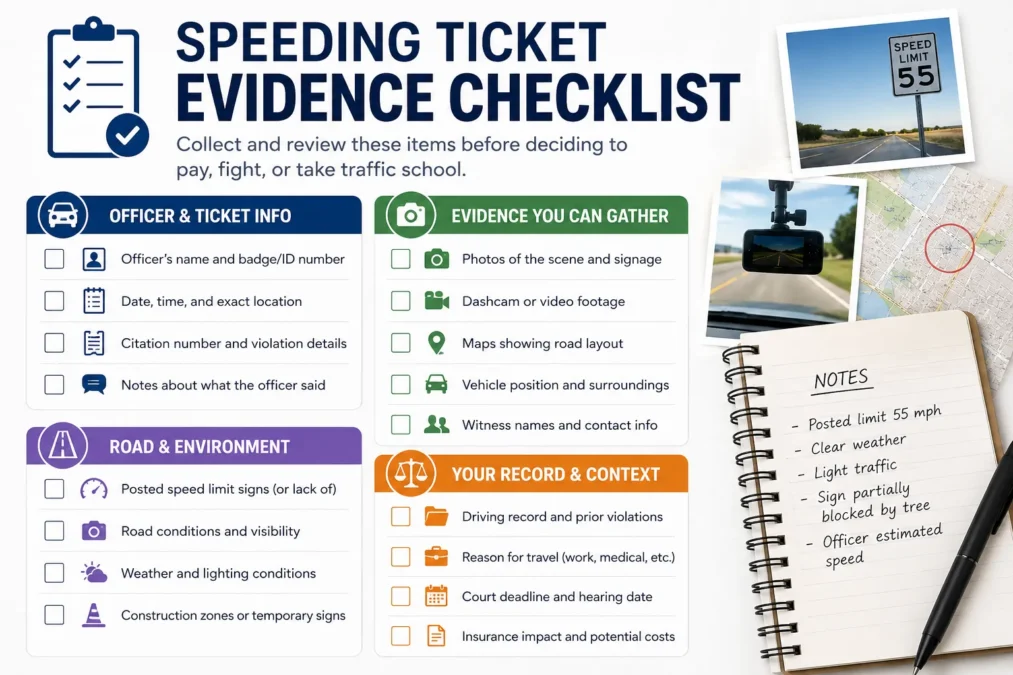
Useful evidence may include:
- Dashcam footage
- Photos of blocked, missing, or confusing speed-limit signs
- GPS or telematics data, if reliable and relevant
- Repair records if equipment or speedometer accuracy is an issue
- Witness statements
- Weather or road-condition evidence
- A copy of the ticket showing an incorrect plate, location, date, or violation code
Do not assume one typo automatically dismisses a ticket. Some errors are harmless. Others may matter. The stronger question is whether the error affects the actual charge or the state’s ability to prove it.
4. The insurance math is bigger than the court cost
Before paying, add the case-specific costs you can verify:
- The ticket fine
- Court costs and state or local assessments and surcharges
- Attorney fees, travel, and time required to contest the citation
- Any insurer-specific premium change expected at renewal
- Any clean-driver or violation-free discount that could be lost
- Point or license consequences that carry a practical cost for you
Use the amounts on the ticket and court materials. For insurance, ask your insurer or agent how the result on your record could affect renewal. If you compare quotes, keep the liability limits, deductibles, and optional coverage the same. The NAIC shopping tool can help you compare equal coverage, but it cannot predict how an insurer will price your ticket.
Then compare that case-specific total with the cost of contesting the ticket. If an attorney may be able to reduce or dismiss a serious violation, the fee may be financially reasonable. If the violation is minor and the likely record impact is small, the same fee may not be worth it.
5. You are an out-of-state driver
Do not assume an out-of-state ticket stays local. Whether states share the conviction, and how your home state or insurer treats it, depends on the states, charge, result on the record, and their rules.
If appearing in person would require travel, a traffic attorney may be able to appear for you in some courts. Confirm this before deciding.
When Fighting Usually Is Not Worth It
1. It is a minor first violation and you have a clean record
If this is a low-level speeding ticket, your driving record is otherwise clean, and the court offers no dismissal or point-avoidance option, paying may be the practical choice.
That does not mean the ticket has no cost. It means the cost of fighting may be larger than the realistic benefit.
2. You have no evidence and no legal issue to raise
Going to court with no evidence can still sometimes lead to a reduction, but it is uncertain. Courts often rely on the officer’s testimony, radar/lidar records, and the citation details.
If your only argument is “I do not think I was going that fast,” the case may be weak unless you have evidence to support it.
3. A better court-approved option is available
If you are eligible for traffic school, deferred disposition, or dismissal, that may be better than fighting. The key is to confirm the actual outcome with the court before paying or enrolling.
Do not rely only on a course provider’s marketing page. Court approval matters.
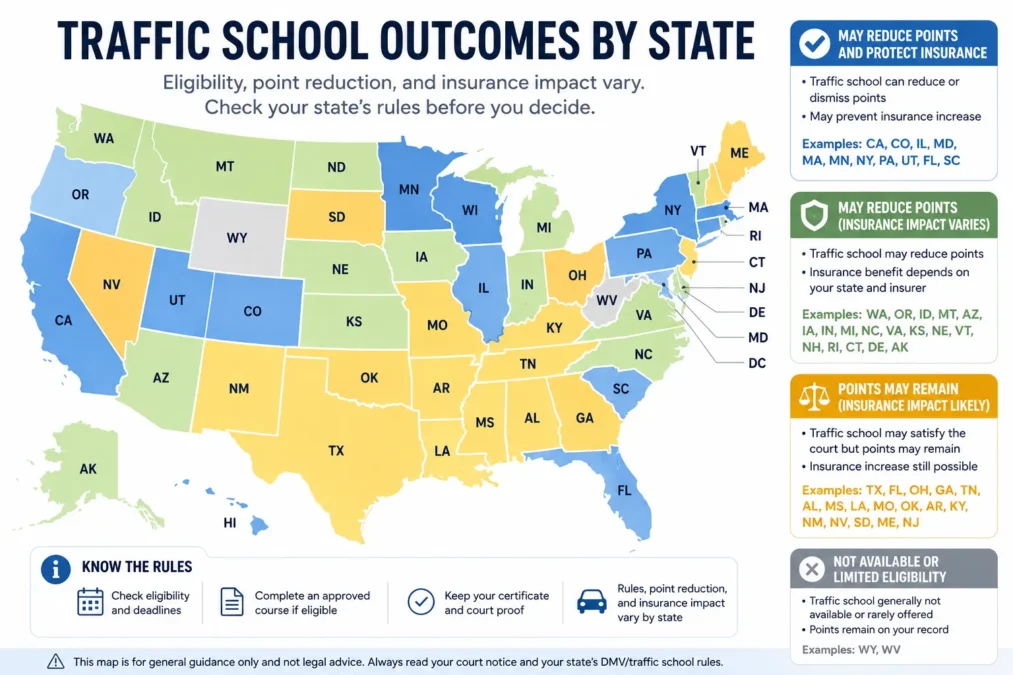
Traffic School Is Not the Same in Every State
This is one of the biggest points drivers miss. Traffic school, defensive driving, and driver improvement courses can produce different outcomes depending on where the ticket was issued.
| State / Court Example | Possible Course Outcome | Why It Matters |
|---|---|---|
| Houston and Dallas municipal-court examples | An eligible driving-safety-course request may lead to dismissal when that court’s approval, payment, course, and document requirements are completed. | These are local examples, not a single statewide court procedure. |
| Florida, where eligible | Choosing Basic Driver Improvement under §318.14(9) prevents points and withholds adjudication if you meet the rules; it is not dismissal. | Section 318.14(9) does not set the course-choice deadline. Follow the clerk’s instructions for choosing BDI, paying, fees, and completion. |
| New York | PIRP may subtract up to four points for suspension-calculation purposes. New York DMV states that completing an approved course reduces the base rate of automobile and motorcycle insurance premiums by 10% each year for three years. The reduction applies to the liability and collision premiums of a qualifying principal operator. | It does not remove the violation, conviction, or points from the driving record. |
Before choosing this path, ask the court:
- Am I eligible for a course or deferred disposition?
- Will it dismiss the ticket, withhold adjudication, avoid points, or only reduce active points?
- Do I need court approval before enrolling?
- What is the deadline?
- Will completion be reported automatically, or must I submit proof?
- Will this still appear on my driving record?
How to Fight a Speeding Ticket If You Decide To
Step 1: Read the ticket carefully
Check the response deadline, court name, violation code, speed alleged, speed limit, location, officer information, and whether the ticket requires a court appearance.
Missing the deadline can create a worse problem than the original ticket.
Step 2: Decide whether to plead not guilty or request a hearing
The procedure varies by state and court. Some courts allow online responses. Others require mail, in-person filing, or a specific form.
Do not pay until the official instructions explain what the payment does. If you plan to fight the ticket, follow the court’s plea or hearing steps. Paying can end the case, while some official course or deferral programs include payment when you choose them.
Step 3: Request records if available
Depending on the court, you may be able to request:
- Officer notes
- Radar or lidar calibration records
- Maintenance records
- Training records
- Body-camera or dash-camera footage
- Court discovery materials
Availability varies. Some courts handle traffic discovery informally; others require a formal request.
Step 4: Prepare a narrow argument
A strong traffic-court argument is usually specific:
- The speed-limit sign was missing or blocked.
- The ticket lists the wrong vehicle or location.
- The alleged speed is inconsistent with available evidence.
- The radar/lidar evidence has a documentation issue.
- The violation code does not match the alleged conduct.
Avoid emotional arguments. Focus on facts, records, and the legal issue.
Step 5: Ask about reduction options
Even if you do not win outright, the court or prosecutor may offer a reduction. A reduction can matter if it lowers points, avoids a moving violation, or changes the insurance impact.
Do not assume every reduction is valuable. A lower fine with the same moving-violation conviction may not help much.
Should You Hire a Traffic Attorney?
A traffic attorney is most worth considering when the ticket has consequences beyond a simple fine.
Consider hiring one if:
- The ticket is for high-speed or reckless driving
- You may lose your license
- You already have points or recent violations
- You have a CDL
- You live out of state
- The ticket involves a crash
- You cannot appear in court yourself
- Your job depends on a clean driving record
No lawyer can guarantee dismissal—be careful with anyone who suggests otherwise. You are paying for someone who knows the local court, knows what deals it usually offers, and will not miss a filing deadline.
Pay vs. Fight vs. Traffic School: A Practical Decision Framework
Use this order before choosing.
1. Check the deadline first
Your first job is not to decide emotionally. It is to avoid missing the response deadline.
2. Check course or dismissal eligibility
If a court-approved course can dismiss the charge, withhold adjudication, or avoid points, that may be the best option for a minor ticket.
3. Check the point value and record impact
Look up your state’s point chart and suspension threshold. A ticket that adds several points deserves more caution than a zero-point or low-point violation.
A zero-point or reduced-point result does not necessarily eliminate the conviction, court record, or possible insurance consequences. Confirm each outcome separately.
4. Estimate insurance impact
Your insurer may not change your premium immediately, but a moving violation can matter at renewal. The exact impact depends on your company, state, age, record, and discounts.
5. Decide whether evidence exists
If you have a factual or legal defense, fighting becomes more reasonable. If not, look harder at course, deferral, or negotiated reduction options.
6. Consult an attorney for serious cases
For high-risk tickets, get a consultation before paying. Consultation procedures and fees vary by attorney and jurisdiction.
Common Mistakes to Avoid
Paying before checking your options
Paying can close hearing, deferral, or course options. But some official programs include payment as one of their steps. Read the ticket and court instructions to learn exactly what paying does.
Assuming traffic school always removes the ticket
In some places it can dismiss or avoid points. In others it only reduces active point calculations or gives an insurance discount. Confirm the exact outcome.
Waiting until the deadline
Traffic-ticket deadlines are often short. Waiting can remove options that were available earlier.
Fighting only because you are angry
A court argument needs facts. Anger alone does not reduce points or protect your insurance rate.
Ignoring out-of-state consequences
A ticket issued in another state can still affect your home-state driving record or insurance, depending on the violation and state rules.
Frequently Asked Questions
Does fighting a speeding ticket affect insurance if I lose?
If fighting the ticket ends in a conviction, the result can affect insurance under the insurer’s rules. Simply asking for a hearing is different from the final result, but you can still face court costs, lawyer fees, and other expenses.
Can I fight a speeding ticket without a lawyer?
Yes. Many drivers represent themselves in traffic court, especially for minor tickets. It is most realistic when the violation is low-level, you can appear in person, and you have clear evidence or a narrow issue to raise. For serious violations, a lawyer is usually worth considering.
Is it better to fight a ticket or take traffic school?
If traffic school will dismiss the ticket, avoid adjudication, or prevent points, it may be better than fighting because the outcome is more predictable. If traffic school only reduces active point calculation and the conviction still remains, fighting or negotiating may still be worth considering.
What happens if I ignore a speeding ticket?
Ignoring a ticket is usually the worst option. It can lead to additional fines, late fees, a failure-to-appear problem, license suspension, collection activity, or a warrant depending on the court and violation. Start with the response deadline and court instructions. See what to do after getting a ticket for the basic steps.
Can a speeding ticket be reduced to a non-moving violation?
Sometimes. It depends on the court, prosecutor, your record, and the charge. A nonmoving result can reduce point or insurance effects, but it does not erase every record or promise the same premium. Before accepting a reduction, confirm what will appear on your record and how the insurer will treat it.
Does a defensive driving course remove points?
Sometimes, but not always. In New York, a PIRP course can reduce the point total used for suspension calculation and provide an insurance discount, but it does not physically remove the violation, conviction, or points from the driving record. Florida and Texas have different rules for eligible drivers. Always check with the court or DMV in the state where the ticket was issued.
Should I fight a speeding ticket if it is my first one?
For a minor first ticket, first check whether you are eligible for traffic school, dismissal, deferred disposition, or point avoidance. If no such option exists and the expected record impact is small, paying may be more practical. If the ticket is high-speed, in a work zone, or carries several points, treat it more seriously even if it is your first ticket.
Bottom Line
Fighting a speeding ticket can make sense when the charge puts your license, job, insurance, or criminal record at real risk—or when you have evidence the ticket is wrong. For a minor first ticket, a court-approved course, deferred program, or another official option can be more practical.
Before you pay, ask three questions: What happens to my record? What happens to my insurance? And is there a court-approved way to avoid the conviction or points?
That is the real decision — not just whether the fine is affordable today.
Related Reading
- How to Get a Speeding Ticket Dismissed Before It Hits Your Record
- Can You Keep a Traffic Ticket Off Your Record Before It Affects Insurance?
- Car Insurance Increase After a Ticket: How to Avoid or Reduce It
- Traffic School Insurance Discount: Can It Lower Your Rate?
- How to Avoid Points on Your License
Sources
Sources reviewed August 20, 2026.
- NAIC — A Shopping Tool for Auto Insurance
- New York DMV: Driver License Points and Penalties
- New York DMV: The New York State Driver Point System
- New York DMV: Point and Insurance Reduction Program
- Florida Statutes §318.14
- Florida FLHSMV: Basic Driver Improvement course rules
- City of Houston Municipal Courts: Requesting Driver Safety Course
- Dallas Municipal Court: Driving Safety Course