

Traffic School vs. Court: How to Choose After a Ticket
Traffic school and court are not universally interchangeable options. Start with the choices listed by the court handling your citation. If an approved course offers a defined result for your specific violation, compare that result with what you would preserve—or waive—by requesting a hearing.
That means there is no national winner in the traffic school vs. court decision. The better path depends on the law that applies to your ticket, the options the court actually offers, your eligibility, the deadline, and the exact result of completing a course.

Important: This article provides general information, not legal advice. Rules and available options depend on the jurisdiction and the facts of the citation.
Start With Your Citation and Court Instructions
Before paying, enrolling in a course, or requesting a hearing, read the citation and the court’s official instructions. Identify:
- the deadline to respond;
- every response option listed for your case;
- whether traffic school or another driver course is available;
- whether the court must approve the course before you enroll;
- what completing the course changes—and what it does not change;
- whether choosing the course gives up a hearing or another procedural option; and
- what happens if you enroll but do not finish on time.
Do not assume that a course advertised online is approved for your case. Use the court or motor-vehicle agency’s official provider list when one is supplied.
Traffic School and Court May Solve Different Problems
A court appearance or hearing is part of resolving the citation. A driver course may be one available method of resolving it, a condition attached to a particular disposition, or a separate program that affects only a later consequence.
Before comparing the options, ask the court what legal result the course provides for this ticket. Possible labels can sound similar while producing different effects. For example, a system may address adjudication, confidentiality, a point calculation, or course eligibility without erasing the underlying event.
The safest comparison is therefore not “course or court?” in the abstract. It is:
What result does this approved course provide in my case, and what right or option would I give up by choosing it?

A Six-Step Decision Check
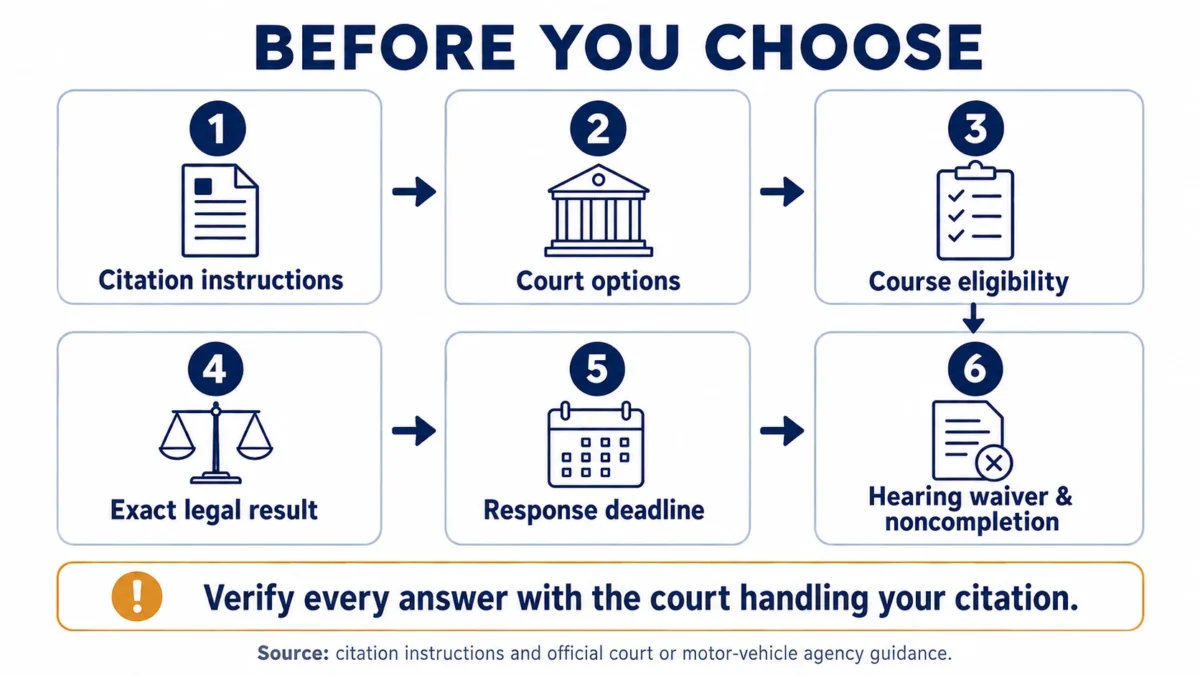
1. Confirm the response deadline
Use the date and instructions on the citation or the court’s official case information. Do not rely on a course provider’s marketing page for the deadline.
2. List the options the court actually offers
These may include a hearing, payment, an approved course election, or another case-specific route. If the citation is unclear, contact the court listed on it.
3. Verify course eligibility
Ask whether your license class, the vehicle involved, the charged violation, prior course use, and other case facts affect eligibility. Do not treat a general online eligibility checklist as a ruling on your case.
4. Get the exact result in writing
Confirm whether successful completion affects adjudication, public or confidential reporting, a point calculation, or something else. Also ask what remains visible to courts or government agencies.
5. Identify what you would waive
Before electing a course or paying the ticket, confirm whether that action waives or limits a hearing or another option. The controlling answer should come from the court handling the citation.
6. Confirm completion and reporting rules
Record the enrollment deadline, completion deadline, approved provider, proof-of-completion method, and consequences of noncompletion.
California Example: Confidentiality and Point Treatment Are Separate
California illustrates why the exact mechanism matters.
For a qualifying proceeding under Vehicle Code §1803.5, §1808.7 generally makes the Department of Motor Vehicles’ record of a first eligible conviction within an 18-month period confidential. A court can still receive the record, and the department may use it only for statistical purposes. If the record is confidential under that section, the violation is not counted as a point under §12810.
The section also lists exceptions, so this is not a promise that every course completion produces confidentiality or point treatment. The exception most drivers encounter is that confidentiality does not apply when the conviction would result in more than one point under §12810—so a two-point violation receives no confidential treatment at all. The record is also not confidential for a California or out-of-state commercial driver license holder, or when the violation occurred in a commercial motor vehicle.
California has a narrower rule for some commercial-license holders. To the extent the court is in conformance with applicable federal requirements, a person holding a Class A, Class B, or commercial Class C license may be permitted to attend traffic violator school when operating a vehicle that required only a Class C or Class M license, subject to the exclusions in §42005(c). The conviction cannot be kept confidential. Instead, it is excluded from the violation-point count only for determining whether the driver is presumed to be a negligent operator under §12810.5.
That CDL rule should not be summarized as “no points.” It is a limited calculation rule subject to the statutory conditions and exclusions.
California also provides that the person chooses the licensed traffic violator school and that the court supplies the DMV’s current list. Use that official list rather than assuming any online course qualifies.
Florida Example: An Election With Defined Effects and Limits
Florida law provides an election to attend a basic driver improvement course for eligible citations. When the statutory requirements are met, adjudication is withheld, no points are assessed, and any civil penalty imposed under §318.18(3) is reduced by 18%.
The election is limited. The person must not hold a commercial driver license or commercial learner’s permit and must be cited while driving a noncommercial motor vehicle. Florida generally permits no more than one election in a 12-month period and no more than eight elections in a lifetime. The election is also unavailable for a violation of §§316.183(2), 316.187, or 316.189 when the cited speed is 30 mph or more above the posted limit.
Florida’s general response period under §318.14 is 30 days after the date the citation is issued. A Florida driver should still follow the instructions for the court handling the case, verify eligibility before enrolling, and confirm the course and completion process the court accepts.
Decision Worksheet
Complete this worksheet from the citation and official court or motor-vehicle sources before making an election.
| Question | Verified answer | Official source or contact |
|---|---|---|
| What is my response deadline? | ||
| What options are listed for this citation? | ||
| Is a course available for this violation and license class? | ||
| Must the court approve the course before enrollment? | ||
| Which providers or courses are officially approved? | ||
| What exact legal result follows successful completion? | ||
| What remains on a government or court record? | ||
| Does electing the course waive a hearing or another option? | ||
| What are the enrollment and completion deadlines? | ||
| Who reports completion, and how can I verify it? | ||
| What happens if I do not complete the course? |
When to Get Individual Help
Consider contacting the court or a qualified attorney if you do not understand the listed options, the citation involves a serious charge, your driving privileges may be affected, you hold a commercial driver’s license, or you want advice about contesting the allegation. Evidence such as video, photographs, location data, equipment records, or an apparent citation error can be fact-specific; possessing it does not by itself establish a defense.
Bottom Line
Do not choose traffic school because it is described as universally safer, cheaper, faster, or better. Verify what the court offers, whether you qualify, the precise result of successful completion, the deadline, and what you would waive. Then compare that defined course result with the hearing or other options available in your case.
Related Reading
- Pay Ticket or Traffic School?
- Does Traffic School Remove a Ticket From Your Record?
- How to Get a Speeding Ticket Dismissed Before It Hits Your Record
- Can You Keep a Traffic Ticket Off Your Record Before It Affects Insurance?
- Car Insurance Increase After a Ticket: How to Avoid or Reduce It
Sources
Sources reviewed August 19, 2026.