


Pay Ticket or Traffic School? Real Cost Comparison
If you just received a traffic ticket, paying it may feel like the easiest way to move on. But the fastest option is not always the least expensive or least consequential one.
The real question is not simply whether to pay the ticket or take traffic school. It is what each available option would do to the case, your driving record, your procedural rights, and your insurance at renewal.
An approved course may be useful when it produces a defined result such as dismissal, deferred disposition, confidential record treatment, a point-calculation change, or an insurance discount. None of those results is automatic. The rules depend on the jurisdiction, court, violation, license class, prior course use, insurer, and timing.
Before paying, enrolling, or requesting a hearing, confirm every available option with the court handling the citation.
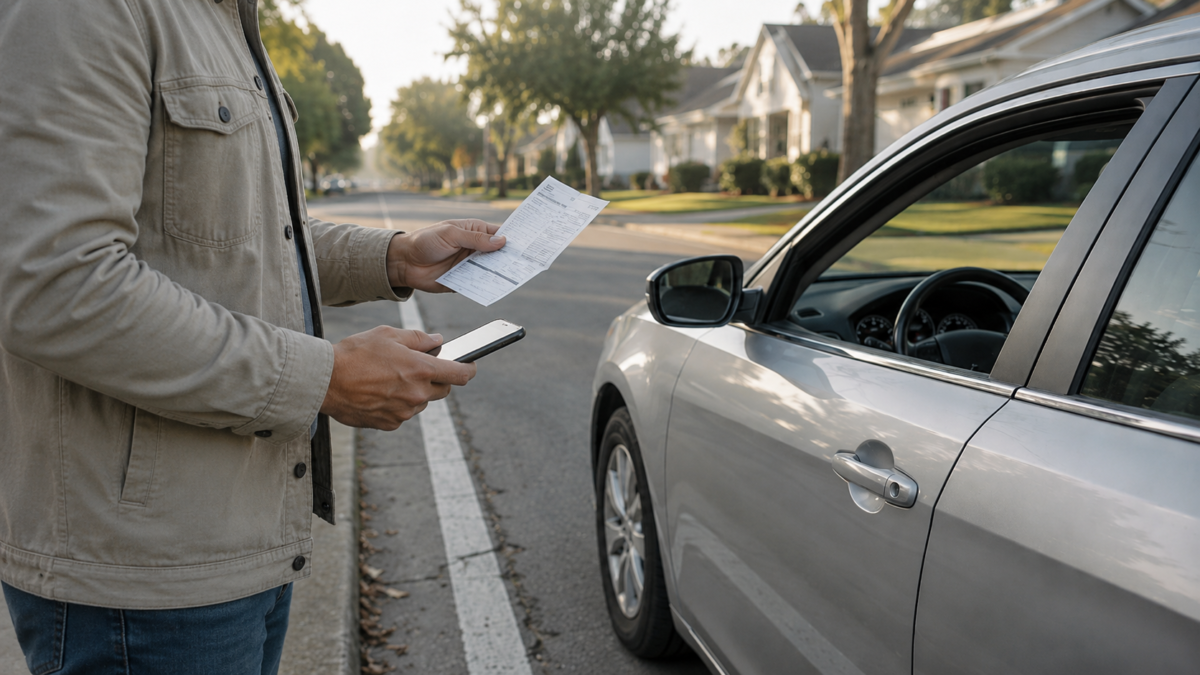
Important: This article provides general information, not legal or insurance advice. Court procedures, course outcomes, fees, driving-record treatment, and insurance effects vary by jurisdiction, court, insurer, violation, and driver.
Quick Answer: Compare the Verified Outcome, Total Cost, and Rights You Give Up
A court-approved course is worth comparing when the court confirms that successful completion will produce a useful result for your citation. That result might involve dismissal, deferral, confidential record treatment, a point calculation, or a program-specific insurance discount.
Paying may be a reasonable choice when you have verified that a course is unavailable or provides no meaningful benefit, and you do not intend to request a hearing. Contesting the citation may be another option when you dispute the allegation or the possible consequences justify case-specific advice.
Do not choose from a generic national rule. Compare the choices listed by the court handling your ticket.
| Option | What to verify | Possible advantage | Tradeoff or risk |
|---|---|---|---|
| Pay the ticket | Total amount due, payment deadline, and whether payment is treated as an admission or closes a hearing or course option | May resolve the citation quickly | May create a conviction, record entry, points, or an insurance consequence, depending on the jurisdiction and insurer |
| Court-approved course | Eligibility, total fees, completion deadline, and the precise legal or record result | May provide a defined benefit if every condition is met | May require court payments and a provider fee; completion may not erase the violation |
| Contest the ticket | Hearing procedure, deadline, evidence rules, and possible outcomes | Preserves the opportunity to challenge the allegation | Requires time and may involve uncertainty or court-specific costs |
First: What Paying the Ticket May Mean
Paying a traffic ticket is not merely a financial transaction. Depending on the jurisdiction and payment process, it may be treated as an admission or waiver of the opportunity to contest the citation. It may also result in:
- a conviction or violation entry on a driving record;
- points or violation history under the applicable state system;
- an insurance review when the insurer next evaluates the driving record; or
- loss of a course, deferral, or hearing option if payment closes the case.
Read the citation and the court’s official instructions before paying. Some authorized course elections require payment as part of the process, so the correct sequence is the one specified by the court handling the citation.
Once a payment produces a final disposition, reopening the case or requesting a different outcome may be difficult or unavailable. Confirm the effect of payment first.
What Paying the Ticket Can Really Cost
The amount printed on the citation may be only one part of the comparison. Build the total from verifiable categories rather than national estimates.
| Cost category | What to verify |
|---|---|
| Fine, bail, or civil penalty | Amount shown by the citation or official court system |
| Court and administrative costs | Charges imposed by the court for the selected option |
| State or local assessments and surcharges | Statutory amounts that apply to the citation |
| Course-provider fee | Tuition charged by an officially approved provider |
| Payment or processing charge | Online, card, installment, or service fees, if any |
| Time and lost work | Attendance, hearing, enrollment, course, and reporting requirements |
| Driving-record consequence | Conviction, confidential treatment, points, or another defined result |
| Insurance consequence | Information obtained from the insurer or agent for the specific policy and violation |
A November 2025 LendingTree analysis of Quadrant Information Services rate data modeled a first speeding violation for driving 11–15 mph over the limit. The modeled driver was a 30-year-old man with good credit, a clean record, full coverage, and a 2018 Honda CR-V EX. In that comparative scenario, the quoted annual premium was 22.7% higher after the violation—an annual difference of $524.74. LendingTree’s three-year figure of $1,574.22 extends that modeled annual difference across three years.
Those figures describe LendingTree’s specified model; they are not a prediction for an individual driver. Actual premiums depend on the state, insurer, rating rules, policy, driver profile, prior record, violation, and when the insurer reviews the record.
The printed amount is therefore only one category in a case-specific cost comparison.
What Traffic School Can Actually Do
“Traffic school” is a broad label. Depending on the state, court, insurer, and program, an approved course may produce one of several different outcomes.
| Possible course outcome | What it can mean | Why the distinction matters |
|---|---|---|
| Ticket dismissal or deferred disposition | The court may dismiss the charge or enter another disposition after all conditions are completed | This is different from merely changing points or receiving a discount |
| Point masking or confidentiality | The jurisdiction may restrict how an eligible conviction or point is disclosed or counted | The violation may still exist in a government or court record |
| Point-calculation change | A program may change the points used for a specified suspension calculation | This does not necessarily remove the violation or affect an insurer’s separate system |
| Insurance discount | A qualifying course may produce a policy-specific or state-required discount | A discount does not necessarily prevent a violation-related increase |
| Court compliance only | The court requires a course as part of the case | Completion may satisfy the requirement without erasing or hiding the violation |
California provides one state-specific example. California Courts says that, for an eligible noncommercial driver who completes traffic school by the deadline, the point is hidden from insurance companies. Under Vehicle Code §1808.7, confidential treatment applies to the first qualifying proceeding and conviction under §1803.5 in any 18-month period. It is unavailable when the conviction would result in more than one point under §12810, so a two-point violation does not receive confidential treatment. The record is also not confidential for a California or out-of-state commercial driver license holder, or when the violation occurred in a commercial motor vehicle.
New York’s Point and Insurance Reduction Program works differently. Completing an approved PIRP course does not remove the violation, conviction, or points from the driving record. It can reduce by up to four the points used for a specified suspension calculation. It also provides a 10% reduction in the base rate of liability and collision premiums for three years for a qualifying principal operator, but it does not prevent general premium increases or increases caused by violations or crashes.
So the right question is not simply, “Can I take traffic school?” Ask:
If I complete this approved course, what exactly happens to the citation, driving record, point calculation, procedural options, and insurance policy?
Traffic School vs. Paying the Ticket: A Verifiable Cost Comparison
Do not assume that a course is merely a small provider fee. Some programs require payment of a fine or bail, a court administrative charge, and a separate course-provider fee. Other jurisdictions use different structures.
| Comparison factor | Pay the ticket | Court-approved course |
|---|---|---|
| Citation or court payment | Confirm the amount and the legal effect of payment | Confirm whether the program also requires the fine, bail, or another court payment |
| Court or administrative fee | Check the court’s official instructions | Check the court’s official instructions |
| Provider fee | No course-provider fee | Obtain the fee from an officially approved provider |
| Time | Payment may be faster | Account for enrollment, instruction, completion, and reporting |
| Record and points | Verify the disposition and state reporting rules | Verify whether completion changes adjudication, confidentiality, or a point calculation |
| Insurance | Ask how the reported outcome may affect the policy | Ask whether the precise course result or discount applies to the policy |
| Procedural rights | Confirm whether payment waives a hearing or another option | Confirm what the election requires and whether it waives another option |
Compare the verified one-time costs with the precise legal and insurance consequences. A course that costs more upfront could still provide a useful result, but only when that result is confirmed for the specific citation and policy.
When a Court-Approved Course May Be the Better Fit
A course may deserve closer consideration when all or most of the following are true:
- the court confirms that you are eligible;
- the violation and license class qualify;
- prior course use does not disqualify you;
- the provider is officially approved;
- you can meet every enrollment, payment, completion, and reporting deadline;
- completion produces a defined result that matters in your case; and
- your insurer or agent confirms how that result or discount applies to your policy.
For a driver with an otherwise clean record, a verified dismissal, deferral, confidentiality rule, or other record-protection result may help preserve a policy benefit or reduce exposure to a state point threshold. The effect must be confirmed rather than assumed.
The value comes from the verified result—not merely from attending a course.
When Paying the Ticket May Make More Sense
Paying is one possible resolution, but it should be compared with any hearing, course, deferral, or other option listed by the court.
A course is unavailable
Some violations, license classes, vehicles, or prior course elections do not qualify. Use the court’s ruling or official instructions rather than a provider’s general eligibility page.
The course provides no useful result for your case
If the course only satisfies a requirement and does not change the disposition, record treatment, point calculation, or policy cost, its financial benefit may be limited.
The insurer confirms little or no policy effect
Nonmoving, administrative, or other violations may be treated differently from moving violations. Ask the insurer or agent how the specific reported outcome would be evaluated.
The course deadline has passed
Options may narrow after a court deadline. Ask whether an extension or another procedure is available; do not assume one will be granted.
The verified total cost outweighs the likely benefit
Compare every court payment, administrative charge, provider fee, time requirement, record consequence, and insurer-specific effect. A convenient label such as “traffic school” does not establish that the option is cheaper or better.
The Timing Issue Many Drivers Miss: Insurance Renewal
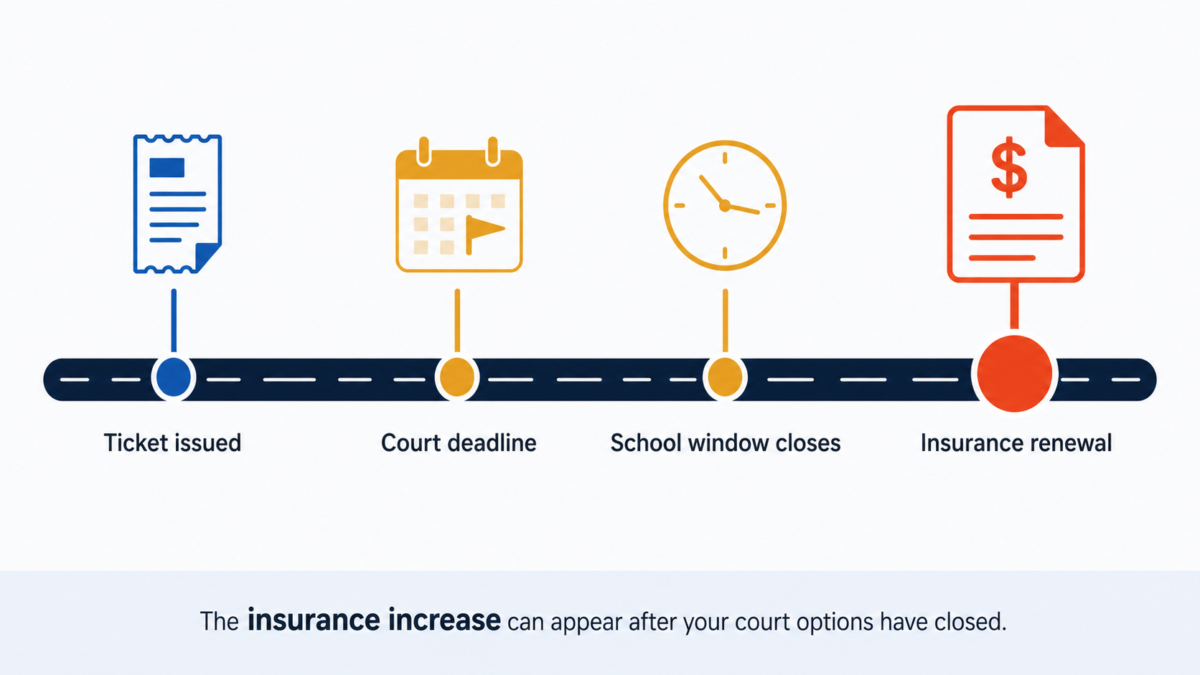
Insurance consequences may not appear when the court case closes. An insurer may review the driving record at renewal or another underwriting event, potentially after a course or hearing deadline has passed.
Use this order:
- Read the citation and the court’s official options.
- Confirm eligibility and every response or completion deadline.
- Confirm whether the course changes the disposition, record treatment, point calculation, or only provides a discount.
- Ask the insurer or agent how the specific outcome may affect the policy.
- Compare paying, taking the approved course, requesting a hearing, or using another listed procedure.
If the reported outcome may affect the premium, review ways to lower your car insurance through available discounts, policy adjustments, and comparison shopping before renewal.
Questions to Ask Before You Pay
Before paying online, use the citation and the court’s official website or contact information to answer:
- Am I eligible for traffic school, defensive driving, deferred disposition, or another option?
- What exact result follows successful completion?
- Do I need court approval before enrolling?
- Which providers are officially approved?
- What are the response, enrollment, payment, and completion deadlines?
- Must I also pay the fine, bail, court costs, or an administrative fee?
- Who reports completion, and how can I verify it?
- Will the result be reported to the motor-vehicle agency?
- Does my license class or the vehicle involved affect eligibility?
- Does paying first close a hearing, course, or other option?
This check can prevent an avoidable decision based on incomplete information.
Common Mistakes to Avoid
Mistake 1: Taking an online course without approval
For a ticket-related court outcome, a course helps only if the court or motor-vehicle agency accepts it for the specific citation. An insurance-only course is a separate matter governed by the policy and applicable law.
Mistake 2: Assuming traffic school erases everything
Dismissal, deferred disposition, confidential treatment, point reduction, and an insurance discount are different outcomes. Ask which one applies.
Mistake 3: Waiting until insurance renewal
The court’s response or course deadline may pass before the insurer next reviews the record.
Mistake 4: Ignoring the total cost
The comparison may include court payments, statutory assessments, administrative charges, provider fees, processing charges, and time.
Mistake 5: Forgetting license-class and vehicle rules
Commercial-license holders and citations involving commercial vehicles may be subject to different eligibility and reporting rules.
What If You Already Paid the Ticket?
If you already paid, first confirm what legal result the payment produced. Remaining options vary and may be narrower than the options available before payment.
Possible next steps include:
- ask whether the court allows reopening, withdrawal of payment, or a late course request;
- confirm whether the payment produced a conviction or served another procedural purpose;
- ask whether an insurer-approved course provides a separate policy discount;
- check whether the state offers a post-conviction point-calculation program; and
- obtain the driving record after the court reports the disposition.
A course taken after payment may not change the citation’s disposition. A separate point program or insurance discount may still be available, depending on the state, court, program, and insurer.
See also how to avoid points on your license and how to keep a traffic ticket off your record.
Frequently Asked Questions
Should I pay the ticket or take traffic school?
Compare the choices listed by the court. A course may be worth selecting when you are eligible, can meet every condition, and have verified that completion produces a useful result. Paying may be reasonable when you understand its legal effect and the alternatives provide no meaningful benefit.
Does traffic school erase a ticket?
Not necessarily. Depending on the jurisdiction and program, completion may result in dismissal, deferral, confidential treatment, a point-calculation change, an insurance discount, or court compliance only.
Do I still have to pay the ticket if I take traffic school?
Some programs require a fine or bail, court or administrative charges, and a separate provider fee. Other programs use different structures. Follow the instructions issued for the citation.
Will traffic school keep my insurance from going up?
It may help when the reported outcome is not used by the insurer or when an applicable discount reduces the policy’s base rate. It is not a universal guarantee. Ask the insurer or agent about the specific violation, disposition, course, and policy.
Can I take traffic school online?
Online completion may be available, but only an officially accepted provider will produce the intended court, motor-vehicle, or insurance result. Confirm approval before enrolling.
Can I take traffic school for an out-of-state ticket?
Start with the court handling the citation. Then check with the home-state motor-vehicle agency about license points or reporting and with the insurer about policy treatment. Do not assume that approval in one state controls the others.
Is traffic school worth it for a first ticket?
It depends on eligibility, total cost, deadlines, and the exact result. A clean prior record does not by itself establish that a course is the best choice.
What if my deadline is close?
Contact the court immediately using official contact information. Ask whether an extension or another procedure is available, but do not assume the request will be granted.
Bottom Line
There is no nationwide winner between paying a ticket, taking traffic school, and requesting a hearing. The better comparison uses the options listed by the court, their verified total costs, the exact disposition or record result, the rights each choice waives, and insurer-specific information.
Before deciding, ask the court one direct question:
If I select this option and complete every requirement, what exactly happens to the citation and my driving record?
Then ask the insurer or agent how that reported outcome may affect the policy.
Related Reading
- Traffic School vs. Court: How to Choose After a Ticket
- Should I Fight a Speeding Ticket? 5 Signs It’s Worth It
- How to Get a Speeding Ticket Dismissed Before It Hits Your Record
- Does Traffic School Remove a Ticket From Your Record?
- Traffic School Insurance Discount: Can It Lower Your Rate?
Sources
Sources reviewed August 20, 2026.
- California Courts Self-Help Guide: Traffic School
- California Vehicle Code §1808.7
- San Francisco Superior Court: Traffic School
- New York DMV: Point and Insurance Reduction Program
- New York DMV: Approved Point and Insurance Reduction Program Courses
- LendingTree: Across the U.S., Speeding Tickets Drive Up Insurance Costs by More Than $500 a Year