

How Long Do Points Stay on Your License? DMV vs. Insurance Timelines
There is no one US end date for license points because each state sets its own rules. A state decides when points can lead to a license action, how long a ticket stays on the record, and whether safe driving or a class can cut the point total.
Your insurance rate follows a separate clock. A ticket can stop counting toward a DMV penalty before your insurance company stops using it, or stay on your record after it no longer affects your rate.

DMV points, record entries, and insurance-rate periods can end on different dates.
Important: This article gives general information, not legal or insurance advice. Rules vary by state and can change. Check your current record, the state rules for your ticket, and any notice from your insurance company or court.
Quick Answer
There is no one US time limit for license points. To find your date, answer three questions:
| Question | Best place to check | Why it matters |
|---|---|---|
| When does the ticket stop counting toward a license action? | Your state DMV or license office | This is the active-point clock. |
| How long does the conviction stay on your record? | Your state record and rules | The record may outlast the active points. |
| When will the ticket stop affecting your auto rate? | Your company or agent | Each company uses its own state-approved rating rules. |
Do not assume that “points are gone” means the record is clear or the rate effect has ended.
The Three Clocks Are Different
1. The active-point clock
States use points to identify drivers who may face a warning, course requirement, hearing, or suspension. But they do not all use the same system.
Some states count points earned during a rolling period, while others cut the total after a clean-driving period. A few keep a permanent history while subtracting points from the current total under specific rules.
2. The driving-record clock
A ticket can stay on the record after it stops counting toward a point-based license action. The time can depend on the offense, and a serious case may stay longer than a basic moving ticket.
3. The insurance clock
An insurance company does not just copy the DMV point total. It may use the ticket, its date, the type of offense, recent claims, and other factors allowed in your state.
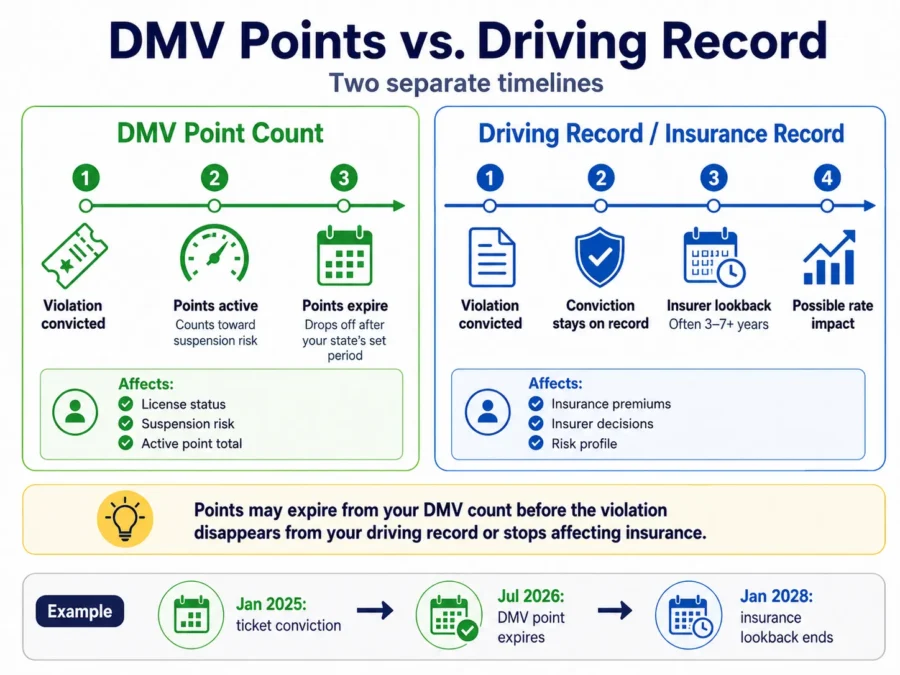
A point window and the time an entry stays on your record are separate rules. Check both.
The Starting Date Is Not Always the Conviction Date
Do not use the ticket date, payment date, or conviction date until the state rule tells you which one controls.
For example:
- New York DMV counts points from the violation date, not the conviction date.
- Virginia DMV says demerit points remain for two years from the offense date.
- California DMV counts how long many entries stay from the date of the offense.
The conviction date on your record may still help, but it may not start the clock you need.
State Examples Show Why a National Estimate Does Not Work
The examples below are not a full 50-state chart. They show how much state systems differ. Read the linked state rule before you make a choice about your license.
| State | What the official rule says | What to watch |
|---|---|---|
| New York | Points stop counting toward the DMV total after 24 months from the violation date. Six or more points within 18 months can trigger a separate Driver Responsibility Assessment. | The conviction can remain on the record after the points stop counting. |
| California | Negligent-operator thresholds include 4 points in 12 months, 6 in 24 months, or 8 in 36 months. Many ordinary traffic convictions are retained for three years, while most named two-point violations are retained for 10 years. | A threshold window is not the same as record retention. |
| Virginia | Demerit points remain for two years from the offense date. The conviction stays for the separate period listed by Virginia DMV, and some convictions are retained permanently. | Do not confuse the two-year point period with the conviction record. |
| Wisconsin | Twelve or more points from violations occurring within any 12-month period can cause a suspension. Most convictions can be removed after five years, while alcohol-related convictions remain indefinitely. | The suspension window and record-retention rule are different. |
| Utah | Individual conviction points are automatically removed three years after the violation date. A clean-driving period can reduce the total sooner. | A reduction in the total does not erase the conviction. |
| New Jersey | The state keeps a permanent record of points earned but can subtract points from the current total after qualifying violation-free periods or approved programs. | Insurers may still consider the original events and may not recognize DMV point deductions. |
| Pennsylvania | Three points are removed after each 12 consecutive months without a point-carrying violation and without a suspension or revocation. | This is a clean-driving reduction, not one fixed expiration date for every violation. |
| Florida | The statute uses rolling totals for suspension: 12 points within 12 months, 18 within 18 months, or 24 within 36 months. | These are suspension thresholds, not a general statement that every point “expires” after a set period. |
| South Carolina | Points are reduced by half one year after the violation date. An approved course may provide a separate reduction when its conditions are met. | Reduction rules affect the total; they do not necessarily delete the event from the record. |
Read the full rules: California point limits, Wisconsin point system, Utah point system, New Jersey license actions, Pennsylvania point system, Florida Statutes § 322.27, and South Carolina point system.
When Does a Ticket Stop Affect Insurance?
There is no sound US-wide time limit for auto rates. Even in one state, companies may use different rating plans under state law.
The National Association of Insurance Commissioners says your driving record is one factor that may affect your rate. It does not set one time limit for all companies.
For a useful answer, ask your company or agent:
- Which violation and date are affecting my current premium?
- How long can this violation be used under the current rating plan?
- Will you check my record again when the policy renews?
- Did the violation remove a safe-driver or claim-free discount?
- If the DMV cuts the points, does that change how you rate the ticket?
Ask for the answer in writing if it will affect your budget or a choice to switch plans. You can also compare equal quotes. Keep the limits, deductibles, drivers, cars, and added coverage the same.
Can Traffic School Remove the Points Sooner?
Sometimes a class changes the active total. But “point reduction” does not mean that the ticket is erased.
For example, New York's Point and Insurance Reduction Program can subtract up to four points when DMV checks for a possible suspension. The violation, conviction, and original points stay on the record.
Other states use other models, and New Jersey, Utah, and South Carolina have their own rules and time limits. Ohio BMV calls its class benefit a credit against a future suspension total; it does not delete points already earned.
Before enrolling, confirm:
- that the course is approved for your purpose;
- whether it affects active points, your auto rate, a court result, or only one of them;
- whether you must complete it before a deadline;
- whether prior course use limits eligibility; and
- whether the ticket will still appear on your record.
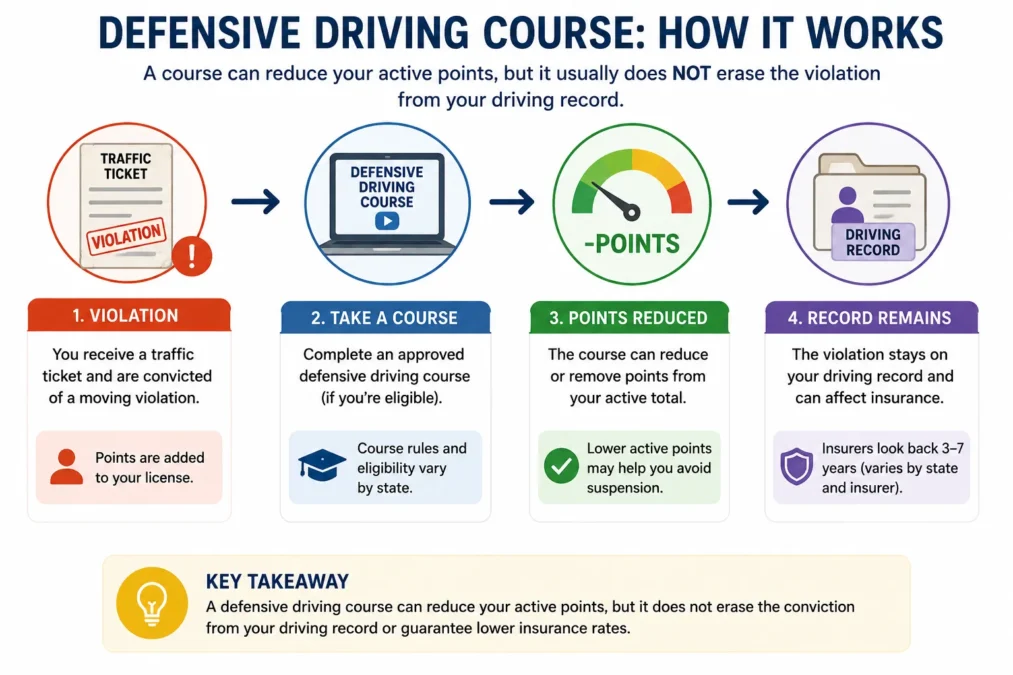
A class may cut an active point total without removing the ticket.
See How to Get Points Off Your License for a closer look at reduction programs and their limits.
How to Find Your Own End Date
Step 1: Order your current driving record
Use the state DMV or license-office site. A report from a private firm may be incomplete or use other labels.
Step 2: Identify the event and every relevant date
Write down the state, offense, violation date, conviction date, and any suspension or restoration date. Then check which date the state rule uses.
Step 3: Find the active-point rule
Look for the rolling point window, fixed end date, safe-driving cut, or lasting point-history rule used by that state.
Step 4: Find the record-retention rule
Do not guess from the active-point rule. Check whether serious offenses, work driving, alcohol cases, or crashes stay for a different time.
Step 5: Check for unresolved matters
An open case, late report, wrong entry, or unresolved license action can change what you see. Contact the court or state office if the dates or result do not match your papers.
Step 6: Ask the insurer about the rating date
The DMV cannot tell you when a company will stop using a ticket. Ask which event it uses and when it will review your policy again.
What to Do While the Violation Is Still Relevant
- Avoid another moving ticket. A new one can enter the same point window or break a safe-driving period.
- Keep your address current with the DMV and court so you receive notices.
- Finish any required class, payment, or filing by the stated due date.
- Check your record after the state has had time to process a fix or class credit.
- Review coverage at renewal and compare equivalent quotes if the premium changes.
Frequently Asked Questions
Does moving to another state erase the points?
Do not treat a move as a reset. The first state keeps its record, while the new state decides how to handle tickets reported from elsewhere. Check both state license offices before you assume the move changes your risk.
Does paying a ticket make the points expire sooner?
In most cases, payment closes the case but does not shorten the state point period. In many places, paying also counts as a guilty plea or admission. Read the ticket and court steps before you pay. Your choices and due dates depend on the court.
Will my premium fall as soon as the DMV points stop counting?
Not always, because the company may use the court result instead of the DMV point total. A change may not appear until the policy renews. Ask what the company uses and when it will review that item.
Can a corrected driving record change the insurance result?
It can if the record has an error. Follow the state steps to fix it, then send the new record or written proof from the state to the company and ask for a review. The company will set the start date under its rules and state law.
Bottom Line
“How long do points stay?” is really three questions. When do the points stop counting toward a license action? How long does the ticket stay on the record? When does the insurance company stop using it?
Start with your state record. Match it to the current rule for the state that issued the ticket. Then ask your insurance company about its own time limit. That gives you a date based on your case instead of a broad guess.
Related Reading
- Traffic School Rules by State
- How Driver's License Points Work
- How Many Points Is a Speeding Ticket?
- How Traffic Violations Affect Insurance Rates
- How to Keep a Ticket Off Your Driving Record
Sources
Sources reviewed August 20, 2026.
- New York DMV — The New York State Driver Point System
- New York DMV — Point and Insurance Reduction Program
- California DMV — Negligent Operator Point Count
- California DMV — Online Driver Record Request and Retention Periods
- Virginia DMV — Demerit Points
- Wisconsin Department of Transportation — Driver License Point System
- Utah Driver License Division — Point System
- New Jersey Motor Vehicle Commission — Suspensions and Restorations
- Pennsylvania Department of Transportation — Pennsylvania's Point System
- Florida Legislature — Florida Statutes § 322.27
- South Carolina Department of Motor Vehicles — Points System
- Ohio Bureau of Motor Vehicles — Remedial Driving Course Point Credit
- National Association of Insurance Commissioners — Auto Insurance