


How to Lower Car Insurance Rates: 9 Proven Ways That Actually Work
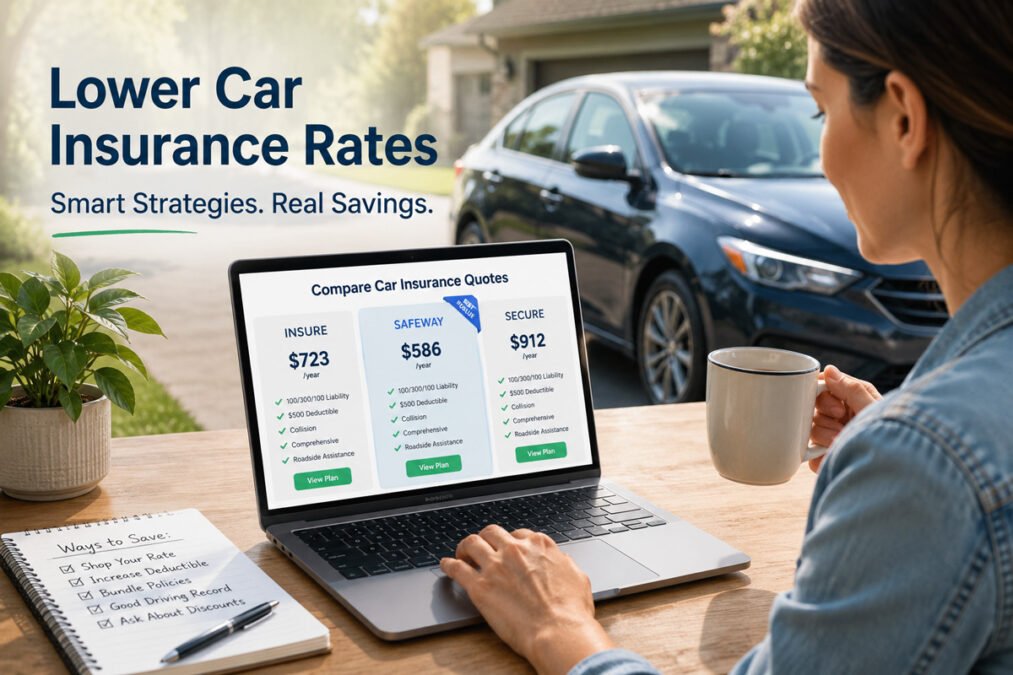
Quick Summary
| Strategy | Difficulty | Potential Savings* |
|---|---|---|
| Shop rates annually | Easy | High |
| Defensive driving course | Easy | Medium |
| Raise deductible | Medium | Medium |
| Bundle policies | Easy | Medium |
| Keep a clean record | Ongoing | High |
| Ask about discounts | Easy | Low–Medium |
*Typical ranges vary by insurer and state.
What Has the Biggest Impact on Your Insurance Rate?
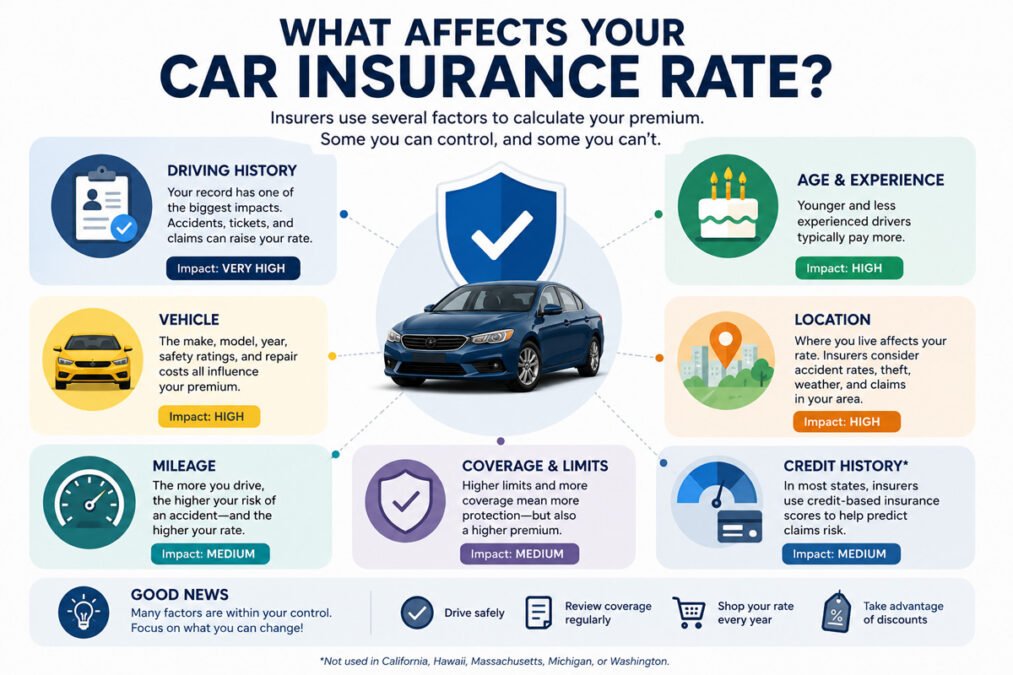
Your premium is influenced primarily by your driving record, location, vehicle, mileage, coverage limits, deductible, and—where permitted by law—your credit-based insurance score. The strategies below focus on factors most drivers can control.
If you’re wondering how to lower car insurance costs, you’re not alone — insurance premiums have risen steadily in recent years, and most drivers are paying more than they were two or three years ago. The good news is that your rate isn’t fixed. Several factors that determine your premium are within your control.
This guide covers the strategies that actually move the needle, in order of impact.
1. Shop Your Rate — Every Year at Renewal
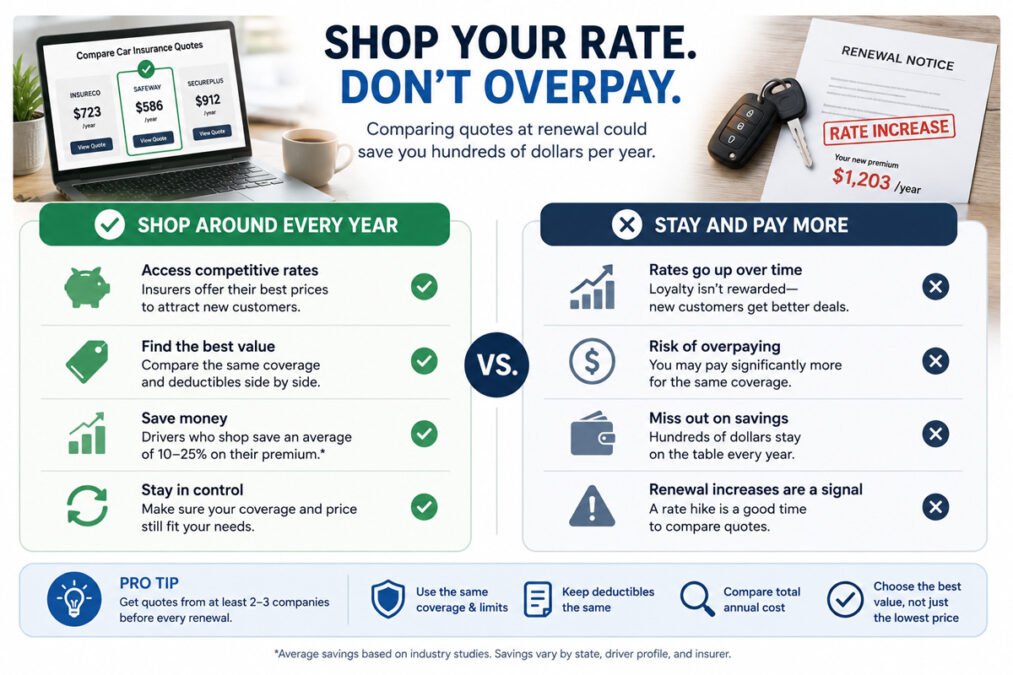
The single highest-impact action most drivers never take. Insurers don’t compete aggressively to keep existing customers — they compete to acquire new ones. Staying with the same insurer for years often means paying more than a new customer with the same profile would pay elsewhere.
At every annual renewal, get quotes from at least two or three competitors. The process takes 20–30 minutes online and can save hundreds of dollars per year on identical coverage.
When shopping matters most:
- After a life change — marriage, new address, new vehicle, teen driver added
- After a violation falls off your record (typically at three years)
- After your rate increases at renewal — a signal to compare immediately
What to compare: Same coverage limits, same deductibles, same policy features. An apples-to-oranges comparison that finds a lower premium often finds less coverage.
2. Complete a Defensive Driving Course
Most insurers offer a discount — typically applied directly to your premium — for completing a state-approved defensive driving course. The discount usually lasts three years and can be renewed by retaking the course.
This is one of the few ways to lower car insurance without changing your coverage or taking on more risk. You complete a four-to-eight hour course, submit your certificate to your insurer, and the discount applies at your next renewal or immediately depending on the insurer.
Before you enroll: Confirm which courses your insurer accepts. Not every approved course qualifies with every insurer. Call your insurer or check their website for a list of accepted providers.
See how defensive driving works for what the courses cover and how the discount process works.
3. Increase Your Deductible
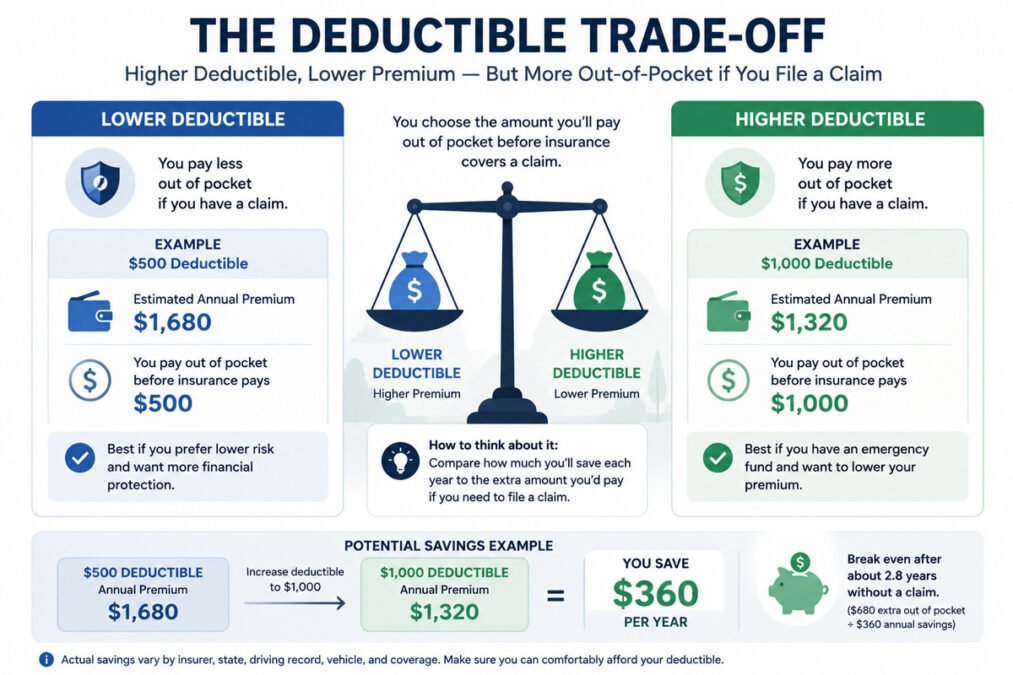
Your deductible is the amount you pay out of pocket before insurance covers a claim. A higher deductible means lower monthly or annual premiums — because you’re absorbing more of the small-claim risk yourself.
How to evaluate it:
- Calculate the annual savings from raising your deductible
- Compare that to how much more you’d pay out of pocket if you filed a claim
- If you’d save $200/year by raising your deductible from $500 to $1,000, you break even after 2.5 years without a claim
This strategy works best if you have an emergency fund that can cover the higher deductible without financial strain.
4. Bundle Your Policies
Most insurers offer a discount — often 10–15% — for bundling auto insurance with homeowners, renters, or life insurance. If your policies are spread across multiple providers, consolidating them often produces meaningful savings.
Run the math before assuming bundling is cheaper: occasionally, specialist insurers for each coverage type beat the bundle discount. But for most drivers with a home or renters policy, bundling is worth checking.
5. Keep Your Driving Record Clean
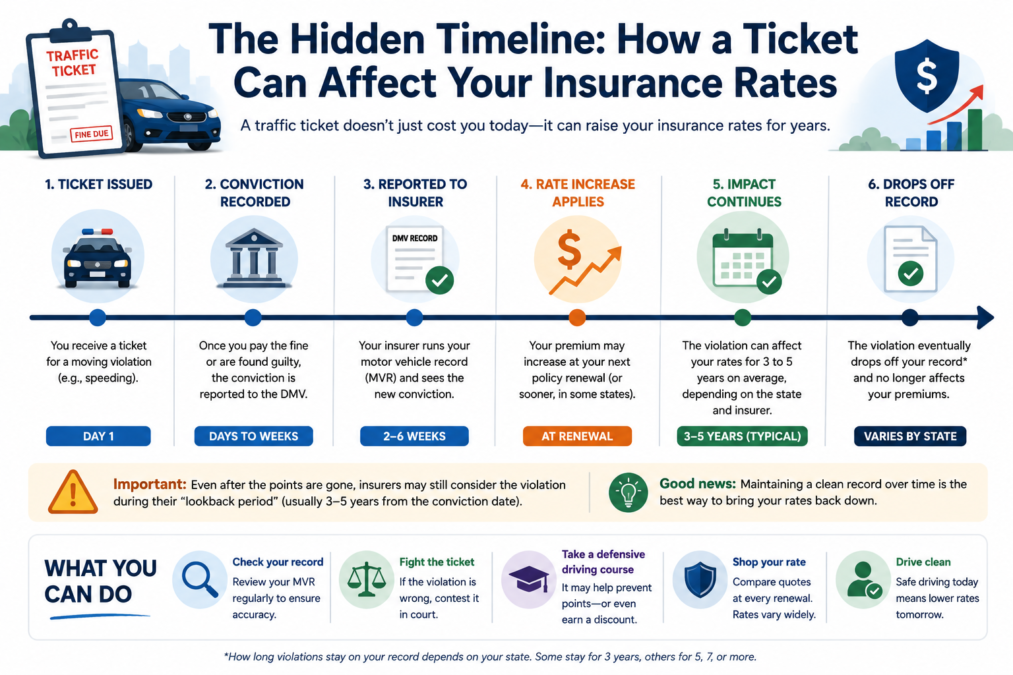
Your driving record is one of the most heavily weighted factors in your rate calculation. A single speeding ticket can increase your premium by a meaningful amount at the next renewal — and the increase persists for three years or more while the violation stays within your insurer’s lookback window.
Building practical habits that help you avoid speeding tickets is one of the simplest ways to protect both your driving record and your future premiums.
Practical implications:
- Violations that happened more than three years ago may no longer affect your rate — check your insurer’s lookback window
- If you receive a ticket, check whether dismissal through a defensive driving course is available before paying the fine. A dismissed ticket produces no conviction and no record impact. See what to do after getting a traffic ticket for the step-by-step process
- If a violation is already on your record, completing a defensive driving course may qualify you for a discount that partially offsets the rate increase
6. Review Your Coverage on Older Vehicles
Comprehensive and collision coverage pay to repair or replace your vehicle after an accident or covered event. For older vehicles with low market value, the math sometimes doesn’t support the cost.
A rough guideline: If your annual comprehensive and collision premium exceeds 10% of your vehicle’s current market value, consider whether that coverage makes financial sense. If your car is worth $4,000 and you’re paying $600/year for comprehensive and collision, you’d need to file a claim within seven years just to break even — and the payout is capped at the car’s market value minus your deductible.
Check your vehicle’s current value at a resource like Kelley Blue Book before making this decision.
Don’t drop liability coverage. Liability coverage protects you from costs if you cause an accident injuring another person or damaging their property. Required in every state, and the limits you carry should reflect your actual financial exposure — not just the state minimum.
7. Ask About Discounts You May Not Know About
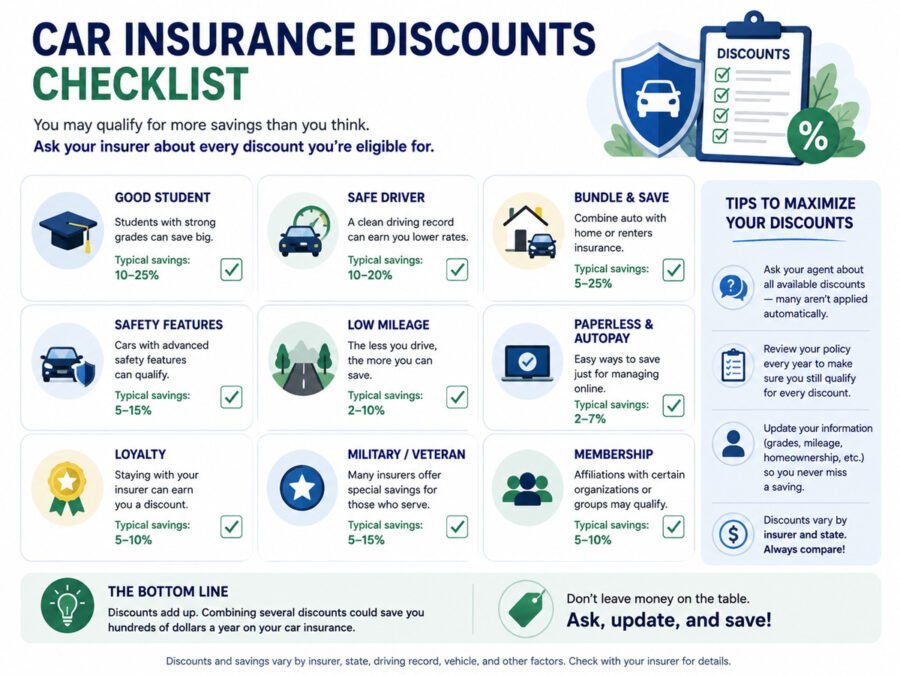
Insurers offer a range of discounts that aren’t always advertised proactively. Common ones worth asking about:
- Good student discount — for drivers under 25 with a GPA above a threshold (typically 3.0)
- Low mileage discount — if you drive significantly fewer miles per year than average
- Pay-in-full discount — paying your annual premium upfront instead of monthly
- Paperless / autopay discount — small but adds up
- Vehicle safety features — anti-lock brakes, airbags, anti-theft systems
- Loyalty discount — some insurers offer this after a set number of years, though it’s worth comparing anyway
- Occupation or affiliation discounts — some insurers offer discounts for teachers, military personnel, or members of certain professional associations
Call your insurer and ask specifically what discounts you currently receive and which you might qualify for.
8. Improve Your Credit Score (Where Applicable)
In most states, insurers use a credit-based insurance score as one factor in rate calculation. Drivers with higher credit scores typically pay lower premiums than drivers with lower scores, all else equal.
States where credit scoring in insurance is restricted or prohibited: California, Hawaii, Massachusetts, and Michigan do not allow insurers to use credit scores for auto insurance rating.
In states where it applies, improving your credit score over time — paying bills on time, reducing credit utilization, avoiding new hard inquiries — can gradually lower your insurance rate as your score improves.
9. Consider Usage-Based Insurance
Many insurers offer telematics programs — apps or devices that track your actual driving behavior (speed, braking, time of day, mileage) and adjust your rate based on how safely you drive.
Who benefits: Drivers who drive fewer miles than average, primarily during daytime hours, without hard braking or rapid acceleration. Safe, infrequent drivers can see meaningful discounts.
Who should be cautious: Drivers who regularly drive late at night, on highways at higher speeds, or who have braking habits that the app may penalize. Some programs can increase your rate if your tracked behavior scores poorly.
Review the program terms before enrolling — specifically whether a poor score can raise your rate or only fail to lower it.
What Doesn’t Lower Your Rate
Calling your insurer and asking for a discount. Asking doesn’t hurt, but rate calculation is formula-driven. What moves the needle is changing the inputs: your record, your coverage, your deductible, your discounts.
Changing your coverage limits to the state minimum. State minimums are often dangerously low. A serious at-fault accident can easily exceed minimum coverage limits, leaving you personally liable for the remainder. Cutting liability coverage to save money is a financial risk that rarely makes sense.
Canceling and immediately re-enrolling. Insurance lapse, even briefly, is a negative rating factor with most insurers and can raise your rate when you re-enroll.
Frequently Asked Questions
How much can I realistically lower my car insurance?
It depends on your current rate and how many strategies apply to your situation. Shopping your rate alone can save 10–25% for drivers whose current insurer has become uncompetitive. Adding a defensive driving discount and adjusting your deductible can add further savings. The range is wide — the strategies above are all legitimate levers, not guarantees.
How often should I shop my car insurance rate?
At every annual renewal at minimum. Also shop after any significant life change — new vehicle, new address, marriage, teen driver added — and after a major violation falls off your record.
Will filing a claim raise my rates?
Usually yes, particularly for at-fault claims. Not-at-fault claims affect rates with some insurers and not others. If you’re considering filing a small claim, compare the payout against the likely premium increase over the next three years — sometimes paying out of pocket is cheaper.
Does the color of my car affect my insurance rate?
No. Insurers don’t rate on vehicle color. Factors that do affect rate include the vehicle’s make, model, year, safety rating, repair cost, and theft rate.
Can I lower my insurance if I work from home and drive less?
Yes — ask your insurer about a low-mileage discount and update your annual mileage estimate. Some insurers also offer usage-based programs specifically designed for low-mileage drivers.
The Two Steps That Matter Most
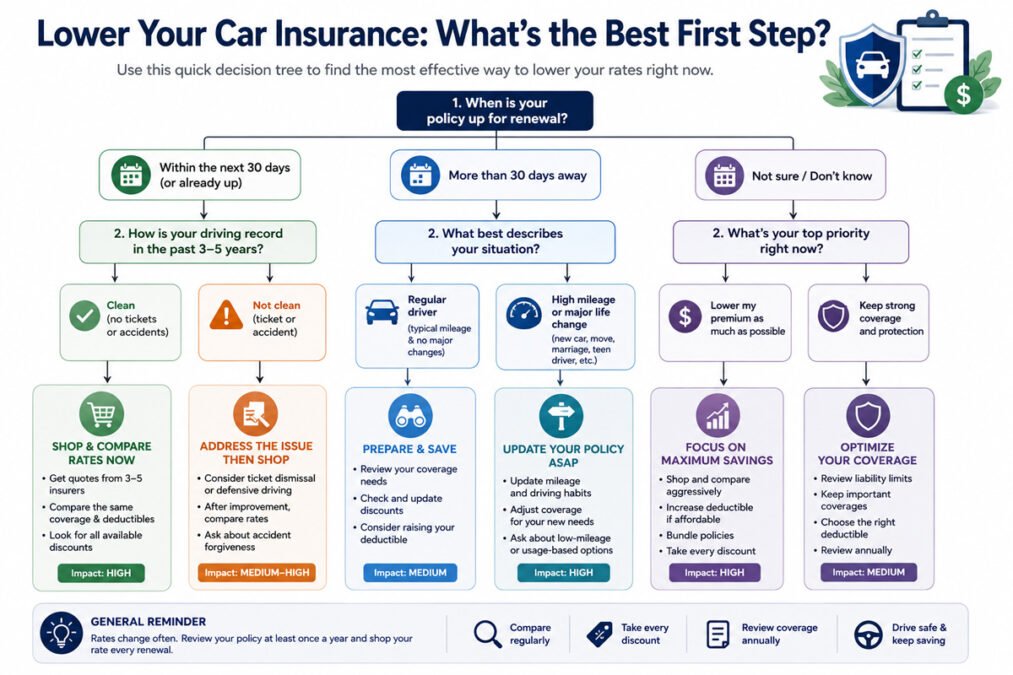
Learning how to lower car insurance rates is mostly about acting at the right moments — shopping at renewal, checking dismissal options before paying a ticket, completing a defensive driving course proactively, and asking specifically about discounts. None of these require changing your lifestyle or taking on more financial risk.
Start with shopping your rate at the next renewal and completing a defensive driving course if you haven’t recently. Those two steps alone cover the majority of what’s available to most drivers.


