

Driver License Points: How the Point System Works
Driver license points are one way a state tracks tickets that end in a guilty finding. If you collect too many points or case results in a set time, the state may warn you, require a course, restrict your driving, or suspend your license.
There is no national point system. Each state sets its own point values, time windows, and license rules. Some states do not use a normal point total at all.
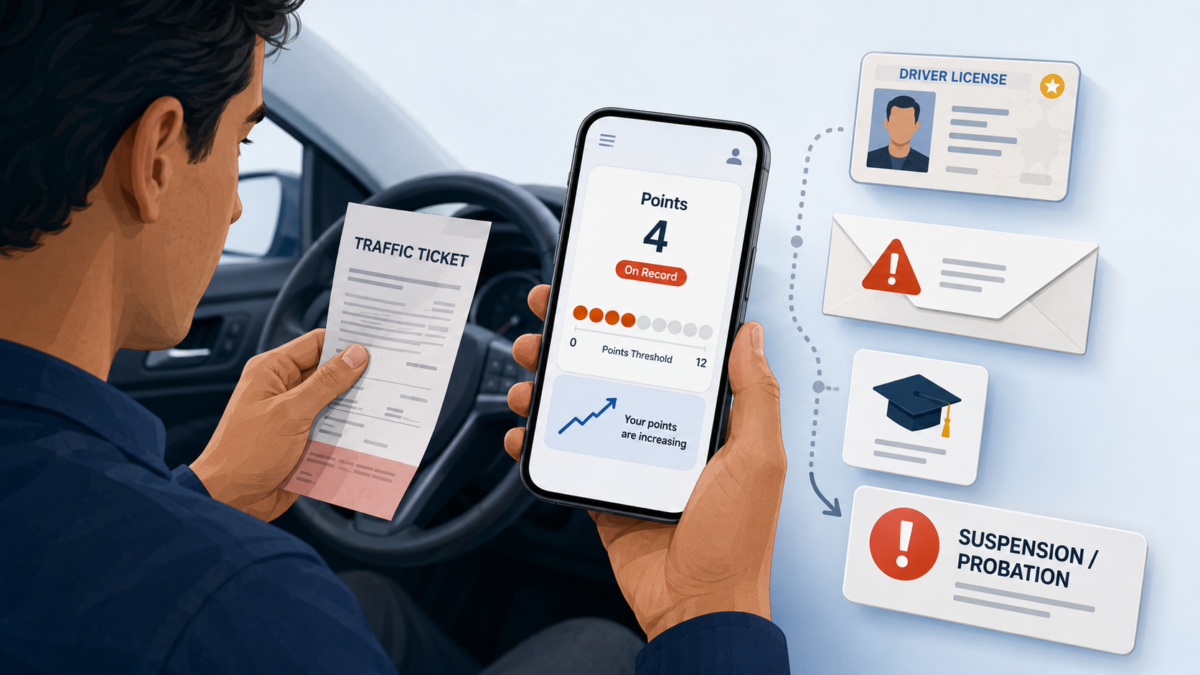
A ticket matters most when the court enters a guilty finding on your driving record.
Important: This article gives general information, not legal or insurance advice. Rules depend on your state, age, license, violation, record, and court result. Follow every deadline on your ticket or state notice.
Quick Answer: What Are Driver License Points?
Points are numbers that some state driver agencies assign to traffic convictions. A more serious violation often carries more points. Your state may act when your total reaches a set level within a set time.
Before you pay a ticket, check:
- What the court will enter: Payment may count as a guilty plea or conviction.
- How your state treats the result: Look up the exact code on the state point schedule.
- Your current record: An older ticket may put you closer to a warning or suspension.
- Your options and deadlines: A course, dismissal, deferral, or hearing may require action before you pay.
| Question | Plain answer |
|---|---|
| What adds points? | Usually a traffic conviction, not the ticket by itself. |
| Who assigns them? | Your state DMV or other licensing office. |
| Does every state use points? | No. Some states track tickets and crashes without a normal point total. |
| Are DMV points the same as insurance points? | No. The state and your insurer do not use the same system. |
| Can a course remove points? | Sometimes it changes the state calculation. It may not erase the ticket. |
How the Point System Works
When a court reports a traffic conviction, your state may add points to your driving record. The point value usually reflects the type or seriousness of the offense.
States use these systems to spot repeated unsafe driving and decide when to send a warning or take action against a license.
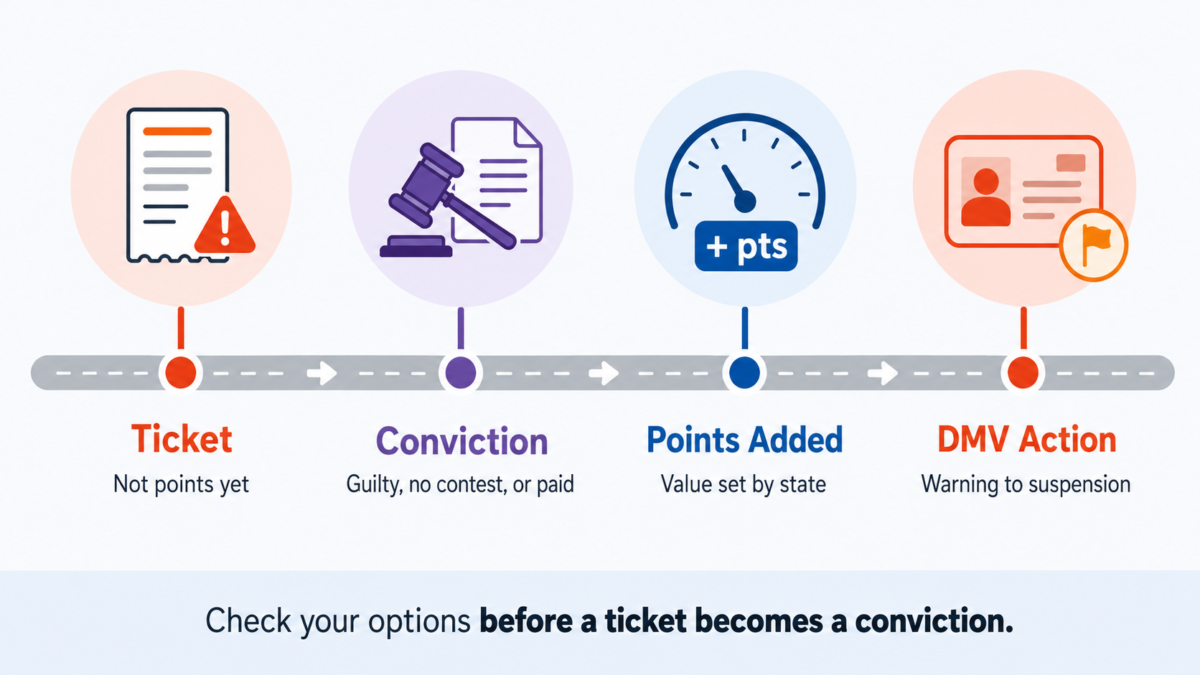
The court decides the case. The state DMV controls points and license action.
A serious offense may trigger a suspension or revocation on its own, even if you have few or no prior points. Age, a commercial driver license, and the type of vehicle can also change the result.
Points Usually Begin With a Conviction
Getting a ticket does not always add points right away. Points normally follow the result entered in the case. That can happen when you:
- Pay a ticket that treats payment as a guilty plea
- Plead guilty or no contest
- Are found guilty after a hearing or trial
- Accept a case result that the state records as a conviction
Read the court instructions before paying. Some programs require payment as part of the process, while ordinary payment may end your right to a hearing. Ask the court what it will enter on your record.
If you want to compare dismissal, a course, and court, read what to do after getting a traffic ticket.
How States Assign Points
Do not use a nationwide “typical point range.” The same offense can carry a new point value across a state line, and some states do not assign points to it at all.
These state examples show the gap:
| State | Verified example | What to notice |
|---|---|---|
| Florida | Speeding not more than 15 mph over the limit is 3 points; more than 15 mph over is 4 | The charged speed changes the point value |
| Georgia | Speeding less than 15 mph over does not add points; 15–18 over adds 2 | A lower-speed ticket may not get the same treatment |
| New York | Speeding 1–10 mph over is 3 points; 21–30 over is 6; more than 40 over is 11 | One speeding ticket can reach the suspension level |
| Virginia | Moving offenses carry 3, 4, or 6 demerit points | Virginia also awards safe-driving points |
Use the offense code printed on your ticket. A short label such as “speeding” may not identify the right row.
The Time Window Matters as Much as the Total
A point total means little without its time window. State time periods and date rules vary.
New York, for example, calculates its 24-month total from the violation date, not the conviction date. Virginia demerit points stay valid for two years from the offense date (Virginia DMV — The Points System). Check both the number and the date rule for your state.
Do not assume that “two years” means the ticket disappears from your driving record after two years. The active point window and the record term are not the same.
For more detail, see how long points stay on your license.
What Happens When Points Add Up?
The exact steps vary, but a state may:
| Stage | What the state may do | What you should do |
|---|---|---|
| Early notice | Send a warning or record notice | Check your state record and the point window |
| Driver improvement | Require or allow an approved course | Confirm what the course changes before enrolling |
| Review | Order a hearing, probation, or closer monitoring | Read the notice and meet its deadline |
| Restriction | Limit when or why you may drive | Follow every restriction until the state clears it |
| Suspension | Remove your driving privilege for a set time | Do not drive; check reinstatement steps |
| Revocation | Cancel the license or privilege | Ask the state about reapplication and testing |
Do not wait for a suspension notice if a new ticket puts your license at risk. Check your record and options while the case is still open.
Verified State Thresholds and Rules
Each example comes from a state source. They show why a national threshold would mislead readers.
| State | Verified adult rule or example | Time period |
|---|---|---|
| California | 4 points can lead to a one-year probation order with a six-month suspension | 12 months |
| Florida | 12 points can lead to up to 30 days; 18 to up to 3 months; 24 to up to 1 year | 12, 18, or 36 months |
| Georgia | 15 points suspends a license | 24 months |
| New York | 11 points may lead to suspension | 24 months |
| Ohio | 12 points leads to a six-month suspension | 2 years |
| Virginia | For drivers 18 and older, action starts with an advisory letter, rises to a required clinic, and can reach a 90-day suspension | 12 or 24 months |
| Oregon | For drivers 18 or older, three qualifying cases or preventable crashes lead to a 30-day restriction; five lead to a 30-day suspension | 24 months |
| Texas | The Driver Responsibility Program and its point-based surcharges ended in 2019 | Not applicable |

States use their own numbers, time periods, and ways to count unsafe driving.
California
California DMV sends a warning at 2 points in 12 months, 4 in 24 months, or 6 in 36 months. It sends a notice of intent to suspend at 3, 5, or 7 points in those periods. At 4, 6, or 8 points, the DMV orders one year of probation with a six-month suspension (California DMV — Negligent Operator Actions).
Florida
Florida may suspend a license for up to 30 days at 12 points in 12 months, up to 3 months at 18 points in 18 months, and up to 1 year at 24 points in 36 months. The state assigns 3 points for speeding not more than 15 mph over the limit and 4 points for more than 15 mph over (Fla. Stat. § 322.27(3)(a)–(d)).
Georgia
Georgia suspends a license at 15 points in 24 months. Eligible residents can request a reduction of up to 7 points once every five years after completing a certified driver-improvement course. Speeding less than 15 mph over the limit does not add points (Georgia DDS — Points and Points Reduction).
New York
New York may suspend your license at 11 points in 24 months. The state uses the offense date to calculate that total. New York does not add points for a conviction in another state or country, with one exception: a conviction in Canada is recorded and carries the same points as a New York conviction (New York DMV — Driver Point System).
Ohio
Ohio sends a warning when you reach 6 points in two years. A total of 12 points in two years leads to a six-month suspension, a remedial driving course, a new license exam, and other reinstatement steps (Ohio BMV — Points and 12-Point Suspension).
Virginia
Virginia uses demerit points for unsafe driving and safe-driving points for good driving (Virginia DMV — The Points System). Moving violations are grouped into 3-, 4-, and 6-point levels (Virginia DMV — Moving Violations and Point Assessments).
For drivers 18 and older, Virginia sends an advisory letter at 8 points in 12 months or 12 points in 24 months. At 12 points in 12 months or 18 in 24 months, you must complete a driver-improvement clinic. At 18 points in 12 months or 24 in 24 months, Virginia suspends your driving privilege for 90 days. You must complete the clinic before your privilege is restored, and a six-month probation period begins after restoration (Virginia DMV — Drivers Age 18 and Over).
Oregon
Oregon’s adult Driver Improvement Program counts qualifying cases and preventable crashes. Three within 24 months lead to a 30-day restriction. Five within 24 months lead to a 30-day suspension (Oregon DMV — Suspensions, Revocations and Cancellations).
Texas
Texas ended the Driver Responsibility Program on September 1, 2019. DPS reinstated driving privileges that had been suspended solely for unpaid program surcharges. Other fines, fees, case results, and non-program suspensions can still apply (Texas DPS — Driver Responsibility Program).
Active Points and the Driving Record Are Different
You need to check two timelines:
- Active point period: how long the state counts the points toward a warning or license action
- Driving-record period: how long the conviction stays visible on your state record
The active points may stop counting before the ticket leaves your record. A course may also change a suspension calculation without deleting the ticket.
Ask your state DMV for a fresh record instead of relying on an old notice or memory.
DMV Points and Insurance Pricing Are Separate
Your state uses points or ticket history to manage your license. Your insurer uses its own rules to price coverage.

A course can change a state point calculation without changing how an insurer treats the ticket.
| State system | Insurance system |
|---|---|
| Controls warnings, restrictions, and license action | Controls underwriting, discounts, and price |
| Uses state rules and published thresholds | Uses the insurer’s approved rating rules |
| May count points for a set period | May review the driving record over its own period |
| May give a point credit or calculation reduction | May or may not give a course discount |
The NAIC lists driving record as one factor insurers use to price auto coverage. Ask your insurer how it would treat the exact ticket result. When comparing quotes, give each company the same information (NAIC — Consumer Auto Insurance).
Read how traffic violations affect insurance rates for a fuller comparison.
Can a Course Remove Points?
Sometimes a state-approved course changes the point total used for a license decision. It may instead add a credit, meet a court term, or earn an insurance discount. Those results are not the same.
Before you enroll, ask:
- Who approves the course?
- Does it change existing points or only future calculations?
- Does the ticket stay on the record?
- Does it protect you from suspension?
- Does it qualify for an insurance discount?
Use how to get points off your license to compare state programs. If the case is still open, also check how to avoid points on your license.
How to Protect Your License After a Ticket
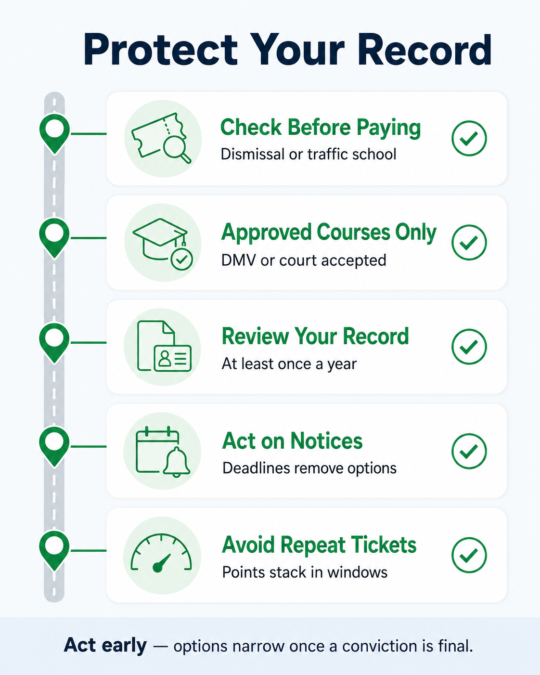
Check the case result and your current record before a new ticket moves you closer to state action.
1. Read the ticket
Write down the court, offense code, deadline, charged speed, and any required appearance.
2. Get your state driving record
Check your current points, case results, and license status through your state DMV. Look for duplicate or wrong entries.
3. Look up the exact state rule
Use your state’s point schedule and license-action page. Do not rely on a chart from a new state.
4. Ask what each court option changes
Find out whether a course or agreement results in dismissal, the court holding off on a guilty finding, a ticket kept off the record insurers can see, a point change, or only an insurance benefit.
5. Meet every deadline
Court and DMV deadlines are not the same. Keep proof of payment, course completion, dismissal, or the final result.
6. Check the record again
After the case closes, request a fresh record or check the state portal. Contact the court or DMV if the result is wrong.
Common Mistakes
Paying before checking the result. Payment can close the case as a conviction and end your chance to ask for a new option.
Counting only the new ticket. Your current record may place you close to a warning, course, or suspension level.
Using the wrong state’s rules. Point values, dates, and thresholds do not transfer cleanly across state lines.
Assuming a course erases the ticket. A point reduction, court result, and insurance discount are three distinct benefits.
Ignoring an out-of-state ticket. Your home state decides how to treat the result. New York does not add points for most out-of-state convictions, but it records Canadian convictions and assigns the same points they would carry in New York.
Driving during a suspension. Do not drive until the state confirms that your privilege is valid and you have met every reinstatement step.
Frequently Asked Questions
How do I find out how many points I have?
Request your state driving record or use the secure DMV portal. Check the point total, case dates, and license status.
Does getting a ticket add points right away?
Usually the conviction adds points, not the officer writing the ticket. The state may use the offense date, court date, or another date to set the active window.
Does paying a ticket add points?
It can. Many courts treat payment as a guilty plea or conviction. Read the ticket and ask the court what payment enters before you give up a hearing or course option.
Do out-of-state points transfer?
Do not assume the number transfers. Your home state decides whether to record the case, assign its own points, or take action. Check your home state’s rule.
Do points reset when I move?
Not necessarily. A new state can review your past driving history and apply its own rules. Ask the new state DMV how it handles earlier tickets.
Can a defensive-driving course remove points?
Only if your state program says it does. A course may change the suspension calculation, add a credit, meet a court term, or provide an insurance discount without erasing the ticket.
What is the difference between suspension and revocation?
A suspension removes your driving privilege for a set time or until you meet stated terms. A revocation cancels the license or privilege and may require you to reapply or retest.
Can points affect car insurance?
The ticket result can affect insurance even when the state points do not. Insurers use their own rating systems and may review your driving record at renewal.
Do points disappear when they stop counting?
Not always. Points can stop counting toward state action while the ticket remains on your driving record. Check both timelines.
The Bottom Line
Driver license points are state-specific. The number, time window, and case result all matter.
Before you pay a ticket, check your current record, the exact state rule, and what the court will enter. Acting early gives you the best chance to protect your license and avoid a preventable surprise.
Related Reading
- Speeding Ticket Points: How Many Points Does a Speeding Ticket Add?
- How Much Can Car Insurance Increase After a Ticket?
- Can Traffic School Lower Your Insurance Rate?
- Should I Fight a Speeding Ticket?
- How to Keep a Ticket Off Your Driving Record
Sources
Sources reviewed August 20, 2026.
- California DMV — Negligent Operator Actions
- Florida Statutes § 322.27 — Driver License Point System
- Georgia Department of Driver Services — Points and Points Reduction
- New York DMV — Driver Point System
- Ohio Bureau of Motor Vehicles — Points and 12-Point Suspension
- Virginia DMV — The Points System
- Virginia DMV — Moving Violations and Point Assessments
- Virginia DMV — Drivers Age 18 and Over
- Oregon DMV — Suspensions, Revocations and Cancellations
- Texas Department of Public Safety — Driver Responsibility Program
- National Association of Insurance Commissioners — Consumer Auto Insurance