

How to Get Points Off Your License: What Works by State
Getting points off your license depends on where your case stands. If the ticket is still pending, a court option may keep points from being added. If points are now on your record, only some states offer a course or credit that changes the active total.
A lower point total also may not erase the ticket. The court result, DMV record, and rate review are related, but they are not the same thing.

Start by checking whether the ticket is pending or now on your driving record.
Important: This article gives general information, not legal or insurance advice. Rules depend on your state, court, charge, license, car, age, record, and deadlines. Follow the instructions from the court or DMV handling your case.
Quick Answer: How Can You Get Points Off Your License?
First, check whether the ticket is still pending.
| Your situation | Best next step | Possible result |
|---|---|---|
| Ticket is pending | Ask the court about dismissal, traffic school, or a reduced charge | Points may never be added |
| Points are already posted | Check for an official DMV point-reduction program | Active points may be reduced |
| The record is wrong | Ask the DMV how to correct the record | An incorrect entry may be fixed |
| No reduction program exists | Avoid new tickets and wait for the point window to pass | Old points may stop counting |
| Insurance is the main concern | Ask the insurer about its record review and course discounts | A discount may apply, but the ticket may remain visible |
Do not buy a course until the court or DMV confirms that it will count for the result you need.
A Ticket, a Court Result, DMV Points, and Rates Are Different
These terms are easy to mix up:
| Term | What it means | Why it matters |
|---|---|---|
| Ticket | The citation issued by an officer | It starts the case |
| Court result | A dismissal, guilty plea, no-contest plea, payment, or ruling | It tells the DMV what happened |
| DMV points | Numbers a state uses to track certain driving offenses | They may affect warnings or license action |
| Insurance record | Information an insurer uses to price a policy | It can matter even when DMV points are reduced |
A course may change one item without changing the others. For instance, New York can lower the points used to decide a license action, but the ticket and points stay on the driving record. Ohio gives a two-point credit rather than deleting points.
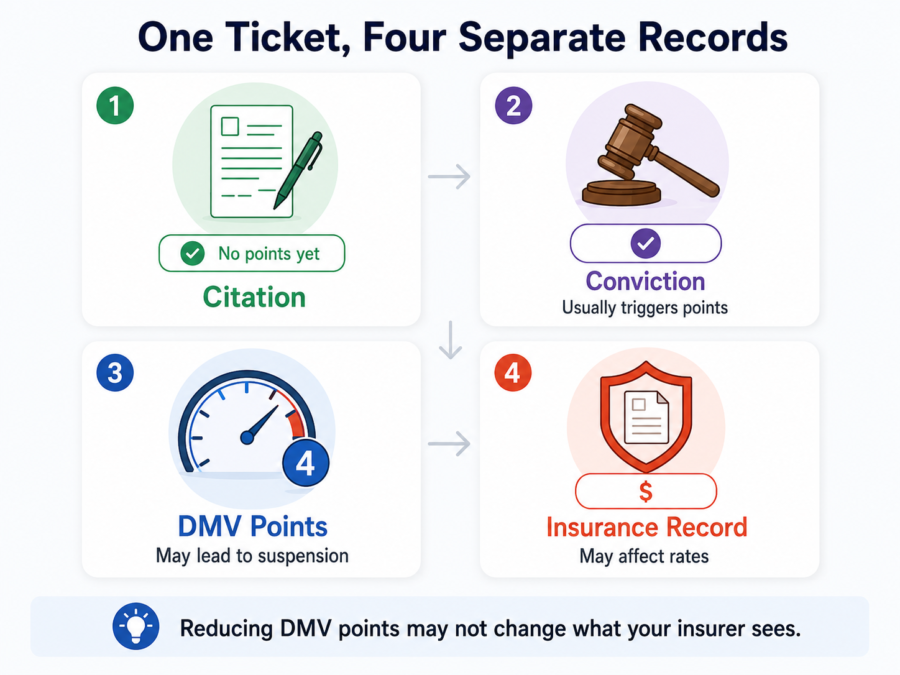
A DMV course result may not change the court record or the insurer’s review.
For a broader explanation, read how the driver license point system works.
Option 1: Act Before Points Are Added
If the ticket is still pending, ask what each court option changes before you pay. Payment can count as accepting guilt, depending on the state and ticket.
A court program may:
- Dismiss the charge
- Keep the result hidden from the public or insurers
- Prevent DMV points
- Reduce the charge to an offense with fewer or no points
Those outcomes are not interchangeable. Ask the court what it will report to the DMV and whether the ticket will remain visible.
California: traffic school can hide an eligible one-point result
California traffic school does not simply erase a ticket. Under Vehicle Code § 1808.7, the first qualifying traffic-school result in an 18-month period can be kept private. No point is assessed for that confidential result.
The private treatment is not available when the offense carries more than one point. It also does not apply to a California or out-of-state CDL holder or to an offense in a commercial motor vehicle. The court sets the due date. See the California Courts traffic-school guide before enrolling.
Florida: the statute prevents points but does not give a school-election deadline
Florida Statutes § 318.14(9) allows a driver who qualifies to elect an approved Basic Driver Improvement course. The driver must not hold a CDL and must have been in a noncommercial car. Adjudication is withheld and points are not assessed.
The election is limited to once in 12 months and eight times in a lifetime. It is not available for the listed speeding offenses when the driver is charged with going 30 mph or more over the posted limit.
Section 318.14(9) does not state a course-election deadline. A different part of the law, § 318.14(4)(a), gives a person who does not elect to appear 30 days to pay the civil penalty or enter a payment plan. Paragraph (4)(b) says that step admits the infraction and waives a hearing. Follow the clerk’s instructions and act within the deadline on your ticket.
Read how to keep a ticket off your record before choosing a course.
Option 2: Use a State Program After Points Are Posted
Some states let drivers reduce active points, earn safe-driving points, or receive a credit. The program may protect the license without removing the ticket.
A sound process is:
- Order your current driving record.
- Confirm which ticket and points are posted.
- Open the state DMV or court program page.
- Check the result, deadline, course type, and limits.
- Use only an approved school.
- Submit proof exactly as instructed.
- Check the driving record again after processing.
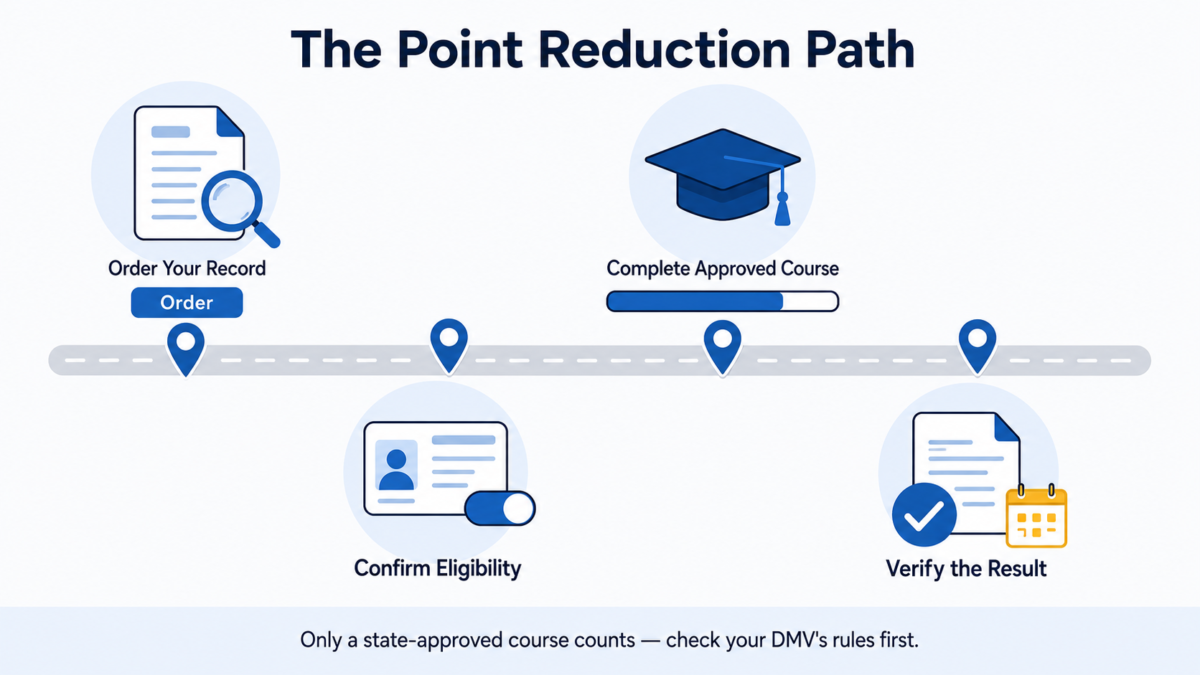
A course works only when it matches the state’s rules and timing.
Verified State Programs: What Each One Does
The table shows why “point removal” is too broad. Some programs reduce a total, while others prevent points, create a credit, or deal with a pending license action.
| State | What the program does | Key timing or limit | Official source |
|---|---|---|---|
| New York | Reduces the points used to calculate a suspension by up to 4; does not remove the ticket or points from the record | Once in an 18-month period for point reduction | New York DMV |
| California | Keeps the first qualifying one-point traffic-school result in 18 months confidential; no point is assessed for that result | More-than-one-point offenses, CDL holders, and commercial-vehicle cases do not get confidentiality | Cal. Veh. Code § 1808.7 |
| Florida | Withholds adjudication and prevents points after an eligible BDI election | Once in 12 months, up to 8 lifetime; listed 30-mph-over speeding charges and CDL cases are excluded | Fla. Stat. § 318.14(9) |
| Virginia | May award 5 safe-driving points after a driver-improvement clinic | Once in 24 months; the highest safe-driving balance is 5 | Virginia DMV |
| Georgia | Reduces up to 7 points after a certified driver-improvement course | Once every 5 years | Georgia DDS |
| Pennsylvania | A first-time driver at 6 points can pass a written exam to remove 2 points or complete Driver Improvement School to remove 4 | Attendance is assigned for point buildup or excessive speed; drivers cannot volunteer | PennDOT |
| Michigan | For an eligible ticket, BDIC prevents points and keeps the ticket information from being sent to the insurer; the ticket still appears on the driving record | Finish within 60 days of the state notice; the benefit may be used once | Michigan Secretary of State |
| Ohio | Gives a two-point credit to an eligible driver with at least 2 but fewer than 12 points | It is a cushion against a future 12-point suspension, not point deletion | Ohio BMV |
| South Carolina | Reduces up to 4 points after an approved eight-hour course | Once in 3 years; take it after points are assessed and before a point suspension begins | South Carolina DMV |
| Wisconsin | Reduces the demerit total by 3 after an approved course | Once in 3 years; current point-reduction courses are in person, not online | Wisconsin DMV |
| Tennessee | Removes up to 5 points from one eligible speeding conviction; the conviction remains | Complete an approved four-hour course within 90 days; once in a 4-year period | Tennessee Department of Safety |
| Kentucky | Court-referred State Traffic School prevents points from being assessed | A Kentucky District or federal court must refer the driver; most out-of-state drivers are not eligible; once every 12 months | Kentucky DRIVE |
| Maryland | Does not remove points on request | Points remain under state time rules; Driver Improvement is required at 5–7 points | Maryland MVA |
| Connecticut | A required Operator Retraining course can prevent or clear the related suspension when completed on time | It is a DMV notice-based program, not a general point-removal course | Connecticut DMV |
Texas: do not look for the old DRP point system
Texas repealed its Driver Responsibility Program in 2019, so DPS no longer assesses DRP points for moving violations. An eligible driver may still ask a local court about a Driving Safety Course, but that is a court-case option, not a statewide DMV point-reduction program. The Texas DPS repeal FAQ explains what ended, and the San Antonio Municipal Court shows one local course process.
Option 3: Wait for the Point Window to Pass
When no request-based program applies, time may be the only way for active points to stop counting. The ticket can remain on the driving record after the active point window ends.
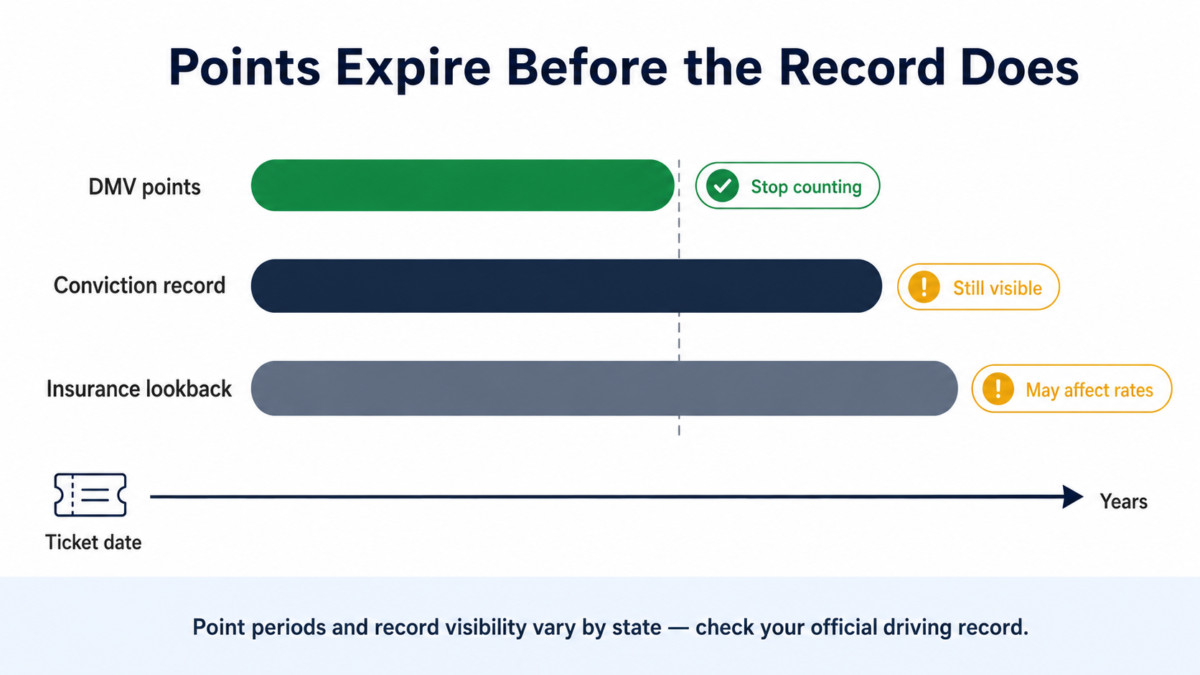
Points can stop counting before the ticket leaves the driving record or an insurer’s review.
For instance:
- New York says most violations, convictions, and points stay on the driving record for up to four years. PIRP changes only the point total used for certain suspension calculations; it does not remove them. Alcohol- and drug-related violations remain for 10 or 15 years.
- Wisconsin says most guilty results may be removed after five years. Alcohol-related cases stay on the record for an unlimited time.
- Maryland says points are not removed on request and remain under the state’s time rules.
Read how long points stay on your license for a fuller look at DMV and rate timelines.
Option 4: Correct a Record Error
If a dismissed or amended charge appears incorrectly, treat it as a record-correction problem. A DMV will not normally remove a correct entry simply because a driver asks.
How to challenge an incorrect entry
- Order the state driving record.
- Compare it with the court’s final paperwork.
- Note the ticket date, court, case number, and offense code.
- Gather the court order or amended result.
- Follow the DMV’s correction process.
- Keep copies of everything you send.
- Check the record again after the DMV responds.
Maryland, for instance, tells drivers to review the guilty-result details and send proof when a fix is needed. Your state may use a different form or office.
What Does Not Work
Paying first and checking later
Payment may count as accepting guilt, so ask what it does before giving up a hearing or court option.
Taking any online course
Each program accepts only certain courses. Wisconsin now requires an in-person course for its three-point cut. Florida requires a department-approved BDI course. A general online class may provide no DMV help.
Treating a credit as point deletion
Ohio’s two-point credit is a cushion. Virginia’s safe-driving points can offset demerit points. Neither description means the original offense vanished.
Assuming a lower point total fixes your rates
The NAIC consumer guide lists driving record as a rating factor. A rate may still reflect a ticket that remains visible after DMV points change.
Waiting until a license loss starts
Some programs must be done before the effective date. South Carolina says an approved course will not end a point-based license loss after it begins. Connecticut says the course provider may charge up to $85. If you complete the required course on or after the suspension's effective date, DMV also charges a $175 reinstatement fee.
Step-by-Step Checklist
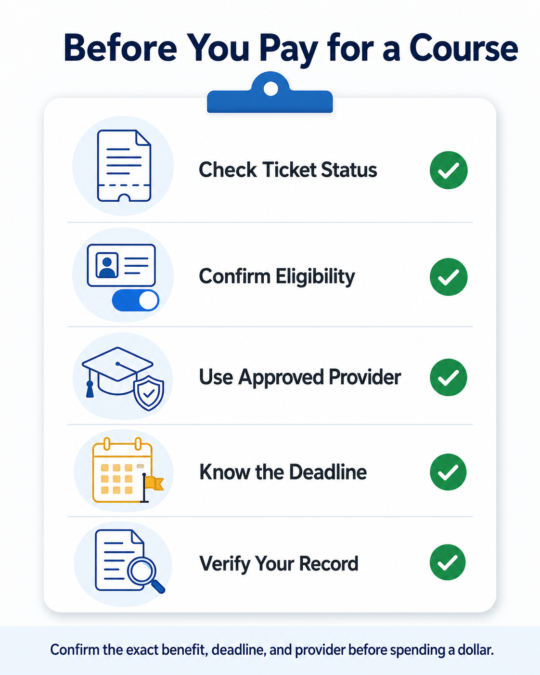
- Check the case status. Is the ticket pending, paid, dismissed, amended, or reported as a guilty result?
- Order your driving record. Do not rely only on a rate app or ticket copy.
- Find the state program page. Use the DMV, court, or licensing agency.
- Name the exact result. Does it prevent points, reduce a total, create a credit, or affect your license?
- Check the deadline and frequency limit. Write both down.
- Confirm course approval. Use the school list linked by the agency.
- Submit proof correctly. The school, court, or driver may be responsible.
- Verify the result. Pull a new record after the stated processing time.
- Call the insurer. Ask whether the course changes a surcharge or earns a discount.
For help comparing a course with a court appearance, read traffic school versus court.
When Fighting the Ticket May Be the Better Choice
If the ticket is pending, court review may offer a stronger result than a point cut after a guilty result.
Consider getting local legal advice when:
- The charge carries many points or could put your license at risk
- The ticket may be factually wrong
- You have useful video, GPS, repair, weather, or sign evidence
- You hold a CDL or drive for work
- You recently used a course and may not qualify again
- The ticket may be treated as a serious or criminal offense
Compare the likely gain with court costs, time, travel, and legal fees. See when fighting a speeding ticket makes sense.
Will Fewer DMV Points Lower Your Rates?
Not automatically—a DMV point change and a policy discount are different results.
Before taking a course to lower rates, ask:
- Is this course approved for a discount on my policy?
- Which coverages receive the discount?
- How long does it last?
- Can it apply if I have a recent ticket?
- When and how should I submit the certificate?
Read how traffic violations can affect insurance rates for the insurance side of the decision.
Frequently Asked Questions
Can you remove points immediately?
Only if a state program allows it and you qualify. Many courses prevent points before they are added, while others change only the active total after points are posted.
Is traffic school the same as point reduction?
No. A course may support dismissal, keep a result private, prevent points, reduce points, create a credit, meet a court order, or earn an insurance discount.
Can I remove points after paying the ticket?
Sometimes, but your choices are often narrower after payment creates a guilty result. Check for a state DMV program or wait for the point window to pass.
Does point reduction erase the ticket?
Usually not—New York, Ohio, Virginia, and many other states treat the active point total and the driving record as different things.
Can an out-of-state course remove points?
Do not assume it can; use only a course approved for the program tied to your license or court case. Kentucky, for instance, generally excludes out-of-state drivers from its State Traffic School.
What if my license is close to suspension?
Act quickly by ordering the driving record and contacting the DMV or court before the effective date. Some course results cannot undo a suspension once it starts.
Can CDL drivers use traffic school to avoid points?
CDL rules are stricter. California and Florida both limit the options discussed above for CDL holders. Commercial tickets may also have their own reporting rules. Check the court, DMV, and employer rules before pleading or paying.
The Bottom Line
There is no single way to get points off a license, so start with the status of the ticket and identify the exact result your state offers.
If the case is pending, ask the court about dismissal, a reduced charge, or an approved course before paying. If points are now posted, use only the state DMV process. Confirm the result on a new driving record and ask the insurer about rate effects.
Related Reading
- How to Avoid Points on Your License
- Speeding Ticket Points by State
- Does Traffic School Remove a Ticket From Your Record?
- Can Traffic School Lower Your Insurance Rate?
- What to Do After Getting a Traffic Ticket
Sources
Sources reviewed August 20, 2026; Connecticut, Kentucky, New York, and South Carolina sources rechecked August 21, 2026.
- New York DMV — Point and Insurance Reduction Program
- New York DMV — Get My Own Driving Record
- California Vehicle Code § 1808.7 — Confidential Traffic-School Records
- California Courts — Traffic School
- Florida Statutes § 318.14 — Traffic Infraction Procedures
- Texas DPS — Driver Responsibility Program Repeal FAQ
- City of San Antonio Municipal Court — Driver Safety Course
- Virginia DMV — Driver Improvement
- Georgia DDS — Points and Points Reduction
- PennDOT — Driver Improvement School
- Michigan Secretary of State — Basic Driver Improvement Course
- Ohio BMV — Remedial Driving Course for Two-Point Credit
- South Carolina DMV — Points System
- Wisconsin DMV — Wisconsin’s Point System
- Tennessee Department of Safety — Traffic School and Speeding-Point Removal
- Kentucky DRIVE — State Traffic School
- Maryland MVA — Driver’s License Points
- Connecticut DMV — Operator Retraining Program
- National Association of Insurance Commissioners — Consumer Auto Insurance