
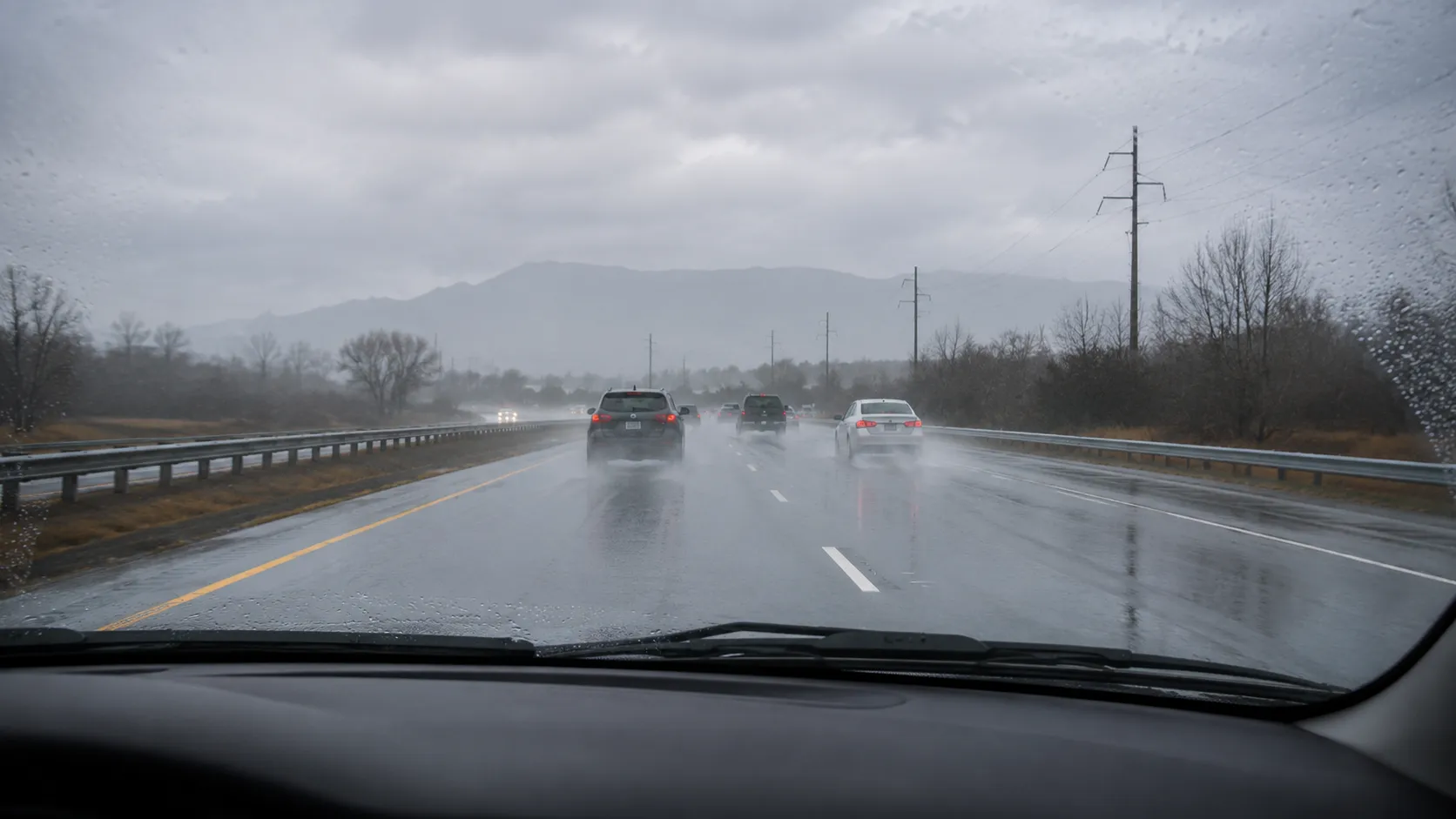
How to Drive in the Rain Safely

Rain can change driving conditions quickly. As rainfall becomes heavier, the road becomes slick, visibility drops, stopping distance increases, and standing water can cause hydroplaning. The safest drivers are not using advanced techniques. They are making simple adjustments before the situation becomes dangerous.
This guide explains how to drive in the rain with practical steps you can use before the trip, while driving, and when rain becomes severe enough that slowing down or stopping is the safer choice.
How to Drive in the Rain: Quick Safety Checklist
| Situation | Safer adjustment |
|---|---|
| Rain starts | Slow down before traffic gets unstable |
| Wipers are on | Turn on low-beam headlights |
| Normal 3-second gap | Increase to at least 5–6 seconds |
| Approaching a curve | Slow before the curve, then steer smoothly |
| Standing water ahead | Ease off the accelerator before reaching it |
| Hydroplaning starts | Do not brake hard; ease off and steer gently |
| Road is flooded | Turn around; do not test the water depth |
| Visibility is poor | Slow sharply or pull off safely and wait |
Why Driving in the Rain Is Dangerous
Heavy rain affects three things at the same time: traction, visibility, and reaction time. Wet pavement reduces tire grip. Spray from other vehicles makes it harder to see lane markings and brake lights. Drivers also need more room because even a well-maintained vehicle takes longer to stop on a wet surface.
Roads can be especially slick near the start of rainfall after a dry spell, when oil, rubber residue, and other debris mix with water. Intersections, ramps, and shaded roads can be more challenging because vehicles brake, turn, and accelerate there repeatedly.
The point is not to panic. The point is to change your driving early. If you drive the same way in a downpour as you do on a dry road, your margin for error becomes much smaller.
Before You Drive in the Rain
1. Check your tires before the storm
Tires matter more than all-wheel drive, stability control, or any driver-assist feature. Your tires are the only part of the vehicle touching the road. In heavy rain, tire tread must move water away from the contact patch so the rubber can stay connected to the pavement.
Check tread depth and tire pressure before long trips and at least monthly. The National Highway Traffic Safety Administration says tires should be replaced when tread is worn to 2/32 inch, and it recommends checking tread when you check pressure. See NHTSA’s tire safety guidance here: TireWise tire safety.
A practical wet-weather rule: do not wait until tires are legally bald before thinking about rain safety. If the tread is low, your risk of hydroplaning rises because the tire cannot clear water as effectively.
2. Replace streaking wiper blades
Wipers that chatter, skip, or leave smears are a safety problem, not just an annoyance. In heavy rain, poor wipers can make a clear windshield turn cloudy in seconds.
Before rainy season, check that the blades clear the full windshield evenly. Also confirm that the washer fluid reservoir is filled. Road spray often leaves grime on the glass, and wipers alone may not clear it.
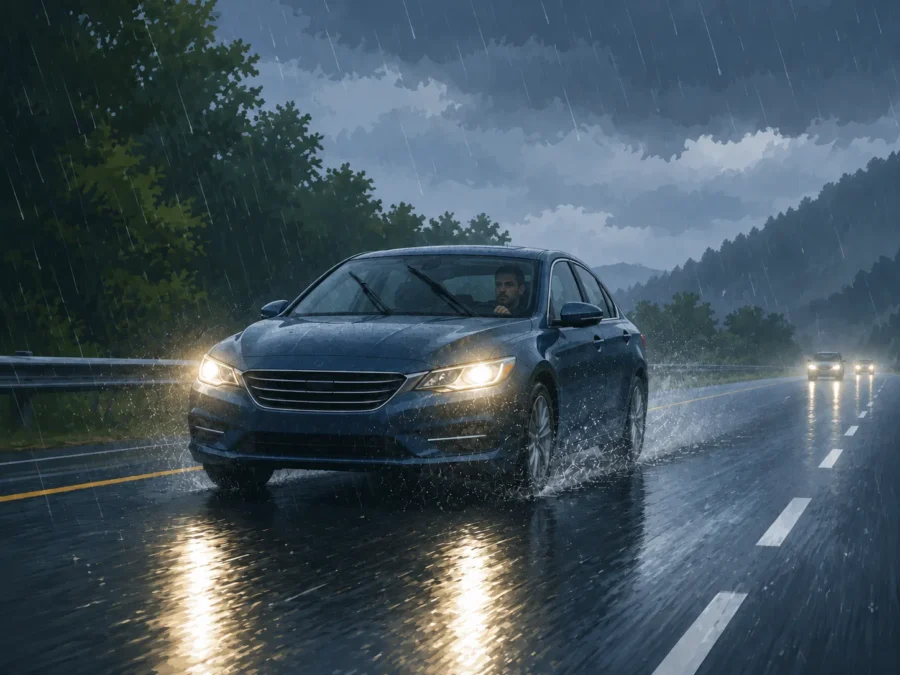
3. Turn on low-beam headlights
Use low-beam headlights whenever visibility is reduced. In many states, headlights are required when windshield wipers are in use, but the safety reason is broader: headlights help other drivers see you from the front and rear.
Avoid high beams in heavy rain. High beams reflect off raindrops and spray, which can make visibility worse instead of better.
While Driving in the Rain
4. Slow down more than feels necessary
The posted speed limit is designed for normal conditions. In heavy rain, treat the limit as a ceiling, not a target.
Speed is a major factor in both stopping distance and hydroplaning. The faster you drive, the less time your tires have to push water out of the way. Even a small reduction in speed can give you more time to see, decide, and respond.
A useful test is simple: if you would not be comfortable making a controlled stop at your current speed, you are going too fast for the conditions.
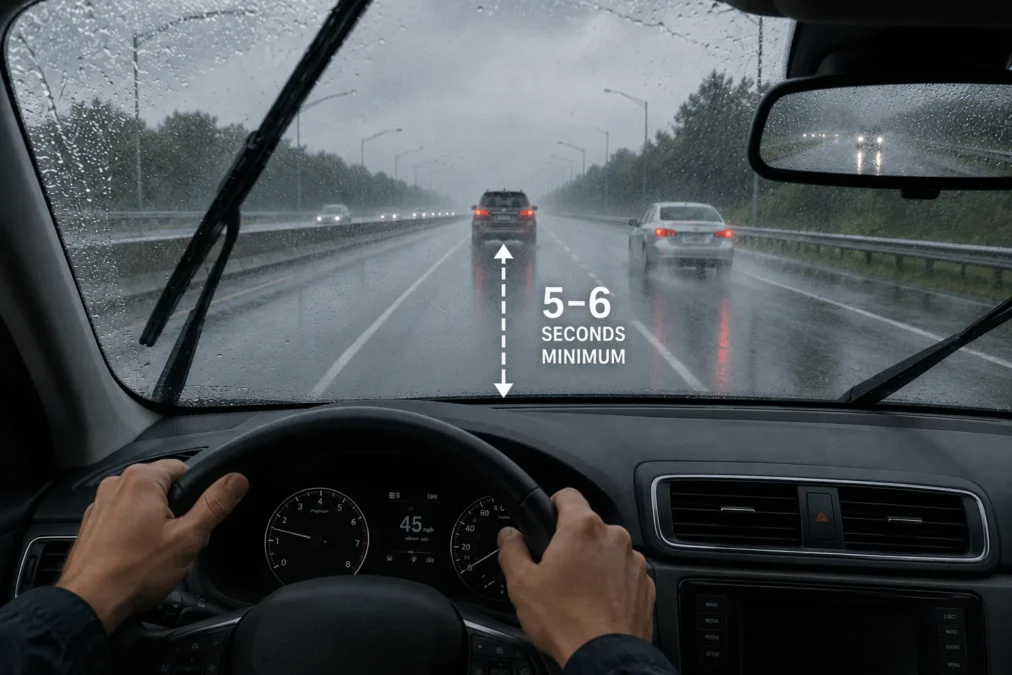
5. Increase your following distance to 5–6 seconds
The normal three-second following distance is not enough in heavy rain. Use at least five to six seconds, and add more if visibility is poor, traffic is fast, or vehicles around you are braking unpredictably.
Pick a fixed object ahead, such as a sign or light pole. When the vehicle in front passes it, start counting. If you reach the object before five seconds, increase the gap.
For broader habits that help in traffic and bad weather, see MyRoadWise’s guide to defensive driving techniques.
6. Brake earlier and more gently
Hard braking on wet pavement can trigger skids or cause the vehicle behind you to react late. Start slowing earlier than usual and apply brake pressure smoothly.
If your vehicle has anti-lock brakes, press the brake pedal firmly and steadily during an emergency stop. Do not pump ABS brakes. If you are driving an older vehicle without ABS and the wheels lock, ease off slightly and reapply pressure more gently.
7. Steer smoothly and avoid sudden lane changes
Abrupt steering is one of the easiest ways to lose traction in rain. Keep movements gradual. Slow before curves instead of braking hard while turning. If you need to change lanes, signal early, check mirrors, and move over smoothly without accelerating sharply.
Do not fight aggressive drivers in rain. If someone tailgates or weaves through traffic, let them go when it is safe. Heavy rain is not the time to prove a point.
8. Avoid cruise control in wet conditions
Do not use cruise control in heavy rain. AAA advises avoiding cruise control in wet weather because staying manually engaged gives the driver more options when responding to a loss of traction. See AAA’s wet-weather guidance here: Wet Weather Driving Tips.
The issue is control. In rain, you want to feel how the vehicle responds through the accelerator, brake, and steering wheel. Cruise control can reduce that feedback and may try to maintain speed when the better response is to slow down.
How to Avoid Hydroplaning in the Rain
Hydroplaning happens when your tires ride on a layer of water instead of gripping the road. For a short time, steering and braking may feel weak or unresponsive. It can happen suddenly, especially at higher speeds, with worn tires, or in standing water.
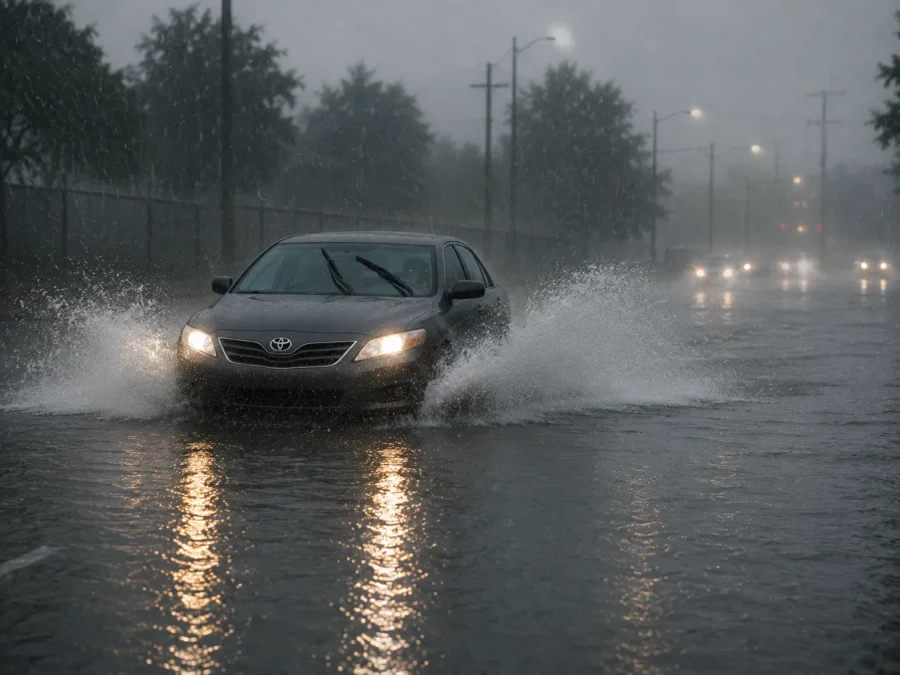
9. Avoid standing water when possible
Watch for dark, shiny patches of pavement, water collecting near curbs, and spray from vehicles ahead. These can signal standing water.
If you can safely avoid a puddle, do so with a smooth lane position change. If you cannot avoid it, ease off the accelerator before reaching it. Do not brake hard while crossing the water. Keep the steering wheel steady and let the tires roll through.
What to do if your car hydroplanes
If the vehicle starts to hydroplane:
- Stay calm and keep your eyes where you want to go.
- Ease off the accelerator gradually.
- Do not slam the brakes.
- Steer gently in the direction you want the vehicle to travel.
- Wait for the tires to regain contact before making stronger inputs.
Most hydroplaning events end as speed drops and the tires reconnect with the road. The biggest mistake is overcorrecting with a sharp steering movement.
When Rain Becomes Too Dangerous
Poor visibility
If you cannot see lane markings, brake lights, or the road edge clearly, slow down significantly. If visibility becomes too poor to continue, leave the roadway when you can do so safely. Choose a parking lot, rest area, or side street over the shoulder of a high-speed road.
Use hazard lights only when stopped or when your state specifically allows them while moving in severe conditions. Hazard-light laws vary by state, and using them while driving can confuse other drivers because hazards often signal a stopped or disabled vehicle.
Flooded roads
Do not drive into water of unknown depth. Water can hide washed-out pavement, open utility covers, or debris. The National Weather Service warns that 12 inches of rushing water can carry away most cars, and 2 feet can carry away SUVs and trucks. See the NWS flood safety campaign: Turn Around Don’t Drown.
If you see water crossing the road, turn around. Do not follow another vehicle through it. A heavier truck making it through does not mean your vehicle can.
If your car stalls in water, do not try to restart it. Restarting can pull water into the engine and make the damage worse. If water is rising or moving, leave the vehicle only if you can do so safely and move to higher ground.
Common Mistakes Drivers Make in Heavy Rain
Many rain-related driving problems come from ordinary habits that are acceptable on dry roads but risky in a downpour.
| Mistake | Why it is risky | Better choice |
|---|---|---|
| Driving at the normal speed limit | Less traction and visibility | Reduce speed early |
| Following at 2–3 seconds | Not enough stopping room | Use 5–6 seconds or more |
| Using cruise control | Less direct speed control | Drive manually |
| Braking hard in puddles | Can worsen loss of traction | Ease off before standing water |
| Using high beams | Reflects off rain and spray | Use low beams |
| Driving through flooded roads | Water may be deeper than it looks | Turn around |
Frequently Asked Questions
How do I drive safely in the rain?
To drive safely in the rain, slow down, turn on low-beam headlights, increase following distance to at least five to six seconds in heavy rain, brake earlier, steer smoothly, avoid cruise control in very wet conditions, and stay away from standing or moving water. If visibility becomes poor or the road floods, the safest option is to pull off safely or wait.
What is the biggest danger when driving in heavy rain?
Hydroplaning and reduced visibility are usually the biggest immediate dangers. Hydroplaning can temporarily reduce steering and braking control, while poor visibility makes it harder to judge speed, lane position, and traffic changes.
How much should I slow down in heavy rain?
There is no single safe speed for every storm. Reduce speed enough that you can stop smoothly within the distance you can clearly see. On highways, that may mean driving well below the posted limit when rain is heavy, traffic spray is strong, or water is collecting on the road.
Should I use hazard lights while driving in heavy rain?
Usually, no. Hazard-light rules vary by state, and in many places they are intended for stopped or disabled vehicles. While moving, hazards can confuse other drivers and make turn signals harder to read. Use low-beam headlights while driving; use hazards when stopped safely off the road.
Should I use cruise control in heavy rain?
No. Avoid cruise control in heavy rain or on wet roads. Manual control lets you adjust speed gently when traction changes, especially near puddles, curves, and traffic slowdowns.
What should I do if my car starts hydroplaning?
Ease off the accelerator, do not brake hard, and steer gently in the direction you want to go. Keep your movements smooth until the tires regain contact with the road.
Is all-wheel drive safer in the rain?
All-wheel drive can help with acceleration, but it does not shorten stopping distance or create extra tire grip while braking or cornering. Tires, speed, and following distance matter more in heavy rain than the drivetrain.
Is it safer to wait instead of driving in heavy rain?
Yes, when rain is severe enough to cause poor visibility, standing water, or flooding. Waiting 20–30 minutes for the heaviest rain to pass is often safer than continuing through conditions where you cannot see or stop reliably.
What to Remember
Learning how to drive in the rain is mostly about reducing risk before it becomes urgent. Slow down early. Create more space. Use low-beam headlights. Brake gently. Keep both hands engaged and avoid cruise control. Never drive through flooded water just because another vehicle did.
Rain driving is manageable when you adjust to the conditions. It becomes dangerous when drivers treat wet roads like dry roads.