


Is Online Traffic School Legit? 7 Smart Checks Before You Pay
If you have never taken an online traffic school course, the process can feel suspicious. You pay a fee, complete a few hours of online lessons, pass a final quiz, and somehow that may satisfy a court requirement, reduce points, or qualify you for an insurance discount.
So, is online traffic school legit? Yes — when the course is approved for your state, your ticket, and your specific purpose. The real risk is not that online traffic school is fake. The risk is taking the wrong course, using a provider that is not currently approved, or assuming that one course works for every court, DMV, or insurance company.
This guide explains how online traffic school works, how to verify whether a course is legitimate, which red flags to avoid, and what to check before you pay.
Quick Answer
Online traffic school is legitimate when it is approved by the correct authority for your situation. That authority may be a court, DMV, Department of Public Safety, state licensing agency, or insurance company.
Before enrolling, verify three things:
- State approval: The provider appears on an official state, court, or agency list.
- Purpose approval: The course qualifies for your goal — ticket dismissal, point reduction, court order, or insurance discount.
- Certificate rules: The certificate will be delivered in the format and timeframe your court, DMV, or insurer accepts.
A course can be legitimate in one state but useless in another. It can also be approved for insurance discounts but not for ticket dismissal. That is why approval must be checked for your exact situation.
Online Traffic School Legitimacy Checklist
| Your goal | Who usually needs to approve it | What to verify before paying | Main risk |
|---|---|---|---|
| Ticket dismissal | Court or state traffic school program | Your ticket qualifies and the provider is accepted | Court rejects the certificate |
| Point reduction | DMV, DPS, or licensing agency | The course applies to your state point rules | Points are not reduced or adjusted |
| Insurance discount | Your insurer and/or state-approved course list | Your insurer accepts the course certificate | No discount after completion |
| Court-ordered completion | Court handling your case | Course length, provider, deadline, and certificate format | Deadline missed or wrong course completed |
| Voluntary driver improvement | Course provider, insurer, or state program | Whether the course creates any official benefit | You pay for education only, not a record benefit |
How Online Traffic School Works
Online traffic school is a driver improvement or defensive driving course completed through a wOnline traffic school is a driver improvement or defensive driving course completed through a website or app instead of a physical classroom. Depending on the state and purpose, the course may include reading modules, videos, quizzes, identity checks, and a final exam.
After completion, the provider issues a certificate or reports the completion electronically. The certificate may go to:
- The court
- The state DMV or licensing agency
- Your insurance company
- You, so you can submit it manually
The important point is that approval is not based on the provider’s marketing language. A course is legitimate only if it meets the rules set by the court, DMV, state agency, or insurer that controls your case.
Most courses take several hours, but the required length varies by state. Some programs allow you to pause and return later. Others use timers, identity verification, or test limits because the state requires them.
When Online Traffic School Is Legit — and When It Is Not
Online traffic school is legitimate when it is approved for the job you need it to do.
It is usually legitimate when:
- The provider appears on an official state, court, DMV, or agency list.
- Your ticket or driving record issue qualifies under that state’s rules.
- The course category matches your goal.
- The certificate can be submitted before your deadline.
- Your insurer confirms the course qualifies for a discount, if insurance is the reason you are taking it.
It is not useful when:
- The course is approved in a different state but not yours.
- The course is approved for insurance discounts but not ticket dismissal.
- You already used traffic school too recently under your state’s rules.
- Your violation is excluded, such as some alcohol, drug, commercial vehicle, or serious offenses.
- The provider cannot clearly explain how completion is reported.
The course itself may still be a real class. It just may not create the legal or insurance benefit you expect.
7 Checks Before You Pay for Online Traffic School
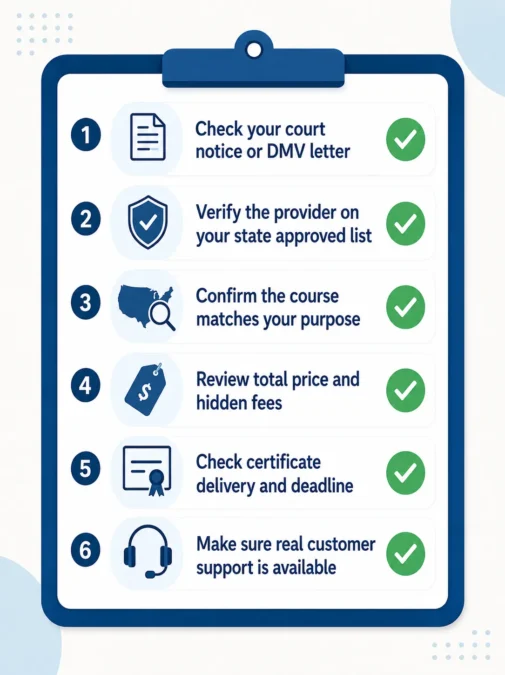
1. Start with your ticket, court notice, or DMV letter
Do not start with Google ads. Start with the document that triggered the course requirement.
Look for:
- The court name
- Citation or case number
- Whether traffic school is allowed
- Completion deadline
- Required course length
- Certificate submission method
- Any approved-provider instructions
If the paperwork says you must use a court-approved course, do not assume a general “state-approved” course will work.
2. Verify the provider on an official source
Use the official state, court, DMV, Department of Public Safety, or licensing-agency website. Search results and provider landing pages are not enough.
For example, California DMV provides an online traffic school list for locating traffic schools, while California Courts explains general traffic school eligibility. New York DMV publishes approved Point and Insurance Reduction Program sponsors, including online and alternate delivery courses.
A provider’s own website may say “approved,” but the safer test is whether the provider appears on the official list that applies to your state and purpose.
3. Confirm the course purpose
“State approved” does not always mean “approved for everything.”
A provider may offer separate courses for:
- Ticket dismissal
- Point reduction
- Insurance discount
- Court-ordered driver improvement
- Mature driver discount
- Commercial driver training
- General defensive driving education
Before paying, match the course title and purpose to your specific need. If you need ticket dismissal, do not buy an insurance-discount course unless the court confirms it qualifies.
4. Confirm your eligibility
Even if the course is legitimate, you may not be eligible to use it.
Common limits include:
- You already used traffic school within the state’s waiting period.
- Your ticket is too serious.
- You were driving a commercial vehicle.
- The court has not granted permission.
- You missed the election deadline.
- Your license status makes you ineligible.
This is why traffic school should be treated as a conditional option, not an automatic right.
5. Check the certificate process before enrolling
Certificate delivery is one of the most common problems.
Before paying, confirm:
- Whether the provider reports completion directly
- Whether you receive a digital certificate
- Whether your court requires an original certificate
- How long processing takes
- Whether rush delivery costs extra
- Whether the provider can correct certificate errors quickly
If your court deadline is close, certificate timing matters as much as course approval.
6. Review the total cost
Many online traffic schools advertise a low base price. The final cost can be higher after certificate fees, state fees, processing fees, identity-verification fees, rush shipping, or retake fees.
Before entering payment information, check the final checkout total. A legitimate provider should make the full price clear before you pay.
7. Test the support and refund policy
A traffic school course is not complicated until something goes wrong. Then support matters.
Look for:
- Phone, email, or live chat support
- Clear support hours
- A real business address
- Refund policy
- Certificate correction process
- State-specific help pages
A provider that hides contact information or gives only vague answers is a poor choice even if the course is technically approved.
Legit Course vs Risky Course
| Legit online traffic school | Risky or low-quality course |
|---|---|
| Listed by the official state, court, DMV, or agency source | Claims approval but does not appear on official lists |
| Clearly separates ticket, point, insurance, and court-order courses | Uses vague “approved everywhere” language |
| Shows total cost before payment | Adds surprise fees late in checkout |
| Explains certificate delivery and reporting | Makes certificate rules hard to find |
| Offers reachable customer support | Has only a contact form or no reliable support |
| Has state-specific eligibility guidance | Gives generic advice that may not apply to your ticket |
| Does not promise guaranteed legal results | Guarantees dismissal, point removal, or insurance savings |
What Separates a Good Course from a Bad One
All approved courses should meet the minimum requirements for their state or program. What varies is everything around that minimum.
Course design and readability
A good course is organized, readable, and easy to return to if you pause. A bad course may technically meet the requirement but feel outdated, confusing, or unnecessarily slow.
If you need to spend four to eight hours in a course, the interface matters.
Mobile experience
Many drivers complete traffic school on a phone. Before enrolling, check whether the course works well on mobile. Some providers offer dedicated apps, while others use a responsive website. A course that requires desktop use may still be legitimate, but it may be inconvenient.
Clear pacing rules
Some states require timers or minimum seat time. That can make a course feel slow, but it may be a compliance requirement rather than a provider choice. A good provider explains these rules before you start.
Transparent certificate handling
A reliable provider explains who receives the certificate, how long delivery takes, and what happens if your name, citation number, or court information is entered incorrectly.
Real support
Customer support is especially important when a court deadline is near. Choose a provider that can answer state-specific questions and certificate questions clearly.
State Examples: California, Texas, Florida, and New York
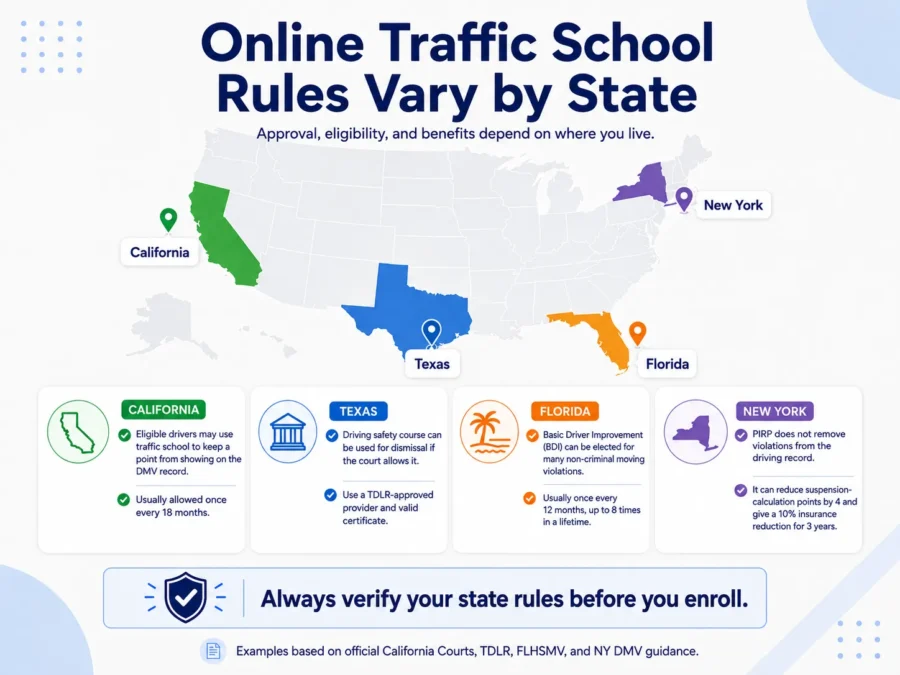
Rules vary by state, and local courts may add their own procedures. Use these examples as a starting point, not as a substitute for checking your own ticket or court notice.
California
California allows traffic school in many eligible traffic cases, but the court determines whether you can use it. California Courts says drivers can usually attend traffic school if they have a valid driver’s license, the ticket involved a noncommercial vehicle, and they have not gone to traffic school in the last 18 months. California DMV also maintains a traffic school list for finding traffic schools.
Official sources:
Texas
Texas commonly uses approved driving safety courses for eligible traffic-ticket dismissal, but eligibility is handled through the court. Texas law refers to completing a driving safety course approved under Chapter 1001 of the Education Code, and the diversion option is generally limited to once every 12 months.
Official source:
Florida
Florida allows eligible drivers with non-criminal moving violations to elect a Florida-approved Basic Driver Improvement course. FLHSMV states that eligible drivers may elect school once every 12 months and no more than eight times in a lifetime. Drivers must also make the election within the required deadline, commonly 30 days from the citation.
Official source:
New York
New York’s Point and Insurance Reduction Program, often called PIRP or IPIRP when delivered online, is available through DMV-approved sponsors. New York DMV explains that the program can reduce points for calculation purposes and may qualify drivers for a 10% insurance reduction, but the tickets and points do not physically disappear from the driving record.
This distinction matters. It is more accurate to say PIRP may reduce the points counted toward a suspension calculation than to say it “removes” points from the record.
Official sources:
- NY DMV — Point and Insurance Reduction Program
- NY DMV — New York State Driver Point System
- NY DMV — Approved PIRP and IPIRP sponsors
Common Mistakes to Avoid
Choosing the cheapest course without checking approval
A cheap course is not a bargain if your court rejects the certificate. Approval matters more than price.
Assuming one provider works in every state
Traffic school approval is usually state-specific. Some national providers operate in multiple states, but that does not mean every course they sell works everywhere.
Confusing insurance discounts with ticket dismissal
Insurance-discount courses and ticket-dismissal courses may overlap in some states, but they are not automatically the same. Confirm the benefit before enrolling.
Waiting until the deadline is close
Even if the course is online, certificate reporting may take time. Do not assume same-day completion means same-day court processing.
Believing traffic school erases everything
Traffic school may dismiss a ticket, reduce points, prevent points, or qualify for an insurance discount depending on state rules. It does not automatically erase every record of the violation.
Frequently Asked Questions
Is online traffic school legit?
Yes, online traffic school is legit when the provider is approved by the correct state, court, DMV, agency, or insurer for your situation. The course must also match your purpose, such as ticket dismissal, point reduction, insurance discount, or court-ordered completion.
Will an online traffic school certificate hold up in court?
Usually, yes — if the court allows online traffic school and the provider is approved for that court or state program. Always check your court notice or court website before enrolling, especially if your deadline is close.
How do I know if a course is state approved?
Look for the provider on the official state, DMV, court, Department of Public Safety, or licensing-agency list. Do not rely only on the provider’s marketing page. If the provider is not listed by the official authority, contact the court or agency before paying.
Can I take online traffic school more than once?
Often yes, but states usually limit how often you can use traffic school for an official benefit. California generally uses an 18-month traffic school limit for eligible cases. Texas and Florida commonly use a 12-month limit for eligible programs. New York PIRP point reduction can be used once in an 18-month period. Always check your state’s current rule.
Is online traffic school easier than in-person traffic school?
It may feel easier because you can complete it at your own pace, but the course still has to meet the required curriculum and timing rules. Some online courses use timers, quizzes, identity checks, or final exams because the state requires them.
What happens if I fail the final exam?
Many providers allow retakes, but the rules depend on the state and provider. Check the retake policy before enrolling, including whether retakes cost extra or whether there is a waiting period.
Do insurance companies accept online traffic school certificates?
Many insurers accept approved defensive driving or driver improvement courses, but acceptance varies. Contact your insurer before enrolling and ask whether the course qualifies for a discount, how long the discount lasts, and what certificate they need.
What if I already paid for the wrong course?
Contact the provider first and ask whether the course can be switched or refunded. Then contact the court, DMV, or insurer to confirm whether the certificate can still be accepted. If the course is not approved for your situation, you may need to take a different course before your deadline.
Bottom Line
Online traffic school is real, widely used, and often accepted by courts, DMVs, and insurers. The question is not simply whether online traffic school is legitimate. The better question is whether this specific course is approved for your state, your ticket, and your purpose.
Before you pay, verify the provider on an official source, confirm your eligibility, check certificate rules, and review the full cost. A legitimate online traffic school course can save time and help with a ticket, points, or insurance discount — but only when it matches the rules that apply to your situation.