
How to Avoid Speeding Tickets: 9 Habits That Actually Work
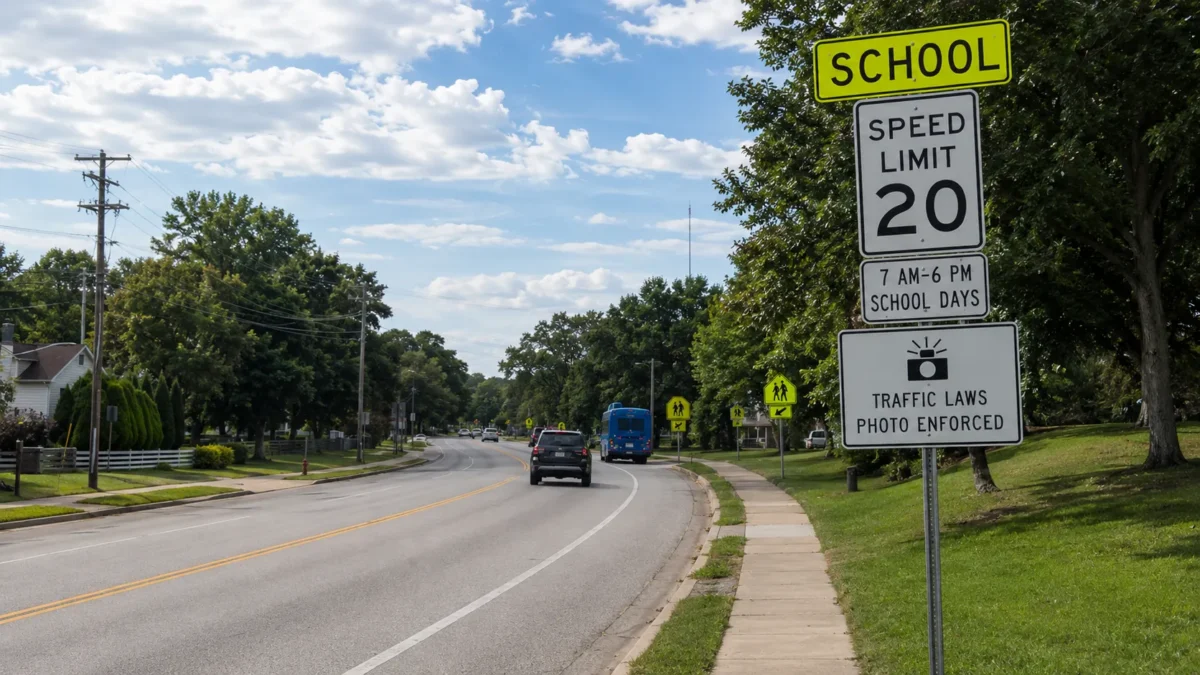
The most reliable way to avoid speeding tickets is not a radar detector, a shortcut, or luck. It is building habits that keep your speed close to the posted limit before enforcement becomes an issue.
That sounds simple, but most speeding tickets do not start with a plan to drive recklessly. They happen when you get comfortable going 10–15 mph over on a familiar road, miss a speed-limit change, follow faster traffic, or try to make up time after leaving late.
Speed also matters for safety, not just citations. The National Highway Traffic Safety Administration reports that speeding was a contributing factor in 29% of all traffic fatalities in 2024. NHTSA also notes that driving too fast for conditions can be dangerous even when a driver is technically at or below the posted limit.
This guide explains how to avoid speeding tickets by recognizing high-risk enforcement zones, controlling speed creep, planning trips realistically, and knowing which habits actually reduce your risk.
Quick Answer: How Do You Avoid Speeding Tickets?
Five habits prevent most speeding tickets:
- Treat the posted limit as your target, not your floor
- Check your speedometer often instead of estimating
- Start slowing before the limit drops, not after
- Leave a 5–10 minute buffer so you are not trying to make up time
- Take extra care in school zones, work zones, neighborhoods, and roads you do not know
Radar detectors, keeping up with traffic, and “everyone else is speeding” do not reliably protect you.
The safest approach is simple: know your actual speed, slow down before the risky zone, and avoid using speed to solve a scheduling problem.
Speeding Ticket Risk Zones to Watch
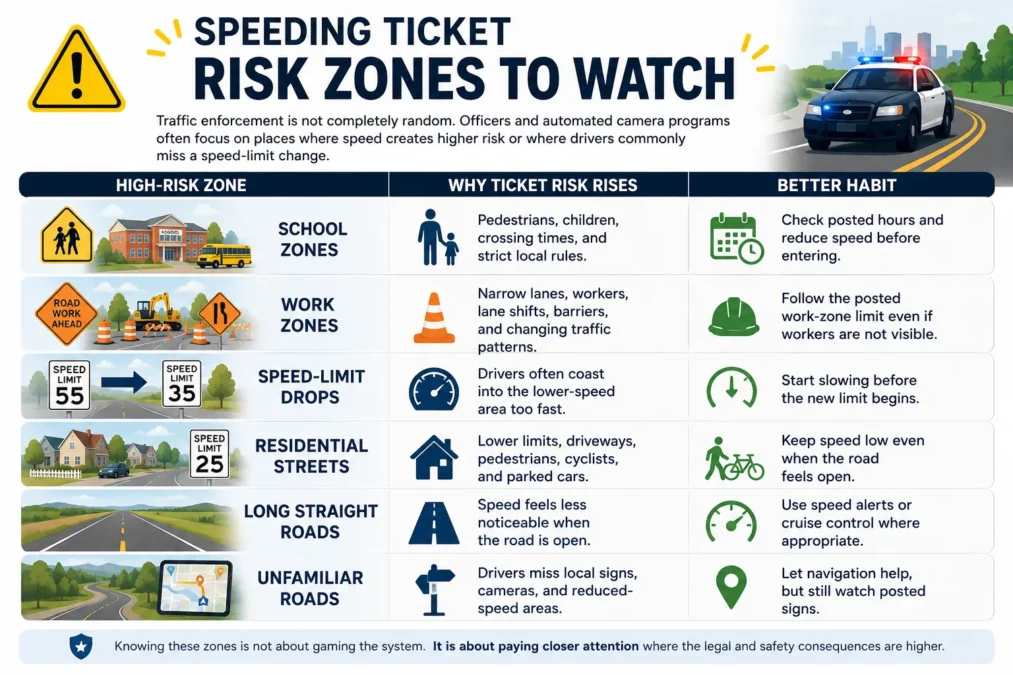
Enforcement often shows up where speeds drop and where people are close to traffic—school zones, work zones, and neighborhoods. NCSL notes that some state laws limit automated cameras to places such as school or work zones.
| High-risk zone | Why ticket risk rises | Better habit |
|---|---|---|
| School zones | Pedestrians, children, crossing times, and strict local rules | Check posted hours and reduce speed before entering |
| Work zones | Narrow lanes, workers, lane shifts, barriers, and changing traffic patterns | Follow the posted limit and any time or condition shown on work-zone signs; enhanced penalties vary by jurisdiction. |
| Speed-limit drops | Drivers often coast into the lower-speed area too fast | Start slowing before the new limit begins |
| Residential streets | Lower limits, driveways, pedestrians, cyclists, and parked cars | Keep speed low even when the road feels open |
| Long straight roads | Speed feels less noticeable when the road is open | Use speed alerts or cruise control where appropriate |
| Unfamiliar roads | Drivers miss local signs, cameras, and reduced-speed areas | Let navigation help, but still watch posted signs |
Knowing these zones is not about gaming the system. It is about paying closer attention where the legal and safety consequences are higher.
1. Treat the Speed Limit as the Target, Not the Starting Point
Many drivers treat the posted speed limit as the lowest acceptable speed and then add an informal “buffer.” That mindset is what creates risk.
Do not treat the posted limit as a minimum or assume a universal enforcement buffer. State law may also require a lower speed when weather, traffic, visibility, or road conditions make the posted speed unsafe.
A better rule: use the posted limit as your target speed, then adjust downward when conditions require it.
This habit is especially important when you are driving through a lower-speed area after being on a faster road. Your body may still feel calibrated to highway speed, so 45 mph can feel slow even when the new limit is 30 or 35 mph.
2. Slow Down Before Speed-Limit Changes
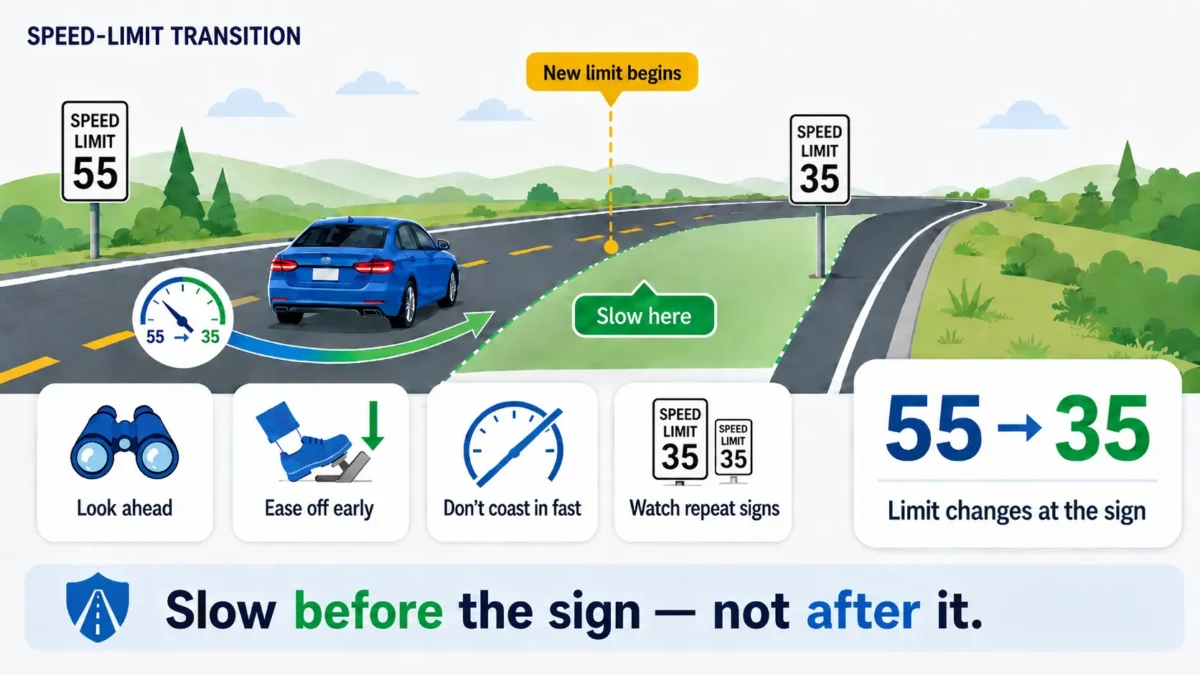
Speed-limit transition points are one of the easiest places to get caught speeding. A road may drop from 55 to 35, 45 to 30, or 35 to 20 near a school, village center, construction area, or residential stretch.
Begin slowing early enough to comply when the lower limit applies. Sign placement, zone boundaries, and any time-based conditions depend on the posted control and local law, so do not assume a grace distance after the sign.
Practical habit:
- Look farther ahead for upcoming signs.
- Ease off the accelerator before you reach the lower-speed zone.
- Avoid coasting into the new zone above the limit.
- Watch for repeated signs confirming the lower speed.
This one habit can prevent many “I didn’t realize it dropped there” tickets.
3. Control Speed Creep on Familiar Roads
Speed creep is the gradual, unconscious increase in speed on roads you know well. It happens because familiar roads feel safer than they really are.
Common causes include:
- Matching the speed of surrounding traffic instead of the posted limit
- Driving the same commute so often that you stop noticing signs
- Feeling safe on a wide road even when the limit is low
- Letting music, conversation, or stress reduce your speed awareness
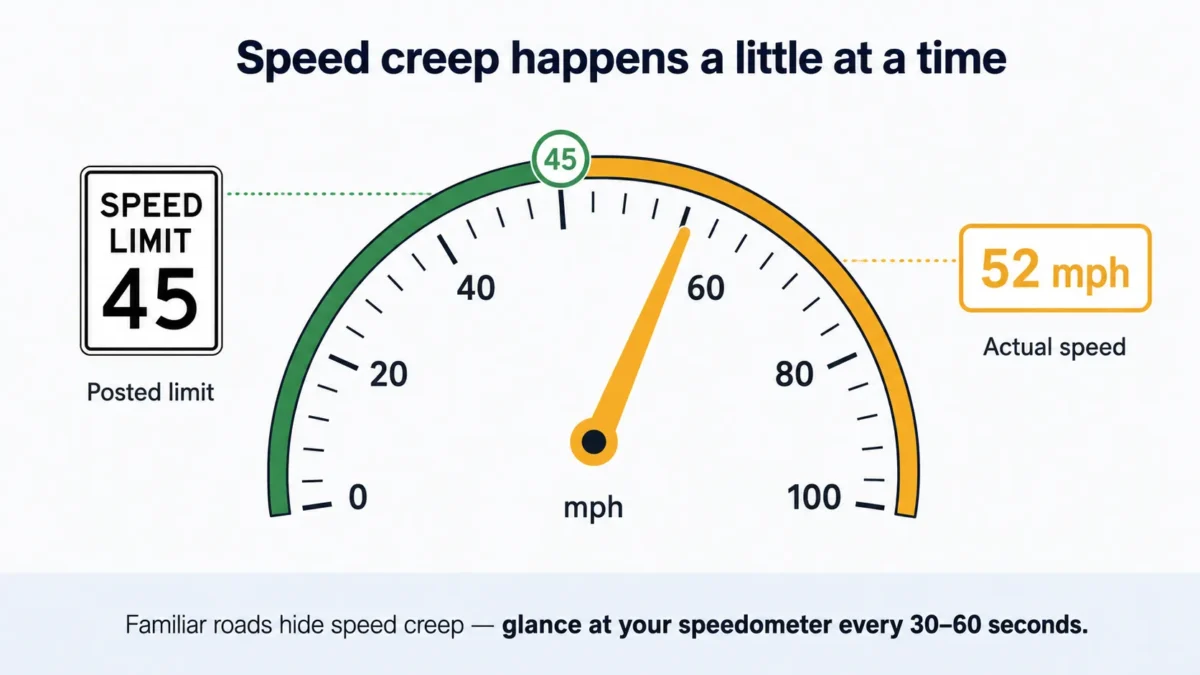
How to reset the habit:
- Check your speed regularly on enforcement-prone roads.
- Use your vehicle’s speed-limit display if it has one.
- Set a speed alert in your navigation app or vehicle settings when available.
- Re-check your speed after passing through open stretches, downhill sections, or highway exits.
The goal is not to drive nervously. The goal is to know your actual speed instead of estimating it.
4. Use Cruise Control Carefully on Highways
Cruise control can help you avoid speeding tickets on open highways because it prevents gradual drifting above your intended speed. This is especially useful on long drives where your foot slowly adds pressure without you noticing.
But cruise control is not always appropriate. Do not use it in heavy traffic, rain, snow, icy conditions, construction zones with lane shifts, or situations where you need frequent speed changes.
If wet weather begins, cancel cruise control and follow these practical guidelines for driving safely in the rain, including reducing speed, increasing following distance, and avoiding sudden inputs.
A practical approach:
- Use cruise control only when conditions are stable.
- Set it at or near the posted limit, not above it.
- Cancel it before work zones, toll areas, exits, congestion, or poor weather.
- Do not use adaptive cruise control as a substitute for watching the speed limit.
Cruise control is a tool for consistency, not permission to stop paying attention.
5. Give Yourself a Real Time Buffer
A large share of speeding comes from one simple problem: you are late.
The problem is that speeding usually saves less time than people think. On a 30-mile highway drive, going 75 mph instead of 65 mph saves only a few minutes in ideal conditions. On a city or suburban drive, traffic lights, stop signs, parking, school buses, and congestion often erase most of the difference.
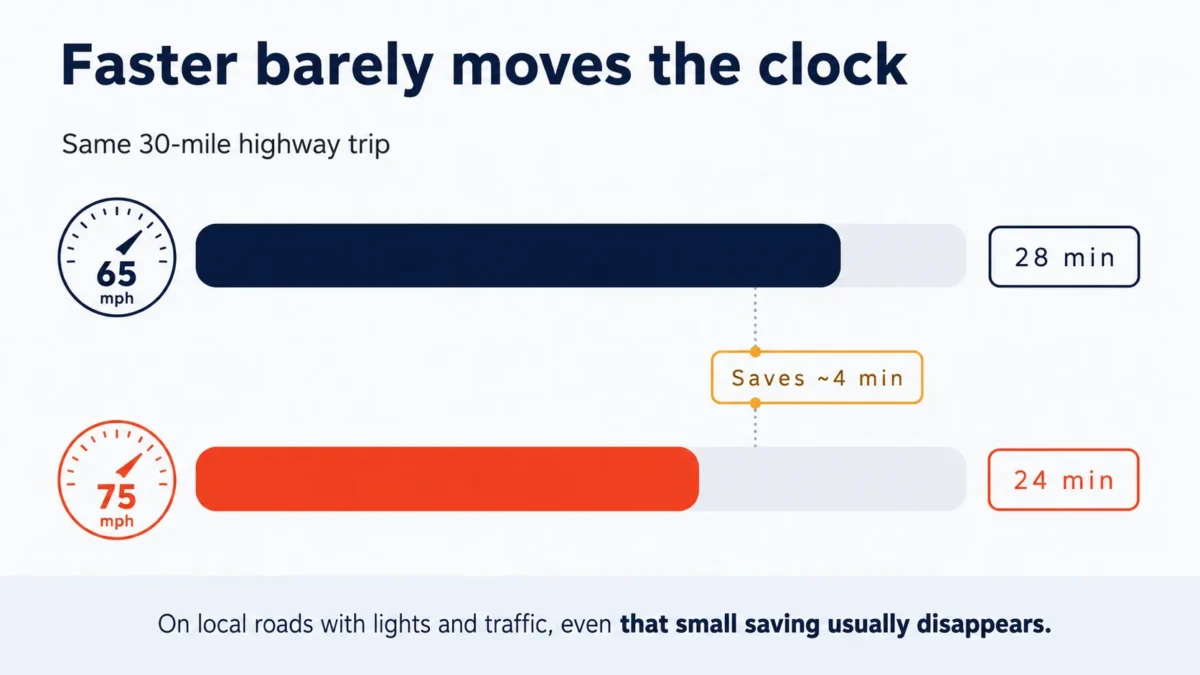
A better habit is to build a 5–10 minute buffer into regular trips.
That buffer does three things:
- Reduces the urge to make up time with speed
- Gives you time for traffic lights, parking, or a missed turn
- Makes you less reactive when another driver slows you down
If you are already late, speeding rarely fixes the problem. It usually adds a second problem.
6. Do Not Let Faster Traffic Set Your Speed
Driving with faster traffic does not create a nationwide legal defense. An officer may still cite a driver who exceeds the applicable limit, although defenses and enforcement procedures depend on the jurisdiction and facts.
Following a faster car also creates two risks:
- You may gradually match their speed without noticing.
- You may reduce your following distance while trying to stay with traffic.
A safer approach is to let faster drivers pass when safe. Stay in the appropriate lane, keep a steady speed, and avoid turning surrounding traffic into your speed reference.
You do not have to be the slowest vehicle on the road, but you should not let impatient drivers decide your speed for you.
7. Be Extra Careful in School Zones, Work Zones, and Residential Areas
Some speeding situations carry more serious consequences than others. School zones, work zones, and residential areas deserve special attention because the risk involves pedestrians, workers, children, cyclists, driveways, and limited reaction time.
School zones
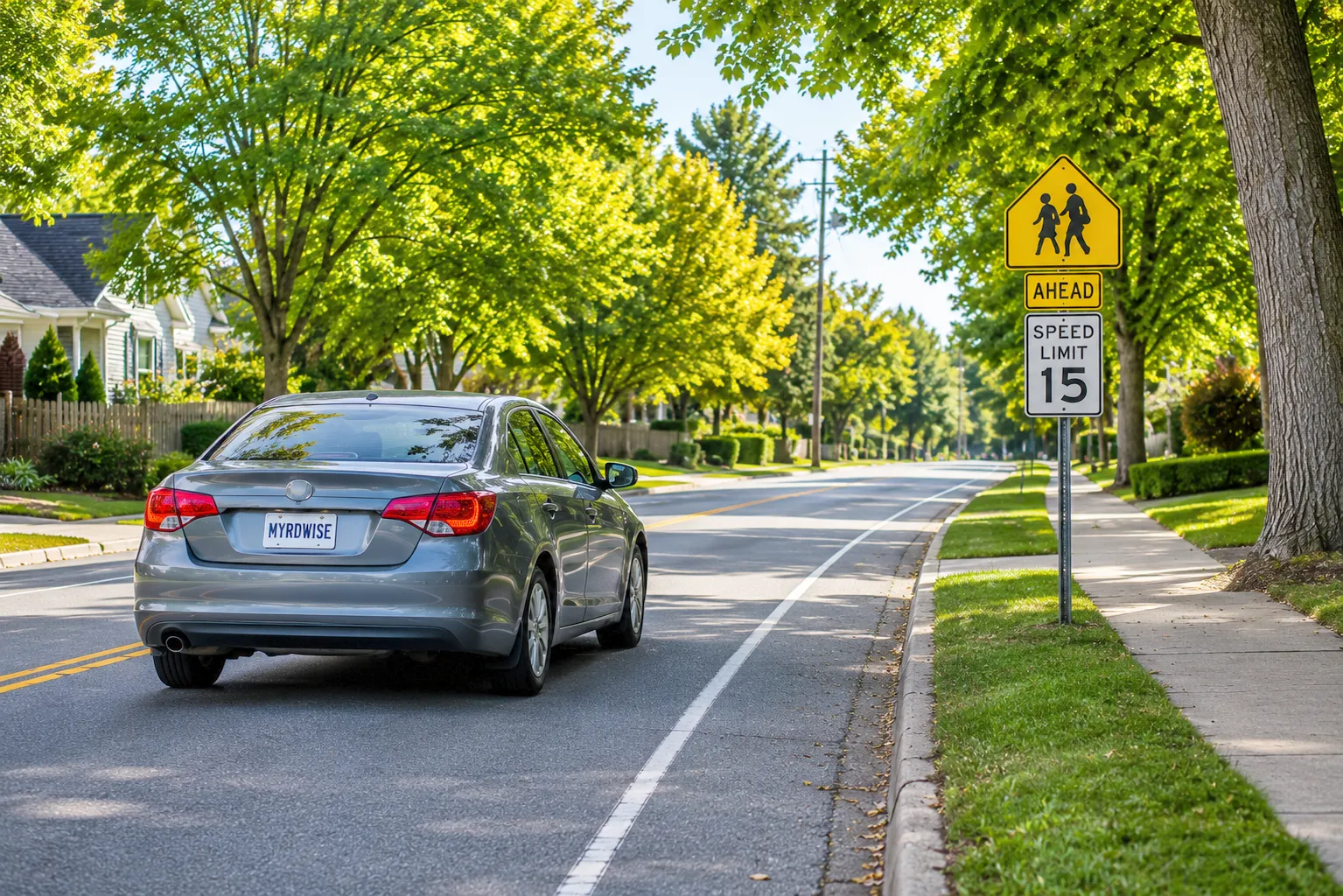
Check the posted signs carefully. Some school-zone limits apply only during certain hours, while others may apply when lights are flashing or during posted school days. Local camera rules also vary.
The safest habit is to slow early and avoid trying to interpret the rule at the last second.
Work zones
Follow the posted work-zone speed and any stated time or condition even when workers are not immediately visible. Enhanced fines or penalties may depend on local law, sign language, and whether workers are present.
Residential areas
Residential roads often feel calm, but that can create false confidence. Driveways, parked cars, pedestrians, delivery vehicles, cyclists, and children can appear quickly. Keeping speed low gives you more time to react and reduces ticket risk.
8. Know the Rules That Vary by State
States use different speeding laws, camera rules, point systems, traffic-school rules, insurance rules, and reckless-driving limits. A rule in one state might not apply in another.
Traffic cameras are a good example. The National Conference of State Legislatures notes that state law often controls where cameras can be used, how local governments run them, and what limits apply.
Before assuming a camera ticket will or will not add points, check your state DMV, the citation itself, or the court listed on the notice.
Check whether your state treats certain speeds as reckless, careless, or aggressive driving. In Virginia, for example, driving 20 mph or more over the limit or over 85 mph can be charged as reckless driving.
That does not mean every state uses Virginia’s rule. It means the same speed can have very different consequences depending on where you are driving.
9. Stop Relying on Ticket-Avoidance Myths
Some common habits feel useful but do not reliably help you avoid speeding tickets.
Radar detectors
Radar-detector rules vary by jurisdiction and vehicle type. Even where a detector is permitted, it is not a complete solution. If radar or lidar is already aimed at your vehicle, the warning may come too late. Some enforcement methods may also be difficult for a detector to warn against in time.
More importantly, relying on a detector can reinforce the wrong habit: speeding until you think you might get caught.
Following a faster car
Some drivers think a faster car ahead will get targeted first. In reality, officers may target any visible vehicle in a group. If you are speeding, another driver’s speed does not protect you.
Assuming familiar roads are safe
Familiarity creates inattention. Drivers often speed on roads they know well because they stop actively reading signs, checking speed, or noticing changing conditions.
Flashing headlights to warn others
Laws and court decisions concerning flashing headlights vary by jurisdiction and circumstance. Warning other drivers can also distract from signs and road conditions. Focus on your own lawful speed and awareness.
What to Do If You Are Pulled Over Anyway
None of these habits guarantees that you will never be stopped. If an officer pulls you over, the roadside is not the place to argue the case.
These are general roadside-safety suggestions; specific legal duties vary by jurisdiction:
- Pull over promptly and safely.
- Move fully off the road if there is a safe shoulder or parking area.
- Turn off the engine.
- Keep your hands visible.
- Turn on the interior light if it is dark.
- Be polite and direct.
- Avoid arguing the case roadside; ask for clarification if needed and review your legal options afterward.
- Ask what speed was recorded if you need clarification.
- Accept the citation calmly if one is issued.
You can decide later whether to pay, contest the ticket, request traffic school, seek dismissal, or ask the court about available options.
For next steps, see what to do after getting a ticket and how to dismiss a speeding ticket.
Frequently Asked Questions
Does going 5 mph over the limit always risk a ticket?
There is no universal safe buffer. Some officers may focus on higher speeds, but school zones, work zones, residential areas, camera zones, and local enforcement priorities can be stricter. The safest assumption is that any speed over the posted limit can create ticket risk.
Is keeping up with traffic a defense to speeding?
Do not assume it is a defense. Whether surrounding traffic matters is jurisdiction- and fact-specific, but other drivers’ speed does not guarantee that your own speed is lawful or that you cannot be cited.
Can cruise control help prevent speeding tickets?
It can help some drivers manage speed on open highways in stable conditions, but it cannot prevent a citation and does not replace checking posted limits. Do not use it where traffic, weather, road design, or changing limits require frequent adjustment.
Do speed cameras result in points on your license?
There is no nationwide answer. Automated-enforcement consequences depend on state law, the program, and the violation. Some notices are civil penalties against a vehicle owner; others may be handled differently. Check the citation and official DMV or court instructions before assuming anything about points or the driving record.
Will a speeding ticket affect my insurance if I take a course?
Insurance treatment depends on the legal disposition and the insurer’s applicable rating rules. A course may produce dismissal, confidential treatment, point-related relief, or only a discount; these outcomes are not interchangeable. Even when dismissal avoids a conviction-based surcharge, it does not guarantee that the total premium will remain unchanged. See can traffic school lower your insurance for more detail.
What speed turns a speeding ticket into reckless driving?
It varies by state. Some states use a specific mph-over-the-limit threshold. Others consider the total circumstances, such as speed, traffic, weather, road design, and danger to others. Virginia is one example of a state with a clear speed-based reckless-driving rule: 20 mph or more over the limit or over 85 mph can qualify as reckless driving.
Are school-zone speeding tickets more serious?
They can be. School-zone penalties, camera rules, hours of operation, points, and fines vary by location. Because children and pedestrians may be present, many areas enforce school zones more strictly than ordinary roads.
Is a radar detector enough to avoid speeding tickets?
No. A radar detector may provide warning in some situations, but it cannot reliably prevent citations. It also does nothing for pacing, aircraft enforcement, some camera programs, visual estimates, or situations where you are already being measured.
What should I do after getting a speeding ticket?
Do not assume that paying—or refusing to pay—is always the correct first step. Read the citation and official court instructions. A payment may resolve the case, while some authorized programs require payment as part of an election. Confirm the deadline, possible points, and insurance implications before acting. Start with What to Do After Getting a Traffic Ticket.
The Bottom Line
The best way to avoid speeding tickets is to make speeding less likely in the first place. Watch your actual speed, slow before reduced-speed zones, build time into your trips, and treat school zones, work zones, residential streets, and unfamiliar roads with extra attention.
Avoiding a ticket is not about outsmarting enforcement. It is about building driving habits that keep you inside the legal limit before a small mistake becomes expensive.
If you already received a citation, follow its deadline and official court instructions before making a payment whose legal effect you do not understand. Then review how to keep a ticket off your record, how to avoid points on your license, and how a speeding ticket may affect insurance.
Sources
Sources reviewed August 19, 2026.