

Ohio Traffic School for Ticket Dismissal: What Courts Offer and Who Qualifies

Can you take traffic school to dismiss a ticket in Ohio? The answer depends on where you got the ticket and what charge you face.
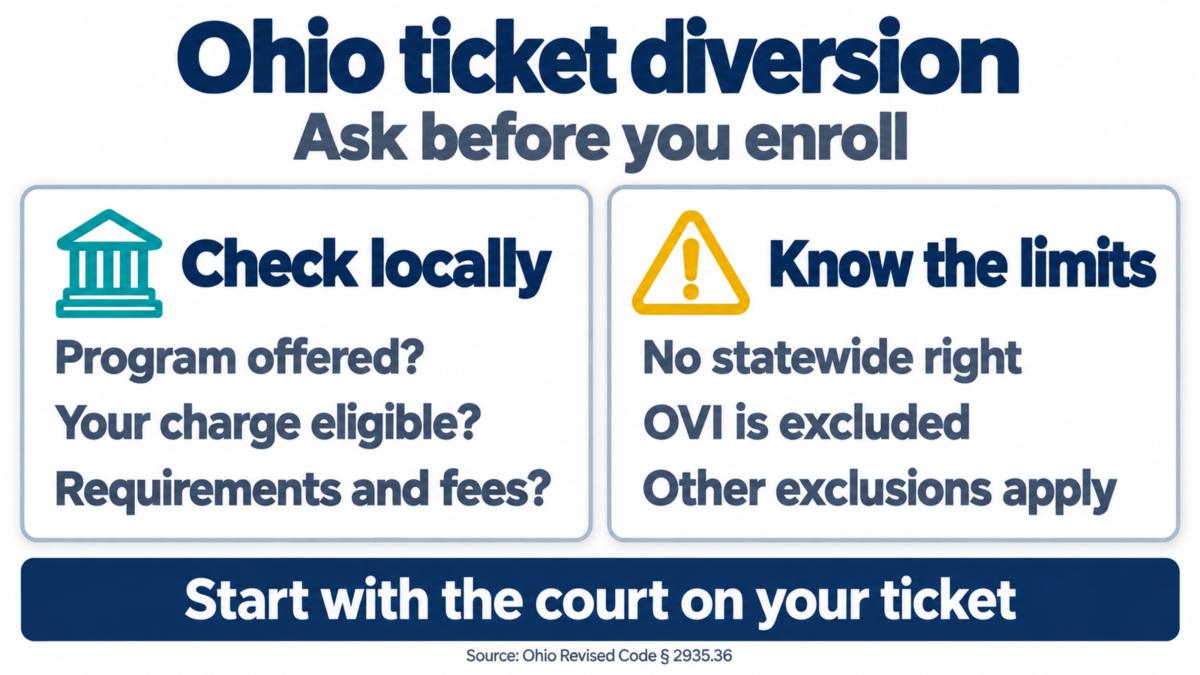
Ohio does not offer a statewide traffic school program. There is no law that says every court must let you take a course to clear your ticket. Instead, some local courts may offer a program called pre-trial diversion. But whether this program exists for your ticket depends entirely on the prosecutor in your county. Some offer it. Many do not.
This guide explains how pre-trial diversion works in Ohio, who cannot use it, what you must do to join, and what happens if you finish it or fail.
Placement: After the introduction, replacing the infographic placeholder.
No Statewide Right to Traffic School in Ohio
Ohio law does not require every court to offer traffic school. Under Ohio Revised Code § 2935.36(A), a prosecutor may set up a pre-trial diversion program for adults accused of crimes. But the choice is up to the prosecutor. It is not automatic.
Here is what this means:
- You cannot demand traffic school. The prosecutor decides whether to offer it.
- Programs vary by county. Some areas have programs for minor tickets. Others do not.
- You must ask the court. Call the court listed on your ticket and ask if a program exists for your charge.
If the prosecutor does offer a program, you may have to pay a fee. This fee helps cover costs like tracking and drug testing while you are in the program.
Who Cannot Use Pre-Trial Diversion
Even if your county offers a program, some people cannot join. Ohio Revised Code § 2935.36(A)(1)–(5) lists who is shut out.
Always Shut Out
Repeat offenders and risky offenders cannot enter the program. If you have past convictions or a pattern of breaking the law, you may be denied.
Persons charged with violent crimes or serious offenses are shut out. Diversion is only for lower-level charges.
Drug charges usually bar you. There are narrow exceptions for certain minor possession offenses under Ohio Revised Code Chapters 2925 and 3719.
OVI charges — hard bar. If you are charged with OVI under Ohio Revised Code § 4511.19, or a similar city law, you cannot use diversion. There are no exceptions. OVI charges do not qualify.
CDL holders and commercial vehicle offenses — hard bar. If you were charged while driving a work vehicle, you cannot use diversion. If you hold a commercial driver’s license and the charge could bar you from driving a work vehicle under Ohio Revised Code Chapter 4506, you are also shut out. This rule protects CDL holders from losing their license through diversion instead of facing the full penalty.
Both the OVI and CDL bars are total. If either applies, diversion is off the table.
What You Must Do to Enter the Program
If the prosecutor lets you join diversion, you must agree to three things in writing before the program starts. Under Ohio Revised Code § 2935.36(B)(1)–(3), you must:
- Give up certain rights. You must waive—only if you finish the program—the right to a speedy trial, a first hearing, the grand jury time limit, and arraignment. These may already have happened. If not, you waive them. If you finish the program, this waiver stays in place. If you complete it, the case is dismissed and the waiver never matters.
- Agree to pause time limits and follow program rules. You must agree to stop the clock on any law that sets a time limit while you are in the program. You must also agree to every rule the prosecutor sets. This may include taking classes, taking drug tests, or checking in with someone.
- Agree to pay a fee. The prosecutor may charge a fee to cover the cost of tracking you. You must agree to pay this fee.
These are required. If you will not or cannot agree, you cannot enter the program.
Victims and Police Can Object
Before the program starts, the prosecutor must tell the victim and the arresting officer that you may be allowed to join. Under Ohio Revised Code § 2935.36(C), both the victim and the officer can file written objections before the program begins.
The law does not require the prosecutor to reject you based on these objections. But it does give victims and officers a chance to be heard. What they say may affect whether you are accepted or what rules you must follow.
What Happens After You Finish or Fail
If You Finish the Program
Under Ohio Revised Code § 2935.36(D), if you finish the program, the prosecutor must ask the court to dismiss the charges. The court must then dismiss them.
The law uses the word “shall” for both steps. The prosecutor must ask for dismissal. The court must grant it. Successful completion means full dismissal—not a reduced charge, not put off, but dismissed.
If You Do Not Enter or Fail
If you choose not to join after being approved, or if you break any rule after joining, you can be brought to trial on the original charges. The waiver you signed becomes void on the date you are removed from the program.
This means the case goes forward as if diversion never happened. You get back the rights you waived, but you also face trial on the original charge without any chance of dismissal through diversion.
Court-Ordered Driving Course Is Different
You may have heard that Ohio courts can order you to take a driving course. This is true, but it does not dismiss your ticket.
Under Ohio Revised Code § 4510.02(C), a court may require you to finish a remedial driving course before you can get your full license back after a suspension. This is a post-conviction rule. It happens after you are found guilty and your license is suspended. Finishing the course lets you get full driving rights once the suspension ends. But it does not dismiss the charge or keep the conviction off your record.
Do not confuse this with pre-trial diversion under § 2935.36. The remedial course applies after conviction. Pre-trial diversion prevents conviction by dismissing the charge before trial. They are two different things that happen at different times.
How to Find Out If Your Ticket Qualifies
Because Ohio has no statewide program, you must ask the court handling your case. Here is how:
- Check your ticket. Your citation lists the court where you must show up. This is usually a city court or mayor’s court in the city where you were cited.
- Call the court clerk. Ask if the prosecutor offers pre-trial diversion for traffic offenses and whether your charge qualifies.
- Ask about what is required and what it costs. If a program exists, ask what you must do to qualify, what rules you must follow, and what fees you will pay.
- Do this early. Diversion programs often require you to ask before you enter a plea or before your first court date. Waiting too long may shut you out even if you meet all other rules.
If the court says no program exists, or your charge does not qualify, your options are to plead guilty, try to get a reduced charge, or contest the ticket at trial.
Summary: What You Need to Know
- Ohio has no statewide traffic school for ticket dismissal. Pre-trial diversion is a local option that depends on the prosecutor in your county.
- OVI charges and CDL-related offenses are always shut out. Repeat offenders, risky offenders, and persons charged with violent or serious crimes also cannot join.
- To enter, you must agree in writing to waive certain rights, follow program rules, and pay fees.
- Victims and arresting officers can file written objections before the program starts.
- If you finish the program, the prosecutor must ask for dismissal and the court must grant it.
- A court-ordered remedial driving course under § 4510.02(C) is a post-conviction rule, not a way to dismiss your ticket.
If you want to know whether diversion is available for your case, contact the court on your citation as soon as you can. The sooner you ask, the better your chances of using this option if it exists.
Common Questions
Does every Ohio court offer traffic school for ticket dismissal?
No. Ohio has no statewide program. Pre-trial diversion is a local option controlled by the prosecutor. Some counties offer it. Many do not.
Can I use traffic school if I was charged with OVI?
No. OVI charges under Ohio Revised Code § 4511.19 are shut out from pre-trial diversion. There are no exceptions.
Can I use diversion if I have a CDL?
Not if the charge could bar you from driving a work vehicle under Ohio Revised Code Chapter 4506. CDL holders charged with offenses that would bar them, and anyone charged while driving a work vehicle, are shut out.
What happens if I finish the program?
The prosecutor must ask for dismissal. The court must grant it. Your charge is dismissed.
What happens if I fail the program?
You go to trial on the original charges. The waiver you signed becomes void and the case goes forward as if diversion never happened.
Is the remedial driving course the same as traffic school for dismissal?
No. The remedial course under Ohio Revised Code § 4510.02(C) is a post-conviction rule for getting your license back after a suspension. It does not dismiss your ticket.
Related Reading
- Ohio defensive driving course overview
- Ohio 2-point BMV credit
- Ohio defensive driving insurance discount
- What to do after getting a traffic ticket
- Keep a ticket off your record
Sources
- Ohio Revised Code § 2935.36(A), chapeau and subsections (1)–(5) (prosecuting attorney may establish pre-trial diversion programs; hard bars for repeat/dangerous offenders, violent crimes, drug chapter violations, OVI, and CDL/commercial vehicle offenses). Accessed 2026-09-22 via https://codes.ohio.gov/ohio-revised-code/section-2935.36.
- Ohio Revised Code § 2935.36(B)(1)–(3) (entry conditions: waiver of speedy trial and related rights, tolling and conditions agreement, supervision fee agreement). Accessed 2026-09-22 via https://codes.ohio.gov/ohio-revised-code/section-2935.36.
- Ohio Revised Code § 2935.36(C) (victim and arresting officer notification and objection rights). Accessed 2026-09-22 via https://codes.ohio.gov/ohio-revised-code/section-2935.36.
- Ohio Revised Code § 2935.36(D) (completion → dismissal; failure → trial). Accessed 2026-09-22 via https://codes.ohio.gov/ohio-revised-code/section-2935.36.
- Ohio Revised Code § 4510.02(C) (court may require remedial driving course as condition for return of full driving privileges after suspension—post-conviction reinstatement only). Accessed 2026-09-22 via https://codes.ohio.gov/ohio-revised-code/section-4510.02.
Last updated: September 22, 2026