
How Much Is a Speeding Ticket? The Real Cost Beyond the Fine
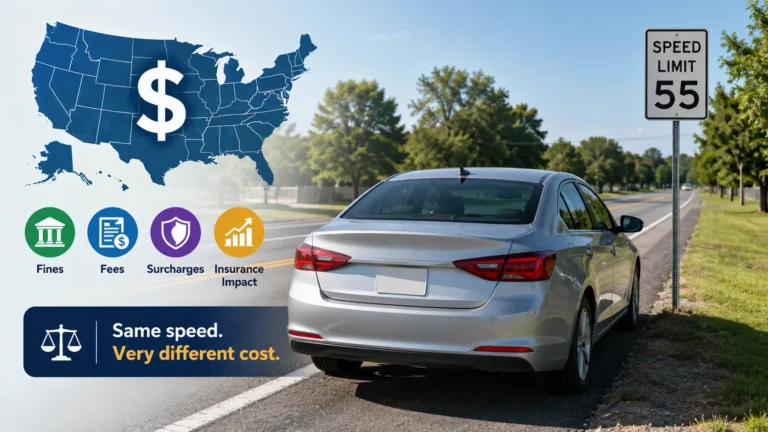
The amount on your speeding ticket is only the first number to check. Your total may also include court fees, state charges, a DMV fee, the cost of traffic school or legal help, and a change in your insurance premium.
There is no reliable nationwide “typical” total. Every state uses its own rules, and costs can also vary by court, speed, zone, and driving record. Start with the court named on your ticket. Then check your state DMV record rules and ask your insurer how a conviction could affect your price.
The amount printed on a speeding ticket may be only one part of the total cost.
Important: This article gives general information, not legal or insurance advice. Rules depend on the state, court, charge, license, vehicle, record, and policy. Follow the instructions on your ticket and confirm your options with the court before you pay or enroll in a course.
Quick Answer: What Does a Speeding Ticket Really Cost?
To find your real cost, check five things:
- Court total: Get the exact fine, fees, and state charges from the court.
- DMV effect: Check whether a conviction would add points or trigger another state fee.
- Course or court option: Ask what traffic school, dismissal, or a hearing would do in your case.
- Insurance effect: Ask your insurer how it uses speeding convictions and when it checks your record.
- Other costs: Add any course fee, legal fee, travel, or time away from work.
Do not use a national average as your answer. Use the court’s amount and your own quote.
| Cost to check | Where to verify it | Why it matters |
|---|---|---|
| Fine, fees, and state charges | Court portal or clerk | This is the amount the court expects you to pay |
| Points and state fees | State DMV | A conviction may add points or trigger a separate DMV charge |
| Traffic school or dismissal | Court instructions | The course may have its own fee and may not erase the ticket |
| Legal help | Lawyer’s written fee terms | The price and possible benefit depend on the case |
| Insurance | Your insurer and comparison quotes | A conviction can affect your price, but there is no national rate increase |
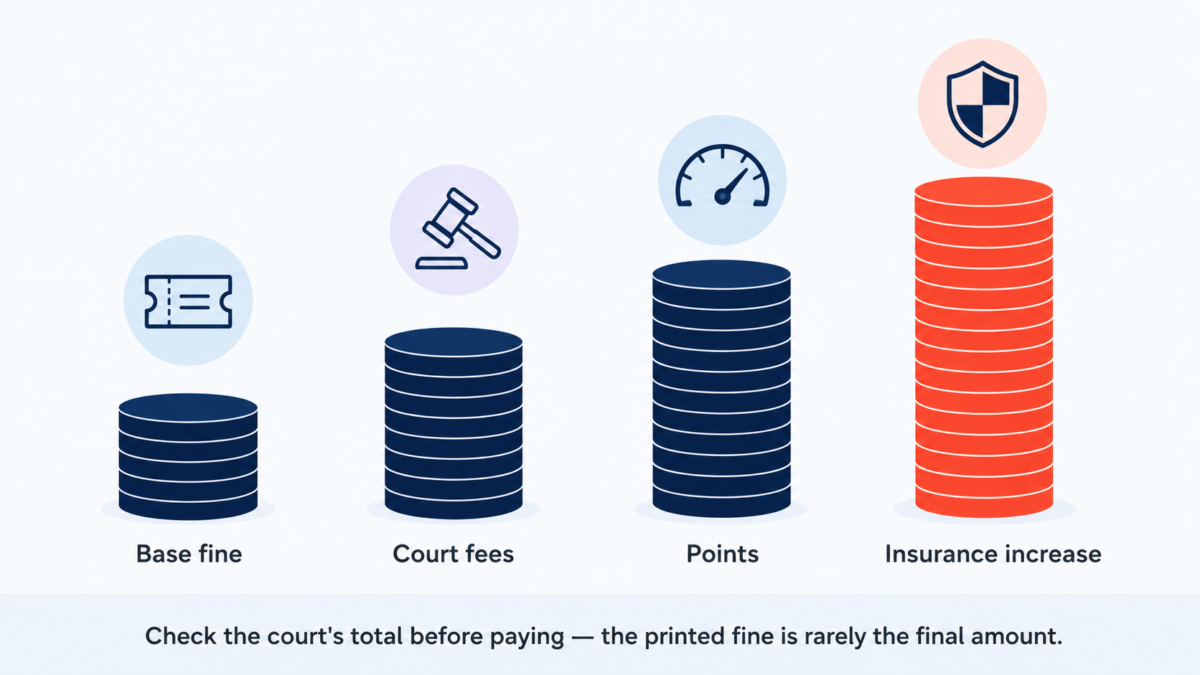
Build your total from costs you can verify instead of relying on a national estimate.
Why the Fine May Not Be the Full Cost
Your ticket may show a fine or payment amount. That number does not always include every charge or later effect.
Check these four layers:
- The court fine
- Court fees, state charges, or local assessments
- DMV points or a separate state fee
- Any change in your insurance premium after a conviction
The court can confirm the first two. Your DMV can explain the record and point rules. Only your insurer can tell you how it would price your policy.
1. Start With the Court Fine
The court fine is the starting charge for the speeding offense. The exact amount may depend on:
- How far over the limit the charge says you drove
- The law or code section on the ticket
- Whether the stop happened in a school zone, work zone, or another special area
- Whether the charge requires a court appearance
- Whether the charge is ordinary speeding or a more serious offense
Do not guess from a chart for another state or county. Enter the ticket number in the court’s official portal, or call the clerk listed on the ticket.
| Detail on the ticket | What to check |
|---|---|
| Speed and posted limit | Which speed band the court uses |
| Code section | Whether the charge is ordinary speeding or something more serious |
| Location | Whether a special-zone rule applies |
| Court and due date | Where to respond and when |
| Appearance notice | Whether you can pay online or must appear |
2. Add Court Fees and State Charges
A court may add charges to the listed fine. The names vary, but they can include a court fee, state assessment, local charge, or payment fee.
California shows why you must check the final court total. Santa Clara County’s 2026 traffic bail page says its schedule does not show the full amount for many offenses because state assessments and fees can raise the final sum. It also says a judge may set bail that differs from the schedule (Santa Clara County Superior Court — Traffic Bail Schedule).
The lesson is simple: a schedule is a starting point, not a personal quote. Use the court portal or ask the clerk for an itemized total.
New York has a separate DMV charge that can come later. If you receive six or more points within 18 months, you must pay a Driver Responsibility Assessment for three years. That charge is in addition to the court’s fines and surcharges (New York DMV — Driver Responsibility Assessment).
3. Check Points and Other DMV Effects
Points do not have a fixed dollar value, but they can still raise the cost of a ticket. They may move you closer to a license action or trigger a state fee.
New York gives a clear example:
| Speed over the posted limit | New York points |
|---|---|
| 1–10 mph | 3 |
| 11–20 mph | 4 |
| 21–30 mph | 6 |
| 31–40 mph | 8 |
| More than 40 mph | 11 |
New York may suspend your license if you get 11 points in 24 months. Six or more points within 18 months also trigger the Driver Responsibility Assessment (New York DMV — Driver Point System).
Other states use different point values and time periods. Some do not use a simple point total at all. Check your own DMV before treating New York’s table as a national rule.
For a broader explanation, see how to avoid points on your license.
4. Check the Insurance Cost
A speeding conviction can affect your insurance price, but there is no reliable national percentage that applies to every driver.
Insurers use different rules. Your result can depend on your state, company, age, record, vehicle, coverage, and the violation itself. The insurance regulators' association says your driving record is one of the main things that sets your price, and that you should give every company the same details when you shop (NAIC — Consumer Auto Insurance).
Ask your insurer these questions:
- Will this conviction affect my premium?
- When do you check my motor vehicle record?
- How far back do you review violations?
- Would a court-approved course change how you price this ticket?
- Which discounts could I lose?
Then get comparison quotes with the same drivers, limits, deductibles, and coverage. A lower quote is useful only if it protects you in the same way.

The court case and the insurance review run on different timelines.
Use a Personal Cost Worksheet
Build your estimate from numbers you can confirm:
Your total is the sum of five parts:
- the court fine and fees
- any state or DMV charge
- the course fee or legal fee
- travel or missed work
- the insurance change, across the renewals your insurer names
| Item | Your verified amount |
|---|---|
| Court fine and fees | $_____ |
| State or DMV charge | $_____ |
| Traffic school fee | $_____ |
| Legal help | $_____ |
| Travel or missed work | $_____ |
| Insurance change | $_____ |
| Estimated total | $_____ |
Keep one-time costs separate from yearly costs. If your insurer gives you an annual change, multiply it only by the number of renewals the insurer says it will apply.
State Examples: Why the Cost Varies
A national article cannot give one exact price for every speeding ticket. These official examples show why.
| State | Rule to check | Cost lesson |
|---|---|---|
| California | The local schedule may not show all state assessments and fees | Confirm the final amount with the court |
| New York | A 21–30 mph-over conviction adds 6 points | Six points within 18 months trigger a separate DMV assessment |
| Virginia | Driving 20 mph or more over the limit, or faster than 85 mph, is reckless driving | The charge may be more serious than an ordinary speeding ticket |
| Your state | Court amount, DMV rule, and insurance price | These are three separate checks |
Virginia’s two reckless-driving thresholds are independent. Driving faster than 85 mph can qualify even when you are not 20 mph over the limit (Va. Code § 46.2-862).
For more state examples, see speeding ticket cost by state.
How Speed Can Change the Cost
Higher speed can change more than the fine.
The court may use a higher fine band
If the court’s schedule uses speed bands, a higher charged speed can move the case into a higher band. Check the schedule for the court on your ticket.
Your state may add more points
If your state assigns more points at higher speeds, the charged speed can move you closer to a license action or another state fee. New York’s point table is one example, not a national rule.
The charge may become more serious
If a state treats high speed as reckless driving or another offense, the case may carry rules that do not apply to an ordinary speeding ticket. Virginia is one example.
Your options may narrow
Some courts limit course or dismissal options by charge, speed, license type, vehicle, or past course use. Ask the court about your exact code section before you enroll.
School Zones, Work Zones, and Other Special Areas
A special-zone rule can change the fine or the court process. The sign, location, time, and presence of workers or children may matter under state law.
If the ticket names a school zone, work zone, safety corridor, or similar area:
- Read the code section on the ticket.
- Check the official rule for that state.
- Confirm the amount and appearance requirement with the court.
Do not assume a rule from another state applies to your case.
Pay, Take a Course, or Go to Court?
The lowest payment today is not always the lowest total cost. Compare each option with the same facts.
| Option | Cost to verify | Main question |
|---|---|---|
| Pay the ticket | Court total and possible insurance change | What does payment enter on my record, and does it end my right to a hearing? |
| Take an approved course | Court fee, course fee, and exact court result | Will the court dismiss the charge, hold off on a guilty finding, keep it off the record insurers can see, or only change points? |
| Contest the ticket yourself | Filing cost, travel, and time | What evidence and deadline apply? |
| Hire a lawyer | Written legal fee and possible court costs | Is the fee reasonable compared with the record, license, job, and insurance risk? |
| Ignore the ticket | Possible added court or license consequences | What will the court do if I miss the deadline? |
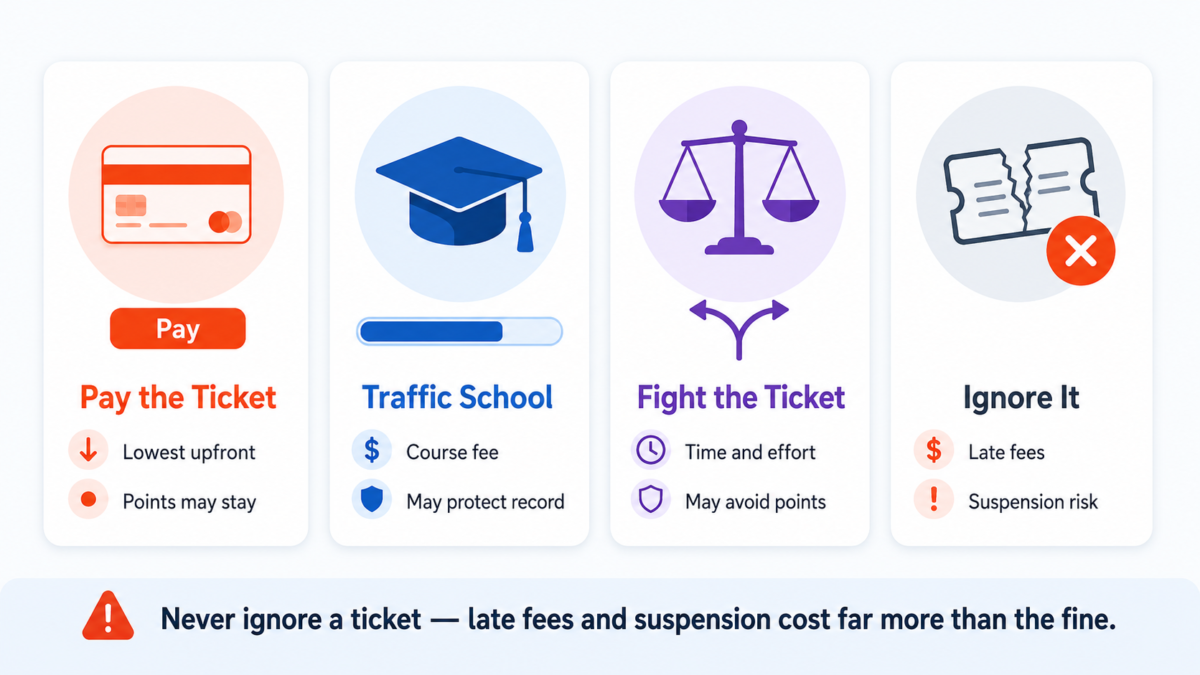
Compare the full cost and record result of each option before you choose.
How to Limit the Total Cost
1. Read the ticket before you pay
Do not assume payment is always the first step. In some places, payment ends your chance to contest the charge. In others, an approved course choice may require payment. Follow the court’s instructions for your ticket.
Use what to do after getting a traffic ticket as a starting checklist.
2. Ask what traffic school would change
Traffic school does not have one nationwide result. It may lead to dismissal, keep a guilty finding off your record, change the points used by the state, or provide only an insurance discount.
Ask the court to name the result in writing. Then review how to get a speeding ticket dismissed and paying a ticket versus traffic school.
3. Request an itemized court total
If the total is higher than you expected, ask for the fine, fee, and state-charge breakdown. This will not remove a required charge, but it shows what you are paying.
4. Ask about a payment plan before the deadline
Some courts offer payment plans. New York, for example, permits monthly installment plans for fines, fees, and surcharges in covered vehicle-and-traffic cases. The judge sets the monthly amount. The rule provides for a $25 minimum or an amount of up to 2% of your net monthly income (New York Courts — Payment Plans for Vehicle and Traffic Offenses).
If your ticket says “Traffic Violations Bureau,” it follows New York DMV’s separate process, including separate payment-plan procedures (New York DMV — Plead or Pay TVB Tickets). Ask the office named on your ticket which process applies.
A payment plan changes when you pay. It does not remove the conviction, points, or insurance effect.
5. Compare insurance quotes fairly
If the ticket becomes a conviction, compare quotes near renewal. Use the same drivers, vehicles, limits, deductibles, and optional coverage for every quote.
6. Protect your record from another ticket
Another conviction can add state and insurance consequences. Follow the speed limit, use cruise control when conditions allow, and watch for speed changes near towns and work zones.
When to Consider Legal Advice
Consider talking with a local traffic lawyer if:
- The ticket names reckless driving or a misdemeanor
- The ticket requires a court appearance
- You hold a commercial driver’s license
- You drive for work
- You already face a license suspension
- The ticket came from another state
- The charge involves a crash, school zone, or work zone
- You believe the ticket is wrong and need help presenting evidence
A lawyer cannot promise an outcome. Ask for the fee terms and likely process in writing before you hire anyone.
Frequently Asked Questions
How much is a speeding ticket for a first offense?
There is no reliable nationwide first-offense price. Get the court total for your ticket, then add any state fee, course or legal cost, missed work, and insurance change.
Why can the final amount be higher than the listed fine?
The listed amount may not include every court fee or state charge. Santa Clara County, California, warns that state assessments and fees can raise the final sum above its traffic bail schedule.
Does a speeding ticket always raise insurance?
No. The result depends on the court outcome, state rules, insurer, policy, and record. Ask your insurer how it would treat the exact conviction instead of using a national average.
How long can a speeding ticket affect insurance?
There is no single national period. Ask your insurer how far back it reviews your motor vehicle record and how many renewals it would use the conviction.
If I take traffic school, do I still pay the fine?
It depends on the court’s program. You may owe the fine, a court fee, a course fee, or a mix of those costs. Confirm every amount and deadline before you enroll.
Is it cheaper to pay the ticket or contest it?
Compare the court payment with the cost of a course, hearing, legal help, travel, missed work, points, and insurance. The better choice depends on the facts and the court options available to you.
Can I get a payment plan?
Some courts offer one. Contact the office named on your ticket before the deadline and ask about the plan, minimum payment, required forms, and any added fee. In New York, local-court tickets and TVB tickets follow different processes, so ask the office that has your case.
Where can I find the exact amount due?
Use the official portal for the court named on your ticket, or call that court’s clerk. A search result, private ticket calculator, or another county’s schedule may not match your case.
What should I check before paying?
Check the court total, deadline, appearance rule, points, state fees, course options, and possible insurance effect. If the charge is serious or could affect your job, consider local legal advice.
The Bottom Line
The real cost of a speeding ticket is the total of several separate numbers. The court controls the fine and fees. The DMV controls points and state charges. Your insurer controls the policy price.
Before you pay, confirm each number that applies to you. That gives you a useful answer without relying on a national estimate that may not fit your case.
Related Reading
- Car Insurance Increase After a Ticket: How to Avoid or Reduce It
- Should I Fight a Speeding Ticket? 5 Signs It’s Worth It
- How to Keep a Ticket Off Your Driving Record
- Traffic School Insurance Discount: Can It Lower Your Rate?
- How to Lower Car Insurance Rates
Sources
Sources reviewed August 21, 2026.
- Superior Court of California, County of Santa Clara — 2026 Traffic Bail Schedule
- New York DMV — The New York State Driver Point System
- New York DMV — Driver Responsibility Assessment
- New York Courts — Payment Plans for Vehicle and Traffic Offenses
- New York DMV — Plead or Pay TVB Tickets
- Code of Virginia § 46.2-862 — Exceeding Speed Limit
- National Association of Insurance Commissioners — Consumer Auto Insurance