


Hawaii Defensive Driving Course: Which Course Will Count?

A Hawaii defensive driving course may satisfy a court requirement or qualify for an insurer’s discount, but the course has to fit your case or policy. Enrolling on your own does not give you a statewide right to ticket dismissal or a premium reduction.212
Start with the result you need. A court referral, a possible insurance discount, and a voluntary safety refresher lead to different enrollment decisions. The same course name can appear in advertising for all three.
General information only: This guide explains Hawaii’s published procedures and course-selection questions. It is not legal advice. Follow your citation, court order, and any instructions issued for your case.
Choose the route before choosing the school
Use this table to identify whom to contact. The questions in the final column are practical enrollment checks, not promises that a benefit is available.
| Your goal | Start here | What to confirm |
|---|---|---|
| Deal with an ordinary civil traffic infraction | The District Court or Traffic Violations Bureau named on the citation | Your response option and deadline; whether a course has any role in your case.1 |
| Complete court-directed education or retraining | The referring court and assigned program | Exact class, delivery format, deadline, fees, and completion reporting.45 |
| Seek an insurance discount | Your insurer or agent | Whether your policy offers a discount for the exact course and what proof it requires.10 |
| Refresh driving skills voluntarily | A provider offering the instruction you want | Curriculum, schedule, delivery, total price, and refund terms; keep any legal or insurance benefit separate. |
If your paperwork gives a program name, use that name when you make inquiries. Asking for “traffic school” alone can send you toward a course that teaches useful skills without meeting the requirement you were assigned.
A ticket needs a court response, even if you plan to take a class
For a traffic infraction, Hawaii Revised Statutes Section 291D-6(a) requires an answer within 21 days of the notice’s issue date. For notices that do not require an in-person appearance, the statute provides three choices: admit and pay, deny and request a hearing or submit a written statement, or admit and explain mitigating circumstances through a hearing or written explanation.1
A course registration is not one of those answers. Put the response deadline on your calendar before researching schools. If you are unsure which choice fits your situation, get help with that decision while there is still time to respond.
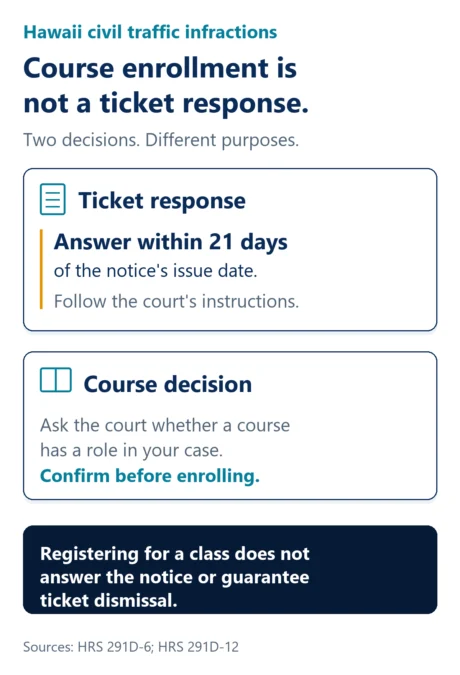
The Judiciary says that penalties for moving and equipment infractions can include attendance at a driving school. It also warns that an unanswered citation can lead to a default judgment. That makes driving school a possible part of the court process, rather than an automatic substitute for answering the ticket.3
Can traffic school dismiss a Hawaii ticket?
A judge hearing an infraction case has statutory authority to dismiss a notice or set aside a judgment for the State. That authority belongs to the court; Section 291D-12 does not give a driver an automatic dismissal for buying or completing a defensive driving course.2
Ask the court whether a course is available or required in your case, and what completing it would accomplish. The distinction matters: satisfying a class requirement and obtaining dismissal are different results. If the court permits a course, ask how its decision will be documented so you know what outcome to verify afterward.
This civil-infraction response process should not be used as a substitute for a required criminal court appearance. The Judiciary directs defendants charged with traffic crimes to appear at the date, time, and location specified in their case paperwork.3
If a judge ordered retraining, follow the assigned program
Hawaii has a specific retraining provision for repeated violations. Under HRS Section 286-128(d), a judge may direct a driving-record review when violations within a 12-month period show disregard for traffic laws and others’ safety. At that review, the judge may order instruction with a designated instructor or school. This is not an elective point-reduction offer.4
When the judge makes that determination and order while the licensee is absent, the clerk must send the specified certified notice. The statute requires an in-person review within 15 days after receipt. Failure to attend the required review or ordered retraining is subject to a fine of up to $100, a license suspension of up to one year, or both.4
The Judiciary’s Division of Driver Education administers traffic-safety education and training for adult and juvenile traffic offenders, with services across the islands. Its published program description is a better starting point for a court referral than a generic online sales page.5
Keep your court order handy when you contact the program. Ask:
- What is the exact course or program I need?
- Must I enroll through the Judiciary, or may I use another provider?
- Is online delivery acceptable for this assignment?
- What are the enrollment and completion deadlines?
- What will I pay, and whom should I contact if scheduling or payment is a problem?
- Who reports completion, and how do I confirm it reached my case?
Keep the answers with your order. If you need a different schedule or format, ask the referring office for instructions before buying a substitute course.
Specialized education may involve more than defensive driving
The Judiciary’s revised December 2025 report describes separate instruction for child-passenger restraints, defensive driving, and operating a vehicle under the influence of an intoxicant (OVUII). It also describes substance-abuse assessments and reports of compliance to courts and related offices.6
An OVUII requirement or a child-restraint assignment therefore needs its own program instructions. A generic defensive driving certificate is not evidence that every part of a specialized assignment is complete. Ask the assigned office to identify any assessment, counseling, class, or reporting requirement that still applies to you.
Point-reduction advertising does not describe Hawaii’s current system
Hawaii’s 2026 House Resolution 88, HD1 describes the State as relying on traffic abstracts to track moving violations and determine continuing license eligibility. It urges the Department of Transportation to consider a demerit-points system. The resolution does not itself establish one or create a course credit.7
The official materials reviewed for this guide do not identify a statewide elective defensive driving point-reduction program. Ask for the specific Hawaii authority behind any promise to “remove points.” A point benefit from another state is not proof that a Hawaii course changes your record.
HRS Section 287-3(a) provides for certified abstracts of alleged moving violations, resulting convictions, and specified administrative revocations. Subsection (b) excludes the Chapter 291A matters it describes. Course completion is not a general record-erasure mechanism in that provision.8
The Judiciary explains that traffic abstracts are commonly used for insurance and employment. If the result you need concerns record visibility, ask what the court actually ordered and which record will show it.9
Insurance savings need confirmation from your insurer
Hawaii’s Insurance Division advises drivers to ask about discounts for completing a defensive driving course. Its FAQ also identifies traffic tickets and accidents as factors in insurance pricing. A possible course discount and the treatment of a ticket are separate questions for your insurer.10
There is a Hawaii-specific reason to be careful with “55+ discount” advertising. HRS Section 431:10C-207 prohibits insurers from basing a standard or rating plan on age, among other listed characteristics.11
In its October 6, 2006 Memorandum 2006-03A, the Insurance Commissioner says insurers may consider discounts for driver-safety graduates when the discounts comply with that statute. The memo uses AARP’s change to an all-ages program to explain why course-based discounts could comply. It permits compliant discounts; it does not require every insurer to give one.12
Ask your insurer for the terms of the discount it would apply to your policy:
- The exact provider and course title it accepts.
- Whether the online, virtual, or classroom version qualifies.
- Whether your reason for attending affects eligibility.
- The dollar savings, covered vehicles or coverages, and effective date.
- How long the discount lasts and what renewal requires.
- How to submit proof and see the change on your policy.
Get that answer before paying. For a course taken mainly to save money, compare the confirmed dollar savings over the stated discount period with the full course cost. If the insurer cannot confirm a benefit, decide whether you still want the instruction for its own sake.
Where to look for a course that fits
For a court assignment, start with the referring office. For insurance, start with the insurer’s accepted-course information. For voluntary learning, look at the curriculum and how you prefer to study.
Hawaii DOT also publishes lists of driver-education schools and instructors, including virtual instruction. These lists come from HDOT’s teen driver-education program; they are not a defensive driving or court-course roster. The page states that inclusion on its school list is not a DOT endorsement. A driver-education listing alone does not establish that a particular course will satisfy your court order or policy’s discount terms.13
Compare the exact product, not just the provider’s name
Once you have an acceptable course, compare: the total fee, class dates, required equipment, exam or retake terms, certificate delivery, support, and refunds. These are questions to put to the provider; this guide does not rank schools or quote unverified prices.
Write down the course title and format. A provider may offer several products, so make sure its answers apply to the one you plan to take. If your court or insurer approved a particular version, send that exact description when you enroll.
After completion, check the result you needed
Keep your certificate, receipt, approval correspondence, and any submission confirmation together.
For a Judiciary assignment, ask the program and referring office whether completion has been recorded and whether anything remains outstanding. The Judiciary’s report describes program status reporting, including classes, assessments, and other obligations; that makes the full assignment worth checking.6
For insurance, submit the requested proof and check the policy documents or next bill for the agreed change. If the discount is missing, contact the insurer with its earlier eligibility answer and your certificate. Ask it to explain the effective date rather than assuming the course provider can apply the discount.
If you need to inspect your traffic history, the Judiciary offers certified abstracts through District Courts. Its instructions list a $20 abstract fee and describe the information needed to identify the correct record. Ask the clerk which record will answer your question before ordering one.9
Your next step: Find the court order or ask your insurer about the exact course you are considering. Save the acceptance answer, then enroll and keep proof until the intended result is confirmed.
Related Reading
- Traffic School by State: Ticket, Point and Insurance Rules
- Defensive Driving Course: How It Works, Benefits, and Limits
Sources
- Hawaii Revised Statutes Section 291D-6 – Answer required, subsections (a)-(c).
- Hawaii Revised Statutes Section 291D-12 – District court judge’s powers, subsection (a).
- Hawaii Judiciary – Moving or Equipment Violations, infraction penalties, response process, and traffic-crime appearances.
- Hawaii Revised Statutes Section 286-128 – Evaluation of nonresident driving privileges; reports of outside convictions; reports of convictions by courts-martial or United States commissioners, subsection (d) (driving-record review and retraining).
- Hawaii Judiciary – District Court Programs, Division of Driver Education.
- Hawaii Judiciary – Revised Report on FY 2025 Non-General Funds, December 2025, printed pages 19-21.
- Hawaii House Resolution 88, HD1 (2026), description of the current abstract system and request to consider demerit points.
- Hawaii Revised Statutes Section 287-3 – Furnishing operating records, subsections (a)-(b).
- Hawaii Judiciary – Traffic Abstracts & Traffic Court Reports, abstract contents, uses, and ordering instructions.
- Hawaii Insurance Division – Auto Insurance FAQs, pricing factors and ways to lower premiums.
- Hawaii Revised Statutes Section 431:10C-207 – Discriminatory practices prohibited.
- Hawaii Insurance Commissioner – Memorandum 2006-03A, October 6, 2006, Graduates of Driver Safety Programs and Premium Discounts.
- Hawaii DOT – Driver Education, school and instructor lists and nonendorsement notice.
Last updated: October 9, 2026