


Iowa Defensive Driving Course: Eligibility, Benefits, and Approved Options

An Iowa defensive driving course may help you avoid an eligible license suspension or qualify for an insurer’s course incentive. The right course depends on who needs to accept it. Iowa DOT Driver Improvement, a teen-driver course, and an insurance class can lead to different results. 1 2
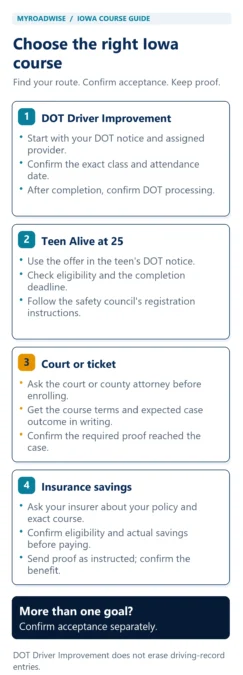
If you have a notice from the Iowa Department of Transportation (DOT), start there. Buying a general online course first can leave you with a certificate that does not meet the requirement in your case.
This guide helps you identify the correct program, check eligibility and scheduling, and follow through after completion.
General information only: This guide explains Iowa programs and practical next steps. Your DOT notice, court instructions, and insurance policy may require individual advice.
Start with the result you need
Quick answer: Iowa’s eight-hour Driver Improvement Program (DIP) is a licensing option for eligible drivers referred by DOT. Completion does not clear violations or accidents from your record. 2 Eligible teens may receive a separate Alive at 25 offer. For insurance savings, ask your insurer which course it accepts before enrolling. 1 7
| Your situation | Where to start | What to establish before paying |
|---|---|---|
| DOT has referred you to Driver Improvement | Your notice and assigned provider | The exact class, attendance date, and any approved schedule change |
| A teen received an intermediate-license suspension notice | The Alive at 25 instructions in the notice | Eligibility for that offer and its completion deadline |
| You want a traffic ticket dismissed or changed | The county attorney or court handling the case | Whether any course arrangement is available and its written terms |
| You want an insurance incentive | Your insurer or agent | Your policy’s eligibility, accepted course, and actual savings |
| An employer requires training | The employer’s written instructions | The accepted curriculum, format, and proof of completion |
These are questions to resolve, not interchangeable approvals. A course appearing on a DOT page does not establish that a prosecutor, employer, or insurer accepts it for your particular purpose.
DOT Driver Improvement: an alternative to an eligible suspension
Iowa’s current Driver Improvement rule is 761-615.27. It allows DOT to require an approved program, at the driver’s expense, in lieu of suspension for a habitual violator, a conviction for speeding 25-29 mph over the limit, a driver subject to suspension under Section 321.210C, or a first unlawful school-bus-passing conviction covered by the rule. This option is unavailable more than once within a two-year period. 3
A habitual violator generally has convictions for at least three countable moving violations committed within 12 months. The offense dates determine the period; convictions establish the violations. Out-of-state moving violations can count too. 4 2
Eligibility is therefore more specific than having a speeding ticket. A driver with a different speed, prior DIP use, or another sanction should ask DOT about the case rather than assume the class will substitute for suspension.
Keep these documents together: the DOT notice, any provider scheduling letter, your driver or customer number, and the paperwork for the underlying violation. When calling, describe the notice you received instead of asking only for “defensive driving.” That makes it easier to establish which process you are in.
Countable violations have exceptions
For suspension determinations, Section 321.210 excludes certain violations, including qualifying low-level speeding. As amended effective July 1, 2026, the speeding exception covers the first two violations within 12 months that are 10 mph or less over the limit in a speed zone with a legal limit between 34 and 61 mph. For ordinary posted limits, that includes 35 through 60 mph. 5 6
The exception has both a speed-over-limit condition and a speed-zone condition. It is not a blanket allowance for two speeding tickets. A 10-over ticket in a 70-mph zone does not meet that zone condition.
If your DOT letter seems inconsistent with an exception, ask DOT to review the actual offenses and dates. Do not decide on your own that the letter is invalid or skip the assigned class while you wait for an answer.
Scheduling: use the referral process
Under Rule 615.27, DOT sends contact information to the approved provider nearest your last known address, and the provider schedules the next available opening. The provider may grant one rescheduling request if the replacement program begins within 30 days of the originally scheduled date and space is available. An out-of-state program may be permitted if DOT approves its curriculum. 3
That 30-day rule describes a permitted rescheduling window. It is not a universal deadline measured from your ticket date, conviction date, or the day a notice arrives.
If work, travel, illness, or transportation makes attendance difficult, contact the assigned provider promptly. Ask for the approved replacement date in writing. If you need a different provider or an out-of-state course, ask who must approve the change before registering elsewhere.
Simply purchasing another class is not a useful substitute for resolving the assignment. Keep the original date on your calendar until you have confirmation of the change.
Missing the program can bring back the suspension
The rule requires suspension when a referred driver fails to attend or successfully complete the program. The period is the length of the underlying suspension. Successful completion is followed immediately by one year of probation; a moving violation committed during that period can lead to the underlying suspension. 3
Treat the attendance requirement as a licensing obligation. Ask the provider about identification, arrival time, late entry, breaks, and what counts as successful completion. Those practical details can matter more than the name printed on the course advertisement.
After class, ask DOT to explain your probation terms and confirm the relevant dates. Do not assume a restriction or exception from another licensing process applies to your DIP case.
Approved options: start with the official program directory
The Iowa DOT Driver Improvement page lists community-college providers. Examples include Des Moines Area Community College, Eastern Iowa Community College, Hawkeye Community College, Kirkwood Community College, and Western Iowa Tech Community College. 1
Use that directory to locate program contacts. For a DOT referral, resolve attendance with the assigned provider rather than choose a different college solely because its location looks convenient.
The table below shows two different program examples. It is not a ranking or a finding that either course is accepted for every purpose.
| Program example | Published format and course details | How to use the information |
|---|---|---|
| DMACC Driver Improvement Program | In-person at Southridge Center. Listed eight-hour sections cost $200; the schedule includes single-day and two-evening offerings. | Confirm the assigned section, current charge, and cancellation terms with DMACC. |
| Iowa-Illinois Safety Council Alive at 25 | The provider lists virtual Zoom classes. It requires a computer or tablet, not a cell phone, and closes registration one week before class unless it fills earlier. | Use the teen’s DOT notice to establish eligibility, then follow the council’s registration and technology instructions. |
DMACC details come from its Driver Improvement information and course schedule. Alive at 25 details come from the Iowa-Illinois Safety Council. 8 9 10
The $200 example is a DMACC listed price, not a statewide fee. Check the total before paying, including any rescheduling charge and travel expense. Compare complete sections: a class spread across two evenings still requires attendance at both sessions.
Can you take the course online?
Resolve format within the exact program you need. DMACC publishes in-person DIP offerings, while the safety council publishes Zoom delivery for Alive at 25. One program’s virtual availability does not establish approval for another. 8 10
For an assigned DIP course, ask the provider and DOT whether a proposed online alternative satisfies your referral. For insurance, ask the insurer whether the exact online product qualifies. Save the answer before purchase.
Look closely at the course title, not just the provider name. A college can offer several mandated courses, and a national provider can sell different products for different states or purposes. Send a link to the exact class when requesting acceptance.
Teen drivers: check the Alive at 25 offer
DOT says teens who receive a second violation on an intermediate license receive a suspension notice with information about the four-hour Alive at 25 course offered through the Iowa-Illinois Safety Council. DOT describes this as a one-time opportunity to complete the program instead of serving suspension. The course is optional; a driver can proceed with the suspension. 1 7
For a parent or guardian, the first task is to read the notice with the teen and identify the deadline. Do not apply the adult DIP rescheduling rule to this offer.
The council reports course registration and completion to DOT. Its instructions also direct students with no available class before their deadline to contact DOT about an extension. Request one promptly; do not treat the request as approval. 10
For a virtual class, help the student test the device and check the registration email. Make sure there is a quiet place to participate for the full session. If the confirmation or class link is missing, use the council’s help instructions while there is still time to resolve it.
A course does not automatically dismiss a ticket
The DOT licensing program operates after qualifying convictions. It does not clear the resulting record entry. If your goal is to avoid or change a conviction, resolve that court question before buying a course. 2
The Iowa Judicial Branch’s traffic FAQ explains that you may plead guilty by paying the fine shown on your ticket before the court date. 11 A course purchase does not establish a different disposition.
Ask the office handling your case:
- Is there a course arrangement available for this charge and this defendant?
- Who must approve it, and must that approval come before enrollment?
- Which exact course and delivery format will count?
- What payments, completion deadline, and proof are required?
- What will happen to the charge if all conditions are satisfied?
Get the answer in terms of the case outcome. “The class is accepted” does not tell you whether the charge will be dismissed, amended, or remain a conviction. If the outcome or plea choice is unclear, consult an Iowa attorney before acting.
This guide does not establish a general statewide right to elect traffic school for dismissal. Any offered arrangement needs its own case-specific terms.
Insurance: confirm a benefit before buying a class
Iowa DOT says some insurers may offer incentives for completing DIP. GEICO’s Iowa page says an approved defensive driving or driver’s education course may qualify for a discount. Its discount guidance adds that eligibility, course requirements, and amounts vary by state and policy, and not all courses qualify. 1 12 13
Those statements do not establish a fixed Iowa discount percentage, a universal age threshold, or a promise that a ticket-related increase will disappear.
Ask your insurer to identify the eligible driver, exact course, accepted format, discount amount, start date, duration, and certificate submission method. If you already have a DOT assignment, ask whether that specific DIP course qualifies too. You may be able to use one completion for two purposes, but establish both forms of acceptance first.
Compare the savings with the cost
Use the insurer’s estimated dollar savings rather than a headline percentage. Ask whether the estimate applies to the whole policy or only particular coverages and whether it reflects your current driving record.
For example, if an insurer confirms $40 in annual savings for three years, that is $120 in total savings before considering future policy changes. A voluntary $200 class would cost more than that estimate. These figures are hypothetical, not an Iowa discount or a prediction for your policy.
An assigned licensing course serves a different purpose. Its value is not limited to whether the insurer offers a discount. Keep the licensing requirement and the optional insurance calculation separate when deciding what to do.
Minor-speeding protection does not require a course
Iowa also limits certain insurance uses of minor speeding violations. Under Section 516B.3 as amended by 2026 Iowa Acts chapter 1132, insurers may not use the first two qualifying violations in any 12-month period to establish rates or cancel or refuse renewal. For violations on or after July 1, 2026, the conditions include speeding 10 mph or less over the limit in a zone with a limit between 34 and 61 mph. 5
This protection is independent of course completion. If your situation appears to meet it, ask your insurer how the violation was classified and whether it affected the rate. The law preserves different date-based conditions for earlier offenses, so provide the actual violation date and speed-zone information.
After completion, verify the result you expected
Keep proof of completion with the paperwork that led you to the course. Then follow up with the organization that needs it.
For DMACC DIP, the college says DOT will be notified within 48 business hours of completion. That is DMACC’s reporting statement, not a statewide deadline for every provider or a guarantee of immediate DOT processing. 8
For another provider, ask when and how it reports. If a notice still shows a missing requirement, contact the provider about transmission and DOT about the licensing record. Explain when you finished and have your proof ready.
For a court requirement, confirm that the case has received the required proof and that you satisfied any remaining conditions. For insurance, send the certificate as instructed and ask for confirmation of the applied benefit. For an employer, retain the acknowledgement that its training requirement was met.
Finishing the class and getting the expected result are separate tasks. Keep your certificate until the responsible office confirms what was processed.
Your next step: Find the notice, policy, or written requirement behind your course search. Confirm the exact accepted class and expected outcome before paying. Afterward, verify that the organization requiring it received and accepted your completion.
Related Reading
- Traffic school rules in other states
- License points and record entries
- Checking a course insurance discount
Sources
- Iowa DOT — Driver Improvement Program.
- Iowa DOT — Suspension for Habitual Violators & Serious Violation.
- Iowa Administrative Code, chapter 761-615, Rule 615.27(1)-(4).
- Iowa Administrative Code, Rule 761-615.6, with chapter 615 definitions and Iowa Code Section 321.210.
- 2026 Iowa Acts chapter 1132, Sections 1, 2, 4, and 5, amending Iowa Code Sections 321.210(2)(d), 321.210C(3), 321A.3(4), and 516B.3(1).
- Iowa Legislature — Senate File 378 bill history.
- Iowa DOT — Can Iowa Repeat Low Traffic Fatalities in 2026?, Alive at 25 discussion.
- DMACC — Court and State Mandated Courses, Driver Improvement Program section.
- DMACC — Driver Improvement course schedule.
- Iowa-Illinois Safety Council — Alive at 25.
- Iowa Judicial Branch — Traffic Citations FAQ.
- GEICO — Iowa Car Insurance, course-discount statement.
- GEICO — Defensive Driver Discount.
Last updated: October 6, 2026