
Defensive Driving Course: How It Works, Benefits, and Limits
A defensive driving course teaches you how to anticipate road hazards before they become crashes. Instead of assuming every other driver will behave correctly, defensive driving trains you to create more time, space, and options around your vehicle.
For many drivers, the course also has a practical reason: it may qualify for an insurance discount, point reduction, or traffic ticket dismissal. The exact benefit depends on your state, your insurer, your violation, and whether the course is approved for your specific purpose.
Quick Answer: What Is a Defensive Driving Course?
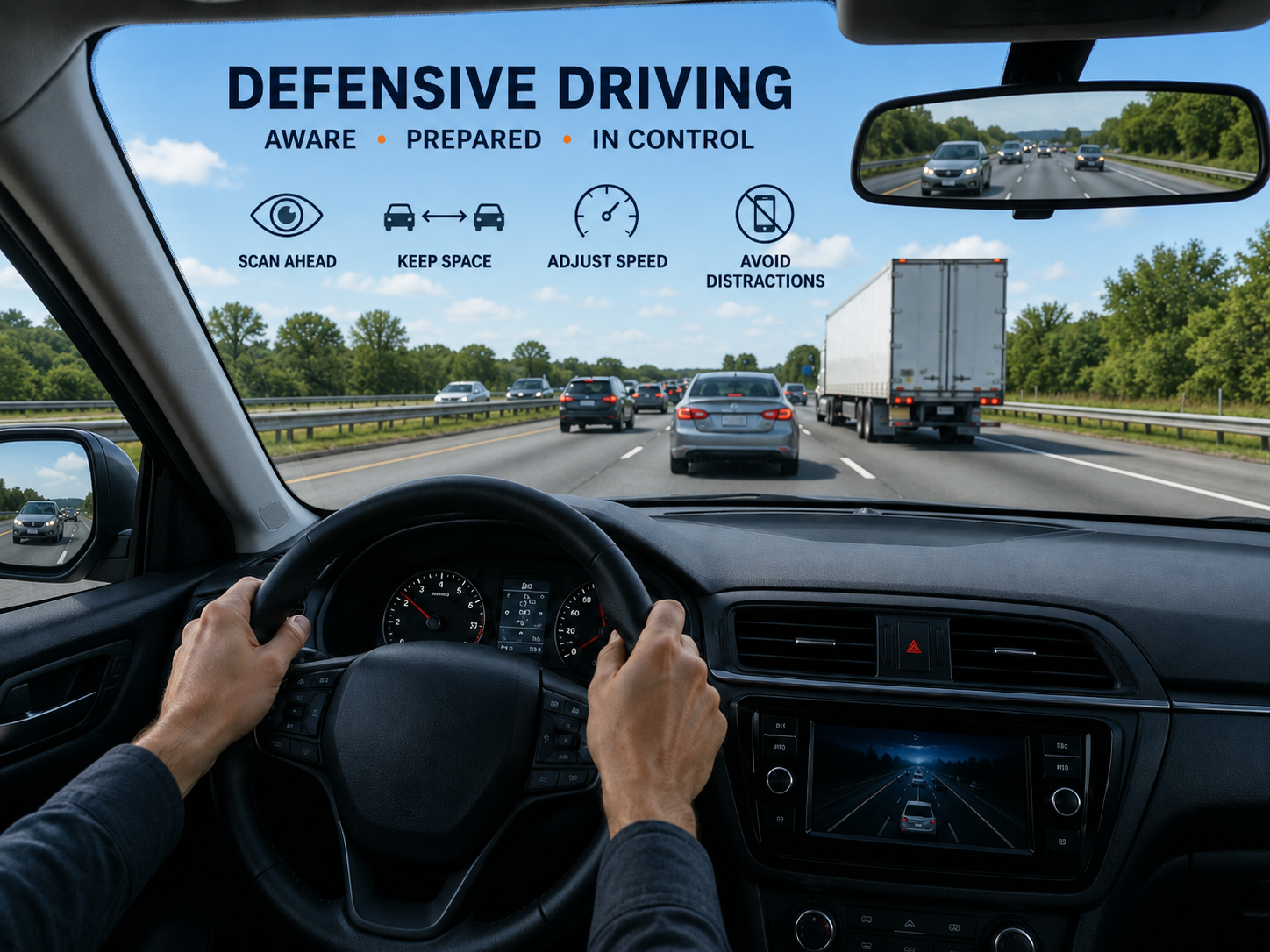
A defensive driving course is a driver safety class that teaches hazard recognition, safe following distance, speed management, intersection awareness, and distraction-free driving.
Depending on where you live, completing an approved course may help you:
- Qualify for an auto insurance discount
- Reduce points used for license suspension calculations
- Dismiss or mask an eligible traffic ticket
- Refresh safe-driving habits after years behind the wheel
The important limit: a course does not automatically erase every ticket, remove every point, or guarantee a lower insurance premium. You need to confirm the rules with your court, DMV, or insurance company before you enroll.
Defensive Driving vs. a Defensive Driving Course
Defensive driving is the skill set. A defensive driving course is the formal class that teaches and documents those skills.
| Topic | Defensive driving | Defensive driving course |
|---|---|---|
| Meaning | Everyday driving habits that reduce crash risk | A structured class, often approved by a state, court, or insurer |
| Main purpose | Prevent crashes and violations | Teach the habits and provide a completion record |
| Practical benefit | Safer daily driving | Possible discount, point benefit, or ticket outcome |
| Proof | Your behavior on the road | Certificate or electronic completion record |
| Rules | Applies everywhere | Varies by state, insurer, court, and course provider |
This distinction matters because a course is only useful for points, ticket dismissal, or insurance if the specific course is approved for the benefit you want.
What Defensive Driving Actually Means
Defensive driving is a set of techniques that help you anticipate and respond to hazards before they turn into crashes. The goal is to reduce your risk even when other drivers, bad weather, poor visibility, or road conditions create problems.
A defensive driver does not simply drive slowly. Defensive driving means actively scanning, predicting, and adjusting before a situation becomes urgent.
A few things defensive driving is not:
- It is not aggressive driving
- It is not passive or hesitant driving
- It is not a one-time trick
- It is not a substitute for following traffic laws

The core idea is simple: the more time and space you create, the more options you have.
The Core Principles of Defensive Driving
Look further ahead than the car in front of you

Most drivers focus on the vehicle immediately ahead. Defensive drivers scan farther down the road so they can spot brake lights, lane changes, pedestrians, roadwork, and signal changes early.
Practical habit: at a red light, watch the cross traffic before your light turns green. At highway speeds, look several vehicles ahead, not only at the bumper directly in front of you.
Keep a measured following distance
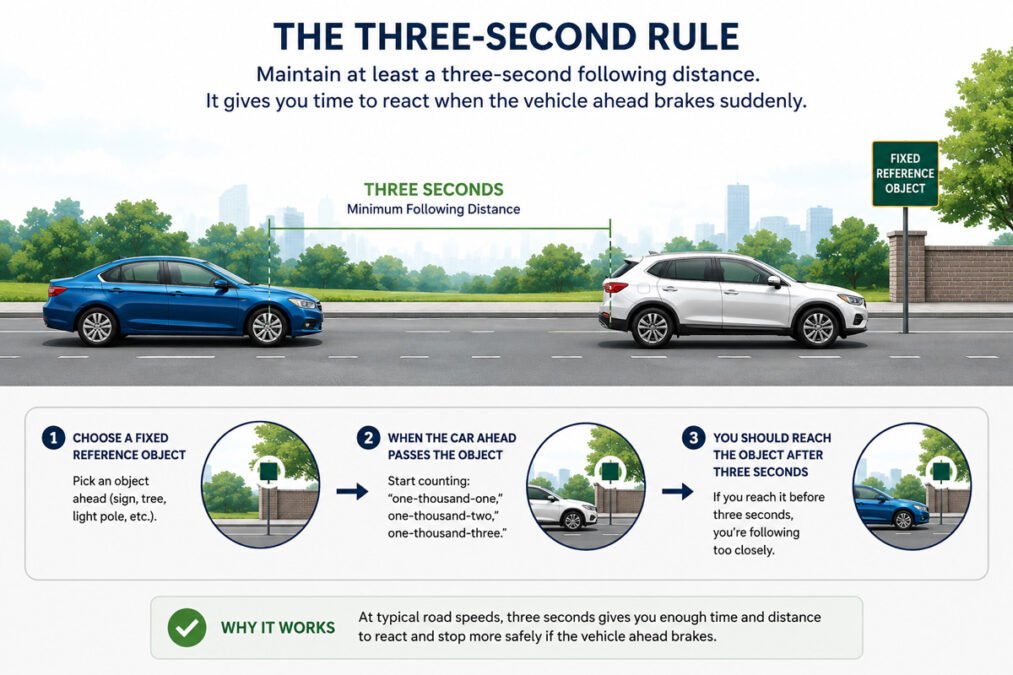
A three-second following distance is a common minimum under normal conditions. In rain, at night, in traffic, or behind a large vehicle, you need more space.
To measure it, choose a fixed object ahead. When the vehicle in front passes it, begin counting. If you reach the same object before at least three seconds have passed, you are following too closely.
For more guidance on following distance, reduced traction, hydroplaning, and standing water, see how to drive safely in the rain.
Adjust speed for conditions, not only the posted limit
The posted speed limit assumes normal conditions. Wet pavement, fog, traffic, construction zones, glare, and darkness can all reduce your stopping distance or visibility. Defensive drivers treat the speed limit as a ceiling, not a target.
Expect other drivers to make mistakes
This is not cynicism. It is risk management. If you expect the vehicle at the stop sign to roll forward, you are already prepared when it happens. If you assume every driver will act correctly, one mistake by someone else can become your emergency.
Practical habit: before entering an intersection, check left, right, then left again, even when you have a green light.
Remove your own distractions
A defensive driver loses the benefit of scanning and space management when attention moves away from the road. Phone use, eating, adjusting screens, reaching into the back seat, or trying to multitask can all reduce the time available to respond.
Manage your position on the road
Your lane position and relationship to other vehicles affect your escape options. Avoid staying in another driver’s blind spot. On multilane roads, leave gaps that give you somewhere to go if traffic suddenly stops.
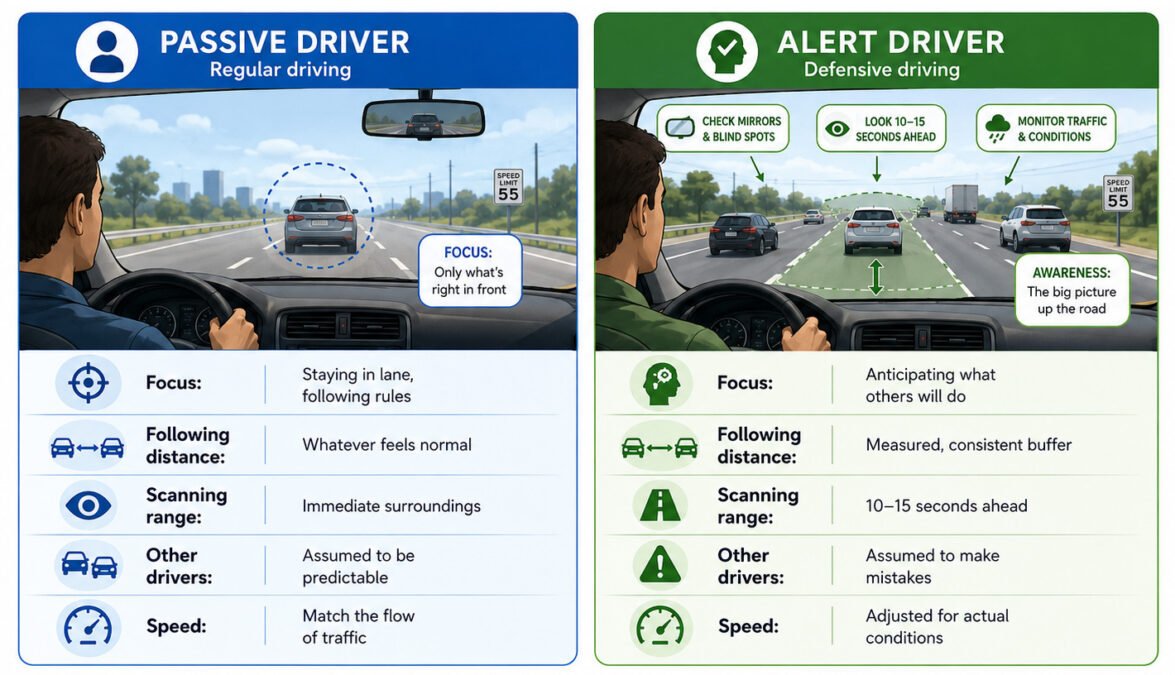
How Defensive Driving Differs From Regular Driving
| Regular driving | Defensive driving | |
|---|---|---|
| Focus | Staying in lane and following rules | Anticipating what others may do |
| Following distance | Whatever feels normal | Measured, consistent buffer |
| Scanning range | Immediate surroundings | Farther ahead and around the vehicle |
| Other drivers | Assumed to behave predictably | Expected to make mistakes |
| Speed | Matched to traffic flow | Adjusted for real conditions |
| Distractions | Often tolerated | Actively controlled |
From the outside, defensive driving may look ordinary. The difference is internal: you are actively reading the road instead of passively moving through it.
What Happens in a Defensive Driving Course

A defensive driving course is usually four to eight hours, depending on the state and course type. Many approved courses are available online, though some states, courts, or situations may require a specific provider or delivery method.
A typical course covers:
- Traffic laws and regulations — including rules drivers may not have reviewed since getting licensed
- Collision prevention — following distance, scanning, blind spots, and intersection safety
- Hazard recognition — weather, road conditions, night driving, pedestrians, and aggressive drivers
- Speed and space management — how stopping distance changes with conditions
- Driver attitude and behavior — frustration, overconfidence, fatigue, distraction, and decision-making
- State-specific requirements — rules, deadlines, forms, and certificate submission steps
At the end, you usually receive a completion certificate or an electronic completion record. Some providers submit completion directly to the DMV or court; others require you to submit proof yourself. Always confirm the submission process before paying for the course.
What a Defensive Driving Course Can Do for You
A defensive driving course can have different benefits depending on why you take it.
| Goal | What the course may do | What to confirm first |
|---|---|---|
| Insurance discount | May reduce part of your premium for a set period | Whether your insurer accepts the course |
| Point reduction | May reduce points used for suspension calculations | Whether your state allows it and how often |
| Ticket dismissal | May dismiss an eligible citation | Whether the court approves the option before you start |
| Ticket masking | May keep an eligible point from appearing to insurers | Whether your state uses masking instead of point removal |
| Skill refresh | May improve habits and awareness | Whether you need a general or state-specific course |

Insurance Discount
Many insurers offer a discount for completing an approved defensive driving course, but the amount and eligibility rules vary. Some discounts apply only to certain coverages, certain drivers, or certain age groups.
New York’s Point and Insurance Reduction Program is a clear example: an approved course can reduce the base rate of auto and motorcycle insurance premiums by 10% each year for three years. That does not mean every state or insurer uses the same rule.
Before enrolling, ask your insurance company:
- Which course providers are accepted?
- Which coverages receive the discount?
- How long does the discount last?
- Does the provider submit proof, or do you need to upload a certificate?
- Can the discount combine with any other driver-safety discount?
Do not assume that any cheap online course will qualify. Approval matters more than price.
Point Reduction
Some states allow a course to reduce points, but the phrase “point reduction” can be misleading.
In New York, for example, PIRP completion can reduce up to four active points for the purpose of calculating a suspension. It does not physically remove the violation, conviction, or points from the driving record. The ticket can still appear on the record for years.
That distinction matters for insurance. DMV points and insurance rating systems are separate. A course may help with a DMV point threshold and still not erase the violation from the insurer’s view.
To understand the remedies available in different states, review how point-reduction programs work by state.
Use this rule of thumb:
- Point reduction usually helps after points are assessed
- Ticket dismissal or masking usually helps before a conviction becomes visible
- Insurance discounts depend on insurer rules, not just DMV rules
Ticket Dismissal or Ticket Masking
In some states, a defensive driving or traffic school course can help with an eligible ticket before it becomes a conviction or public point.
Texas is a common example of dismissal through a court-approved driving safety course. Eligibility is limited, and many courts require approval before the driver starts the course. Texas courts commonly exclude drivers who used the option in the previous 12 months, CDL holders, certain high-speed violations, work-zone violations, and other serious offenses.
California uses a different model. Eligible drivers who complete traffic school may keep the point from showing on the public DMV record that insurers normally see, but eligibility and timing are controlled by the court.
Florida also uses a different structure. A driver who properly elects a Basic Driver Improvement course within the required deadline may avoid point assessment and have adjudication withheld. That is different from removing points that are already on the record.
What a Defensive Driving Course Cannot Do
A course can be useful, but it has limits. It usually cannot:
- Erase every violation from your driving record
- Cancel a mandatory suspension or revocation
- Remove responsibility for court costs, fines, or state assessments
- Guarantee that your insurer will lower a surcharge
- Dismiss serious violations such as DUI, reckless driving, or major speeding
- Help if you miss the court or DMV deadline
- Substitute for legal advice in a serious case
This is why the safest step is to check the official rule before enrolling, especially if you are taking the course because of a ticket.
How to Choose the Right Defensive Driving Course
Before paying for a course, confirm these items:
- Your purpose: insurance discount, point reduction, ticket dismissal, court order, or skill refresh.
- Approval source: insurer, DMV, court, or state agency.
- Provider list: use the official approved-course list when available.
- Deadline: court and DMV deadlines can be strict.
- Certificate submission: confirm whether the provider submits it or you must file it.
- Course format: online, classroom, video, or another approved delivery method.
- Eligibility limits: prior course use, CDL status, violation type, speed, and work-zone rules.
If your goal is ticket dismissal, do not start the course until the court allows it, unless your citation instructions clearly say otherwise.
Who Should Take a Defensive Driving Course?
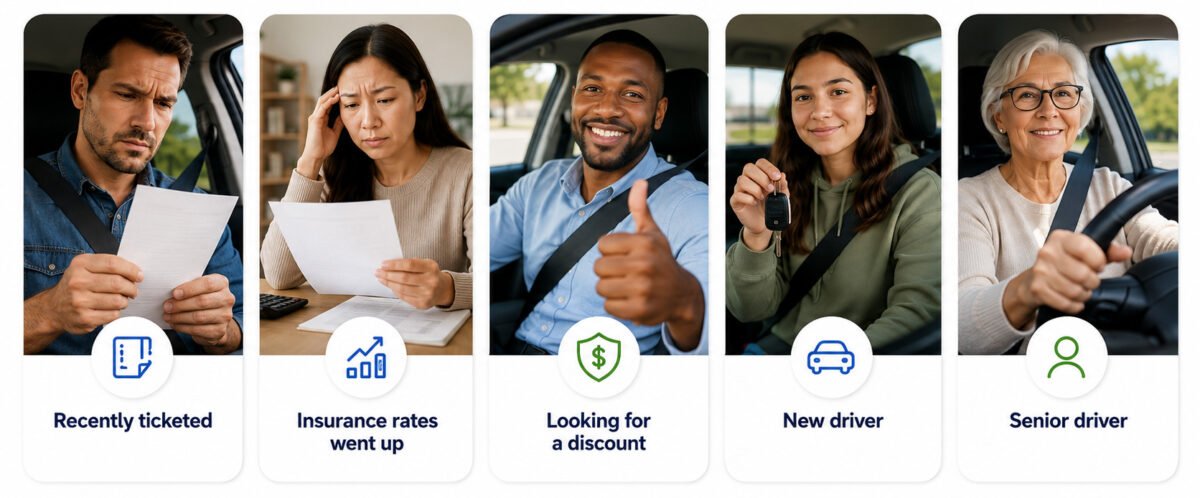
A course may make sense if:
You recently got a ticket. You may have a dismissal, masking, or point-reduction option, depending on your state and timing.
Your insurance rate increased. A course may qualify for a separate safety discount, even if it does not erase the underlying violation.
You want a proactive discount. Some insurers reward drivers who complete an approved course even without a recent ticket.
You are a newer driver. Formal training can build habits that many drivers only learn after years of experience.
You are an older driver. Some mature-driver courses are designed for insurance discounts and age-related driving refreshers.
You drive often for work or family needs. More road time creates more exposure to risk, so a structured review can be useful even for experienced drivers.
Is a Defensive Driving Course Worth It?
For many drivers, yes, but only when the course is approved for the benefit they want.
A course is usually worth considering when:
- The insurance discount is larger than the course cost
- The course helps you avoid a license-point threshold
- The court allows it for ticket dismissal or masking
- You want a structured refresh after a close call, ticket, or long gap in training
It is less likely to help when:
- The course is not approved by your insurer, DMV, or court
- The violation is too serious to qualify
- The deadline has passed
- Your insurer will still surcharge the underlying violation
The practical value comes from two places: safer habits and documented completion. You need both for the course to be more than a generic online class.
Frequently Asked Questions
How long does a defensive driving course take?
Most approved courses take several hours. Many state-approved online courses fall in the four-to-eight-hour range, but the exact length depends on the state, course type, and approval purpose. New York’s classroom PIRP course, for example, is 320 minutes.
How much does a defensive driving course cost?
Online courses commonly cost less than in-person courses, but prices vary by state, provider, delivery method, and certificate processing. Do not choose only by price. The course must be approved for your purpose.
Can I take a defensive driving course online?
Often, yes. Many states and insurers accept online courses, but not every online course is accepted for every purpose. Court-ordered, ticket-dismissal, point-reduction, and insurance-discount courses can have different approval rules.
Will a defensive driving course remove points from my record?
It depends on the state. Some programs reduce points used for suspension calculations. Some prevent points from being added if you act before conviction. Others mask a ticket from public insurer view. A course does not automatically erase a violation from the record.
Can a defensive driving course dismiss a ticket?
Sometimes. In states and courts that allow it, an eligible driver may use an approved course to dismiss or mask a minor traffic ticket. Serious violations, CDL cases, repeat use within a restricted period, or missed deadlines may make the driver ineligible.
Will my insurance go down after a defensive driving course?
Possibly, but not automatically. Some insurers offer a course discount. Others may not, or they may still consider the underlying ticket or crash. Ask your insurer before enrolling if your main goal is lowering your premium.
Do I need a ticket to take defensive driving?
No. Many drivers take a course voluntarily for an insurance discount or skill refresh. The rules are stricter when the course is tied to a ticket, point reduction, or court requirement.
Should I take the course before or after paying a ticket?
Do not assume paying the ticket and taking a course will protect your record. In many states, paying a ticket is treated as a conviction. If you want dismissal, masking, or a court-approved option, read the citation instructions and contact the court before paying.
Bottom Line
A defensive driving course is useful when it is both educational and officially accepted for the outcome you want.
For safety, it teaches the habits that reduce crash risk: scanning ahead, leaving space, managing speed, expecting mistakes, avoiding distractions, and keeping escape options open.
For paperwork, the value depends on the rules. The same course might qualify for an insurance discount in one case, point reduction in another, and no official benefit in a third. Before enrolling, confirm the course with the insurer, DMV, or court that controls your specific situation.