

Nevada Defensive Driving Course: Eligibility, Benefits, and Approved Options

A Nevada defensive driving course can reduce eligible DMV demerit points, satisfy an accepted court requirement, or support a conditional insurance discount for drivers 55 and older. The course and eligibility rules depend on the result you need. 1 5 7
Choosing by price alone can leave you with a certificate that does not solve your problem. A course used for a court agreement has different point consequences from voluntary attendance, and the insurance benefit has its own age and driving-record conditions.
General information only: This guide explains Nevada rules and practical next steps. Your DMV notice, court case, and insurance policy may require individual advice.
Start with the result you need
Quick answer: Nevada DMV describes a three-point reduction for eligible drivers with three to 11 demerit points who voluntarily complete an approved traffic-safety course. It does not erase the conviction. A court arrangement and the age-based insurance benefit require separate eligibility checks. 1 2 7
| Your situation | Where to start | What to confirm |
|---|---|---|
| You already have Nevada demerit points | Your DMV notice and current record | Point total, prior course use, and voluntary eligibility |
| You have a ticket or court course requirement | The court named on your citation | Whether a course is accepted, the case result, and every deadline |
| You are 55 or older and want insurance savings | Your insurer or agent | Driving-record eligibility, approved course, and actual reduction |
| You need teen driver education or DUI school | The specific program instructions | Ordinary traffic safety school does not fulfill those requirements |
DMV says a traffic-safety class should not be substituted for minor driver education or DUI school. 3
Use the name of the accepting office when asking about a course. “Does this qualify for Nevada DMV voluntary point reduction?” is a more useful question than “Is this defensive driving?” For court or insurance use, identify the court or policy as well.
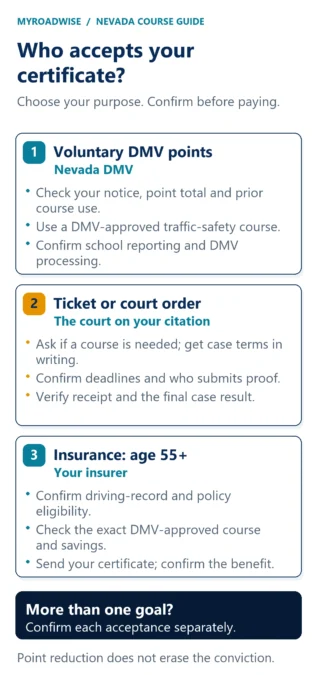
Start with the office that will accept your certificate. Court terms may offer an alternative to a course. Age alone does not establish insurance eligibility, and course attendance required because of moving violations cannot qualify for the statutory insurance reduction.
Voluntary traffic school can reduce DMV points
Under NRS 483.475, the voluntary program applies to a driver who holds a license and has accumulated at least three but fewer than 12 demerit points. The law provides for DMV notice, approved course completion, proof, and a signed statement establishing that attendance was not required under an excluded court arrangement. It authorizes cancellation of no more than three points. 2
DMV describes its ordinary program as removing three points for eligible drivers with three to 11. You still need to meet the eligibility conditions. 1
Check the timing before enrolling
You may attend a course for point reduction only once in a 12-month period. The statute also limits cancellation to the 12 months immediately following successful completion. That provision does not promise a credit you can bank for future tickets. 2
Check your prior attendance and current balance before paying. If a ticket is still pending, tell the school and DMV; the school’s reporting form includes pending violations and whether attendance relates to a plea agreement or sentencing condition. 4
Reaching 12 points before you finish changes the outcome. The statute says you are no longer entitled to cancellation through that course and your license must be suspended. A first qualifying 12-point accumulation carries a six-month suspension, with longer periods for specified repeat accumulations. Suspension also has a notice and hearing process; enrolling in a course does not replace responding to a DMV notice. 2
For example, a driver who has seven eligible points and receives the three-point reduction would have four remaining. That arithmetic illustrates the benefit; it does not establish that a particular driver qualifies or that a pending violation will disappear.
Point reduction does not remove the underlying record
NRS 483.475 says the reduction affects the demerit record only. It does not change the person’s DMV driving record or insurance record. 2
DMV also says points expire 12 months after the conviction date while the conviction remains in driving history. Point expiration and conviction history are different things. 1
If your goal is to remove a ticket or stop an insurer from considering it, a lower DMV point balance is not proof that either happened. Ask about the actual record or policy consequence you need to resolve.
Court traffic school follows the terms of your case
A Nevada court may accept or require traffic school as part of a case arrangement. Start with the court listed on your citation, and get the course requirements and promised result in writing before you enroll. Las Vegas Municipal Court, for example, says its traffic school is available to people with a moving-violation ticket who have court authorization. 6
Court attendance does not automatically earn the voluntary DMV reduction. NRS 483.475 excludes attendance required under a plea agreement or a court order entered under NRS 484A.7043, the civil-infraction provision referenced by the statute. 2
The regulation also addresses attendance imposed as a sentencing condition and allows DMV discretion over the specified point treatment. Ask about your exact order; a court-required class should not be assumed to count as voluntary attendance. 4
A local example: Las Vegas Municipal Court
Las Vegas Municipal Court’s Rule 2.7 describes a route for eligible moving violations carrying four demerit points or fewer to be amended to a non-moving violation. This is a change to the violation, not a promise of dismissal. 5
Among the conditions, the person must not hold a CDL or contest the violation, must provide a 10-year driving record that does not show a pattern of moving violations under the court’s rule, and must pay the required fines, assessments and fees. 5
For the course option, completion and proof are due by the 90-day appearance/response date or the date ordered by the court. For a first-occurrence four-point violation, the rule also allows a demerit point reduction fee in place of the course, so ask the court which option applies before you enroll. Payment in full of that fee is due by the same appearance/response date or court-ordered date. The rule also distinguishes course levels according to traffic-school attendance in the preceding 12 months. 5
If the court’s website links an older order, use JO 2.73, effective September 1, 2025; it rescinds JO 2.70. 5
These are Las Vegas Municipal Court rules. A citation from Las Vegas Justice Court or another Nevada court needs that court’s instructions. Similar names do not establish the same procedure.
Get four answers from the court
Ask the court:
- Acceptance: Is a fee option available instead of a course? If you need a course, which school, course level and delivery format will the court accept for your case?
- Result: Will successful compliance amend the violation, satisfy an order, or produce another stated result?
- Timing: What are the separate payment, course and proof deadlines?
- Proof: Who must deliver the certificate, and how will the court confirm receipt?
Keep the written offer or order with your course records. After completion, confirm the case disposition as well as certificate receipt. A school reporting to DMV does not by itself show that you delivered the proof required by the court.
Insurance savings have a separate 55-and-older rule
Nevada’s NRS 690B.029 requires a premium-reduction provision in qualifying motor-vehicle liability policies delivered or issued for delivery in the state to a person age 55 or older. The benefit operates in three-year periods, with a DMV-approved course completed after reaching 55 and every three years afterward. 7
There are driving-record conditions. For the three years before completing the course and each three-year period afterward, the insured must:
- Have no at-fault motor-vehicle crash.
- Maintain a driving record free of violations.
- Have no conviction or guilty, guilty-but-mentally-ill, or no-contest plea for a moving traffic violation or the DUI-related conduct specified in the law, including comparable conduct under another jurisdiction’s law. 7
A course required because of moving traffic violations cannot be used for this statutory premium reduction. The course provider must issue a certificate, and the insured must use it to qualify. 7
The law does not set one statewide discount percentage. The reduction depends on the insurer’s actuarial and loss data and approval by the insurance commissioner. 7
Ask for the policy-specific answer first
Give your insurer your age, driving history and proposed course name. Ask it to confirm:
- Whether you meet the statutory and applicable policy conditions.
- Whether the exact DMV-approved course and format qualify.
- Which premium the reduction applies to, the dollar savings, and when it starts.
- How to send the certificate and maintain eligibility through renewal.
If you are under 55, ask whether your insurer offers a separate course incentive. The 55-and-older statute does not establish a benefit for you, and this guide does not promise one.
Compare the insurer’s quoted savings with the full course cost. A percentage without the applicable premium can be misleading. Ask for a dollar amount so you can weigh the savings against the cost and time. Keep the insurer’s answer so you can compare it with the policy after processing.
Find an approved option for your purpose
For DMV traffic-safety use, begin with the Nevada DMV Traffic Safety Schools directory. It lists licensed schools and available course formats, including online, classroom and correspondence entries. DMV says you may use a Nevada-licensed school regardless of where in Nevada you live. 3
Match the school name and website to the directory. If you arrive through an advertisement, return to the official listing before entering payment details. A business can advertise several courses, so identify the exact Nevada product and purpose.
Then verify acceptance with the office that will use the certificate:
| Purpose | Approval check | Extra acceptance check |
|---|---|---|
| Voluntary DMV points | DMV-licensed traffic-safety school | Confirm your eligibility and correct course length |
| Court case | School and course accepted for the case | Confirm level, format, deadline and proof instructions with the court |
| Age-based insurance reduction | DMV-approved course under the statute | Have the insurer confirm the exact course and your policy eligibility |
A directory listing does not establish acceptance for every use. For insurance, confirm that the course meets the statutory approval requirement; the business name alone is not enough.
Five hours or eight hours?
NAC 483.786 sets minimum traffic-safety instruction according to convictions within a 12-month period:
| Convictions in the relevant 12-month period | Minimum instruction |
|---|---|
| Two or fewer | Five hours |
| Three or more | Eight hours |
The regulation includes instruction using communications technology. Its count is based on convictions, not simply how many tickets you remember receiving. Give the provider an accurate history and resolve any pending case or court-level requirement before selecting the shorter class. 4
When you find an online option in the DMV directory, ask how the specific course works. Ask whether it is scheduled instruction or another approved format, what attendance and testing involve, and how quickly you can obtain proof. Court instructions can require a particular level even when you were shopping by hours.
Check the total cost and certificate handling
DMV directs students to schools for pricing, schedules and enrollment. 3 Ask for the total price and what it includes rather than assume the advertised amount covers every service you need.
Useful questions include whether there are extra certificate or delivery charges, what happens if you miss a session, whether a retest costs extra, and what refund terms apply if the course is not accepted. These are shopping questions, not a claim that every school charges those fees.
If a deadline is close, leave time to finish the required instruction, pass the test and submit proof. An instant enrollment confirmation is not a completion certificate.
Finish the course, then confirm the result
Nevada’s regulation requires the school to report completion information to DMV. It also says the specified point credit is unavailable for plea-agreement attendance, missed class sessions, or a final-exam score below 70 percent. Follow the attendance and exam requirements for your approved course. 4
Keep a copy of your certificate and any submission confirmation. Use the follow-up that matches your original goal:
- DMV points: Confirm that the school reported completion and that DMV processed the eligible reduction. If the balance is unclear, ask DMV to explain it.
- Court case: Follow the court’s proof instructions and verify the final disposition. Keep evidence of submission before the deadline.
- Insurance: Send the certificate through the insurer’s accepted channel, then check that the approved reduction appears on your policy or billing documents.
Nevada DMV’s Driver History Reports page explains three-year and 10-year reports and request options. The three-year report excludes suspensions and revocations. Select the report required for your purpose; a driving-history document should not be assumed to answer every question about your current point balance. 8
If the expected result is missing, start with the responsible office and your completion records. Ask whether the issue is reporting, identifying information, eligibility or a missing court/insurer submission. Avoid paying for another class until you know what went wrong.
Special situations to check before paying
You hold a commercial license or permit
Las Vegas Municipal Court’s described amendment route excludes CDL holders. Federal rules also prohibit masking qualifying CLP/CDL convictions through the specified deferral or diversion practices, including violations committed in a personal vehicle, subject to the regulation’s exceptions. 5 9
These rules do not mean commercial drivers can never take a safety class. Tell the court and DMV about your commercial status and ask about the exact record and license consequences. Voluntary demerit cancellation and conviction reporting are different questions.
Your ticket or license comes from another state
Nevada DMV says an out-of-state conviction can enter a Nevada driving history without adding Nevada demerit points. If you are a visitor cited in Nevada, contact the Nevada court on the ticket and your home licensing agency about the outcome there. DMV notes that some Nevada courts may accept an out-of-state traffic safety school; confirm with the court on your citation before enrolling. A Nevada course is not proof of automatic credit in another state. 1
You already have a suspension notice
Work from the notice and DMV instructions. The voluntary course has a statutory point ceiling and completion cutoff; it is not a general reinstatement program. Obtain an explanation of your license status and required actions before buying a course. 2
Make the course solve the right problem
Start with one question: Who needs to accept this certificate? Then confirm eligibility, the exact course, total cost and every deadline. Keep your proof until the DMV, court or insurer confirms the result you sought.
Drive Wise. Spend Less. Stay Safe.
Related Reading
- How point reduction differs by state
- What traffic school changes on your record
- Compare course costs with insurance savings
- Check an online traffic school before paying
Sources
- Nevada Department of Motor Vehicles, Demerit Point System.
- Nevada Legislature, NRS 483.475 — Demerit points.
- Nevada Department of Motor Vehicles, Traffic Safety Schools.
- Nevada Legislature, NAC 483.786 — Traffic-safety course instruction and NAC 483.787 — Attendance, completion and reporting.
- Las Vegas Municipal Court, Judicial/Administrative Order 2.73 and Traffic Rules, Rule 2.7.
- City of Las Vegas, Municipal Court Resources — Traffic School.
- Nevada Legislature, NRS 690B.029 — Premium reductions for persons 55 or older.
- Nevada Department of Motor Vehicles, Driver History Reports.
- Electronic Code of Federal Regulations, 49 CFR 384.226 — Prohibition on masking convictions.
Last updated: October 6, 2026