


Wisconsin Defensive Driving Insurance Discount: Check Eligibility Before You Pay
Confirm your insurer’s course eligibility and expected savings before paying.
A Wisconsin defensive driving insurance discount may be available, but the company insuring your car matters. GEICO publishes a Wisconsin course offer; American Family expressly lists Wisconsin as ineligible for its Defensive Driver discount.12
Before buying a class, find out whether your policy qualifies. This guide helps you check the published eligibility differences, get a useful savings estimate, and confirm that completion produced the credit you expected.
General information only: This guide covers course-related savings on Wisconsin personal auto insurance. It is not legal or insurance advice. Sources were checked October 4, 2026. Your insurer’s applicable program and policy terms determine your eligibility and benefit.
Start with your insurer’s Wisconsin program
Wisconsin’s Office of the Commissioner of Insurance, or OCI, says some insurers offer course discounts to older adults, usually ages fifty-five and up. That is general consumer guidance, not a single eligibility rule for every policy.3
Here are two published Wisconsin positions worth checking. This is a limited eligibility comparison, not an insurer ranking or a complete market list.
| Insurer | Published Wisconsin position | Your next step |
|---|---|---|
| GEICO | Potential course savings of up to 5% on applicable coverages. Its Wisconsin section identifies age 50+ and voluntary completion as potential eligibility criteria, with variation by GEICO company. | Confirm the driver, course, covered premiums and actual dollar credit under your policy. |
| American Family | Wisconsin is expressly excluded from its Defensive Driver discount. Its separate Good Driving program is a different benefit. | Ask about other available savings rather than buying a course solely for this discount. |
Sources: GEICO’s Wisconsin section and American Family’s state eligibility list.12
A brand’s national discount page can be a useful starting point, but it may leave the Wisconsin result unsettled. For example, The Hartford describes a course benefit nationally and directs customers to confirm acceptance before enrolling. Its general page does not establish the Wisconsin terms for your policy.4
State Farm’s Wisconsin page lists other savings programs, including Steer Clear for eligible drivers under twenty-five. That program listing does not establish a general defensive-driving course benefit. The absence of a course discount from a public list also is not enough to conclude that every policy under a brand excludes one.5
If your insurer is not in the table, start with customer service or your agent. Ask specifically about a course-completion discount, since a clean-record benefit or a program that monitors driving can have different requirements.
Ask for policy confirmation, not just a course name
A useful opening question is:
“For my Wisconsin auto policy, will this exact defensive driving course qualify for a discount for this driver? What would it save in dollars, and for how long?”
Have your policy number, the driver’s name and age, and the course’s exact title and provider ready. If you have already received a court or DMV direction to take a class, mention that too. Whether the class is voluntary can matter under an insurer’s program.
Request a response that identifies these details:
- Eligibility: the driver, insured vehicle and underwriting company that qualify.
- Course acceptance: the exact course, online or classroom format, and any completion requirements.
- Savings: the percentage or credit, affected coverages and estimated dollar reduction.
- Timing: the effective date, certificate deadline, benefit period and any renewal requirements.
- Proof: who submits completion and how to verify that it was processed.
Keep the response with the course receipt and certificate. If the answer is only “we accept defensive driving,” ask for the course-specific and policy-specific details before proceeding. A course-specific answer can prevent an unnecessary purchase.
OCI explains that your declarations page lists the coverages in force and their amounts; the policy and endorsements contain the applicable contract terms. Use those documents when checking what is insured, and ask your insurer to explain the premium calculation.7
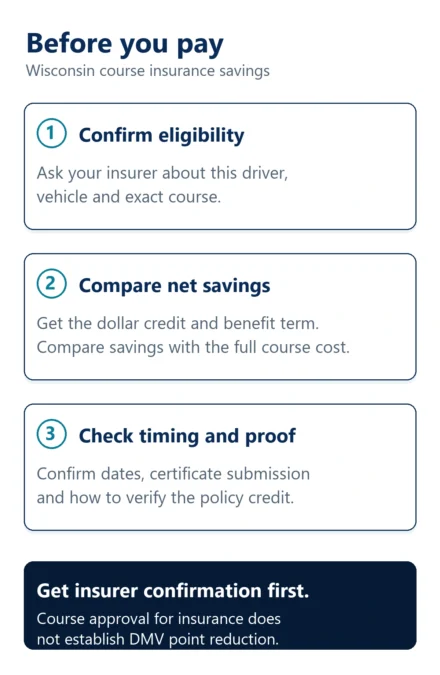
Get policy-specific confirmation from your insurer. Compare savings over the confirmed benefit term with the full course cost, then verify that completion produces the expected credit.
Age fifty-five is not a universal starting line
OCI’s usual age description and a company’s published eligibility can differ. Use your insurer’s answer for the relevant driver and policy. A course provider accepting someone into a class does not, by itself, establish insurance eligibility.
For a household with several drivers, ask which driver must finish the course and which vehicle premiums would receive a credit. Get that answer before paying for multiple enrollments. This guide does not establish that two certificates produce twice the savings or that every household vehicle qualifies.
A required class needs a separate insurance check
If a court or DMV requires attendance, fulfilling that obligation comes first. Ask the insurer whether the assigned course also qualifies for a credit; do not substitute a different course merely because it advertises savings.
If you already completed an assigned class, disclose that circumstance when asking about insurance. A certificate can show successful completion while still failing an insurer’s voluntary-course condition. The insurer should explain which condition it is applying to your policy.
Choose through an insurer-confirmed route
GEICO’s Wisconsin section identifies online routes through IMPROV, National Safety Council and American Safety Council. It also allows that other courses may qualify. Treat those links as starting points for an acceptance check, not a promise that every visitor is eligible.1
Open the route your insurer confirms and check that the page is for the correct state and purpose. A provider can sell several courses with similar names. Save the course title and enrollment details so you can match them to the insurer’s confirmation later.
Review the total price, required time, quizzes, accessibility, cancellation terms and certificate delivery before paying. If a quoted price changes at checkout, use the actual total in your savings calculation. If the course cannot fit your schedule or accessibility needs, resolve that before registering.
Provider advertising and insurer eligibility are different kinds of information. An attractive advertised percentage does not establish the rate your policy will receive. Ask the insurer to resolve a mismatch before purchasing rather than choosing the larger number.
Insurance approval does not establish DMV point reduction
Wisconsin DMV says its approved point-reduction Traffic Safety courses are offered in person through technical colleges, with no approved online courses for that benefit. An online insurance course should not be purchased as a substitute for that DMV program.6
If you need both results, check each separately: DMV approval for the point benefit and insurer acceptance for the policy credit. Follow the relevant course and notice requirements. This article does not establish that one class will satisfy every purpose or that an insurance certificate dismisses a ticket.
Calculate savings on the premiums that actually qualify
The phrase applicable coverages matters. A percentage advertised for part of a policy is not automatically the same percentage off the whole bill.
Ask your insurer for a dollar estimate with your current vehicles, drivers, limits and deductibles held constant. That is usually more useful than trying to reconstruct the rating calculation yourself. If another discount is already applied, ask whether the course produces an additional reduction and how the credits interact.
For a simple estimate, use:
Eligible premium for the period × confirmed discount rate = estimated course savings for that period.
Then compare the savings over the confirmed benefit period with the entire course cost. Use annual figures together or six-month figures together; mixing those periods can double or halve your estimate by mistake.
A hypothetical example: a small credit can still cover the fee
Suppose your insurer confirms that $600 of annual premium qualifies for a 5% reduction, and the course costs $30 in total. Those figures are hypothetical, not a quote or a typical Wisconsin price.
| Calculation | Result |
|---|---|
| $600 eligible annual premium × 5% | $30 estimated annual savings |
| $30 savings − $30 course cost | $0 first-year net savings |
| $600 × 5% × two years, if the benefit lasts that long and inputs stay unchanged | $60 estimated savings before course cost |
| $60 − $30 course cost | $30 estimated net savings over those two years |
The example breaks even after one full year of the assumed credit. If only six months of savings is available, the same annualized estimate would yield about $15 before the $30 fee, leaving a $15 cost. Your time is an additional consideration.
A larger total insurance bill would not change this example unless more premium actually qualified. If the whole annual bill were $1,200 but the eligible portion remained $600, applying 5% to the whole bill would overstate the estimated annual savings by $30.
These calculations assume a simple proportional credit, unchanged eligible premiums and continuous eligibility. Use the insurer’s own estimate when its calculation works differently. A change in vehicle, coverage, driver or policy can require a new estimate.
Get the benefit dates before planning another course
Ask when the credit begins, when it ends and what is needed to continue it. Also ask whether the start depends on completion, certificate processing or renewal. The time a provider estimates for finishing the course does not tell you when your insurance bill changes.
Get any certificate-submission deadline in writing. If renewal is close, ask whether finishing now would affect that renewal and what happens if the proof arrives afterward. This guide does not establish a uniform Wisconsin filing deadline, benefit term or retroactive-credit right.
Once the insurer gives you an end date, keep it with the certificate and set a reminder far enough ahead to check renewal requirements. Reconfirm eligibility before paying for a repeat course; the original approval describes the original circumstances.
After completion, verify the actual policy credit
Keep a copy of the certificate even when a course provider handles reporting. Ask for submission confirmation and follow the insurer’s instructions for any additional proof. Avoid sending identity or policy information through a website that your insurer has not confirmed as the appropriate route.
Check the updated policy documents or account after the insurer’s stated processing period. Look for the credit’s effective date and dollar effect, rather than relying only on a “course complete” message.
If the expected result is missing, gather the acceptance confirmation, receipt, certificate and any submission record. Ask the insurer whether the problem is missing proof, a different course, an eligibility condition or an effective-date issue. Those records help customer service identify what needs to be resolved.
If the insurer’s answer remains unsatisfactory, OCI advises first attempting to resolve the concern with the agent or company, then contacting OCI. Use the exact insurance-company name in a complaint; OCI warns that similar company names can delay its investigation. A complaint is a route to review a dispute, not a guarantee that a discount will be awarded.7
A course credit does not promise a lower renewal bill
Compare the credit separately from the total premium. OCI explains that rating can depend on driving history, vehicle, age, location and mileage, and that an accident or traffic violation may produce a surcharge.7
For example, a hypothetical $30 course credit would not offset an otherwise $100 increase: the net change would still be $70 upward. That does not prove the course was ignored. Ask for an explanation of the credit and other changes on the same renewal.
If no course benefit applies, skip a purchase made solely for insurance savings. OCI’s other cost-saving suggestions include shopping around, checking mileage-related savings and asking about available discounts. Compare equivalent coverage and consider the out-of-pocket risk before choosing a higher deductible.8
Changing insurers just to obtain a course discount can be a poor calculation if the new policy costs more overall. Evaluate the complete quote with comparable protection, not a discount percentage in isolation.
Make the enrollment decision with three answers
Enroll for insurance savings once you have three useful answers: this driver and course qualify; the expected dollar credit justifies the cost; and you know how to submit and verify completion. If one answer is missing, obtain it from the insurer before paying. Keep that confirmation until you can see the promised treatment on your policy.
Related Reading
- Traffic School Insurance Discount: Can It Lower Your Rate?
- Is Online Traffic School Legit? 7 Checks Before You Pay
- Car Insurance Increase After a Ticket: 5 Ways to Avoid or Reduce It
- How to Lower Car Insurance Rates: 9 Proven Ways That Actually Work
Sources
- GEICO — Defensive Driver Discounts & Courses.
- American Family — Good Driver & Defensive Driving discount.
- Wisconsin OCI — Insurance for Retirement.
- The Hartford — Defensive Driving Course Discount.
- State Farm — Wisconsin Auto Insurance Discounts.
- Wisconsin DMV — Wisconsin’s point system.
- Wisconsin OCI — Frequently Asked Questions: Automobile Insurance.
- Wisconsin OCI — Tips for Saving on Auto Insurance.
Last updated October 4, 2026


