


Car Insurance Increase After a Ticket: How to Avoid or Reduce It
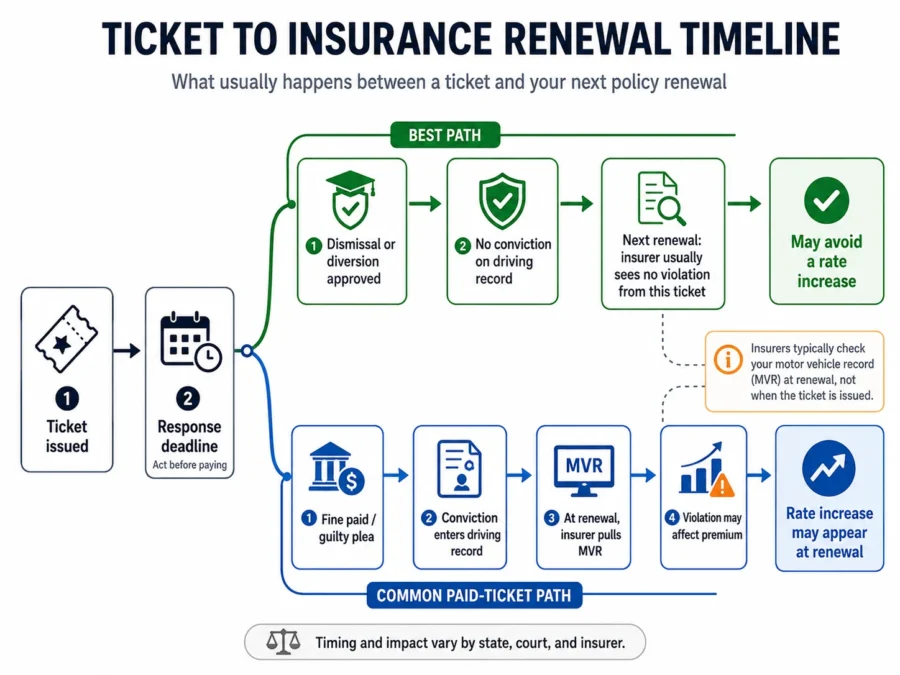
A car insurance increase after a ticket is not always immediate. In many cases, the real insurance impact happens later, when the violation becomes a conviction on your driving record and your insurer checks your motor vehicle report at renewal.
That timing matters. If the court dismisses the ticket, there is no moving-violation conviction for the insurer to charge you for. Your total premium can still change for other reasons. If the conviction is already on your record, a course discount or a lower quote from another insurer can reduce the cost. Reducing DMV points alone might not change the price.
This guide explains what to do before you pay, which options can lower the cost, and which common moves do not hide a violation from your insurer.

Quick Answer: Can You Avoid a Car Insurance Increase After a Ticket?
If the court dismisses the ticket, there is no moving-violation conviction for your insurer to charge you for. That does not lock your total premium; it can still change for other reasons. If dismissal is not available, an approved course discount or a lower quote can cut the cost. Reducing DMV points alone might not change your insurer’s price. Review these other ways to lower your car insurance.
The best outcome usually depends on three things:
- Whether your state or court allows dismissal for your violation
- Whether the conviction appears on your driving record before renewal
- How your insurer rates that violation once it sees your motor vehicle report
Best Options After a Ticket
| Option | What it can do | Changes the conviction? | Possible insurance effect |
|---|---|---|---|
| Ticket dismissal | Ends the cited charge without a conviction when the court allows it | Yes, if the court dismisses the charge | Can avoid a conviction surcharge but does not freeze the total premium |
| Point reduction | Lowers the point total used for certain state decisions | Usually no | Helps only when state or insurer rules provide another benefit |
| Defensive-driving discount | Lowers the policy price if you and the course qualify | No | Can offset part of the increase; course and proof rules apply |
| Shopping before renewal | Shows how other insurers price the same record | No | Can produce a lower quote but does not hide the conviction |
| Waiting for the insurer’s lookback period | Gives the violation time to age | No | The price effect can shrink or end under state and insurer rules |
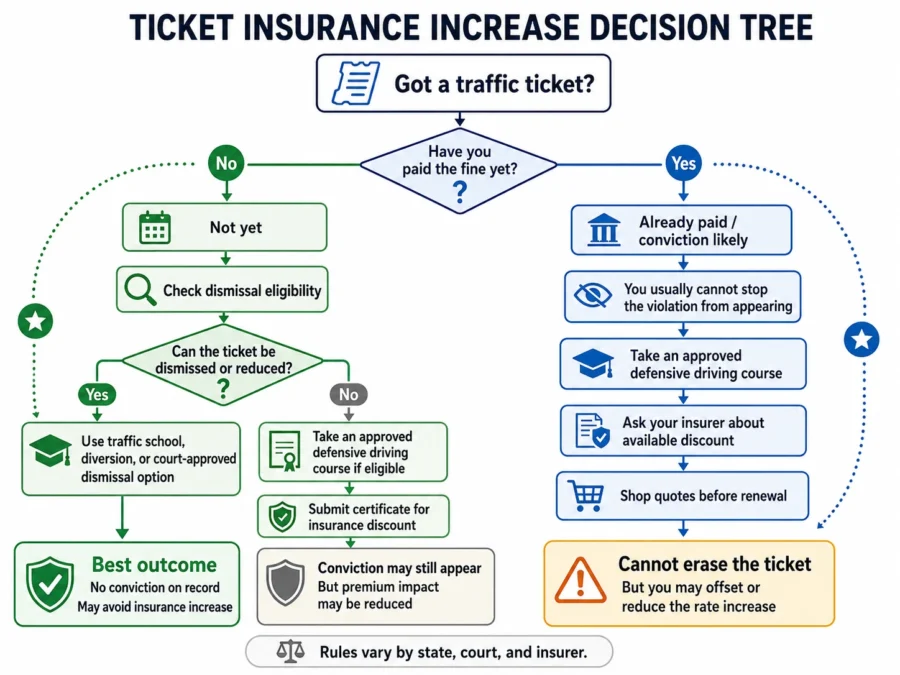
Step 1: Check Your Deadline Before Paying the Ticket
Do not pay until you understand what that payment does. It can end the case as a conviction or plea. But some official programs require fines, fees, costs, or bail when you choose the program. Follow the instructions from the court handling your ticket.
Read the ticket carefully and check:
- The response deadline
- Whether you must plead guilty, not guilty, or request a hearing
- Whether the court offers dismissal, diversion, traffic school, or a defensive driving option
- Whether completing a course must happen before payment or before the court date
Your response window may be short. Some courts require action within a few weeks, while others give more time. The exact deadline is the one printed on the citation or listed by the court handling the ticket.
Practical move: Before paying, contact the court listed on the ticket and ask whether your violation is eligible for dismissal, traffic school, or another option that prevents a conviction.
Step 2: Pursue Ticket Dismissal If You Are Eligible
If the court dismisses an eligible ticket, there is no moving-violation conviction for the insurer to surcharge. The final effect still depends on what the court and motor vehicle agency report and how the insurer prices that result.
Dismissal rules depend on the state, county, court, charge, and your driving history. Some states allow dismissal through an approved traffic school or defensive-driving course. Others require a court appearance, approval from a prosecutor, a deferred program, or another local process.
You may qualify when:
- The ticket is for a minor moving violation
- You have not used dismissal recently
- The violation did not involve a crash, DUI, reckless driving, or commercial driving restriction
- The court allows dismissal for that specific charge
- You complete the required course or court process on time
Important caution: A dismissed ticket can help prevent a ticket-based surcharge, but it does not freeze your insurance rate. Your premium can still change for other reasons, such as claim history, location, vehicle changes, coverage changes, broader rate filings, or insurer pricing updates.
See How to Keep a Traffic Ticket Off Your Record for the full dismissal process and eligibility questions to ask.
Step 3: If Dismissal Is Not Available, Explore Point Reduction
If the court cannot dismiss the ticket, reducing points can still help. A point program can lower the total used for a specific state decision, such as a suspension. The conviction and original points can stay visible on your driving record, as New York’s program shows.
However, point reduction is not the same as removing the conviction. In many cases, your insurer can still see the underlying violation even if your DMV point total is reduced.
What point reduction can do:
- Reduce the point total used for a specific suspension or administrative calculation, where state law permits
- Help reduce the risk of license suspension if you are near a point threshold
- Show that you completed a safety course
- Qualify you for a separate insurance discount in some states
What point reduction usually does not do:
- Erase the conviction from your driving record
- Hide the violation from insurers
- Guarantee that your rate will not increase
For example, New York’s Point and Insurance Reduction Program is a DMV-approved course that can reduce points and provide an insurance premium reduction, but that is a New York-specific program. Other states and insurers may handle point reduction and discounts differently.
Step 4: Complete a Defensive Driving Course for the Discount
Even if the conviction stays on your record, an approved defensive driving course may reduce the cost of your policy. The discount is separate from whether the ticket remains visible.
How it usually works:
- Confirm with your insurer which courses qualify
- Enroll in a state-approved or insurer-accepted course
- Complete the course before your policy renewal, if possible
- Request your completion certificate
- Submit the certificate to your insurer
- Confirm when the discount will apply
Do not assume every online course qualifies. A course may be approved by a state but not accepted by your insurer for a discount, or it may qualify for point reduction but not for premium reduction. Call before enrolling.
Timing matters: If your policy renews soon, ask your insurer whether submitting the certificate before renewal can affect the upcoming premium. If the rate already increased, ask whether the discount can be added mid-term or only at renewal.
See How to Lower Car Insurance Rates for other strategies that can stack with a defensive driving discount.
Step 5: Shop Your Rate Before Renewal
If the ticket will stay on your record, compare quotes before you renew. Insurers do not all price violations the same way. One company may apply a larger surcharge for a first minor speeding ticket, while another may be more forgiving, especially if your prior record is clean.
When to shop:
- After receiving a renewal notice with a surcharge
- Before renewal if you know a conviction is likely to appear
- After completing a defensive driving course
- When the violation becomes older and may carry less weight
- When your current insurer raises your rate more than expected
Compare identical coverage, not just price. Match liability limits, deductible, uninsured motorist coverage, rental coverage, roadside assistance, and any other features that matter to you. A lower quote with weaker coverage is not always a real saving.
How Your Insurer Learns About the Ticket
Getting a ticket does not change your rate by itself. Your rate can change once a conviction shows up on a driving record or other report your insurer pulls. When the insurer checks—and what it does with the result—depends on the company and state.
Many insurers use a motor vehicle report, often called an MVR, to review driving history. The National Association of Insurance Commissioners notes that insurers may use driving record, prior violations, claims history, location, vehicle use, and other factors when setting auto insurance premiums.
A common sequence is:
- Citation issued
- Driver responds, pays, contests, or requests dismissal
- Court records a dismissal, conviction, or other outcome
- The state driving record updates
- Insurer checks the motor vehicle report during underwriting or renewal
- The premium changes if the insurer rates the violation
What Does Not Prevent a Car Insurance Increase After a Ticket
Some common assumptions sound logical but do not work.
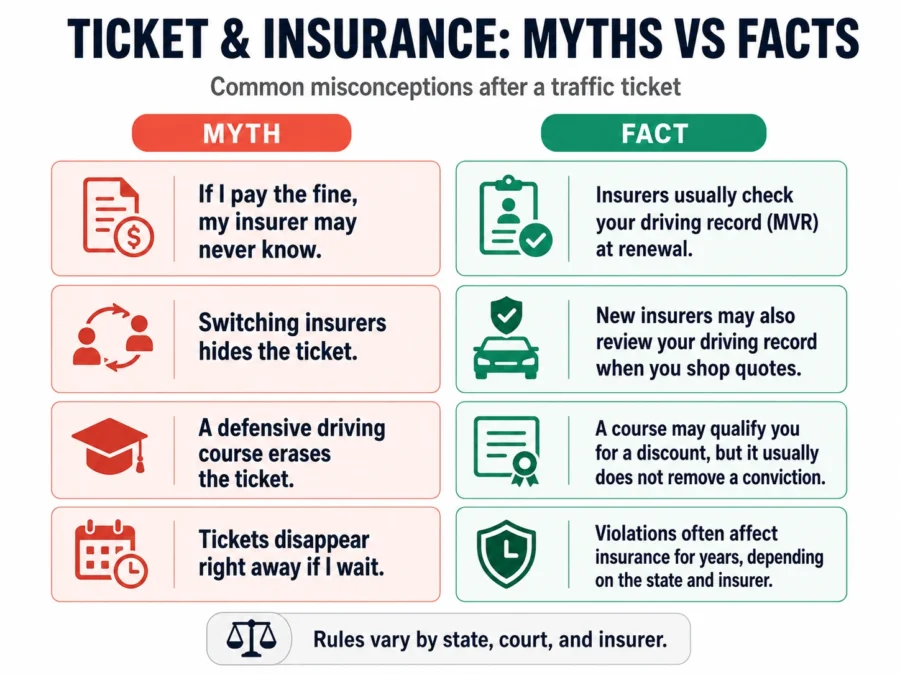
Paying the fine and hoping the insurer does not find out. If payment creates a conviction, the violation may appear on your driving record. Insurers that check your motor vehicle report can see it.
Switching insurers after the conviction appears. A new insurer can also check your driving record during the quote or underwriting process. Switching may still save money, but it does not hide the violation.
Taking a course but never submitting the certificate. If the discount requires proof, completing the course alone is not enough. Send the certificate and confirm it was applied.
Waiting without checking the deadline. Ignoring the ticket can lead to default penalties, license issues, or a conviction depending on the jurisdiction. Follow the instructions on the ticket and act before the deadline.
Assuming all tickets are treated the same. A minor speeding ticket, a red-light violation, reckless driving, DUI, and a commercial-driver violation can have very different insurance consequences.
If the Rate Has Already Increased
If the rate increase is already in effect, the best option is no longer prevention. The goal is damage control.
Complete a defensive driving course now. Ask your insurer whether an approved course can still qualify you for a discount. Even if the ticket surcharge remains, the discount may offset part of the increase.
Review the renewal notice carefully. Check whether the increase is tied to the ticket, a claim, coverage change, vehicle change, garaging address, statewide rate increase, or another factor. A ticket may not be the only reason your premium changed.
Compare quotes with identical coverage. If your current insurer rates the violation harshly, another insurer may offer a better price for the same coverage.
Check the applicable experience period. Ask the insurer what driving-history or experience period applies to the violation. The NAIC notes that insurers generally ask for several years of driving history, but the applicable period and rating effect vary by state, carrier, and violation. Compare rates again at future renewals rather than assuming an exact three-year cutoff.
Ask about other discounts. Bundle discounts, paperless billing, pay-in-full discounts, telematics programs, low-mileage discounts, and course discounts may help offset the increase.
Checklist: What to Do After a Ticket
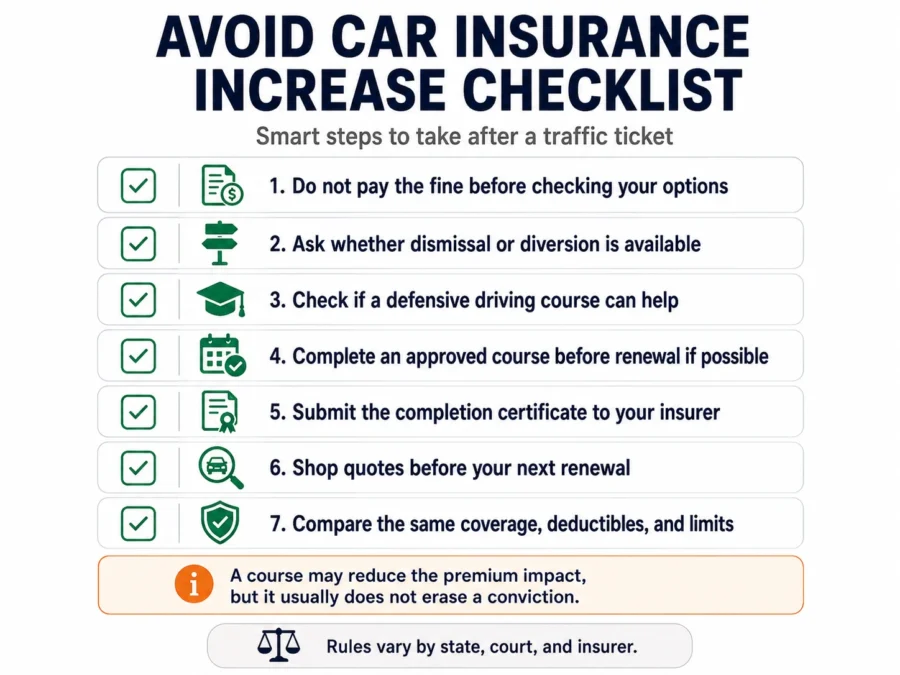
Use this checklist before your deadline passes:
- Read the citation and confirm the response deadline
- Ask what paying actually does; some programs include payment as part of the deal
- Ask the court about dismissal, diversion, or traffic school
- Confirm whether the violation is eligible
- Complete required steps before the court deadline
- Ask your insurer which courses it will accept
- Submit the completion certificate and confirm receipt
- Compare renewal quotes using identical coverage
- Keep copies of court outcomes and course certificates
- Shop again once the ticket is old enough to stop counting
Frequently Asked Questions
How much does one ticket raise your insurance rate?
It depends on the ticket, insurer, state, driving record, coverage, and recent claims. A first minor ticket on a clean record can cost less than a serious charge or a second ticket during the insurer’s lookback period. See how traffic violations affect car insurance rates for examples by ticket type.
Will a warning affect my insurance rate?
A warning is usually not a moving-violation conviction. A written warning can appear in another record, and an insurer might see or use it. The answer depends on the state, report, and insurer. Check your official driving record if you are unsure.
How long does a ticket affect car insurance?
There is no universal three-year rule. The period depends on state rating law, the insurer’s approved rules, the violation, and the driving-history period the insurer uses. Serious violations may be considered for longer where permitted.
Can traffic school keep a ticket off my insurance?
Sometimes. If traffic school leads to dismissal before a conviction is entered, it may keep the ticket from affecting your insurance. If the course only reduces points or creates a discount, the conviction may still appear on your record.
Does a dismissed ticket affect insurance?
A dismissal usually means there is no conviction on the dismissed charge. The ticket or court record can still remain visible, and another reported event can still affect the price. State and insurer rules control. Keep the dismissal record in case the court, DMV, or insurer reports the result incorrectly.
Should I tell my insurance company about a ticket?
Read your policy, application, and renewal questions to see what you must report. There is no single nationwide rule for every ticket. Answer the insurer’s questions truthfully. Send proof of dismissal or course completion if it corrects an error or earns a discount.
Is a parking ticket different from a moving violation?
Yes. Parking tickets usually do not affect car insurance because they are not moving violations. But an unpaid parking ticket can still cause registration trouble, collection action, or local penalties.
Can I switch insurance companies before the ticket shows up?
You can shop at any time, but switching does not erase a conviction. A new insurer may check your driving record during underwriting. Shopping can still help if another company rates the same violation less severely.
Does getting a ticket in another state affect insurance?
It can. Out-of-state tickets may be reported to your home state or appear on records that insurers check. The effect depends on the states involved, the violation type, and how your insurer reviews driving history.
Can I fight the rate increase directly with my insurer?
You can ask why the rate changed and check for errors. A ticket surcharge usually follows the insurer’s pricing rules, so it is not something you bargain over. Useful proof includes a dismissal, a corrected driving record, or a defensive-driving certificate.
What if my rate increase seems too high?
Compare quotes for the same coverage. If the increase looks wrong, ask the insurer to name the ticket, conviction date, and record it used. If it will not fix a clear error, contact your state insurance department.
Bottom Line
It is usually easier to limit an insurance increase before the ticket becomes a conviction. Start with the court deadline, not the insurance renewal date. If the court dismisses the charge, there is no moving-violation conviction for the insurer to surcharge. Your total premium can still change for other reasons.
If dismissal is not available, focus on reducing the cost: complete an approved defensive driving course, submit the certificate, compare renewal quotes, and shop again when the violation becomes older. You may not be able to erase the ticket, but you can still limit how much it costs you.
Sources
Sources reviewed August 19, 2026.