

Minnesota Defensive Driving Course: Choose the Right Program

A Minnesota defensive driving course can qualify eligible drivers age 55 and older for an insurance premium reduction, while a ticket-related course needs acceptance from the office handling the case. Choose the program for your actual goal before paying: insurance approval does not establish court acceptance. 146
Several websites sell classes under similar names. Whether you want to save money, respond to a ticket, or finish a required driver improvement clinic, the course title alone will not tell you which one to buy.
This guide helps you find the right course and send proof to the right place. It also explains why older advice about an eight-hour first insurance course can send you toward the wrong class.
Which Minnesota course do you need?
Find your goal in the table, then confirm who will accept your certificate.
| Your goal | Starting point | What to confirm |
|---|---|---|
| Claim the age 55+ insurance benefit | DVS accident-prevention directory and your insurer | Your eligibility, the listed course/format, and certificate submission |
| Seek an alternative outcome for a ticket | Court or prosecutor handling the citation | Whether a program is available for your case and which course it accepts |
| Complete an ordered driver improvement clinic | The court or agency named in your instructions | Exact clinic, format, deadline, and reporting recipient |
| Improve your driving without a promised legal benefit | Course provider | Curriculum, format, support, and total cost |
Minnesota’s insurance course and driver improvement clinic have different legal foundations. The approved accident-prevention directory concerns premium reductions; a court can order an approved clinic as part of a judgment of conviction. Minneapolis also publishes a local Traffic Education diversion option. 468
Keep your written course directions beside the sign-up page. For an insurance course, use the details your insurer gives you. For a ticket or order, use the case terms. Match the course name and format before you pay.
The insurance course for drivers age 55 and older
Minnesota Statutes Section 65B.28 requires an appropriate premium reduction of at least 10% on qualifying private-passenger vehicle insurance issued, delivered, or renewed in Minnesota for insureds age 55 or older who successfully complete the approved accident-prevention course or refresher. 1
Ask your insurer how that rule applies to your policy. Get the expected dollar saving, the coverages or cars it applies to, the start date, and where to send proof. Those details help you decide whether to take the class. Using 10% of your whole bill may give you the wrong budget.
If you are younger than 55, ask about any insurer-specific voluntary benefit. This statutory age-based reduction does not establish your eligibility, and a generic promise to save on insurance is not enough to justify buying a course.
The initial course is now four hours
The current law sets the original accident-prevention course at four hours. The refresher may be no more than four hours. The change to the original course took effect July 1, 2024, for courses held on or after that date. 12
Some older brochures and PDFs still describe an eight-hour first course followed by a four-hour refresher. If you find one, compare it with the current law and ask the provider which Minnesota product it is selling. Eight-hour advice can also refer to an entirely different program, such as a driver improvement clinic.
On a sign-up page that serves several states, choose the Minnesota course meant for your insurance benefit. Save the course details with your receipt so you can refer to them if a question comes up later.
Plan for renewal and proof
Under Minnesota Statutes Section 65B.28, subdivision 4, drivers age 55 and older may retake the original course or take the refresher every three years and receive a certificate to remain eligible for the premium reduction. 1 The rule also recognizes the completion certificate as evidence of qualification. 3
Ask your insurer when you need to renew the course. Set a reminder that leaves time to choose a class and send proof. Keep your certificate where you can find it if you switch insurers or need another copy.
The course administrator must issue a certificate to a person who satisfactorily completes the course. 5 Check your name and completion details when it arrives. Correct an error through the provider before sending it to your insurer.
Find an approved course in the format you want
Use the Minnesota DVS approved accident-prevention course list as your starting point. Its classroom and online columns let you distinguish approval for the available formats. 4
Examples on the directory’s first page include:
| Listed organization | Four-hour classroom | Four-hour online |
|---|---|---|
| Minnesota Safety Council | Listed | Listed |
| AARP Driver Safety Program | Listed | Listed |
| Precision Driving Center of Minnesota, St. Cloud State University | Listed | Listed |
| Chisago Lakes Community Education | Listed | Not marked |
These are examples of directory entries, not a ranking or a promise that a seat is available. Use the directory to identify the organization and format, then check the provider’s registration page for the actual class. A classroom listing alone does not establish approval for that organization’s online offering. 4
For example, Minnesota Safety Council describes a self-paced four-hour online course that tracks progress and allows you to log off and return. It says you receive a certificate to give to your insurance company. 7 That can be useful if you prefer several shorter study sessions.
Compare the practical terms before enrolling
Once you have found an approved option, check whether it fits your schedule and budget:
- Total cost: ask whether the displayed price includes certificate delivery and any required fees.
- Schedule: for a classroom course, check every session and the cancellation process.
- Online access: ask about supported devices, the access period, and how progress is saved.
- Help: find out how to contact support if a lesson or certificate fails to load.
- Completion proof: ask when and how the certificate arrives and whether replacements cost extra.
- Refunds: read the policy before starting the course.
A short comparison of two accepted options may be enough. Weigh the schedule against support and, for classroom courses, the trip to class.
If you sign up through a community program, ask who teaches the course and issues the certificate. Match that answer to the state list and your insurer’s terms. The name on the sign-up page may not tell you who supplies the class.
A ticket requires a different approval conversation
Ask about your ticket options before paying the citation or buying a course. The Minnesota Judicial Branch explains that paying a fine is a guilty plea and results in a conviction. 9
For citations issued in Anoka, Carver, Dakota, Hennepin, Ramsey, Scott, or Washington counties, the Judicial Branch identifies a hearing-officer appointment route through the Court Payment Center. For other counties, it directs readers to the county’s court administration. 9
Ask that office about your case. A course seller can explain its product, but the office handling the citation decides what it will accept or offer you.
Have the citation number ready and ask:
- Is a course-based option available for this charge and my history?
- Must I receive an agreement or permission before enrolling?
- Which exact course and delivery format are accepted?
- What fees, completion dates, and other conditions apply?
- Who receives proof, and how do I confirm the final case outcome?
Get the terms in writing, including what will happen to the case. Dismissal, avoiding a conviction, changing a charge, and finishing a sentence mean different things. Ask the office to explain any unclear terms before you decide.
Minneapolis offers a local example
The City of Minneapolis lists Traffic Education for people charged with a moving violation. Its published requirements include an online course and test plus court costs. The possible benefits are that the violation may not appear on the record or that the person may avoid a conviction. The city tells readers to contact it to determine eligibility. 6
That example establishes a local option. It does not establish eligibility for every Minnesota ticket or permission to choose any online defensive driving class.
If you are offered a program, keep its terms with the ticket. Write down the class deadline and any later dates you must meet. Finish the class, then check whether the case has reached the agreed result.
If you are ordered to attend a driver improvement clinic
A required clinic may follow a conviction. Section 169.89, subdivision 5, allows a trial court to order satisfactory completion of an approved driver improvement clinic in conjunction with, or instead of, other penalties in its judgment of conviction. Failure or refusal to comply can lead to a license suspension by the commissioner of public safety for up to 30 days. 8
Read the order before substituting a cheaper class. If it names a clinic or requires a particular format, ask the referring office about any alternative you are considering.
The clinic rules set a course of study of eight to nine hours, with no individual class longer than three hours. This is different from the four-hour age 55+ insurance course. The clinic rules cover directed traffic violators and people who attend voluntarily. 10
Look for class dates and the address for sending proof in your order. If a deadline or school is missing, call the office that referred you. Save its answer and any approved change.
An order entered in a judgment of conviction should not be read as a promise to erase that conviction. Likewise, completing an insurance class does not establish compliance with a clinic order. Match the certificate to the requirement you were given.
Do these courses remove Minnesota license points?
Minnesota’s habitual-violator suspension rule counts traffic convictions within set periods rather than points. It does not provide a credit for completing a defensive driving course. 11 The course provisions discussed here do not establish a completion credit that removes those convictions from your record. 110
A ticket can still have consequences for your license. Check those separately from an insurance benefit or local case agreement. If you received a warning or suspension notice, use its contact details and instructions.
If a sign-up page says “reduce points,” ask what that means for your Minnesota case. Find out what benefit you are buying and who accepts the course. For a ticket from another state, ask the office handling that ticket about its rules as well.
Work out whether the insurance course is worth the cost
Get a dollar estimate from your insurer and the provider’s full enrollment price. Then compare them over the period you realistically expect to keep the qualifying coverage.
Illustrative example: suppose your insurer confirms a $60 annual saving and the course costs $35. The first year’s net saving would be $25. If the same saving continued for three full years, the total would be $180 before the course cost, or $145 after it. Those are hypothetical inputs, not a provider quote or a forecast for your policy.
Use the same arithmetic with your own figures. If the insurer gives a six-month saving, compare it with the relevant number of policy periods rather than treating it as an annual figure. Include travel or certificate charges if they affect your choice.
For a ticket program, the decision is different. Compare the written case outcome and all required costs, and ask your insurer separately about any premium effect. A promised legal result should come from the responsible office, not from a course checkout page.
Finish the paperwork after the course
Keep three items together: your enrollment receipt, completion certificate, and the instructions for the benefit or requirement.
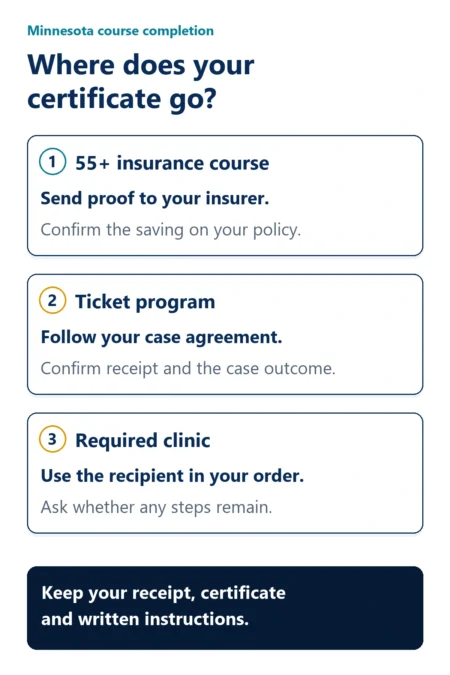
For insurance, send proof as your insurer directs. Ask whether it arrived and how your premium will change. Check the next policy notice or bill that should show the saving. If it is missing, follow up with your saved proof.
For a ticket agreement or required clinic, send proof to the named person or office in the form it asks for. Ask whether the school sends proof and whether you must send a copy too. Keep proof that it arrived. Then ask the office whether you have more tasks to finish.
If you finish the wrong course, explain the mistake to the insurer or referring office before buying another. Ask whether it accepts the certificate or requires a different class. Separately, ask the provider about its refund or transfer policy. Acceptance and refunds are different questions.
Choose the course only after its purpose is clear
Before enrolling, confirm who will use the certificate and which course and format it accepts. For the 55+ insurance benefit, start with the DVS accident-prevention directory. For a ticket or clinic order, start with the office handling your case. Save the instructions with your receipt, then keep the certificate until you confirm the expected result.
Related Reading
- Checks before paying for online traffic school
- How traffic school insurance discounts work
- Compare traffic school rules by state
Sources
- Minnesota Statutes Section 65B.28 — accident-prevention premium reductions
- 2024 Minnesota Laws, Chapter 104, Article 1, Section 3
- Minnesota Rules 7411.7700 — qualification and continuing eligibility
- Minnesota DVS — approved accident-prevention courses
- Minnesota Rules 7411.7600 — approval, records, and certificates
- City of Minneapolis — diversion programs, Traffic Education
- Minnesota Safety Council — four-hour online defensive driving
- Minnesota Statutes Section 169.89, subdivision 5 — driver improvement clinic attendance
- Minnesota Judicial Branch — traffic issues
- Minnesota Rules Chapter 7411 — driver improvement clinics, parts 7411.5200 and 7411.5700
- Minnesota Rules 7409.2200 — license suspension and repeated convictions
Last updated: October 5, 2026