

Nebraska Defensive Driving Course: Eligibility, Benefits, and Approved Options

Match the exact course and format to your attendance reason before enrolling.
A Nebraska defensive driving course can earn eligible drivers a DMV point credit, satisfy required DMV training, or serve an approved local ticket-diversion program. The course you need depends on your reason for attending: these programs have different eligibility rules, deadlines, and results. 7, 12
Start with the outcome you need, then choose the course. A class advertised as “defensive driving” is not enough information to know whether it will count for your license, ticket, or insurance policy.
General information only: This guide explains Nebraska programs and a labeled local example. It is not legal advice. Follow your DMV notice, court directions, or diversion agreement for your case.
Which Nebraska course do you need?
Choose the program by who needs proof of completion and what you want that proof to accomplish.
| Your situation | What completion can do | Where to start |
|---|---|---|
| You want voluntary credit for existing points | Reduce eligible points under Nebraska’s voluntary-credit rules | DMV point-credit rules and certified course directory |
| You are under 21 and received a six-point notice | Satisfy required training to prevent the stated suspension | Your DMV notice and underage-21 instructions |
| Your license was revoked for points | Satisfy one reinstatement requirement | DMV point-revocation checklist |
| You received a ticket and want STOP diversion | Lead to dismissal through an eligible local program | Program handling the jurisdiction where the ticket was issued |
| A court specifically ordered a class | Meet the terms of that order | Court handling your case |
| You want an insurance discount | Qualify only if your insurer accepts you and the course | Your insurer before registration |
The DMV routes are documented in its 7. Local dismissal requires a separate diversion process; Nebraska law allows county and city attorneys to establish those programs with the appropriate governing body’s concurrence. 8
If you already have paperwork, write its stated attendance reason next to the course name before booking. For a court order, ask the court to confirm the exact class, format, deadline, and proof it requires. Compare those details with the provider’s registration page.
Voluntary point credit: check your record and timing first
Nebraska’s voluntary program can reduce two points assessed within the previous two years, or one point if only one was assessed during that period. You must have fewer than 12 points and successfully complete a DMV-approved driver improvement course. The credit is allowed once within a five-year period. 1
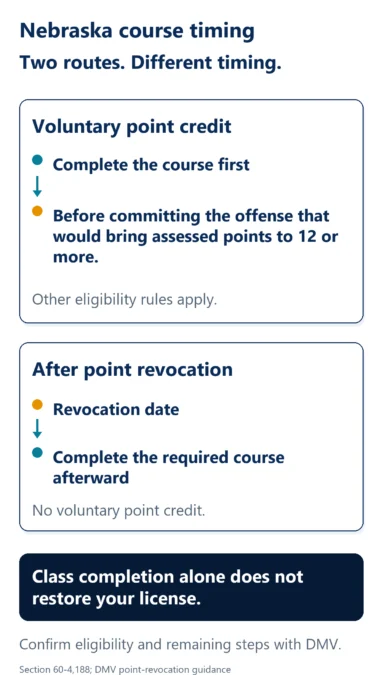
The timing is stricter than “take a class before you reach 12 points.” You must finish before committing the offense that would otherwise bring your assessed total to 12 or more points. Taking a course after that offense does not satisfy this condition merely because the conviction has not yet reached your record. 1
Required attendance under the listed DMV provisions does not qualify for this voluntary credit. That includes the under-21 and point-revocation courses discussed below. The conducting organization sends completion notification to DMV. 1
Check your current point total, prior credit use, and any pending ticket before spending money. If you are close to 12 points, give DMV the pending violation’s date when asking whether you can still qualify. A course seller cannot decide how that offense affects your eligibility.
Credit also does not erase a conviction. DMV says convictions remain on the driving record for five years and points are assessed upon conviction using the violation date. 2
For young drivers, another distinction matters: DMV says voluntary credit does not undo the points already assessed for the provisional-permit rule governing eligibility for a Class O license. An under-18 POP holder should confirm the Class O requirements separately rather than treating a lower point total as permission to upgrade. 2
Under 21 with a DMV notice: this is required training
Drivers under 21 who hold an operator’s license or provisional operator’s permit and accumulate six or more points within any 12-month period must complete an approved driver improvement course. The minimum is four hours. Failure to finish within three months after the notification date leads to suspension. 3
Use the DMV notification date for this deadline, not the ticket date or the day you decide to enroll. Keep the notice available while registering so the school can identify the required attendance reason.
This course does not give you the voluntary two-point credit. DMV says the school submits completion electronically and that submission usually takes three to five business days after completion. Provide your full name, date of birth, and Nebraska license or POP number accurately. 4
If suspension has already occurred, follow the reinstatement instructions rather than assuming your certificate alone restores driving privileges. DMV lists a $50 reinstatement fee for completion after suspension, with an additional $3 for online payment. At age 21 the course is no longer required, but DMV still lists the reinstatement fee. 4
After a point revocation, the class is one reinstatement step
Nebraska law requires revocation when a driver accumulates 12 or more points within two years and requires an approved driver improvement course before reinstatement. The course has a minimum of four instructional hours. 5
For this route, DMV says the course must be completed after the revocation date. It does not earn voluntary point credit. That is a different timing rule from the voluntary program, where completion must precede the offense that would bring the total to 12 points. 6
Reinstatement also involves requirements beyond class attendance. DMV’s checklist includes proof of financial responsibility, normally an SR-22, a $125 reinstatement fee, and testing and application for a new license. Read the 6 for the surrender, reporting, insurance, and other requirements that apply.
Book the correct course using your revocation paperwork. After completion, confirm both that the school submitted the result and that your remaining reinstatement requirements are satisfied. A completed class is not itself confirmation that you may drive again.
STOP diversion can dismiss an eligible ticket
STOP is a local ticket-diversion route, not the voluntary DMV point-credit program. Nebraska’s minor-traffic diversion framework requires a DMV-approved safety curriculum and gives the program administrator responsibility for eligibility. It limits participation to once in any three-year period in Nebraska. 10
That three-year rule is easy to confuse with the voluntary point-credit program’s five-year limit. Tell the administrator about prior ticket-diversion attendance, including attendance elsewhere in Nebraska, instead of checking only whether you recently used DMV credit.
State law excludes several offenses from the minor-traffic category, including speeding 20 or more mph over the limit, injury accidents, specified impaired-driving offenses, reckless or willful reckless driving, and driving on a suspended or revoked license. Local acceptance still needs checking even if your violation is not one of those examples. 9
For example, Lancaster County offers a four-hour or online STOP course for eligible minor citations. Its program page lists a $100 nonrefundable in-person registration payment and additional card-processing fees. Registering within ten business days after receipt of the ticket avoids court costs; later in-office registration requires court costs. Its exclusions also include texting and school-bus violations. These are Lancaster County terms. 12
Lancaster’s online FAQ states a stricter online enrollment instruction: register within ten business days by 5 p.m. after receiving the citation, then finish by the court date printed on it. Confirm the current online enrollment arrangements with the program if your registration window is close or has passed. 13
Have the local program determine your eligibility first. Then register through its designated route, pay the required program charges, and complete all conditions. Buying an unrelated online class does not establish enrollment in diversion.
Lancaster says the school transmits online completion to the courthouse and the ticket is then dismissed. Keep your completion certificate and confirm the case outcome. If your citation came from another jurisdiction, start with that jurisdiction’s program rather than registering through Lancaster. 13
CDL and CLP holders need a separate eligibility check
The current DMV directory says CDL and commercial learner’s permit holders are not eligible for STOP or the two-point credit class. Treat that as the DMV’s published program guidance even if a provider registration page lets you select a course. 7
The diversion statute expresses the commercial-license restriction conditionally, referring to federal-law noncompliance and possible loss of federal funds. It should not be read as permission to bypass DMV’s published restrictions. Ask the responsible agency or program about your case, including a ticket received in a personal vehicle. 11
These restrictions do not mean a commercial driver can ignore required training. Use the instructions for the requirement you actually received.
Find approved options for your attendance reason
Use DMV’s current certified-course directory for DMV training, then confirm the exact class with the listed organization. Examples of organizations in that directory include National Safety Council, Nebraska; Nebraska Safety Council; Nebraska Safety Center; Road-Ready Driver Training School; and Pass Drivers Ed. The directory expressly lists online English or Spanish options for the two safety councils. 7
Those names are starting points, not a ranking. An organization can sell several classes, so match the specific course and delivery format to your attendance reason. “STOP,” “under 21,” and “reinstatement” on different registration pages are meaningful distinctions.
For a concrete price example, National Safety Council, Nebraska advertises its under-21 course at $120 for four hours, with in-person classes in Omaha and Lincoln and an online option. That is one provider’s offer for that program, not a statewide course price. 15
When comparing eligible choices, ask about the total charge, earliest available completion date, language, identity requirements, test or participation requirements, refund terms, and how the result is reported. If you need help accessing an online class, resolve that before choosing it solely for convenience.
Nebraska’s relevant DMV statutes set a four-hour minimum; a particular approved class can be longer. Use the current directory and your program instructions to verify format rather than assuming all Nebraska classes require eight hours in a classroom. 1, 7
Ask your insurer before paying for a discount
The Nebraska Department of Insurance says completing defensive driving may qualify you for a discount. Its guidance does not promise a universal discount amount or establish that every course qualifies. 14
Ask your insurer to confirm your eligibility, the exact accepted course and format, whether required attendance counts, the dollar savings, the discount period, and where to send proof. Keep the response with your course receipt so you can follow up with the same details afterward.
For insurance-only attendance, compare the confirmed savings with the full course cost. For example, if an insurer confirms $30 in annual savings for two years and the class costs $80, the discount alone leaves you $20 behind. This is hypothetical arithmetic, not a Nebraska discount quote.
If the course is required for your license or court case, complete that requirement regardless of whether a discount is available. Ask about an insurance benefit as a separate question.
Finish the process by checking the result
Keep your registration confirmation, receipt, and certificate together. Then check the outcome with the organization that controls it:
- Voluntary credit: confirm that DMV received the school’s report and applied the eligible credit.
- Required DMV training: confirm course reporting and your remaining license-status requirements.
- STOP diversion: confirm the completion report and dismissal with the local program or court.
- Court order: confirm that the required proof reached the court through its specified channel.
- Insurance: confirm that your insurer applied any promised discount.
DMV publishes a usual three-to-five-business-day electronic reporting period for its under-21 and point-revocation courses. That is not a guaranteed date for every course outcome. 4, 6
If the expected result is missing, contact the school with your completion details, then the receiving agency or program. Ask whether the problem is an unsubmitted report, mismatched identifying information, or an unmet requirement.
Keep the certificate until the point adjustment, license requirement, case dismissal, or insurer discount has been confirmed.
Related Reading
- Traffic school rules by state
- How license points and course credits differ
- Checking insurance savings before enrolling
- How to check an online course before paying
Sources
- Nebraska Revised Statute 60-4,188 — voluntary driver improvement and point reduction
- Nebraska DMV — Nebraska point system
- Nebraska Revised Statute 60-4,130.03 — under-21 required course
- Nebraska DMV — underage-21 point accumulation suspension
- Nebraska Revised Statute 60-4,183 — point revocation and required course
- Nebraska DMV — point revocations
- Nebraska DMV — certified driver education and training courses
- Nebraska Revised Statute 29-3602 — establishment of diversion programs
- Nebraska Revised Statute 29-3605 — minor traffic violations
- Nebraska Revised Statute 29-3606 — minor-traffic training and frequency
- Nebraska Revised Statute 29-3608 — commercial-license eligibility
- Lancaster County — Safety Training Option Program
- Lancaster County — STOP online FAQ
- Nebraska Department of Insurance — premium factors and savings
- National Safety Council, Nebraska — under-21 course offer
Last updated: October 8, 2026