


Utah Defensive Driving Course: Eligibility, Benefits, and Approved Options

A Utah defensive driving course can help with points, a traffic case, or an insurance discount. But the course accepted for one purpose may not qualify for another. Paying for a class before you identify the right program can leave your original problem unresolved.
Start with the result you need. The Driver License Division (DLD) controls point credit. Courts set the terms of their traffic-school deals. Utah also has a separate Deferred Traffic Prosecution program. The insurance benefit has its own age, policy, and course rules. 1 3 10
Check who accepts the course before you pay, and confirm the result after you finish.
General information only: This guide explains Utah programs and official instructions. Your court agreement, DLD notice, and insurance policy may require case-specific steps.
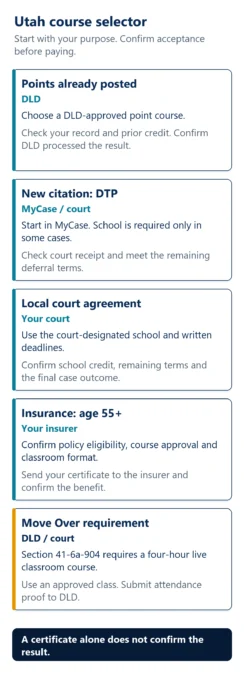
Which Utah course fits your situation?
Quick answer: A DLD-approved defensive driving course can reduce your existing point total by up to 50 points once in three years. Court traffic school may be a condition of resolving a pending ticket. For qualifying drivers 55 or older, a motor vehicle accident prevention course supports a required insurance premium reduction. These benefits have separate requirements. 1 2 5 10
| Your situation | Route to check | What to verify first |
|---|---|---|
| Points are already on your Utah record | DLD-approved defensive driving course | Your point total, prior course credit, and the exact course’s point-reduction approval |
| You have a new moving-infraction citation | Deferred Traffic Prosecution through MyCase | Eligibility, application timing, and whether the system requires its traffic-school course |
| Your court offers traffic school with a plea in abeyance | That court’s agreement and designated school | Written terms, provider, deadlines, fees, and the promised case outcome |
| You are 55 or older and want an insurance benefit | Qualifying motor vehicle accident prevention course | Named-insured/principal-operator status, course approval and format, and insurer certificate instructions |
| Your case involves Section 41-6a-904, including Move Over duties | Required live classroom course | Approval by DLD or a Utah court, attendance deadline, and certificate submission to DLD |
The first four routes are explained below. The last has a specific live-classroom requirement that makes ordinary online-course advice unsuitable. 12
Reducing points already on your Utah record
Utah’s point program follows Administrative Rule R708-3. Finish the course that meets the rule, and you can receive a 50-point decrease once in a three-year period. DLD describes the benefit as a maximum of 50 points. 2 1
DLD accepts the point-reduction courses through the Utah Safety Council or National Safety Council. Its published guidance permits either a live four-hour class or an online course for this purpose. 1
Check the exact course, even if you know the school by name. A school can offer several courses, and a court may send drivers to a different program. Ask DLD or the school which option gives Utah point credit.
What the credit changes
The point decrease changes your point total. It does not provide a court dismissal of the underlying conviction. R708-3-6(1) and R708-3-8(1) separately direct DLD to post moving-violation convictions and their points. 2
Example: If you have 120 points and qualify for the full 50-point decrease, that leaves 70 points. Your own result depends on what is posted, which points have dropped with time, and whether you have used the course credit before.
Age matters when your license is at risk. R708-3 sets a hearing threshold of 200 points for drivers 21 or older and 70 points for drivers 20 or younger. If course credit brings you into a lower range, DLD may consider action at that lower threshold. That does not promise to cancel a hearing or suspension already in place. 2
If DLD has sent you a notice, follow it and ask what a course can do in your case. Keep meeting the notice’s deadlines while you arrange the class.
What to check before registering
Get your record and identify the points you want reduced. DLD offers motor vehicle records online, in an office, and by mail. Ask the division if you need help confirming your current point total or the date of a previous course credit. 13
Then confirm:
- The course qualifies for DLD point reduction.
- You have not already used that benefit within the applicable three-year period.
- Your chosen format meets any separate requirement in your DLD or court notice.
- You know where to submit proof and how to verify the credit afterward.
Points can also fall with time. R708-3 provides a 50% decrease after one year of violation-free driving and a 100% decrease after two years. Points for each violation drop three years after it occurred. DLD describes the one- and two-year cuts in terms of driving without a moving-violation conviction. 2 1
Use your own record and DLD’s guidance to work out your total. Each type of point decrease has its own timing; they do not all start on the same date.
A new ticket: check Deferred Traffic Prosecution
Utah’s Deferred Traffic Prosecution (DTP) program is a separate option under Section 77-2-4.2. It uses a deferred no-contest plea and can lead to dismissal after the 12-month deferral period if the statutory conditions are met. Some eligible cases require traffic school, while others do not. 3
Start in Utah Courts’ MyCase process, rather than buying an unrelated defensive driving course. The court website directs drivers to wait at least five days after receiving the citation and register within 21 days of receipt. MyCase checks eligibility. 4
Who should check this route?
The statute excludes drivers under 21, CDL holders, and people without a current Utah driver license. It also sets detailed restrictions based on the offense, recent convictions, and the number of moving infractions from the same incident. 3
The traffic-school branch allows some cases that do not qualify for ordinary DTP. Section 77-2-4.2(6) lists four limited situations: one or fewer moving-infraction convictions in the 24 months immediately before the current citation, two moving infractions from one incident, an accident without serious bodily injury or death, or speeding 20-30 mph over the limit without exceeding twice that limit. If more than one of those conditions applies to you, you cannot use that branch. Other exclusions still apply. 3
That is a screening outline, not a complete eligibility test. Enter the citation in MyCase and ask the court about a disputed or unclear result. Being willing to attend school does not by itself qualify a case.
Costs, school, and the deferral period
Utah Courts lists the ticket fine plus a $5 registration fee for DTP. Where online traffic school is required, its instructions list an additional $40 school fee and completion within 28 days. The statute ties the school-completion period to the application for traffic-school deferred prosecution. 4 3
Read the due dates shown when you apply. The first signup window runs from the citation; the school deadline is a later step. Save your application, receipt, course directions, and proof that you finished.
The law requires the Department of Public Safety to ensure that the program allows its traffic-school provider to transmit successful completion to the court electronically. Check that MyCase or the court shows that you met the school requirement. 3
Finishing the class does not end the full deferral period. You must still meet the terms through that period. A conviction for another traffic violation during the deferral period requires the court to enter a judgment of conviction for each deferred traffic infraction. Follow the court’s instructions if you get another citation while enrolled. 3
Court traffic school and a plea in abeyance
Your court may offer a plea in abeyance even if DTP is unavailable. A plea in abeyance holds a guilty or no-contest plea while you complete an agreement’s conditions. 6 Section 77-2a-3 requires consent from both the prosecutor and defendant. 5
Traffic school may be one condition. Read the agreement’s outcome too: the statute allows agreements providing for dismissal or a reduction to a lesser offense with a conviction. Do not assume every plea in abeyance promises dismissal. 5
Local examples show why the court comes first
| Court | Published traffic-school instructions | Practical consequence |
|---|---|---|
| Salt Lake City Justice Court | Lists a $25 plea-in-abeyance fee in addition to the violation fee, a $65 online school fee, and school completion within 90 days. The payment receipt supplies an authorization code. | Confirm qualification and use the court’s enrollment process. |
| Lehi Justice Court | Requires the agreement and citation payment plus a $25 fee within 29 days of receiving the citation. Lists a $65, three-hour online course, with completion and certificate submission within 90 days of receipt of the agreement. | The initial agreement deadline and later completion deadline have different triggers. |
These are local examples, not a Utah-wide fee or timetable. Both courts publish additional eligibility conditions. Lehi’s instructions expressly require submitting the plea-in-abeyance form before registering for school or paying the fine. 8 9
Ask your own court which course it accepts, what you must pay, when each step is due, and whether you need to request dismissal after completing all conditions. Utah Courts notes that some courts require a motion to dismiss rather than automatically closing the case. 6
If you fail to substantially comply, Section 77-2a-4 allows the court, after the applicable hearing process, to terminate the agreement and enter a conviction and sentence. A course certificate cannot replace the other terms. 7
Dismissal also does not mean every case record disappears. Utah Courts distinguishes dismissal from expungement and flags possible CDL consequences even when charges are ultimately dismissed. CDL holders should obtain case-specific guidance before entering an agreement. 6
Insurance benefits for drivers 55 or older
Section 31A-19a-211 requires an appropriate premium reduction for an eligible driver who finishes the qualifying accident prevention course. You must be 55 or older, a named insured, and the covered car’s principal operator. The benefit applies to liability, personal injury protection, and collision coverage on private passenger policies. 10
The law sets no statewide discount percentage. The benefit lasts three years after you finish the course, and the school must issue a certificate. A course taken as a penalty imposed by a court or other government entity for a moving violation is excluded. 10
If you hope one required class will also earn the insurance benefit, ask your insurer about this exclusion. Explain why you are taking the course so the insurer can assess the actual facts.
Check the course format and approval
Administrative Rule R708-20 requires the course sponsor to get Department of Public Safety approval. It sets a minimum of four hours of classroom instruction. You must finish within 30 days of enrolling. 11
The online allowance for ordinary point credit is a different rule. An online school’s claim about insurance savings does not prove that its course meets the classroom rule. Before paying, ask your insurer and the school to confirm approval of the exact course and format for this benefit. 11 1
Have the insurer answer four practical questions:
- Do I meet the named-insured and principal-operator requirements for this vehicle?
- Which qualifying course and format should I use?
- What reduction applies to the specified coverages on my policy?
- How do I submit the certificate and confirm the benefit’s start and end dates?
Your insurer may set a condition for keeping the benefit: no conviction or guilty/no-contest plea for a moving violation that can carry license points. The law preserves an exception for a violation under Section 53-3-221(12). Ask the insurer how this condition applies to you. 10
If you are younger than 55, ask your insurer whether it offers a voluntary course discount and which product it accepts. The senior statute does not establish a mandatory course discount for your age group.
Move Over cases require a live classroom course
If you violate Section 41-6a-904, subsection (7)(a) requires a four-hour live classroom defensive driving course. DLD or a Utah court must approve it. You must give DLD the attendance certificate. 12
Subsection (7)(b) sets a narrower suspension rule for violations of subsections (1) through (3). If you fail to finish the course within 90 days of sentencing or pleading guilty to one of those violations, DLD must suspend your license for 90 days. The attendance rule covers more of the section than this suspension trigger. 12
If DLD receives the required attendance certificate before that suspension ends, it must shorten the suspension effective immediately. Reinstatement fees still apply. 12
Use the court or DLD notice to arrange the correct class and submission. An ordinary online point-reduction course does not satisfy the statute’s live-classroom requirement.
Choosing a course and finishing the paperwork
For point reduction, begin with DLD’s accepted course guidance and confirm the exact Utah Safety Council or National Safety Council product. For DTP, use the school assigned through the court system. For a local plea in abeyance, use the school your court designates. For insurance, confirm the approved accident prevention course and your insurer’s requirements.
Compare costs once you know the course is accepted. Count court charges, tuition, and any fees for your certificate or its delivery. A cheaper course is useful only if it produces the result you need.
Certificate handling can differ. Utah Safety Council’s FAQ says its online students must notify the party requiring completion; it does not notify that party for them. The statutory DTP program must allow its school provider to transmit completion electronically to the court. Follow the instructions for the program you actually took. 14 3
After you finish, check with the agency, court, or insurer handling your result:
- DLD: Check that the point credit or required attendance proof was received and processed.
- Court: Confirm school credit, remaining agreement conditions, and the eventual case disposition.
- Insurer: Submit the certificate and obtain confirmation of the applicable premium reduction.
Keep your certificate, receipts, agreement, and submission confirmation together until the expected result is confirmed.
Related Reading
- How license points differ from conviction records
- Checking a traffic-school insurance discount
- Compare traffic-school routes in other states
Sources
- Utah Driver License Division – Utah Points System, Defensive Driving Course section.
- Utah Administrative Rule R708-3 – Driver License Point System Administration, Sections 3, 5, 6, and 8.
- Utah Code Section 77-2-4.2, subsections (1), (5)-(11).
- Utah Courts – Deferred Traffic Prosecution and Traffic Online Dispute Resolution, DTP instructions.
- Utah Code Section 77-2a-3, subsections (2), (3), and (7).
- Utah Courts – Pleas in Abeyance.
- Utah Code Section 77-2a-4, subsection (1).
- Salt Lake City Justice Court – Traffic Citation Information.
- Lehi Justice Court – Traffic School Plea in Abeyance.
- Utah Code Section 31A-19a-211, subsections (1), (3)-(5).
- Utah Administrative Rule R708-20 – Motor Vehicle Accident Prevention Course Standards, Section 3.
- Utah Code Section 41-6a-904, subsection (7).
- Utah Driver License Division – Driving Record (MVR).
- Utah Safety Council – DDC Frequently Asked Questions, online completion-notification instructions.
Last updated: October 6, 2026