


Kentucky Defensive Driving Course: Eligibility, Benefits, and Approved Options

A Kentucky defensive driving course may be part of handling a ticket, protecting your license, or qualifying for an insurance reduction. Choosing by price alone can leave you with a certificate that does not solve your problem.
Start with your court or licensing paperwork, or the insurance benefit you want. Kentucky State Traffic School, county-attorney diversion, and mature-driver insurance courses follow different rules. This guide helps you identify the right program, check approval, and confirm the result after you finish.
General information only: This guide explains Kentucky programs and official procedures. It is not legal advice about your case or a guarantee of an insurance outcome.
Start with your reason for taking a course
| Your situation | Where to start | What you are trying to accomplish |
|---|---|---|
| You received a ticket and want State Traffic School | The court handling the citation | Obtain a referral and avoid points for the covered violation after successful completion |
| Your county offers traffic diversion | The county attorney handling the case | Meet the local agreement’s requirements for a possible dismissal |
| You received a license hearing or probation notice | Kentucky Transportation Cabinet | Follow the hearing decision and any required driver improvement clinic |
| You are 55 or older and want an insurance reduction | Your insurer and Kentucky’s approved mature-driver course list | Complete the qualifying accident-prevention course and submit proof |
| You need a course for your first unrestricted license | Kentucky’s Graduated Driver Licensing program | Meet the separate new-driver education requirement |
The first three routes involve a ticket or licensing action. The insurance route has its own eligibility rules. New-driver education also has a separate curriculum; it should not be substituted for a traffic-offender course simply because both appear on a provider’s website. 1 6 8 11
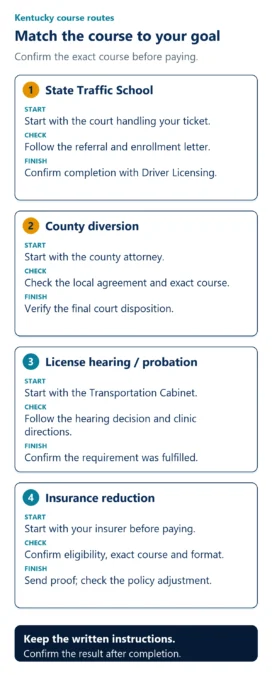
For a ticket, ask the clerk or county attorney which program is being offered before paying for a class. For insurance, ask the insurer to confirm the exact course and delivery format in writing. Keep that answer with your receipt and eventual certificate.
State Traffic School starts with a court referral
Kentucky’s State Traffic School operates under KRS 186.574. A District Court judge may sentence an otherwise eligible driver to the program. Successful completion prevents points from being assessed for the covered violation. The statute describes this as a sentence following a conviction, rather than an automatic dismissal of the charge. 1
That distinction matters when comparing your options. Ask what disposition the court will enter and what costs remain due. A class advertised as “Kentucky approved” does not give you permission to use State Traffic School in your particular case.
Check eligibility before choosing a class
The ordinary State Traffic School route requires a valid license at the time of the violation. A suspended or revoked license and an offense carrying mandatory suspension or revocation generally prevent eligibility. The ordinary frequency limit is once in a one-year period. Referral remains the judge’s decision. 1
There are statutory exceptions. KRS 189.990(28) permits a court to refer a licensed driver under 18, before trial, to a diversion program for a moving violation under Chapter 189. That program can involve an agreement not to drive for up to 45 days, attendance at a driver improvement clinic, or both. Under the no-driving agreement, the court may hold the driver’s license during that period. Satisfactory completion leads to dismissal under that provision. If you are a parent handling a teen’s ticket, ask whether the court is offering this particular diversion route. 2
Kentucky’s agency page says out-of-state drivers are ordinarily ineligible for State Traffic School, but its FAQ also addresses a specific court order to attend. If your license is from another state, contact the Kentucky court and your home licensing agency before enrolling. You need case-specific directions rather than a provider’s general assurance. 3
Follow the referral and enrollment letter
The court sends the referral to the Division of Driver Licensing. The division mails enrollment instructions to the address on your license. Online enrollment requires that letter. 3
Save the referral, write down its date, and check that the mailing address is correct. If the letter has not arrived, call the Division of Driver Licensing at 502-564-1257. Ask how to enroll within the required period; waiting for mail is not a reason to assume the deadline has moved. 3
Once referred, you are complying with a court order. Missing the requirement can lead to license denial or suspension and can also be punished as contempt under the statute. Contact the agency promptly if you cannot attend or finish as directed. 1
Online completion and classroom enrollment have different deadlines
Kentucky publishes two State Traffic School options with different timing instructions: 3
| Option | Published course fee | What must happen within 30 days of the referral/conviction date |
|---|---|---|
| Online State Traffic School through the agency’s RightLane link | $39, nonrefundable | Complete the course |
| Classroom State Traffic School | $15, nonrefundable | Enroll in the class |
The classroom session is four hours. Kentucky says scheduling can take up to six weeks, and sometimes longer in rural areas. That waiting period does not turn the classroom enrollment deadline into a completion deadline. Keep proof that you enrolled, then attend the session assigned to you. 3
For example, if you choose a classroom session scheduled after the 30-day period, confirm that your enrollment was accepted on time. If you choose online study, scheduling your work for a later week does not satisfy a requirement to finish within that period. Use the date in your referral and contact the division if your documents appear inconsistent.
Budget for more than the course fee. Ask the court for the full amount due under your disposition, including any court costs. The State Traffic School statute retains court costs in the ordinary sentencing route. 1
A Zoom class still requires full attendance
Kentucky also publishes requirements for virtual State Traffic School participation. The Zoom protocol requires a workbook and a computer with a working camera and microphone. Phones, tablets, and iPads are not permitted. Participants must attend the full four-hour session, keep their face visible, and sit upright at a desk or table in a quiet, well-lit space with no one else present; attending from a vehicle is prohibited. 4
Check your equipment before accepting that format. A class you can attend from home may still require a particular device and uninterrupted time. Ask the division about available arrangements if you cannot meet the requirements.
Kentucky permits one rescheduling of a scheduled State Traffic School class. Its guidance warns that missing a class results in suspension and directs affected drivers to the division. Make contact before the appointment whenever possible, and confirm both the new class arrangement and your license status. 3
Avoiding new points is different from removing old points
State Traffic School’s statutory benefit is nonassessment of points for the covered offense after satisfactory completion. It does not establish a general credit that you can buy to subtract points from earlier violations. 1
Kentucky says assessed points expire two years after conviction, while the conviction entry remains for five years. Those are different clocks. A lower point total does not, by itself, tell you whether an older conviction is still on the record. 5
If points are already present, identify which conviction produced them. Ask whether the entry is accurate and whether the course referral applies to that case. Keep copies of the court order and completion proof when requesting a correction; an unrelated certificate is not evidence that those points should disappear.
A license hearing is another process
The Transportation Cabinet conducts hearings at the applicable accumulation thresholds: 12 or more points within two years for drivers 18 or older, and seven or more for drivers under 18. A hearing officer may grant probation in place of suspension under the governing conditions. Probation can require a driver improvement clinic; failure to enroll and finish can lead to suspension. 6
If you received a hearing notice, follow its instructions and attend. Ask the hearing officer which course is required and how completion will be recorded. Buying an insurance class or independently finishing a traffic course does not replace the hearing decision.
Record visibility has limits, especially for commercial drivers
Kentucky’s State Traffic School FAQ says attendance does not appear on the three-year public driving record but does appear on the five-year record used by courts, law enforcement, and other government agencies. This is a statement about attendance visibility; it should not be read as a promise that every trace of the case is erased. 3
If you hold a CDL or the ticket involved a commercial vehicle, ask about conviction reporting. The agency says moving convictions must be recorded when the driver holds a CDL or the violation occurred in a commercial motor vehicle. State Traffic School can prevent points but does not prevent the conviction from appearing. The statute also expressly requires the offense to appear for a referred driver who holds or is required to hold a CDL. 3 1
Ask about record treatment using your license type and the vehicle involved. Do not rely on a general “keep your ticket off your record” sales statement. Point protection and conviction reporting answer different questions.
County-attorney diversion can offer a dismissal route
KRS 186.574(6) separately authorizes county-attorney traffic safety programs before adjudication. It excludes specified cases, including DUI, violations of KRS 304.39-080, CDL holders, and the license-status or mandatory-suspension categories identified in the statute. 1
Your local program sets the remaining participation instructions. For example, McCracken County’s official program page describes dismissal after successful completion. Its mailed letter indicates that the citation and history have been reviewed for qualification; a postcard means further eligibility checks are still needed. 7
That example applies to McCracken County. It does not establish the enrollment method, price, or deadline elsewhere.
When offered county diversion, ask:
- Which charge or charges does the agreement cover?
- Must you register before a court date, and is an appearance still required?
- Which provider and exact course must you use?
- What is the full amount due, and what is the completion deadline?
- Who supplies proof, and how will you confirm the final court disposition?
Read the agreement before paying. Keep a copy after completion and check that the court has recorded the promised outcome. A provider’s completion message confirms classwork; the court record confirms the disposition.
Insurance reductions use a separate qualifying course
Kentucky has a statutory premium-reduction program under KRS 304.13-063. It covers eligible insureds age 55 or older who complete a qualifying motor vehicle accident prevention course. It also covers insureds of any age who complete the specified U.S. Armed Forces defensive driving course provided to Armed Forces members. 8
The law requires an appropriate reduction for automobile liability and physical damage insurance for at least three years and up to five years. It sets no uniform percentage. A participant must take an approved course every five years to continue eligibility. A certificate is the basis for qualification; a course completed under a court order resulting from a motor vehicle conviction does not qualify for this statutory discount. 8
Ask your insurer for the dollar reduction, affected coverages, start date, and duration under your policy. Confirm how to send the certificate and when to check for the adjustment. A course discount does not guarantee that your total renewal premium will fall if other rating factors change.
Check course format as well as the provider name
The insurance statute excludes self-instructed courses and requires classroom or field driving instruction. 601 KAR 13:040 sets a minimum of four hours for that instruction and requires Transportation Cabinet approval. 8 9
Kentucky’s mature-driver page lists AARP, Kentucky Safe Driver, and RightLane as approved courses. The agency says listing is not an endorsement and advises drivers to consult their insurers about eligibility. That list is specific to the mature-driver program, rather than permission to use any product sold by those organizations for any purpose. 10
If an online product interests you, send its exact name and format to your insurer and, when necessary, the Division of Driver Licensing. Ask how that format satisfies the applicable requirements. The published legal text does not justify a blanket promise that every online mature-driver product qualifies.
Keep the reply. If the answer only says the company is approved, follow up about the specific class you intend to purchase. This is especially useful when a provider sells both court and insurance courses.
Compare the savings with the total price
Ask the insurer how many dollars you would save on the affected coverages. An advertised percentage alone will not tell you that.
Hypothetical example: A $30 class that produces a confirmed $40 annual reduction would recover its price within the first year. A $30 class producing only $8 a year would take almost four years to recover its price. Those figures illustrate the calculation; they are not Kentucky course prices or promised discounts.
Include any travel or time costs that matter to you. Confirm the benefit period before using several years of savings in the calculation, and keep the next course requirement separate from the current discount’s end date.
After completion, confirm the result you enrolled for
Save your certificate, payment receipt, enrollment instructions, and any court agreement. Then verify the outcome with the office that controls it:
- State Traffic School: confirm completion was accepted by the Division of Driver Licensing and resolve any missing submission or license-status issue.
- County diversion: ask the county attorney or clerk whether all agreement terms were met and check the court’s disposition.
- Hearing or probation: confirm the clinic requirement was fulfilled under the hearing officer’s directions.
- Insurance: submit the certificate as instructed and check that the policy adjustment was applied.
If something is missing, identify the case number, course, completion date, and intended benefit when making contact. Those details help distinguish a reporting problem from enrollment in the wrong program.
Before spending money, get one clear answer: Which exact course will count for the result I need? Keep that answer until the court, licensing agency, or insurer confirms the outcome.
Drive Wise. Spend Less. Stay Safe.
Related Reading
- How to keep a traffic ticket off your record
- Traffic school insurance discounts
- Is online traffic school legit? Checks before you pay
Sources
- Kentucky Revised Statutes, KRS 186.574, subsections (1)-(6).
- Kentucky Revised Statutes, KRS 189.990, subsection (28).
- Kentucky Transportation Cabinet, Kentucky State Traffic School.
- Kentucky Transportation Cabinet, State Traffic School Zoom Class Protocols.
- Kentucky Transportation Cabinet, Kentucky Point System.
- Kentucky Administrative Regulations, 601 KAR 13:025, Sections 6(1), 7(1) and (3), and 9(1)-(3) and (5) (hearing attendance, hearing officer, and suspension/probation decision).
- McCracken County, Traffic Safety Program.
- Kentucky Revised Statutes, KRS 304.13-063, subsections (1)-(6).
- Kentucky Administrative Regulations, 601 KAR 13:040, Sections 1, 2, 4, and 5.
- Kentucky Transportation Cabinet, Over 55 Driver Improvement Courses.
- Kentucky Administrative Regulations, 601 KAR 13:110, Section 1.
Last updated: October 5, 2026