


Florida BDI Insurance Discount: What Your Insurer Controls
Florida insurance statutes checked: September 1, 2026
A Florida BDI insurance discount is possible, but the reason you take the course matters. Florida law creates one optional insurance path for an approved driver-improvement course and a separate required path for certain insured drivers age 55 or older. Neither path turns an elected ticket course into an automatic premium discount.
That distinction is easy to miss when a course provider calls several products “traffic school” or “defensive driving.” The clerk, FLHSMV, and your insurer are solving different problems. A clerk handles a ticket election. FLHSMV approves course categories. Your insurer applies the rating rule to the driver, vehicle, and coverages on the policy.
Quick answer: Before enrolling, ask your insurer whether it offers a reduction under Florida Statutes section 627.06501 or whether you qualify for the age-55-plus reduction under section 627.0652. Confirm the exact approved course, eligible principal operator, covered vehicle, affected coverages, percentage or dollar effect, start date, proof requirement, and events that can end the benefit.
General information only: This guide explains Florida’s statutory framework. It does not quote your policy or your insurer’s current rate filing. Obtain written confirmation from the insurer or agent before relying on a discount.
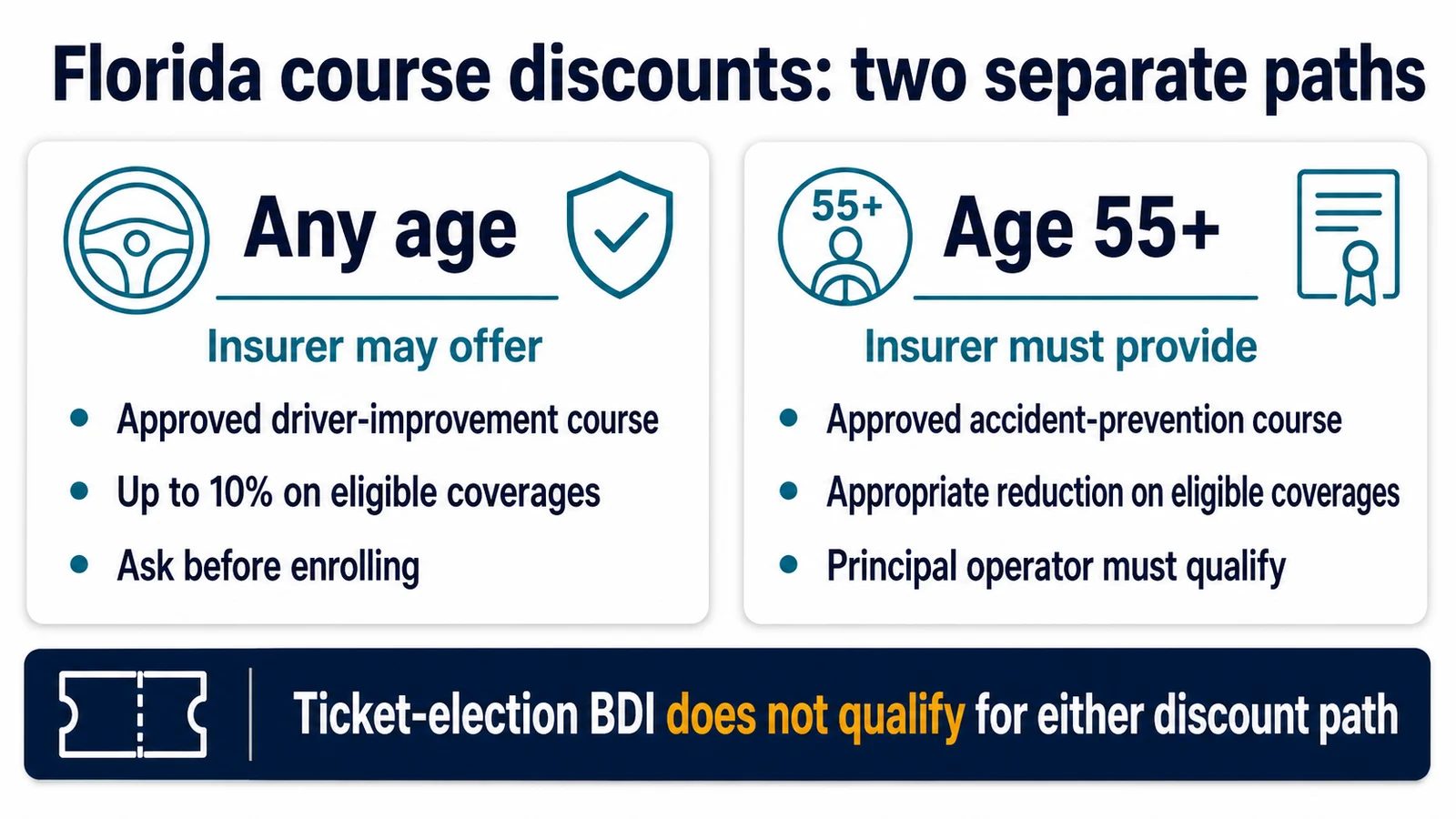
Florida Has Two Course-Based Insurance Paths
The two statutes use similar language but create different rights.
| Question | Approved driver-improvement course | Approved age-55-plus safety course |
|---|---|---|
| Controlling law | Florida Statutes §627.06501 | Florida Statutes §627.0652 |
| Who may qualify | Principal operator who meets the insurer’s filed rule | Insured principal operator age 55 or older |
| Must the insurer offer it? | No. A filing may provide a reduction | Yes. Filed rates shall provide an appropriate reduction when the statutory conditions are met |
| Course | FLHSMV-approved and certified driver-improvement course found effective under §318.1451(5) | FLHSMV-approved motor vehicle accident-prevention course for drivers 55 or older |
| Stated amount | Discounts of 10% or less are presumed appropriate; the statute sets no ceiling | “Appropriate reduction”; the statute sets no statewide percentage |
| Coverages named in law | Liability, personal injury protection (PIP), and collision | Liability, PIP, and collision |
| Duration | Three years after successful completion | Three years after successful completion |
| Ticket-election course eligible? | No | No if taken as punishment resulting from a moving violation |
The coverage list is important. Even when a percentage applies, it does not necessarily apply to the entire policy bill. Comprehensive coverage, fees, taxes, optional services, or another driver or vehicle may sit outside the statutory calculation.
The Any-Age Driver-Improvement Discount Is Optional
Section 627.06501 lets an insurer offer a discount. It does not make the insurer offer one. The principal operator must complete an FLHSMV-approved and certified driver-improvement course found effective in reducing crash or violation rates, or both, under §318.1451(5). Check the current FLHSMV BDI provider list for the course path your insurer names.
The word may controls this path. Florida authorizes the reduction; it does not require every insurer to offer it to every driver. The statute says: “Any discount, not to exceed 10 percent, used by an insurer is presumed to be appropriate unless credible data demonstrates otherwise.” That is a safe harbour, not a ceiling. A discount of 10% or less gets the presumption; a larger discount is not forbidden, but it must stand on supporting data.
That does not mean every approved four-hour BDI product unlocks 10%. It means the insurer must first have a filed rule that recognizes a qualifying course and your circumstances. The insurer’s rule can determine which course category, driver status, vehicle, proof, and coverage lines fit.
Ask these questions before buying:
- Do you currently offer a Florida driver-improvement course discount under section 627.06501?
- What exact FLHSMV-approved course or provider list do you accept?
- Must I be the principal operator of the covered vehicle?
- Which coverages receive the reduction?
- What percentage applies to those coverages, and what is the estimated dollar change for my policy term?
- When will it begin, and what certificate or submission method do you require?
If the representative cannot answer, ask for the underwriting or rating rule name and request written confirmation through the insurer’s secure message system or email.
Drivers Age 55 or Older Have a Separate Required Path
Florida Statutes section 627.0652 uses stronger language. Your insurer must lower the liability, PIP, and collision charges when all of this is true:
- the person is an insured age 55 or older;
- the person is the principal operator of the covered vehicle;
- the person successfully completes a course on FLHSMV’s Mature Driver Discount Insurance Courses list; and
- the course is not taken as punishment imposed by a court or government entity because of a moving violation.
The approved course must include a written test, and the provider issues a completion certificate. The benefit runs for three years after successful completion, subject to the insurer’s permitted maintenance conditions.
This path is required, but the statute does not set one universal percentage. It says: “Any discount used by an insurer is presumed to be appropriate unless credible data demonstrates otherwise.” FLHSMV puts the practical result plainly: “The amount of the discount is at the discretion of each insurance company.” Do not treat an advertisement for 10%, 15%, or any other number as Florida’s statewide rule.
Age alone is not enough
A 55-year-old named on a household policy may not be the principal operator of every vehicle. The statutory benefit is tied to the qualifying insured as principal operator on the covered vehicle. Ask the insurer to identify which vehicle and coverage charges will change.
The course category must match
An ordinary ticket-election BDI course and an age-55-plus motor vehicle accident-prevention course are not interchangeable merely because both discuss safe driving. Use the course category the insurer confirms and verify its current FLHSMV approval before paying.
A Ticket-Election BDI Course Does Not Create the Discount
Florida lets an eligible driver elect BDI for a noncriminal traffic infraction through the clerk. Section 318.14(9) says “adjudication must be withheld,” the qualifying penalty “must be reduced by 18 percent,” and points “may not be assessed.” Those are ticket and driving-record outcomes—not an insurance-discount certificate.
Section 627.06501 expressly excludes a driver-improvement course taken in lieu of a court appearance under section 318.14(9). Section 627.0652 likewise excludes an approved safety course taken as punishment specified by a court or other government entity resulting from a moving violation.
The voluntary insurance course does not use one of your ticket elections. Section 627.06501(4) says: “However, the eight-election restriction enumerated in that section is not applicable to taking the course for the purposes of receiving insurance premium reductions.” The once-per-12-month and eight-lifetime limits in §318.14(9) govern ticket elections, not a separate course taken for the insurance benefit.
This creates a practical rule:
Do not submit your ticket-election BDI completion certificate as if it automatically qualifies for a premium reduction. Ask whether a separate voluntary course and certificate are required.
The restriction on using an elected course for the discount does not mean the election has no insurance value. Withheld adjudication can matter differently from a conviction in an insurer’s rating process. But no-point treatment is not a guarantee of no premium effect, and the statutory course discount is a separate mechanism.
For the national distinction between court outcomes and policy discounts, read how traffic-school insurance discounts work.
What the Insurer Controls
Florida law sets the outer framework. The insurer’s filed rule and your policy data determine the calculation inside it.
The discount percentage
For the optional path, a discount of 10% or less is presumed appropriate. A larger reduction is not forbidden; it simply falls outside that statutory presumption. For the 55-plus path, the law requires an appropriate reduction but states no fixed percentage. Your insurer must provide the actual figure.
The affected coverage charges
Both statutes name liability, PIP, and collision. A quoted percentage may be applied to qualifying base charges within those coverages, not the total premium shown on the declarations page.
The principal operator
The driver completing the course must be the principal operator on the covered vehicle. A multi-driver policy can therefore produce a smaller or different result than a simple percentage of the household’s full bill.
The effective date and proof process
The statutes connect the three-year period to successful completion. They do not tell a consumer whether the insurer will apply the change midterm, from a certificate-received date, or at renewal under its administrative rules. Ask when the credit will first appear and check the updated declarations page.
Conditions for keeping the reduction
For both paths, an insurer may require the insured to avoid:
- an accident for which the insured is at fault; and
- a conviction or guilty or no-contest plea to a moving traffic violation.
Ask how the insurer defines and applies those conditions. Do not assume the benefit will continue for all three years after a new accident or violation.
How to Estimate the Real Dollar Benefit
Do not multiply the advertised percentage by the entire premium unless the insurer confirms that calculation.
Use this process instead:
- Find the six- or twelve-month premiums for liability, PIP, and collision on the declarations page.
- Ask which of those charges are eligible for the course reduction.
- Apply the insurer-confirmed percentage only to the eligible amount.
- Compare the projected three-year savings with the course fee and your time.
- Account for the discount ending early if a permitted maintenance condition occurs.
Example: Suppose a policy costs $2,400 per year, but the insurer says only $900 of named coverage charges qualify for a 5% course reduction. The first-year estimate is $45, not $120. That illustration is arithmetic, not a Florida average or a promise about any insurer.
For the age-55-plus path, ask for the insurer’s dollar estimate even if the representative gives you a percentage. It is the cleanest way to see the actual policy effect.
How to Claim a Florida Course Discount
1. Call before enrolling
Give the insurer your policy number, driver name, age, and vehicle. Ask which statutory path applies and request the exact accepted course description in writing.
2. Verify the course
Use the FLHSMV BDI list for the optional driver-improvement path and the separate Mature Driver Discount Insurance Courses list for the age-55-plus path. Match the exact provider and course category; do not rely on a generic “Florida approved” badge or search advertisement.
3. Complete the correct course and test
Follow the attendance and testing rules. Save the receipt, completion date, certificate, and any provider correspondence.
Both statutes require the course provider to issue a completion certificate: §627.06501(3) covers the optional driver-improvement path, and §627.0652(4) covers the age-55-plus path.
4. Submit proof where the insurer directs
Send the certificate through the insurer’s approved channel. Record the submission date and confirmation number. A provider’s report to FLHSMV or a clerk is not the same as delivery to the insurer.
5. Check the policy change
Review the endorsement or next declarations page. Confirm the driver, vehicle, coverage lines, amount, effective date, and expiration date. If the credit is missing, follow up before the policy-renewal window closes.
6. Calendar the three-year end date
Ask whether a new approved course is required to continue the benefit and how early you may complete it. Do not assume automatic renewal.
When Not to Enroll Yet
Wait if any of this is true:
- The insurer has not confirmed which statutory path applies.
- You are comparing a ticket-election BDI course with a voluntary insurance course as if they were the same product.
- The provider cannot be matched to the correct current FLHSMV list.
- The insurer will not identify the eligible driver or vehicle.
- You are relying on a percentage without knowing the affected coverage base.
- The projected savings do not justify the course cost and time.
- You need the course for a court or license requirement and assume it also earns the insurance benefit.
If your immediate problem is a citation rather than a premium discount, start with the statewide traffic-school-by-state guide and follow the clerk’s instructions. The insurance decision comes after the ticket-purpose decision is clear.
Florida BDI Insurance Discount FAQs
Does Florida require insurers to give a defensive-driving discount?
Yes, for one group. If you are 55 or older, drive the car as the main driver, and finish an approved safety course, your insurer must lower the rate. For the broader driver-improvement path, insurers may offer a discount but are not required to do so.
Is the Florida BDI insurance discount 10%?
Not automatically. The optional driver-improvement statute does not promise 10%—and it does not forbid more. It gives a presumption of appropriateness to discounts of 10% or less. The age-55-plus statute requires an appropriate reduction but sets no statewide percentage.
Can I use the BDI course I elected for a traffic ticket?
Not for the statutory course discount. Florida law excludes a driver-improvement course taken through the ticket-election path. The mature-driver provision separately excludes a course taken as government-imposed punishment for a moving violation. A voluntary insurance course does not count against the eight-lifetime ticket-election limit.
How long can a Florida course discount last?
Both statutory paths describe a three-year period after successful completion. An insurer may condition continued eligibility on avoiding an at-fault accident and a moving-violation conviction or guilty or no-contest plea.
Does the discount apply to my entire auto insurance bill?
Do not assume so. The statutes name liability, PIP, and collision coverages. Ask the insurer which charges qualify and request the estimated dollar effect on your actual policy.
Can a driver younger than 55 qualify?
Possibly. Section 627.06501 allows insurers to offer a reduction for a qualifying principal operator who completes an approved driver-improvement course. The insurer’s filed rule controls whether it offers that path and who qualifies.
Confirm the Policy Benefit Before You Pay
Florida’s rules reward precision. Identify the course purpose first, then confirm the principal operator, approved course, vehicle, eligible coverages, actual reduction, proof process, and effective date with the insurer.
The strongest answer is not a provider’s headline percentage. It is a written insurer estimate tied to your policy and the exact course you plan to take.
Related Reading
- How Traffic-School Insurance Discounts Work
- Traffic School by State
- Florida Basic Driver Improvement Course
- Florida BDI Election Guide
- Florida-Approved BDI Courses Compared
Sources
- Florida Legislature — §627.06501, insurance discounts for certain persons completing driver improvement course
- Florida Legislature — §627.0652, insurance discounts for certain persons completing safety course
- Florida Legislature — §318.14(9), ticket-election limits and outcomes
- FLHSMV — Basic Driver Improvement approved providers
- FLHSMV — Mature Driver Discount Insurance Courses
Last updated: September 1, 2026


