
Florida Basic Driver Improvement Course: 30-Day Election Guide

A Florida Basic Driver Improvement course can keep points from being assessed for an eligible traffic citation, but enrolling in a class is not the first step. You must make the traffic-school election through the clerk of court for the county that issued the citation, and the citation gives you a limited response window.
Florida law separates three dates that drivers often blend together: the citation date, the election deadline, and the course-completion deadline. The statewide citation instructions generally require you to choose a response within 30 calendar days after the citation is issued. The clerk then tells you how long you have to finish the approved course and satisfy the case.
For a valid election under section 318.14(9), adjudication is withheld, points are not assessed, and the applicable civil penalty under section 318.18(3) is reduced by 18%. That does not mean the ticket disappears, the case is dismissed, or every cost is reduced.
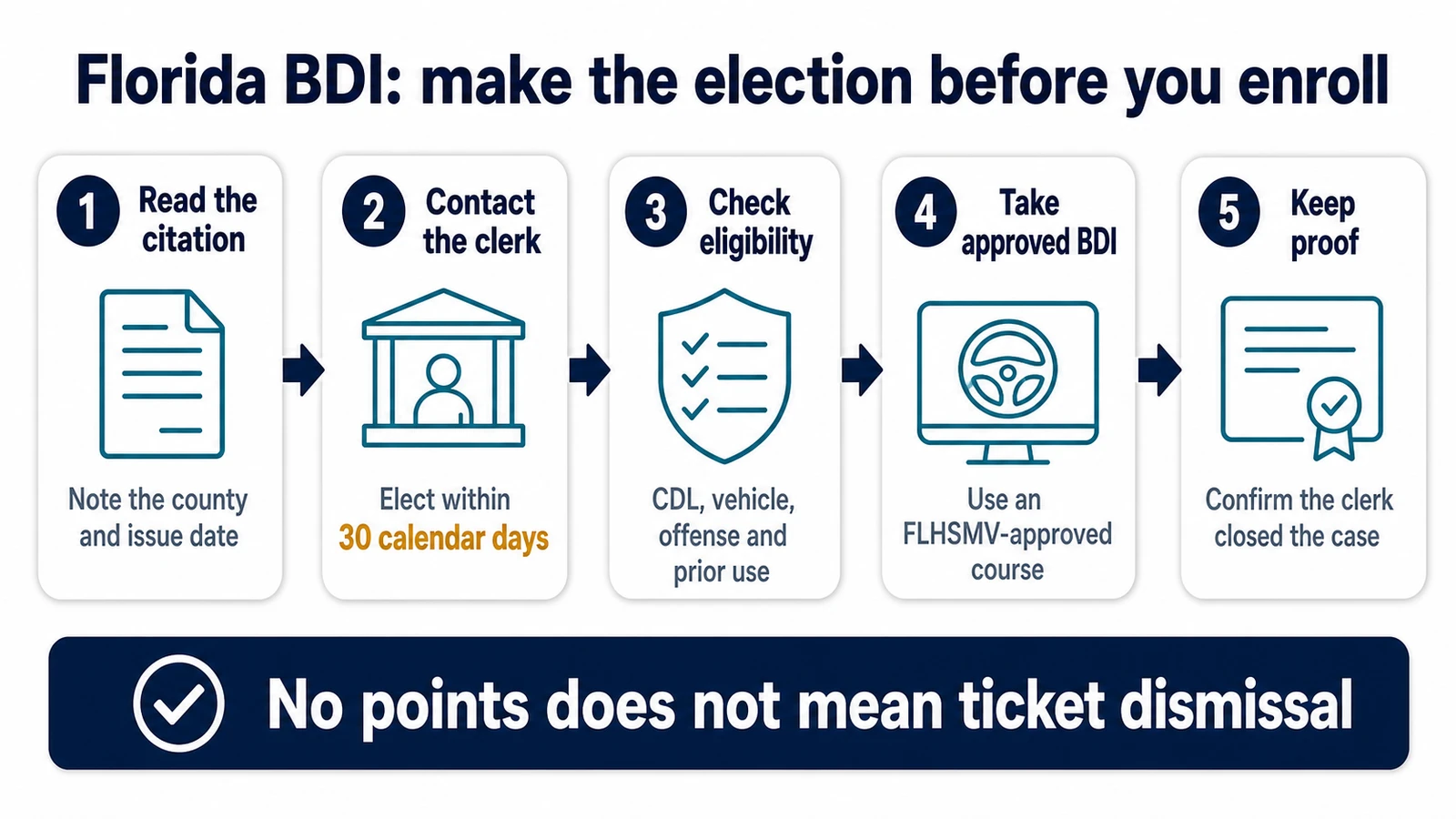
Quick answer: Contact the issuing county clerk before the 30-day citation-response deadline. Confirm that the violation and driver qualify, formally elect BDI, pay the amount the clerk requires, enroll in an FLHSMV-approved course, and meet the clerk's separate completion deadline. Do not simply buy a course and assume the election is complete.
Rules verified: September 1, 2026, against the 2026 Florida Statutes and current FLHSMV citation materials.
General information only: This guide explains Florida's statewide elective BDI framework. It is not legal or insurance advice. The issuing county clerk controls the case workflow and deadline shown for your citation.
What is a Florida Basic Driver Improvement course?
Basic Driver Improvement, usually shortened to BDI, is Florida's four-hour driver-improvement course. People also call it traffic school or a defensive-driving course, but the official course type matters when you enroll.
Florida uses BDI for more than one purpose. A driver may:
- elect BDI after an eligible noncriminal traffic citation;
- be ordered to attend by a court;
- be required to attend because of a qualifying conviction or crash; or
- take a course for another permitted purpose.
This guide covers the first path: a voluntary election under Florida Statutes section 318.14(9). A court order or an FLHSMV notice may carry different instructions, consequences, and deadlines. Do not use an elective-ticket checklist to answer a mandatory-attendance notice.
The course itself must be approved by the Florida Department of Highway Safety and Motor Vehicles (FLHSMV). Section 318.1451 makes FLHSMV responsible for approving and regulating these courses. Approval attaches to the course/provider relationship, not to a generic promise that a website offers “Florida traffic school.” Confirm the exact BDI offering on the current official list before paying.
The 30-day rule: elect first, finish on the clerk's schedule
The most important distinction is between electing traffic school and completing traffic school.
Florida Statutes section 318.14(4)(a) gives a person who does not elect to appear 30 days after the citation date to pay or enter a payment plan. The current Uniform Traffic Citation presents the broader response instruction as “within 30 calendar days of the date of this citation” and lists contacting the clerk to elect a Florida driver-improvement course as one option.
Section 318.14(9) authorizes the elective BDI result but does not state a deadline or name the clerk. The 30-day election instruction comes from the citation workflow; the clerk then supplies the separate course-completion deadline.
That is why waiting until day 29 to start comparing schools is risky. Your first task is to preserve the option with the issuing county clerk. Course completion usually happens later, under a deadline supplied by that clerk.
Count from the citation date
Write down:
- Citation issue date: __________
- Issuing county: __________
- Clerk contact or portal: __________
- Thirty-calendar-day response date: __________
- Election confirmation number/date: __________
- Clerk's course-completion deadline: __________
- Clerk's proof/submission deadline: __________
Do not shift the response calculation to the day the citation arrived in the mail, the day you found it in the glove box, or the day you selected a provider. Use the date and instructions printed on the citation unless the clerk gives you a different controlling order.
Contact the correct clerk
The clerk of court in the county where the citation was issued handles the election. A course provider cannot extend the clerk's deadline, convert an ineligible charge into an eligible one, or complete the court election for you merely by accepting payment.
Use the court information on the citation. Ask:
- Is this exact violation eligible for an election under section 318.14(9)?
- Does your record show that I meet the frequency limits?
- What amount must I pay to elect BDI?
- What is my course-completion deadline?
- Does the provider report electronically, must I submit a certificate, or both?
- How can I confirm the case is satisfied afterward?
Save the receipt or confirmation that shows the clerk accepted the election.
Check eligibility before paying for a course
Florida's elective BDI option is broad, but it is not available for every driver or offense.
You cannot use this election as a CDL or CLP holder
Section 318.14(9) excludes a person who holds a commercial driver license or commercial learner's permit. It also limits the election to a citation received while driving a noncommercial motor vehicle.
Both conditions matter. A person should not assume that driving a personal car solves the problem if the person holds a CDL, or that a regular license solves the problem if the cited vehicle was commercial.
Some violations are excluded
The statute excludes several categories, including certain driver-license, registration, and commercial-vehicle offenses. It also excludes specified speeding violations when the driver exceeded the posted limit by 30 mph or more.
Do not decide from the everyday description alone. “Speeding ticket” or “registration ticket” is not precise enough. Compare the exact Florida statute number on the citation with the current rule and ask the clerk to confirm eligibility.
Mandatory-hearing and criminal cases follow different paths
Elective BDI is described as an alternative to a court appearance for an eligible noncriminal infraction. A citation that requires a hearing or charges a criminal traffic offense is not converted into an ordinary BDI election because a provider is willing to sell a course.
If the citation marks a court appearance as required, contact the clerk or obtain appropriate legal guidance before taking action. Missing the appearance while completing an unapproved course can make the situation worse.
Apply the 12-month and eight-election limits
Florida currently limits a section 318.14(9) election in two ways:
- You cannot make the election if you made one during the preceding 12 months.
- You cannot make more than eight such elections in your lifetime.
These limits apply to the election, not simply to whether you remember finishing a class. Ask the clerk to check the official election history rather than relying only on email receipts or old certificates.
Older forms and articles may still say five lifetime elections. Florida later increased the statutory maximum. The current 2026 statute and citation form say eight. The form states “one such election per 12 month period” and “not more than 8 elections in your lifetime.” Treat a five-election statement as stale unless it is describing a different program or an older case.
This guide gives the screening rule. A separate Florida election guide may cover detailed date examples, prior-election records, and unusual cases without duplicating this page.
What you receive after a valid BDI election
The statewide benefits are specific and should not be overstated.
Adjudication is withheld
When the statutory election is valid and the requirements are completed, adjudication is withheld. Section 318.14(11) says a withheld adjudication under that section is not a conviction.
That is not identical to dismissing the citation. The case still has a disposition, and the election may still count toward the 12-month and eight-lifetime limits.
Points are not assessed
For a valid election, section 318.14(9) directly provides that points under section 322.27 may not be assessed for that citation. The clerk and state systems record the resulting disposition.
BDI prevents those points; it does not subtract unrelated points already on the license. If you have an existing point balance, keep the pending-ticket result separate from your older record.
For a broader explanation of that distinction, see Driver License Points: How the Point System Works.
The applicable civil penalty is reduced by 18%
Section 318.14(9) says a civil penalty imposed under section 318.18(3) “must be reduced by 18 percent.” That does not promise an 18% reduction in the entire amount you spend.
Your total may include:
- the remaining civil penalty;
- court costs or clerk charges;
- the course price;
- a statutory course assessment; and
- optional provider charges you choose at checkout.
Ask the clerk for the election amount and read the provider's full fee disclosure. Compare the complete cost, not an advertised base price.
Should you elect BDI or request a hearing?
BDI is a disposition choice, not just a class purchase. Electing it generally means accepting the statutory no-contest/withheld-adjudication path instead of asking the court to decide whether the infraction occurred.
Consider contacting the clerk or a qualified Florida traffic attorney before electing if:
- you believe the citation is factually or legally wrong;
- the violation is serious or the citation requires an appearance;
- a crash, injury, employment rule, immigration concern, or professional license raises consequences beyond points;
- you hold a CDL or CLP;
- you are close to the election limit; or
- you do not understand what will remain on your record.
Our Traffic School vs. Court guide explains the general decision, but the issuing clerk and Florida law control your case.
Do not pay the citation as an ordinary admission and then assume you can switch to BDI. Under sections 318.14(4)(a) and (4)(b), using the ordinary payment or payment-plan path is treated as admitting the infraction and waiving a hearing on whether it occurred. Use the clerk's stated BDI election workflow before submitting payment.
How to complete the Florida BDI process
Step 1: Read every option on the citation
Confirm that the citation is a noncriminal infraction that does not require a court appearance. Note the issue date, county, exact violation code, and response deadline.
Step 2: Make the election through the issuing county clerk
Use the clerk's official portal, mail process, phone instructions, or counter service. Obtain a dated receipt showing that BDI was elected. Record the course and proof deadlines separately.
Step 3: Select an FLHSMV-approved BDI course
Use the current FLHSMV driver-improvement-school listing. Match the exact provider and exact BDI course. Provider approval and availability can change, so a screenshot from an old article is not enough. The official Florida Driver License Handbook is useful background, but it does not replace the current provider list or the issuing clerk's case instructions.
Florida permits technology-delivered courses that have statewide approval, so online completion may be available. Still check whether the listing and your clerk's instructions accept the specific offering for your case.
Before checkout, confirm:
- complete mandatory price;
- online or classroom format;
- identity and exam requirements;
- completion and support hours;
- certificate delivery;
- reporting process;
- refund policy; and
- optional charges.
A separate provider comparison may evaluate approved BDI options after current approval, price, and checkout facts are verified. This guide makes no ranking or affiliate recommendation.
Step 4: Finish before the clerk's deadline
Florida Administrative Code rule 15A-8.006 says an approved BDI course is conducted with a “minimum of four (4) hours” for course content, minus up to 30 minutes for breaks. Treat four hours as the scheduled minimum block, not four uninterrupted hours of instruction. Build in additional time for registration problems, identity checks, a final assessment, certificate processing, and reporting.
Do not treat the last evening before the deadline as a safe start time. If a technical problem occurs, contact both the provider and clerk while the deadline is still open. A provider cannot guarantee that a late completion will be accepted.
Step 5: Keep proof and confirm the case
Florida law requires providers to issue a certificate after successful completion. Section 318.1451 also requires the provider to submit completion information to FLHSMV within five days. After receiving the unique certificate number, the provider has three days to send the completion information and citation number to the issuing county clerk through the Florida Courts E-Filing Portal.
Electronic reporting does not make recordkeeping optional. Save:
- the clerk's election receipt;
- payment confirmation;
- course registration details;
- completion certificate and unique number;
- provider reporting confirmation; and
- the clerk's final case-status confirmation.
These are provider-reporting deadlines, not promises that the clerk's docket will update immediately. Follow the clerk's instructions if it also asks you to upload, email, mail, or present proof. If the provider or court record has not updated after the applicable reporting period, contact the provider and clerk. Check that the case shows the correct disposition and that no compliance item remains open.
Common mistakes to avoid
Enrolling before electing
A paid course is not proof that the clerk accepted your election. Contact the clerk first.
Calling the result a dismissal
Florida's BDI election can withhold adjudication, prevent points for the eligible citation, and reduce the applicable civil penalty. It does not dismiss or erase the ticket.
Assuming 30 days is the course deadline
The statewide 30-day instruction is the citation-response window. The clerk supplies the completion deadline. Record both.
Using an unapproved or wrong course
Florida runs several driver courses. Make sure the one you buy is Basic Driver Improvement, and check that the provider is on FLHSMV's current list.
Relying on the old five-election limit
Current law allows no more than eight lifetime elections, still limited to one in the preceding 12 months. Old PDFs may not reflect the change.
Assuming no points means no insurance effect
Insurance treatment involves the record, underwriting rules, and the circumstances of the citation. The elective course does not create a universal rate guarantee. A separate Florida insurance page is research-dependent; do not rely on provider marketing for that answer.
Frequently asked questions
Does Florida BDI dismiss a ticket?
Not under the ordinary section 318.14(9) wording. A valid election results in withheld adjudication, no point assessment, and an 18% reduction in the applicable civil penalty. Describe the result accurately rather than calling it dismissal.
Do I have 30 days to finish traffic school?
The statewide citation gives you 30 calendar days to choose an available response, including contacting the clerk to elect BDI. The clerk provides the separate course-completion deadline. Confirm both dates.
Can I take Florida traffic school online?
FLHSMV approves technology-delivered courses for statewide use. Verify that the exact provider and BDI offering appear on the current official list and comply with your clerk's instructions.
Can a CDL holder elect BDI for a ticket in a personal car?
Section 318.14(9) excludes a person who holds a commercial driver license or commercial learner's permit. Contact the clerk or appropriate counsel about the available case options.
Does BDI remove points already on my license?
No. The elective path prevents points from being assessed for the qualifying citation. It does not erase unrelated existing points.
How many times can I elect BDI in Florida?
Current law permits no election if you made one in the preceding 12 months and caps elections at eight in a lifetime.
Who sends the completion certificate to the court?
Current Florida law requires provider electronic reporting to FLHSMV and then to the issuing county clerk through the E-Filing Portal. Follow any additional proof instructions from your clerk and keep your own certificate and confirmations.
The bottom line
A Florida Basic Driver Improvement course can prevent points on an eligible citation, but the benefit depends on completing the legal election and the course—not merely buying traffic school.
Start with the clerk for the county named on the citation. Preserve the 30-day response window, verify the CDL/vehicle/offense and prior-election limits, use an FLHSMV-approved BDI course, and keep proof until the clerk confirms the case is satisfied.
Drive Wise. Spend Less. Stay Safe.
Related Reading
- How driver-license points work
- Traffic school vs. court: how to choose
- Should you pay a ticket or choose traffic school?
- Does traffic school remove a ticket from your record?
- Traffic-school rules by state
Sources
- Florida Statutes § 318.14 — Noncriminal traffic infractions; procedures
- Florida Statutes § 318.1451 — Driver improvement schools
- FLHSMV — Current Uniform Traffic Citation form, HSMV 75901
- FLHSMV — Official Florida Driver License Handbook
- Florida Administrative Code r. 15A-8.006 — Course approval and duration
Last updated: September 1, 2026.