

Arizona Defensive Driving for Ticket Dismissal: Who Qualifies?
Arizona defensive driving can dismiss one eligible traffic violation when you, the charge, the dates, the vehicle use, and the course completion all satisfy the program rules. If you qualify under the ordinary path and finish successfully, the court dismisses the covered citation and the Arizona Motor Vehicle Division does not place it on your driving record.
That result is valuable, but it is not automatic just because a course is available online. Criminal speeding requires court permission. A collision involving death or serious physical injury blocks diversion. A qualifying commercial driver license holder gets a different record outcome. And the state’s public eligibility checker is only a preliminary screen.
Before paying the ticket or a school, match the exact violation code to the official list, compare the right violation dates, and follow the instructions from the court named on the citation.
Rules verified: August 30, 2026, against current Arizona statutes and Arizona Judicial Branch guidance.
General information only: This guide is not legal advice. A charge, collision, license status, or court election can change the available options. Follow the named court’s current instructions and consider speaking with an Arizona traffic attorney when the consequences are material.

Arizona Defensive Driving Ticket Dismissal: Quick Answer
| Situation | Likely diversion result |
|---|---|
| Eligible civil moving violation; all ordinary requirements met | One covered citation is dismissed after successful completion and is not included on the MVD driving record. |
| Several violations on one citation | Current state guidance allows dismissal of only one eligible violation. Ask the court how the others must be resolved. |
| Criminal speeding under A.R.S. § 28-701.02 | The court may allow defensive driving. Permission is discretionary, not automatic. |
| Violation caused death or serious physical injury | Not eligible for dismissal diversion. A court may separately order education as part of a sentence. |
| CDL holder in a noncommercial Class D or M vehicle | May qualify if every other rule is met, but the judgment is reported and the violation appears on the record under the separate CDL statute. |
| Driver operating a commercial motor vehicle requiring a CDL | Not eligible for dismissal diversion. |
| Course taken only to remove existing points | No general post-conviction point-reduction benefit. This program works by diverting an eligible current case; see ways a ticket may stay off your driving record. |
Use this table as a screen, not an approval. A Supreme Court-certified school must still check the defensive-driving database and review your citation and identification.
The Six Checks That Control Eligibility
You need a “yes” on each applicable check before relying on Arizona traffic-school dismissal.
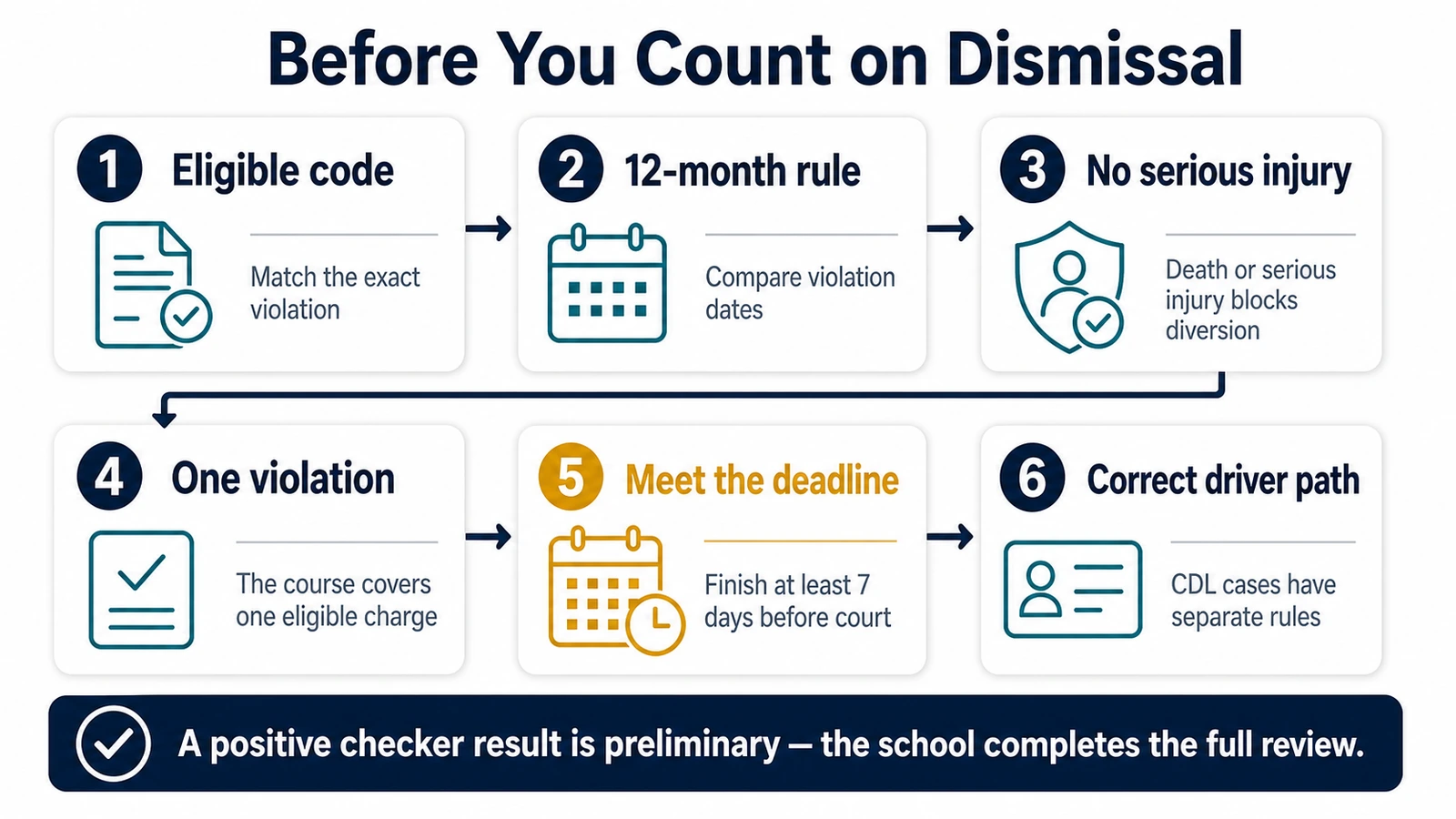
1. Is the charge an eligible moving violation?
Start with the statute number printed on the citation. Compare that number—not a plain-language description such as “speeding”—with the Arizona Judicial Branch’s list of eligible violations.
Under A.R.S. § 28-3392(A)(1), ordinary diversion covers qualifying civil traffic moving violations in chapter 3, articles 2, 3, 4, and 6 through 15, plus corresponding local civil traffic ordinances. Your charge may sound familiar and still follow a different rule, so use the exact code.
The official list uses an important marker:
- No
CMmarker: the code appears on the ordinary eligible list, subject to all other requirements. CMmarker: the charge is eligible only with the express permission of the presiding judge of the court with jurisdiction.- Extra numbers,
SO, orPE: the Judicial Branch says these are local tracking codes and do not determine state diversion eligibility by themselves.SOmeans Sheriff Office-issued citation;PEmeans Photo Enforcement citation. APE-coded filed citation is different from the earlier notice discussed in the photo-enforcement FAQ.
Do not shorten a code or assume that every subsection has the same treatment. Enter and verify the charge exactly as printed.
2. Are the violation dates at least 12 months apart?
Arizona measures repeat eligibility from violation date to violation date. A.R.S. § 28-3392(B) ties the restriction to the last violation for which you were authorized to attend, not the day you finished the previous class.
Suppose a driver was authorized to attend for a violation dated March 10, 2026. A new violation dated February 28, 2027 falls within the restricted period even if the prior class was completed in April. A new violation after the full 12-month interval may pass this check, assuming every other condition also qualifies.
Use the earlier violation for which attendance was authorized, not a vague memory of when you logged into the course. The school checks the state database during registration.
3. Did the incident avoid death or serious physical injury?
A.R.S. § 28-3392(C)(1) bars diversion when a civil or criminal traffic violation resulted in death or serious physical injury.
The statute allows a court to order defensive-driving education in addition to another sentence after an adjudication or admission. That is not the same as diversion. A required class in that setting does not turn the case into the ordinary dismissal/no-record path.
If the citation arose from a serious crash, do not use a school advertisement or automated checker as the final answer. Contact the court and consider legal advice.
4. Are you choosing only one violation?
The Arizona Judicial Branch says: “If eligible, you can attend to have only one violation dismissed.”
If the citation lists two or more charges, identify which one the course would cover and ask the court how to respond to every remaining charge. Enrolling for one count does not pause deadlines or dispose of the others.
This is especially important when the charges carry different points, classifications, or consequences. A school verifies eligibility; it does not choose your legal strategy.
5. Can you meet the court-controlled deadline?
Current Judicial Branch guidance says you must complete the course no later than seven days before the scheduled court date. A.R.S. § 28-3393(A) requires attendance “within the time allowed by the court,” so the court’s instructions control.
If the deadline is close, check the Court Approved Extensions page before enrolling. A certified school may act only for a court on that page. Within seven days of your arraignment date, the school cannot grant an extension; you must contact the court directly. The Arizona Supreme Court does not grant extensions for individual traffic citations.
Online and classroom courses are generally available, but the court may order you to attend in person. Confirm the allowed format before buying an online course.
The detailed fee and extension workflow belongs in the planned S04-04 guide. For eligibility purposes, the key point is simpler: being substantively eligible does not excuse a missed completion date.
6. Does your license and vehicle use fit the right path?
Most noncommercial-license cases use the ordinary outcome described in A.R.S. § 28-3394. CDL cases require a second screen.
A CDL holder may qualify only when:
- the cited vehicle required a Class D or Class M license;
- the vehicle was not being used for commercial purposes; and
- the driver meets the other program requirements.
If you were operating a commercial motor vehicle that required a CDL, A.R.S. § 28-3392(C)(2) makes you ineligible for dismissal diversion. A court may order school as part of a sentence, but it may not use that attendance to dismiss the conviction or finding of responsibility.
Criminal Speeding Requires Court Permission
Arizona criminal speeding under A.R.S. § 28-701.02 is the limited criminal exception in the diversion statute. The word that matters is may: a court may allow attendance, subject to the statutory restrictions.
The current eligible-violations list marks the § 28-701.02 subsections CM, meaning express permission from the presiding judge is required. An online school cannot supply that permission, and a preliminary eligibility result does not replace it.
If the citation is marked criminal or lists § 28-701.02:
- Read the response instructions on the citation.
- Contact the court with jurisdiction.
- Ask whether defensive-driving diversion is available in your case and what written authorization is required.
- Do not miss a criminal-court deadline while waiting to enroll.
Other criminal violations, including DUI and reckless driving, are not ordinary defensive-driving diversion charges under the Judicial Branch’s program guidance. Criminal speeding under § 28-701.02 is a class 3 misdemeanor, so do not miss a criminal-court deadline while seeking permission.
What Successful Completion Does for an Ordinary Driver
A.R.S. § 28-3394(A) opens with the boundary “Except as provided in section 28-3394.01.” If you qualify outside that separate CDL rule and finish successfully, the statute requires two results:
- The court dismisses the civil or qualifying criminal traffic citation covered by the course.
- MVD does not include a record of that citation on the driver’s driving record.
Because the covered violation does not go on your driving record, MVD does not assess points for it. This is point prevention, not removal of points already posted from another case. For the broader distinction, read how traffic school affects a ticket record.
Dismissal also has a boundary. Section 28-3394(B) says dismissal does not prevent evidence about issuance of the citation from being introduced in a civil or criminal proceeding. In plain language, “dismissed for this diversion program” does not mean the underlying event becomes legally nonexistent for every possible purpose.
The CDL Outcome Is Different
A qualifying CDL holder does not receive the ordinary no-record treatment.
Under A.R.S. § 28-3394.01, the court forwards an abstract of the judgment to MVD, and MVD includes the civil traffic violation on the driver’s record. Arizona MVD or another state agency may not use that violation to decide whether to suspend or revoke the license. After successful completion, the court may not impose the civil penalty for the covered citation.
Current Judicial Branch consumer guidance says the court forwards the judgment record to MVD but “no points are assessed to the driver’s record.” The judgment still appears, so the citation does not disappear.
Depending on the violation code, MVD may also direct a qualifying CDL holder to attend Traffic Survival School (TSS). Defensive-driving diversion does not replace that separate program.
The statute also contains separate private-passenger and commercial-vehicle insurance treatment. Because insurance application depends on the policy and vehicle, the planned S04-05 article will handle that question in depth.
Use the Public Checker as a Screen, Not a Decision
The Arizona Judicial Branch provides a public eligibility checker. It asks for driver-license details, date of birth, and the violation date.
The site expressly warns: “This eligibility checker is not a complete eligibility check.” A positive result still requires a certified school to run its full review.
The Judicial Branch says the school will run a court-database check at registration. In practice, you should expect the full check to cover the rest of what this guide has walked through:
- querying the defensive-driving database for prior attendance;
- checking identification and the citation;
- matching the exact violation to an eligible code;
- confirming any required court permission;
- screening injury, CDL, and vehicle-use restrictions; and
- confirming that the course can be completed within the allowed time.
A checker cannot know every fact printed on the citation or every court-specific order. Treat “eligible” as permission to continue verifying, not as a final adjudication.
A Court-First Verification Sequence
Use this order to avoid paying for the wrong solution:
- Read the citation. Record the court, court date, civil/criminal designation, exact code, and every listed charge.
- Check the official code list. Note any
CMmarker. - Compare violation dates. Use the prior authorized violation date, not the old course date.
- Screen disqualifiers. Consider serious injury or death, CDL status, vehicle class, and commercial use.
- Ask the named court about exceptions. Do this for criminal speeding,
CMcodes, multiple charges, or a close deadline. - Run the preliminary checker. Use matching license and citation information.
- Choose a Supreme Court-certified school. The school performs the fuller eligibility check and explains the complete price before registration.
- Complete and confirm. Save the receipt and completion record and verify that the court received the result.
Do not pay the citation first without checking the court’s instructions. Depending on the notice and court process, payment may resolve the charge instead of electing diversion. This is a cautious procedural inference, not a statewide rule stated in the reviewed sources.
Three Mistakes That Can Derail Dismissal
Assuming every speeding charge qualifies
Civil speeding and criminal speeding are not interchangeable. Match the full statute number and obtain judicial permission when the code is marked CM.
Counting 12 months from the old class date
Arizona uses the earlier and current violation dates. A completion-date calculation can produce the wrong answer.
Treating one course as a solution to the whole citation
Only one eligible violation may be dismissed. Every other charge still needs a timely response through the court.
Frequently Asked Questions
Does Arizona defensive driving guarantee ticket dismissal?
No. Four things have to go right: your charge must be eligible, the judge must approve it if your code needs permission, you must register and finish on time, and the school must report your completion. Buying or starting a course is not enough.
Can I take defensive driving after points are already on my record?
No, not as a general point-removal tool. Arizona diversion addresses your eligible current citation before it becomes an ordinary recorded conviction. Existing points follow separate MVD rules; start with ways a ticket may stay off your driving record.
Can two tickets be dismissed with one course?
Current Judicial Branch guidance allows dismissal of only one eligible violation. If several charges or cases are open, ask each court what must be done.
Can an out-of-state driver use Arizona defensive driving?
Possibly. Your Arizona citation and court process still control, and the school must verify that you qualify. Ask your licensing state how it treats the result; Arizona does not control another state’s record system.
Is a DPS photo-enforcement notice eligible?
Arizona Judicial Branch guidance says a DPS photo-enforcement notice of violation cannot itself be dismissed through defensive-driving school. That notice may come before a filed citation. If your later citation carries a PE tracking code, follow that document’s instructions and ask the issuing court what applies.
Can I contest the charge first and take the course if I lose?
Do not assume that option will remain available. Ask the court before choosing a hearing if preserving diversion matters. The program deadline and local case status can affect what the court permits.
The Bottom Line
Arizona defensive-driving ticket dismissal is a structured diversion path, not a coupon attached to every traffic ticket. The clean ordinary result—dismissal, no MVD record entry, and no points—depends on six checks: the exact violation, the 12-month rule, injury status, one-charge limit, deadline, and license/vehicle use.
Verify those facts with the official list, the court named on the citation, and a Supreme Court-certified school before paying. If the case involves criminal speeding, a serious crash, a CDL, or several charges, get the exception resolved first.
Related Reading
- How traffic school affects a ticket record
- Ways to keep a ticket off your driving record
- Traffic school requirements by state
- How long points stay on a driving record
- How speeding-ticket points differ by state
Sources
- Arizona Legislature — A.R.S. § 28-3392, Defensive driving school; eligibility
- Arizona Legislature — A.R.S. § 28-3393, Defensive driving school attendance; discrimination prohibited; notice requirements
- Arizona Legislature — A.R.S. § 28-3394, Successful course completion
- Arizona Legislature — A.R.S. § 28-3394.01, Commercial driver license holders
- Arizona Judicial Branch — Defensive Driving Schools
- Arizona Judicial Branch — List of Eligible Violations
- Arizona Judicial Branch — About the Defensive Driving Program
- Arizona Judicial Branch — Court Approved Extensions
- Arizona Judicial Branch — Preliminary Eligibility Checker
Last updated: August 30, 2026