


New York PIRP Point Reduction: The 11-Point and 24-Month Rules

New York PIRP point reduction can help with a point-based license problem, but it does not erase tickets, convictions, or the original points on your driving record. After DMV receives notice of eligible course completion, the rule requires it to enter a credit of up to four points for specified administrative calculations. 15 NYCRR Section 131.5
The date of each violation matters. New York’s current persistent-violator rules use a 24-month window, while PIRP credit reaches only eligible violations that occurred before and within the 18 months preceding course completion. Points can still count toward the DMV total after they become too old for course credit.
General information only: This guide explains the statewide point framework. It is not legal advice. Follow the dates and instructions on your current DMV record, suspension notice, or hearing notice.
What PIRP can change
| Question | Current New York rule |
|---|---|
| What is the best-known point threshold? | Eleven or more points within 24 months can lead to a formal hearing, subject to a narrow single alcohol- or drug-related incident exception |
| Is 11 points the only trigger? | No. Section 131.4 also has advisory-letter, clinic, speeding, post-hearing, rapid-violation, and single-violation triggers |
| What date controls? | The violation date, not the conviction date |
| What does the regulation require? | Section 131.5 says DMV shall reduce a total of up to four points after eligible completion notice; section 138.3 describes a maximum four-point entry when appropriate |
| Which points can receive the credit? | Eligible points from violations occurring before and within 18 months preceding course completion |
| Do the points disappear? | No. The convictions and original points remain displayed on the driving record |
| Can the calculation fall below zero? | No |
| Can the credit be saved for later? | No. It is not credit against future violations or points |
| How often is the point benefit available? | No more than once in an 18-month period |
| Does PIRP reduce a Driver Responsibility Assessment? | No |
The direct official sources are the New York DMV point-system page and the New York DMV PIRP page.
The 24-month total and 18-month credit window
The two windows serve different purposes: one determines which points count toward the current DMV total; the other limits which points qualify for PIRP credit.
Why official sources show two effective dates
The amended 15 NYCRR Section 131.4 is stamped effective November 6, 2024. A later State Register notice and DMV enforcement memo use February 16, 2026 for enforcement of the revised point values and the current-system transition.
DMV’s enforcement memo says the persistent-violator lookback changed from 18 to 24 months beginning February 16, 2026, and that violations on or before February 15, 2026 keep their former point values. The sources do not separately explain how older violations are counted in a 24-month calculation made after that date. Use the dates and points on your current DMV record.
The revised system still calculates points from the violation date. A later conviction does not move the violation into a newer point window.
PIRP’s point-credit rule did not expand to 24 months. 15 NYCRR Section 131.5 continues to limit the credit to violations that occurred before and within the 18 months preceding course completion.
| Window | What it is used for | What falls outside it |
|---|---|---|
| 24 months | The current 11-point persistent-violator calculation | Violations more than 24 months old do not count in that total |
| 18 months before PIRP completion | Determines which eligible points can receive the up-to-four-point PIRP credit | Points tied to violations in months 19 through 24 are too old for PIRP credit |
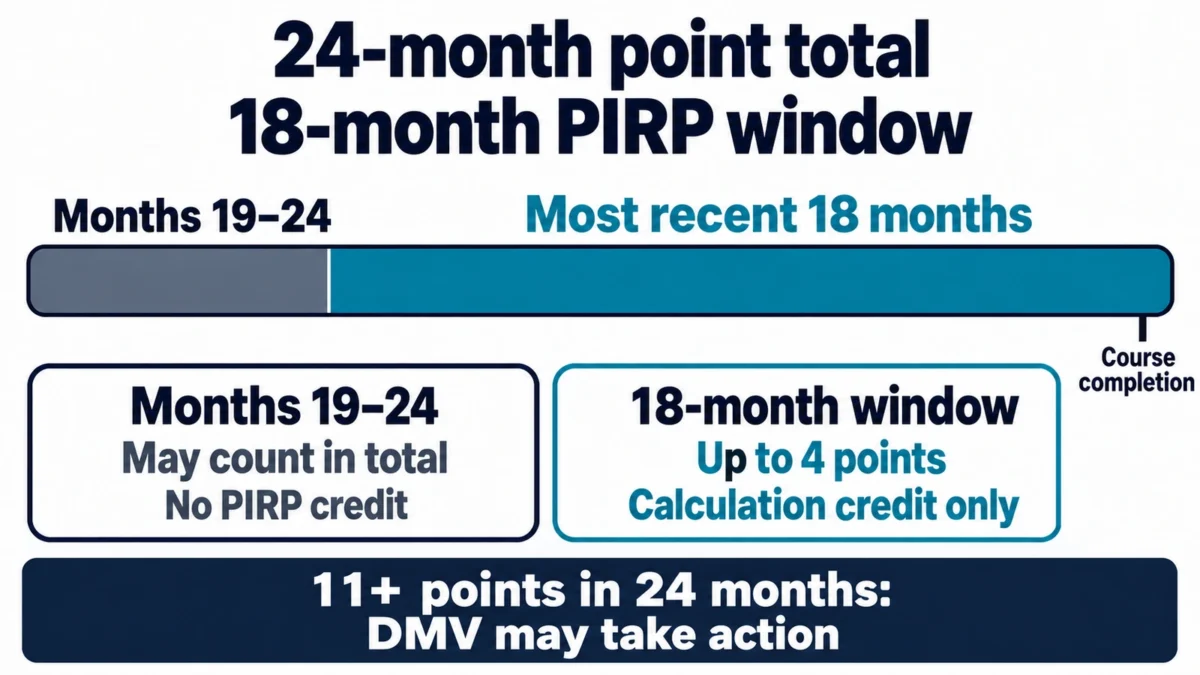
This six-month difference is why “I have 11 points” is not enough information to estimate the course benefit. You also need each violation date and the planned course-completion date.
Why the DMV PIRP page still mentions 18 months
The current DMV PIRP page uses 24 months when describing the 11-point suspension threshold. The same page also retains wording that describes reducing the points received within 18 months and frames the four-point subtraction around drivers who have 11 or more points.
The regulations separate those ideas more clearly. Section 131.4 contains several 24-month and 12-month administrative triggers. Section 131.5 says DMV shall enter up to four points of credit for eligible violations in the 18 months before completion; it does not make 11 points a condition for every reduction. Use the 24-month window to identify the applicable trigger and the 18-month window to estimate the largest PIRP credit pool.
DMV can act before you reach 11 points
Section 131.4 contains more than one point-based response:
| Record pattern | Possible DMV response under Section 131.4 |
|---|---|
| 4-6 points within 24 months | Advisory letter |
| 7-10 points within 24 months | DMV may require a driver improvement clinic; failing to attend when required may lead to suspension |
| 11 or more points within 24 months | Formal hearing where suspension or revocation may be considered, except when all points come from one qualifying alcohol- or drug-related conviction or incident |
| 9 or more speeding points within 24 months | Formal hearing |
| 4 or more additional points within 12 months after a formal hearing | Another formal hearing |
| 3 or more point-bearing violations in an unusually short period | A formal hearing may be required at the commissioner’s discretion even without reaching the listed totals |
| One violation assigned 11 points | A hearing into that specific violation rather than a habitual-violator hearing |
At 10 points, a four-point PIRP entry could change the arithmetic. A lower worksheet estimate does not cancel a clinic instruction or hearing notice. Follow the notice and confirm the recorded result with DMV.
Sort your violation dates with the worksheet
Start with your current driving record. The worksheet gives you a planning estimate; DMV determines the recorded result after the sponsor reports completion.
Step 1: Choose the comparison date
For the PIRP window, use the date you expect to complete the course. Do not use the registration date, conviction date, or date you paid a ticket.
Step 2: List each point-bearing violation
Create one row for each conviction that carries points. Record the violation date and the points currently displayed by DMV.
| Violation | Violation date | Points on current record | Within 18 months before completion? | Within the current 24-month total? |
|---|---|---|---|---|
| A | Yes / No | Yes / No | ||
| B | Yes / No | Yes / No | ||
| C | Yes / No | Yes / No | ||
| D | Yes / No | Yes / No |
Step 3: Separate the two totals
Add the points in the 24-month column. That is your planning total before PIRP.
Then add only the points tied to violations within the 18 months before completion. This is the pool from which the PIRP credit may be drawn.
Also note whether the record includes nine or more speeding points, a prior formal hearing followed by four additional points within 12 months, three point-bearing violations close together, or one 11-point violation. Those Section 131.4 triggers cannot always be evaluated from the general total alone.
Step 4: Apply the four-point cap
To estimate the largest potential credit:
Potential PIRP credit = the smaller of four points or the eligible 18-month point pool
Planning total after PIRP credit = 24-month point total minus the potential credit
Section 138.3 describes a maximum four-point reduction when appropriate; Section 131.5 requires a reduction of up to four after eligible notice. The calculation cannot fall below zero. It does not guarantee DMV’s response to your record or notice, and the original points remain visible.
Step 5: Check the stop conditions
Do not rely on the worksheet if:
- the license is already suspended or revoked;
- DMV has already scheduled a violation hearing;
- the notice describes a mandatory suspension or revocation;
- some convictions or course completions are missing from the current record; or
- you are using PIRP to try to reduce a Driver Responsibility Assessment.
In those situations, follow the official notice or contact DMV before assuming the course changes the outcome.
Five ways the date windows can affect your estimate
The examples below assume that every listed point is already on the DMV record and that no suspension, revocation, or hearing is already in effect. They illustrate the date-window arithmetic only.
| 24-month point total | Points tied to violations within 18 months before completion | Potential PIRP credit | Planning total after credit | What the example shows |
|---|---|---|---|---|
| 10 | 4 | 4 | 6 | A driver in the 7-10 clinic band could plan around a lower total, but must still follow any clinic instruction already issued |
| 11 | 11 | 4 | 7 | All 11 points fall in both windows, so the full four-point credit may be available |
| 11 | 3 | 3 | 8 | Eight points fall in months 19-24, so only the three recent points are in the PIRP pool |
| 11 | 0 | 0 | 11 | All points are outside the PIRP pool; completing now can still use the once-in-18-month eligibility interval even though the estimate is zero |
| 14 | 4 | 4 | 10 | The full credit may apply, but only because at least four points are in the recent 18-month pool |
Even a lower planning total does not promise suspension avoidance. DMV can act under the applicable threshold rules, and other grounds for action may remain outside PIRP’s reach.
The credit changes calculations, not your record history
PIRP changes specified administrative calculations. It does not rewrite the driving record.
DMV records the course completion and enters up to four points of credit after eligible notice, subject to the rules in Sections 131.5 and 138.3. The original convictions and point entries remain visible. Points outside the 18-month PIRP window receive no course credit, and any unused credit cannot be saved for a future violation. DMV PIRP guidance
If your main question is how long convictions or points remain visible, read how long points stay on a driving record. That record-retention question is different from whether a point currently counts in the 24-month suspension window.
Point reduction is not ticket removal
For point-reduction purposes, PIRP works on eligible point-bearing convictions. It does not dismiss a pending ticket or reverse a conviction.
Traffic Violations Bureau and local-court procedures are separate from PIRP. To change the ticket result, start with ways a ticket may stay off a driving record or read whether traffic school removes a ticket.
Some consequences remain even after PIRP
New York uses several calculations that sound similar but are legally separate.
| Consequence | Does PIRP point credit change it? |
|---|---|
| DMV administrative calculations based on point accumulation | Yes, up to four points when the timing and other conditions fit; the exact recorded entry belongs to DMV |
| Points and convictions displayed on the driving record | No |
| Credit against a future violation | No |
| Suspension or revocation already in effect | No |
| Mandatory suspension or revocation | No |
| Scheduled violation hearing | No |
| Driver Responsibility Assessment | No |
| An insurer’s separate point or rating system | No |
The Driver Responsibility Assessment uses a separate 18-month test. Six points produces a $100 annual assessment for three years, or $300 total. Each point above six adds $25 per year, or $75 across the three years. Vehicle and Traffic Law Section 503(4)(a), (b) and (e) and DMV treat this assessment separately; PIRP cannot prevent or reduce it.
Insurance is separate too. A qualifying principal operator may receive a formal premium benefit, but the point credit does not change an insurer’s point system. See defensive driving insurance discounts for national context.
Taking another course: the 18-month limit
New York permits point reduction no more than once in any 18-month period. 15 NYCRR Section 131.5(b) sets that limit. DMV’s Part 138 advertising guidelines add that eligibility is used even when the point benefit is not. Section 138.13(a)(17)(i)
That matters if you complete PIRP when no eligible points are available. You cannot bank four points for a future violation, and repeating the course soon afterward does not create a second point credit.
The insurance cycle is different. New York uses a 36-month course cycle to maintain the separate premium benefit. Do not combine the 18-month point limit and the 36-month insurance period into one rule.
Check your record and notices before paying
Work through these checks before choosing a course:
- Check the current driving record. Confirm which convictions, points, and earlier PIRP completions are displayed.
- Write down every violation date. The date of conviction is not the point-window date.
- Mark the 18-month and 24-month cutoffs. Use the expected course-completion date for the PIRP window.
- Read every active notice. A scheduled hearing or existing, mandatory, or already imposed action is a stop condition.
- Confirm the course is approved. Use the current NY DMV-approved PIRP sponsor list, not a search advertisement alone.
- Keep the completion record. The sponsor reports completion to DMV, but you should retain your own documentation.
An approved sponsor cannot offer a larger statewide point credit: the maximum remains four points. Compare the current price, certificate delivery, refund terms, and support before choosing.
Section 131.5(c) leaves the course charge to the delivery agency. The rule does not set one statewide PIRP price, so verify the current fee before enrolling.
Commercial drivers and commercial-vehicle violations
The PIRP sources used for this guide do not clearly resolve how point reduction applies to a CDL or a violation in a commercial motor vehicle. If that describes your record, ask DMV how the course would affect your specific calculation before enrolling.
Confirm that DMV recorded the completion
The sponsor reports completion to DMV. DMV’s completion guidance says to allow up to 10 weeks for it to appear on your record, then contact the sponsor if it is still missing.
When the point result matters:
- request or review the updated driving record;
- confirm the course completion appears;
- compare the recorded violation dates with the 18-month PIRP cutoff;
- keep the certificate and course receipt; and
- follow up with the sponsor if the completion remains absent after DMV’s stated period.
Do not use an insurance certificate as proof that DMV has completed the point calculation. The point and insurance paths are separate.
Frequently Asked Questions
Does New York suspend a license automatically at 11 points?
No. Eleven or more points within 24 months may lead DMV to require a formal hearing, where suspension or revocation may be imposed, except when all those points come from a single qualifying alcohol- or drug-related driving conviction or incident. 15 NYCRR Section 131.4(c)(1) A worksheet does not replace an official notice or hearing.
Does PIRP remove four points from my New York driving record?
No. Section 131.5 requires up to four points of credit in the specified calculation after eligible notice, but the convictions and original points remain visible.
Why do New York sources mention both 18 months and 24 months?
They govern different calculations, and the current DMV page does not reconcile its wording cleanly. Section 131.4 uses the current 24-month and 12-month administrative triggers. Section 131.5 limits PIRP credit to eligible violations in the 18 months before completion.
Can points from months 19 through 24 receive PIRP credit?
No. Those points may still count in the 24-month persistent-violator total, but they fall outside PIRP’s 18-month credit window.
Can PIRP reduce fewer than four points?
Yes. Four is the maximum. The credit is limited by the eligible points in the 18-month window and cannot reduce the calculation below zero.
Can I take PIRP now and save the four-point credit for later?
No. PIRP does not create credit against future violations or points.
Can I use PIRP twice within 18 months if the first course reduced no points?
The once-in-18-month limit still applies. Part 138 guidance says the interval applies even if the point benefit is not used. Section 138.13(a)(17)(i)
Does PIRP lower my Driver Responsibility Assessment?
No. New York DMV expressly separates that assessment from the PIRP point benefit.
Keep your certificate and receipt until you confirm that DMV recorded the completion. If you already have an action or hearing notice, follow its instructions rather than relying on the worksheet to change the outcome.
Related Reading
- how long points stay on a driving record
- ways a ticket may stay off a driving record
- whether traffic school removes a ticket
- defensive driving insurance discounts
- New York PIRP course
- NY DMV-approved PIRP sponsors compared
- New York PIRP insurance discount
Sources
- New York DMV – The New York State Driver Point System
- New York DMV – Point and Insurance Reduction Program
- 15 NYCRR Section 131.4 – Administrative Actions Based on Point Accumulation
- 15 NYCRR Section 131.5 – Point Reduction
- 15 NYCRR Section 138.3 – Recording Course Completion and Point Reduction
- 15 NYCRR Section 138.13 – Advertising and the Once-in-18-Month Guidance
- New York DMV – Commissioner’s Regulations Part 138
- New York State Register – November 6, 2024, Volume XLVI, Issue 45
- New York State Register – January 14, 2026 Enforceability Notice
- New York DMV – P2/M1 (2026) Enforcement Memo
- New York DMV – Driver Responsibility Assessment
- New York Vehicle and Traffic Law Section 503
- New York DMV – Approved PIRP Courses
Last updated: October 13, 2026