
Does Traffic School Remove a Ticket From Your Record?
Traffic school does not work the same everywhere. Depending on where you got your ticket and whether you qualify, an approved course might get the case dismissed, keep it from counting as a conviction, hide an eligible record from insurers, change the points used for a suspension, or only earn you an insurance discount while the ticket stays on your record.
Those results are not the same. A point benefit can leave the conviction visible. An insurance discount can leave the court case unchanged. Even after dismissal or confidential treatment, certain government users may still see the record.
Before you pay, enroll, or ask for a hearing, ask the court what finishing the course would do in your case.

Important: This article gives general information, not legal or insurance advice. Rules depend on the state, court, course, charge, license, vehicle, past course use, and insurance policy. Ask the court and insurer how those rules apply to you.
Quick Answer: “Remove” Can Mean Several Different Things
An approved course can change what happens after a ticket, but it does not always erase every record of it.
| Possible result | What it may change | What may remain |
|---|---|---|
| Court dismissal | The court dismisses the eligible charge after you finish every condition | Government records may still show that the ticket and case existed |
| Withheld adjudication | The court resolves the case without entering a formal conviction under the state rule | Government records may still show the ticket and how the case ended |
| Confidential record treatment | The law limits who can see an eligible conviction and keeps its point from being added | Government users allowed by law can still see the conviction |
| Point-calculation change | The DMV counts fewer points for a specific suspension rule | The ticket, conviction, and original points stay on the driving record |
| Insurance discount | An approved policy gets a course-related discount | The court case and driving record do not change |

The court decides how the case ends. The motor vehicle agency controls the driving record and points. The insurer applies the rules for the policy. Check with all three when the difference matters.
First, Confirm the Effect of Payment
Payment does more than settle the bill. In some places, paying counts as an admission, gives up a hearing, or closes a course or deferral option. In other programs, the court requires payment when you choose the course.
Read the ticket and the court’s official instructions before you pay. Follow the order the court gives you, not a general rule on a course provider’s website.
For a fuller comparison of payment, course, and hearing options, see pay ticket or traffic school.
The Main Timing and Approval Rules
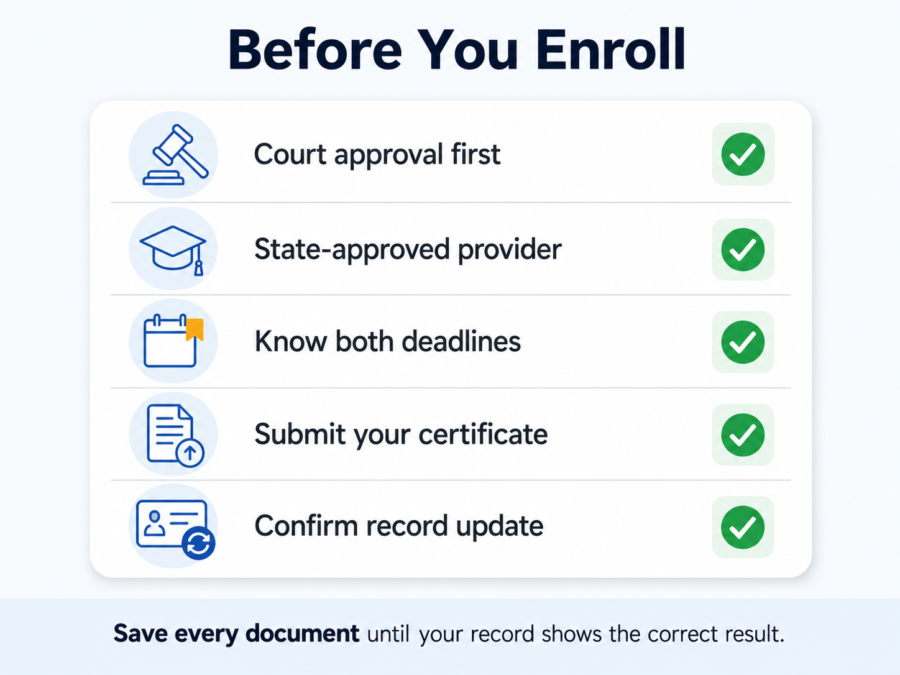
The rules and required order differ, but before taking a court-related course, check:
- whether you need court approval or must choose the option before enrolling;
- whether the charge, license class, vehicle, and past course use qualify;
- which providers are approved for the result you want;
- what you must pay the court and provider;
- when you must finish the course and any other conditions;
- who reports completion and what proof you should keep; and
- what happens if the proof is late, rejected, or never received.
Do not assume any online defensive-driving course can change a court case. A provider can offer a valid insurance course that the court will not accept for dismissal, a confidential record, or another court result.

Outcome 1: A Local Court May Dismiss an Eligible Case
Some courts can dismiss a ticket if you qualify for a driving safety course and finish every condition.
Frisco, Texas, example
Frisco Municipal Court says it may dismiss an eligible case after you finish a state-approved driving safety course. You must plead guilty or no contest, submit the required documents, pay the court costs and fees, and get court approval before starting the course.
Frisco requires a noncommercial Texas license, no driving-safety-course dismissal during the past 12 months, and no charge for speeding 25 mph or more over the limit. Texas law also excludes a charge of 95 mph or more, even if that is less than 25 mph over the posted limit. Other tickets are excluded too. After approval, you have 90 days to submit the completion documents (Article 45A.352(a)(5)).
That is one local court’s process, not a nationwide promise or a complete guide to every Texas court. Check the rules with the court named on your ticket.
If you want dismissal, review traffic school versus court before choosing a process that requires a plea or gives up another option.
Florida: The Ticket Is Not Dismissed, but It Does Not Count as a Conviction
Florida uses a different result. If you meet the rules, do not hold a commercial driver license or learner’s permit, and were driving a noncommercial vehicle, you can choose an approved Basic Driver Improvement (BDI) course instead of going to court. Florida law calls that choice an “election” (§318.14(9)).
If you meet every rule, the court withholds adjudication—it does not enter a formal conviction—and the DMV does not add points. Florida law says that result is not a conviction. The ticket is not dismissed, and government records may still show it (§318.14(9), (11)).
You cannot use this choice if you used it during the past 12 months or have already used it eight times in your life. The law also excludes certain tickets, including speeding 30 mph or more over the limit. CDL, CLP, and commercial-vehicle cases are excluded as well (§318.14(9)).
Florida law does not say how fast you must choose the course. A separate rule gives a person who does not choose to appear in court 30 days from the ticket date to pay the fine or start a payment plan. Paying that way counts as admitting the violation and giving up the right to a hearing (§318.14(4)(a)–(b)). Because that 30-day clock is about payment, not choosing BDI, ask the clerk for the course deadline and payment steps.
Florida also has an insurance rule. In general, an insurer cannot add a premium, cancel the policy, or refuse to renew because of the ticket if the court withheld adjudication and the DMV added no points under §318.14(9) and (10). An exception applies if the insurer paid a loss from a crash caused by the insured driver (§626.9541(1)(o)12).
Follow the clerk’s current instructions for your ticket. Florida’s official process can require payment, so a blanket “never pay first” rule would be wrong.
California: An Eligible Ticket Stays, but Insurers Cannot See It
California Traffic Violator School does not erase an eligible ticket. For the first case and conviction that meet the rules in an 18-month period, the DMV makes the record confidential. Insurers cannot see that record, and the DMV does not add a violation point (§1808.7, §12810).
The rule does not apply when:
- you hold a California commercial driver license;
- you hold a commercial driver license from another state;
- the violation occurred in a commercial motor vehicle; or
- the conviction would produce more than one point under §12810.
That last rule means §1808.7 does not hide a two-point conviction from insurers. The California DMV handbook says the ordinary one-point result stays on the driving record but is not reported to the insurance company.
The plain result is a confidential conviction with no violation point under this rule, not a complete deletion of the ticket.
Outcome 4: New York PIRP Does Not Remove the Ticket
New York’s Point and Insurance Reduction Program gives you benefits without removing the violation.
New York DMV says PIRP does not remove the violation, conviction, or original points from your driving record. Instead, the DMV can subtract up to four points only when it decides whether to suspend your license. The benefit covers eligible violations from the 18 months before you finish the course. It cannot take the count below zero or act as credit against future points.
New York DMV says an approved course reduces the base rate of auto and motorcycle insurance premiums by 10% each year for three years. If you are the covered vehicle’s principal operator, the discount applies to liability and collision premiums. It does not block general price increases or increases caused by violations or crashes.
If you give the certificate to the insurer or agent within 90 days after finishing the course, New York DMV says the discount starts right away and goes back to the completion date. If you present it later, the insurer can start the discount on the date you present it.
New York says the course sponsor will notify DMV within 10 weeks. If the course still does not appear after that, contact the sponsor. The DMV and insurer use separate processes, so follow the insurance certificate instructions too.
An Insurance-Only Course May Leave the Court Record Unchanged
A voluntary course can earn you a policy discount even if it does not change the ticket, conviction, or state points. The law, insurer, policy, driver, and approved course decide whether a discount exists, how much it is, which coverage it affects, and how long it lasts.
Before enrolling, ask the insurer or agent:
- whether the course is approved for the policy;
- which driver and vehicles qualify;
- which coverages receive the discount;
- when the discount begins and ends;
- whether it can be combined with existing discounts; and
- whether a reported violation is evaluated separately.
Do not call an insurance-only discount a dismissal or record removal.
How to Verify the Result Before Enrolling
Use this sequence.
1. Read the citation and official court notice
List every response option and deadline. Look for terms such as dismissal, deferred disposition, withheld adjudication, confidential treatment, traffic violator school, driver improvement, point reduction, or insurance reduction. Similar terms can have different legal effects.
2. Ask the court one precise question
If I take this approved course and meet every requirement, how will the court close my case, what will it report to the motor vehicle agency, and will I give up a hearing or another option?
Also confirm the deadline, total court cost, provider rules, certificate steps, and what happens if you finish late.
3. Confirm the provider for the exact purpose
Use the provider list from the court, motor vehicle agency, or insurance regulator. For example, Texas has an official Driving Safety Course Provider Search. A course approved for one state or purpose might not work for another.
4. Ask about the driving record and points
Ask whether the ticket will remain visible, be hidden from insurers, avoid points, or change only the points used for a certain decision. DMV points and an insurer’s pricing system are not the same.
5. Ask the insurer about the reported result
Tell the insurer the exact violation and how you expect the court to close the case. Ask how that result could affect your policy at renewal and whether a separate course discount applies.
6. Keep proof and verify completion
Keep the court approval or proof that you chose the program, payment receipt, course enrollment, completion certificate, submission proof, and final court result. After the stated processing time, ask the court or motor vehicle agency to confirm the update if needed.
What Traffic School Cannot Promise Nationwide
No course can promise the same legal or insurance result in every jurisdiction.
It cannot guarantee deletion from every record
Even after dismissal, no formal conviction, or confidential treatment, authorized users may still find a court, agency, or other government record.
It cannot revive an expired option automatically
After you pay, enter a plea, miss a deadline, or finish the case, the original course option might close. Only the court can tell you whether it can reopen the case, extend the deadline, or offer another process.
It cannot override eligibility rules
A serious charge, high speed, recent course use, commercial license, commercial vehicle, crash, or another rule can make you ineligible.
It cannot change another jurisdiction’s rules
For a ticket from another state, start with the court that issued it. Then ask your home-state motor vehicle agency how it will record the result and ask your insurer how it will treat it.
It cannot guarantee a particular premium
A record outcome, point rule, and insurance discount are different mechanisms. Ask the insurer or agent about the specific policy instead of assuming that a court benefit prevents every rate change.
Traffic-School Terms in Plain English
| Term | Careful description | Question to ask |
|---|---|---|
| Dismissal | The court throws out an eligible charge after you finish every condition | Will the court dismiss the case, and what record will remain? |
| Deferred disposition | The court delays the final result while you complete its conditions | What plea, rights, cost, and final result does the process require? |
| Withheld adjudication | The court resolves the case without entering a formal conviction under the state rule | Does the law treat this as a conviction, and will the DMV add points? |
| Confidential conviction | The ticket stays on your record, but the law hides the eligible conviction from insurers | Which government users can still see it, and will the DMV add a point? |
| Point-calculation change | The points stay on your record, but the DMV counts fewer of them for a specific suspension decision | Which point decisions change, and which stay the same? |
| Insurance discount | The course lowers the policy price under a specific rule | Does the course change the ticket too, or only the insurance price? |
Frequently Asked Questions
Does traffic school remove a ticket after I already paid?
It depends on what paying did under the court’s rules. In some systems, payment closes the case or gives up a hearing. In Florida’s official BDI process, payment can be one of the required steps. Ask the court how it closed the case and whether a course, reopening, or another option remains.
Will traffic school remove the ticket from my insurance record?
There is no single insurance record or nationwide result. California can hide an eligible conviction from insurers under §1808.7. Florida protects a case that meets its withheld-adjudication and insurance rules. New York PIRP leaves the conviction on the driving record but gives a set discount. Ask how the court reports the exact result and how the insurer will treat it.
Does traffic school remove points from my license?
Sometimes a course keeps points from being added. Other courses change only one point calculation. Florida BDI stops points from being added if you meet the rules (§318.14(9)). California does the same for an eligible confidential conviction (§1808.7). New York PIRP leaves the original points but can subtract up to four only when the DMV decides whether to suspend your license.
Can I take traffic school online?
An online option might be available, but it must be approved for the state, court, program, and result you want. Use the official provider list instead of relying only on an ad.
How long does it take for a course to update my record?
Processing time varies. Follow the court or agency’s instructions and keep proof. New York provides one specific benchmark: a PIRP sponsor should notify DMV within 10 weeks after completion. That timeline should not be applied to other programs.
What if I completed the course but the expected result is missing?
Confirm that the provider and course were approved, every condition was completed on time, and proof was accepted. Contact the court first for a court-related outcome, the motor-vehicle agency for its record, or the insurer for a policy discount. Keep the approval, certificate, receipts, and submission confirmation.
Can a CDL holder use traffic school to hide or dismiss a ticket?
Commercial-driver rules are often different. California §1808.7 does not hide the conviction if you hold a California or out-of-state CDL. Florida §318.14(9) excludes CDL and CLP holders and requires a noncommercial vehicle. Frisco’s course-dismissal process also excludes CDL holders. Ask about the court and license effects before you choose an option.
Bottom Line
Traffic school can change what happens after a ticket, but “remove” is too broad for every program. The court might dismiss the case, close it without a formal conviction, hide an eligible record from insurers, change a point calculation, give an insurance discount, or simply require the course without any of those benefits.
Before you enroll or pay, confirm how the court will close the case, what the DMV and insurer can see, how points will work, the deadlines and costs, and which rights you will give up.
Related Reading
- How to Get a Speeding Ticket Dismissed Before It Hits Your Record
- How to Keep a Ticket Off Your Driving Record
- Traffic School Insurance Discount: Can It Lower Your Rate?
- How Much Can Car Insurance Increase After a Ticket?
- How to Avoid Points on Your License
Sources
Sources reviewed August 20, 2026.
- California DMV Driver Handbook: Traffic Violator School
- California Vehicle Code §1808.7
- Florida Statutes §318.14
- Florida Statutes §626.9541
- New York DMV: Point and Insurance Reduction Program
- Frisco Municipal Court: Driving Safety Course
- Texas Code of Criminal Procedure, Chapter 45A, especially Articles 45A.352 and 45A.356
- Texas Department of Licensing and Regulation: Driving Safety Course Provider Search