


New York PIRP Course: Point Reduction, Insurance & Approved Options

A New York PIRP course can subtract up to four points from a DMV suspension calculation. It can also provide a qualifying principal operator with a 10% reduction on eligible auto insurance base rates for three years. It does not erase a ticket, conviction, or the original points shown on your driving record. New York DMV explains the two benefits.
The course is also called a New York defensive driving course or Motor Vehicle Crash Prevention Course. Choose your goal first, then use the New York DMV’s current sponsor list to confirm that the exact classroom or online course is approved.
General information only: This guide explains the statewide PIRP framework. It is not legal or insurance advice. A ticket, suspension notice, hearing notice, driving record, or insurance policy can require a different next step.
What a New York PIRP course can do
| Question | Current New York rule |
|---|---|
| What does PIRP stand for? | Point and Insurance Reduction Program |
| How long is the course? | 320 minutes of instruction; it is commonly called a six-hour defensive driving course |
| Can I take it online? | Yes, through a currently NY DMV-approved Internet or alternate-delivery sponsor |
| Does it remove a ticket? | No. The violation, conviction, and original points remain on the driving record |
| How many points can it reduce? | Up to four, only for the specified DMV suspension calculation |
| Which violations can receive the point benefit? | Eligible violations occurring within the 18 months immediately before course completion |
| What changed in 2026? | DMV now uses a 24-month window for the 11-point persistent-violator calculation |
| What is the insurance benefit? | 10% of the eligible base-rate amount for three years for a qualifying principal operator |
| Who sets the course fee? | The sponsor or delivery agency; 15 NYCRR Section 131.5(c) leaves the charge to the delivery agency administering the course |
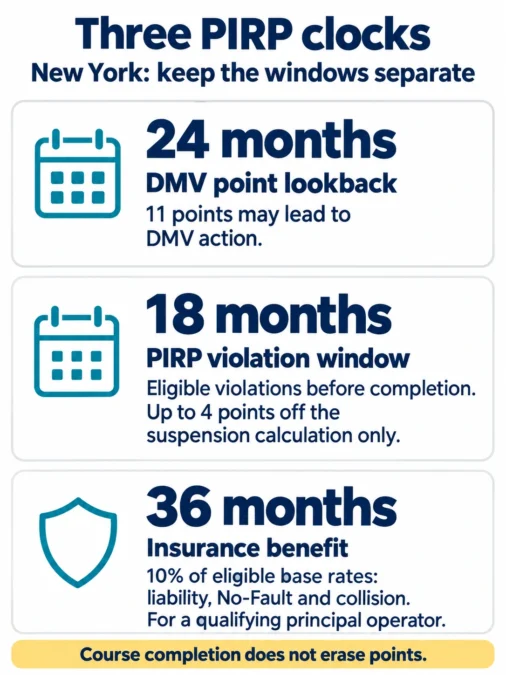
Choose the benefit you need
PIRP has two formal benefits, but they solve different problems.
| Your goal | What PIRP can do | What to check first |
|---|---|---|
| Reduce a DMV suspension calculation | Subtract up to four points from the calculation, subject to the 18-month rules | Your violation dates, current DMV record, and any existing suspension or hearing |
| Lower an insurance premium | Reduce the base rate for liability, No-Fault, and collision by 10% for three years | Whether you are the principal operator and when your insurer needs the certificate |
| Refresh your driving skills | Provide approved crash-prevention instruction | Classroom versus online format, accessibility, identity checks, and certificate delivery |
| Change the result of a traffic ticket | Nothing by itself | The court or Traffic Violations Bureau process; PIRP is not dismissal or plea bargaining |
You may take PIRP for the insurance benefit even when you have no ticket or active points. DMV’s suggested course-advertising guidance says point-reduction eligibility is limited to once in 18 months even if the point benefit is not used (15 NYCRR Section 138.13(a)(17)(i)). Treat that as a timing warning before taking the course early.
Check these issues before paying
- You are trying to dismiss, reduce, or contest a pending ticket. PIRP does not decide the ticket.
- Your license is already suspended or revoked. Point reduction does not undo an action already imposed.
- A violation hearing is scheduled. PIRP does not change that hearing.
- Your notice describes a mandatory suspension or revocation. PIRP does not prevent one.
- You need an online completion applied to a New York license record but do not have a New York DMV ID number. DMV warns that an alternate-delivery completion cannot be applied to the license record without that identifier.
- You are estimating insurance savings from your entire premium. Ask the insurer for the eligible base-rate amount first.
- The course does not appear on the current NY DMV-approved PIRP sponsor list.
Point reduction changes the calculation, not your record
New York uses “point reduction” in a narrow way. The original tickets and points stay visible on the driving record. DMV changes only the point total used for a specified suspension calculation.
Under 15 NYCRR Section 131.5(a)-(b):
- Once DMV receives notice that you completed an approved course, it must credit up to four points when computing the suspension point total.
- Only eligible violations within the 18 months immediately before course completion can receive the benefit.
- No person can receive a point reduction more than once in any 18-month period.
DMV’s PIRP page adds that the result cannot go below zero and cannot create credit against future violations.
The unused-benefit warning comes from DMV’s suggested advertising guidance in Section 138.13(a)(17)(i). Section 131.5(b) itself speaks of receiving a reduction. Under Section 138.3, DMV records completion after receiving the sponsor’s completion data and administrative fee. It enters a reduction of up to four points if appropriate. Taking the course only for insurance does not mean you can count on saving the point benefit for later.
For an explanation of why PIRP does not erase a conviction, see whether traffic school removes a ticket.
The 2026 change: 24 months for suspension, 18 months for PIRP
Beginning February 16, 2026, New York enforced amended 15 NYCRR Sections 131.3 and 131.4. Section 131.4 expanded the persistent-violator lookback from 18 months to 24 months. Section 131.3 changed the values assigned to specified violations.
The transition turns on the violation date. Violations on or before February 15, 2026 retain the former point values. Violations on or after February 16, 2026 receive the amended values, as explained in DMV’s P2/M1 (2026) enforcement memo.
An older violation may still count at its former value if it falls within the current 24-month window. DMV’s point-system page says it adds points for violations occurring within the last 24 months.
PIRP’s reduction window did not expand with it. PIRP still applies only to eligible violations occurring within the 18 months before course completion.
DMV’s driver point-system page describes suspension exposure at 11 points in 24 months. Its PIRP page limits point reduction to eligible violations within 18 months before completion. These are separate calculations.
That creates a six-month gap:
- Points from violations in months 19 through 24 may still count toward the 11-point suspension total.
- Those older violations are outside PIRP’s 18-month reduction window.
- Recent eligible violations may still support an up-to-four-point reduction, but the older points do not become reducible merely because DMV counts them in the 24-month total.
If you are close to 11 points, list every violation date before relying on the course. DMV calculates points from the violation date, not the conviction date.
A practical timeline example
Suppose a driver completes PIRP on August 27, 2026.
- The PIRP point window reaches back 18 months, to February 27, 2025.
- The persistent-violator calculation reaches back 24 months, to August 27, 2024.
- An otherwise countable violation from December 2024 may still affect the 24-month suspension total, using the former point value applicable on its violation date, but is too old to fall inside the PIRP reduction window.
Use this example only to compare dates. Verify the points and violation dates on the current DMV record.
What PIRP cannot change
New York DMV says course completion does not:
- erase a violation, conviction, or points from the driving record;
- prevent a mandatory suspension or revocation;
- affect a suspension or revocation already in effect when DMV records completion (15 NYCRR Section 131.5(a));
- affect a scheduled violation hearing;
- reduce or prevent a Driver Responsibility Assessment;
- change the separate point system an insurance company may use; or
- prevent a general premium increase or an increase tied to a violation or crash.
The Driver Responsibility Assessment has its own threshold: six or more points within 18 months. PIRP does not reduce the points used for that fee.
If the real question is how long information remains visible, read how long license points stay on a driving record. If the goal is to keep a pending ticket from becoming a conviction, start with ways a ticket may stay off a driving record instead of assuming PIRP is a court remedy.
The 10% insurance reduction applies to eligible base rates
New York Insurance Law Section 2336(a) requires an actuarially appropriate insurance reduction for three years. The statute does not set the percentage.
DFS Circular Letter No. 1 (1980), section 3, sets a floor of 10% of the insurer’s liability base rate and includes No-Fault in liability. DFS’s current consumer guidance says insurers must apply the three-year discount to liability, collision, and No-Fault when the principal operator completes a qualified course.
15 NYCRR Section 138.13(a)(18)(i) governs the wording sponsors may use: a 10% reduction for three years in the current base rate for:
- automobile liability premium;
- No-Fault premium; and
- collision premium.
The person who completes the course must be the vehicle’s principal operator to qualify. That requirement appears in Section 138.13(a)(18)(v) and DFS’s consumer guidance. The 1980 letter treats collision as optional; the current DFS guidance supplies today’s coverage requirement.
The reduction is not automatically 10% of the entire policy bill. Ask the insurer or agent to identify the eligible base-rate charges before estimating savings.
Estimate savings from the amount your insurer identifies
Use this calculation only after the insurer identifies the eligible annual base-rate amount:
Eligible annual base-rate amount × 10% = estimated annual PIRP reduction
If your insurer identifies $800 in eligible annual base-rate charges, the estimate is $80 per year. An $800 total policy premium does not establish that saving. Use the eligible amount your insurer gives you.
Who receives the reduction?
The benefit follows the principal operator. If more than one person on the policy completes PIRP, DMV says only the principal operator receives the 10% reduction for that vehicle.
DMV says youthful drivers and drivers in the assigned risk pool receive the insurance premium discount. The principal-operator and course requirements still apply. A driver already receiving a driver-education reduction should ask whether both reductions can apply.
When does the reduction begin?
Present the completion certificate to the insurer promptly.
Three timing rules in New York Insurance Law Section 2336(d) matter:
- The reduction is ordinarily calculated from the course-completion date.
- Present it within 45 days before renewal, and the insurer may start the discount on the first day of the new policy period. You then receive the full three-year term.
- Wait more than 90 days after completion, and the insurer may use the date you presented the certificate instead.
When the discount starts during a policy term, Section 2336(d) says it is prorated over that term. DFS Circular Letter No. 1 (1980), question 6(b) allows a credit toward the next renewal instead of a midterm refund if the insurer applies the reduction from the certification date. The letter is older than Section 2336(d)’s current timing rules. Use the statute to work out the start date, and ask your insurer how the credit will appear.
DMV requires another approved course every 36 months to maintain the insurance benefit. Compare this state-specific rule with the broader guide to defensive driving insurance discounts.
Classroom vs. online PIRP
New York approves classroom courses and Internet or alternate-delivery courses, often called I-PIRP or ADM courses. Both carry the same formal point and insurance benefits when the course and driver qualify.
Online PIRP operates under the internet and alternate-technology pilot authorized by Vehicle and Traffic Law Section 399-k. The current statute marks that authority for repeal on April 1, 2028. If you plan to enroll on or after that date, check the law and DMV’s approved-course list again.
| Detail | Classroom PIRP | Online or alternate delivery PIRP |
|---|---|---|
| Instruction | 320 minutes | 320 minutes |
| Schedule | DMV says one or more sessions | Self-paced within the sponsor’s system |
| Completion window | Follow the sponsor’s class schedule | Must finish within 30 calendar days after registration |
| Testing | DMV says no formal test is required for the classroom course | Quizzes, random tests, or a final exam may be used; sponsor rules vary |
| Identity checks | Instructor and classroom controls | DMV-approved methods can include questions, phone contact, voice print, keystroke analysis, or facial recognition |
| Insurance certificate | Obtain the sponsor’s valid completion certificate | Sponsor mails the physical certificate; an emailed copy is not valid |
For online or alternate delivery, DMV requires the sponsor to issue the physical certificate within 14 business days after completion. Some sponsors offer paid expedited mailing, but that does not change the underlying course benefit.
The DMV online-course guidance says the testing process and consequences can vary by sponsor. A familiar brand name or a low advertised price does not replace state approval for the course.
How to choose an approved PIRP sponsor
Start with the DMV list, not a search ad. New York calls the approved organization a sponsor. A delivery agency may teach a sponsor’s approved classroom course, but the sponsor remains responsible for the program.
Use this sequence:
- Open the official approved PIRP course list.
- Choose classroom or online/alternate delivery.
- Confirm the exact sponsor and course appear in the correct section.
- For online study, review the identity-validation method shown by DMV.
- Read the sponsor’s current fee, refund, testing, device, support, and mailing terms.
- If insurance savings are your goal, confirm acceptance and the eligible base-rate amount with the insurer.
- Save the receipt, completion date, certificate, and a copy of the terms you relied on.
What happens after you finish
For the DMV point record
The sponsor reports completion to DMV. DMV’s public PIRP page tells drivers to contact the sponsor if completion is still missing from the driving record more than 10 weeks after finishing.
Check your driving record if the point result matters to a suspension calculation. The insurance certificate alone does not confirm that DMV has recorded completion.
For the insurance reduction
Send the valid completion certificate to the insurer or agent. You are responsible for this step. For an online course, wait for the mailed physical certificate; DMV says an emailed copy is not accepted for the insurance claim.
Keep the completion date and set a reminder before the three-year benefit ends. The 36-month insurance cycle is separate from the 18-month point rules explained above.
Common PIRP mistakes
Treating PIRP as ticket dismissal
The course does not resolve a pending citation. Court and Traffic Violations Bureau procedures are separate, and New York does not use one statewide plea process.
Counting back from the conviction date
DMV uses the violation date for its point calculations. A delayed conviction does not move the underlying violation into a newer PIRP window.
Assuming all points in the 24-month total are reducible
The current suspension lookback is 24 months, but PIRP’s reduction window is 18 months. Review the dates individually.
Multiplying the full premium by 10%
The rule applies to eligible base-rate coverages, not automatically to every line of the policy. Ask the insurer for the applicable amount.
Buying an unapproved course
Under Vehicle and Traffic Law Section 399-c, the commissioner must approve the course before it qualifies for the mandatory insurance reduction. DFS OGC Opinion 05-12-09 confirms that a non-approved out-of-state course does not qualify.
Insurance Law Section 2336(a)(1) separately excludes self-instruction courses. DMV-approved online PIRP operates under the separate pilot authority described above. Check the official sponsor list before paying.
Waiting to submit the certificate
Presenting it more than 90 days after completion can change the date from which the insurer applies the reduction.
Frequently asked questions
Does a New York PIRP course remove four points from my record?
No. The violation, conviction, and original points remain displayed. DMV may subtract up to four points only for the specified suspension calculation.
Can PIRP keep me from reaching 11 points?
It may reduce the suspension calculation when eligible recent violations and timing rules support the benefit. It cannot affect violations outside its 18-month window, an already imposed suspension, or a mandatory suspension.
Can I take PIRP before I have points?
Yes, but consider the timing. You may take an approved course for the insurance benefit or as a driving refresher, and point reduction cannot be banked against future violations. DMV’s suggested course-advertising guidance, Section 138.13(a)(17)(i), warns that eligibility is limited to once in 18 months even if the point benefit is unused. Section 131.5(b) bars receiving a reduction more than once in that period; it does not expressly address an unused benefit.
How often can I take the course?
Section 131.5(b) bars receiving a point reduction more than once in any 18-month period. To maintain the insurance reduction, DMV says to complete the course once every 36 months.
Is online PIRP valid in New York?
Yes, when the exact Internet or alternate-delivery course is on the current NY DMV-approved sponsor list. An online course must include 320 minutes of instruction and be completed within 30 calendar days after registration.
Will an emailed certificate work for insurance?
No. For an online or alternate-delivery completion, DMV says the sponsor mails the physical certificate and an emailed copy is not valid for the insurance claim.
Does the 10% reduction apply to my whole insurance premium?
Not necessarily. It applies to eligible base-rate coverages. Ask the insurer to identify the applicable dollar amount rather than multiplying the full bill by 10%.
Does PIRP reduce a Driver Responsibility Assessment?
No. DMV expressly states that PIRP cannot prevent or reduce that assessment.
Before you enroll
Check the violation dates, confirm the exact DMV-approved sponsor, and ask the insurer which base-rate amount qualifies. If a suspension, hearing, or pending ticket is involved, follow that official notice before relying on a course.
Related Reading
- New York PIRP point reduction: the 11-point and 24-month rules
- Does traffic school remove a ticket from your record?
- How long do points stay on a driving record?
- Ways a ticket may stay off your driving record
- How defensive driving insurance discounts work
Sources
- New York DMV — Point and Insurance Reduction Program
- New York DMV — The New York State Driver Point System
- New York DMV — Approved PIRP Courses
- New York DMV — Online and Alternative Delivery Method Courses
- New York DMV — Commissioner’s Regulations Part 138
- 15 NYCRR Section 131.5 — Point reduction
- 15 NYCRR Section 138.3 — Point reduction benefits and recording
- New York DMV — Commissioner’s Regulations Part 141
- New York State Register — January 14, 2026 enforceability notice for 15 NYCRR Sections 131.3 and 131.4
- New York DMV — P2/M1 (2026) enforcement memo
- New York Insurance Law Section 2336
- New York DFS — Circular Letter No. 1 (1980)
- New York Department of Financial Services — Auto Insurance Information for Consumers
- New York Vehicle and Traffic Law Section 399-k
- New York Vehicle and Traffic Law Section 399-c
- New York DFS — OGC Opinion 05-12-09: Accident Prevention Course
Last updated: October 13, 2026