


South Carolina Traffic Education Program: Eligibility and Ticket Dismissal Steps

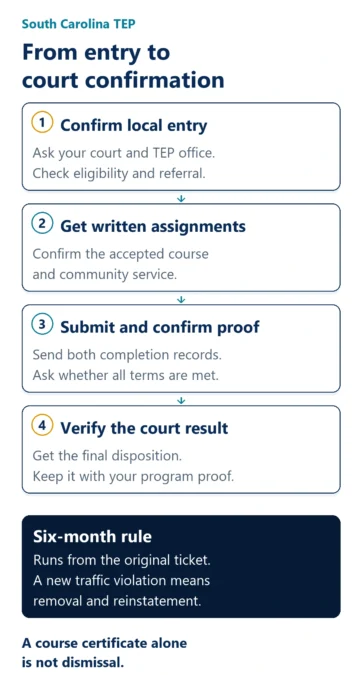
If you have a South Carolina ticket, buying a driving class is not enough to get it dismissed. The South Carolina Traffic Education Program, or TEP, offers diversion for eligible pending tickets. It requires acceptance into the program, education and community service—not just a course certificate.[1][2]
The first step is finding the office that can accept your case. Some offices require a court referral; others publish a route to apply before the court date. Following another county’s instructions can send you to the wrong place at the wrong time.[4][5][6]
This guide helps you check eligibility, identify the local entry process, prepare your documents and verify the court result. The statewide legal framework comes from South Carolina Code Sections 17-22-310 through 350. Local instructions explain how the office handling your citation puts that framework into practice.[1]
General information only: This guide explains South Carolina TEP procedures and does not provide legal advice about your individual ticket or driving record.
Check the ticket and your eligibility first
State prosecutor guidance says TEP is available in at least one county in each of South Carolina’s 16 judicial circuits. That does not establish that every court participates. Start with the court named on your citation and the relevant circuit solicitor’s diversion office.[2]
The statewide prosecutor’s eligibility questions give you a useful initial screen. You must answer no to each of these to be eligible for consideration:[2]
- Do you have a significant history of traffic offenses?
- Did the offense cause death or serious bodily injury?
- Does the offense carry jail time?
- Do you hold a commercial driver’s license or commercial learner’s permit?
- Is the offense punishable by more than four points?
State law also limits TEP participation to once. A clean recent record does not restore the opportunity if you have already participated.[1]
Passing this screen does not guarantee admission. Ask the office to evaluate the exact charge and your history. “Significant history” is not a numerical cutoff in Section 17-22-320, and local offices may publish additional admission criteria. The First Circuit, for example, says a defendant cannot participate with more than four points already on their driving record.[1][5]
The points attached to your pending offense and the points already on your license are different questions. Have both pieces of information ready. If you hold a CDL or CLP, disclose it even if you were driving a personal car; the statewide guidance’s exclusion is based on holding that credential.[2]
TEP is a pending-ticket process
Tell the office whether you have already paid the citation, entered a plea or received a court decision. Ask how that status affects your options before purchasing training. This guide does not establish a way to reopen a resolved ticket.
For points already assessed, South Carolina has a separate DMV course route. TEP is the solicitor-supervised diversion route for a qualifying charge. A course marketed for one purpose is not proof that it completes the other program.[1][2][11]
Find out how your court sends applicants to TEP
Use the state prosecutor’s list of circuit solicitor offices to find the responsible office. Tell the staff the county, court name, citation number and scheduled court date. Ask whether your court participates and whether you need a referral before applying.[3]
The published entry instructions differ by office:
| Office or county | Published entry instructions | What to do with that information |
|---|---|---|
| Horry County | Judge referral is available. Some Summary Court and Municipal Court cases may qualify for self-referral before the scheduled court date.[4] | Contact TEP before court to ask whether your case can use self-referral. |
| First Circuit | Appear at the court date and request a referral. After the office receives it, an enrollment appointment is sent by mail.[5] | Confirm the referral process and keep your mailing address current. |
| Greenville County | Obtain a magistrate referral and call for an application appointment. Approval is not a same-day process.[6] | Arrange the appointment and ask what court obligations remain while approval is pending. |
| Pickens County | Apply in person before the court date, with the listed documents.[6] | Ask the Pickens office how to apply for your citation before that date. |
| Fifth Circuit | Appear at the required court date and request a referral; the coordinator then sends application instructions.[7] | Follow the referral and subsequent letter rather than assuming an unsolicited application is sufficient. |
These are examples, not a complete court directory. Even Greenville and Pickens, served by the same circuit, publish different application steps.
Keep the court date on your calendar until the court tells you whether it has changed or you are excused. An inquiry to a program office is not confirmation that your court obligations have been handled. Ask for written instructions if you receive a referral or acceptance before the scheduled date.
Confirm that the referral actually arrived
A referral and an application are separate steps. The Ninth Circuit’s application instructs applicants to call or email the TEP office first to confirm receipt of the court or prosecutor referral. It also says that requirements will be emailed upon acceptance.[8]
Wherever you apply, ask: “Do you have the referral, and is there anything missing before you can consider my application?” Save the response with your citation paperwork.
Prepare the documents your office requests
Local lists commonly include a copy of the ticket, identification and a Social Security card or permitted substitute. Horry lists a driver’s license, Social Security card and citation. Greenville allows a Social Security office printout and lists a license, learner’s permit or picture identification.[4][6]
Use your own office’s list. Another office may not accept the same substitute that Greenville allows.
To organize the application, make a folder containing:
- The citation and referral: Include the citation number and all court paperwork.
- Requested identification: Check whether the office needs a copy or wants to see an original.
- Driving history: Confirm the required period, certification and issuing agency if a record is requested.
- Payment instructions or a fee-waiver request: Confirm amounts, payees and payment method before buying money orders.
- Contact details: Check the mailing address, phone number and email where you will receive instructions.
Use this checklist to organize your papers, then complete your office’s form. Ask how to send sensitive documents and keep a copy of what you submit. If staff need another item, write down when it is due. Ask whether they can process the application without it.
The Ninth Circuit expressly requires applicants to notify both TEP and the court when their address or telephone number changes. If you move during the process, update the responsible offices promptly.[8]
Out-of-state drivers: arrange the work before returning home
Living outside South Carolina does not automatically rule out TEP. The First Circuit expressly allows out-of-state or out-of-county defendants to participate and describes a mailed application. It requires an out-of-state driving record and says the participant is responsible for arranging the education and nonprofit service in their area.[5]
Record requirements differ by office. Greenville requires a certified three-year driving record for out-of-state drivers. Pickens asks for a three-year record. The Ninth Circuit application requires an official record from the applicant’s state of residence.[6][8]
Ask which version to order before paying your home-state agency. A record with the wrong time span or without the required certification may not satisfy the request.
Also confirm the exact course and service location before booking them near home. Get answers to three questions:
- Is this provider and delivery format acceptable for my assigned education?
- Will service at this nonprofit count, and what proof does it need to supply?
- Where do I send both sets of completion documents?
Horry says it assists out-of-area participants in locating resources.[4] Ask for that help if distance makes the assignment difficult. Your home address does not determine which South Carolina office handles the citation.
Budget for the program, the class and any record follow-up
Section 17-22-350(A) sets a $140 application fee and a participation fee of up to $140, both nonrefundable. It also says inability to pay cannot bar participation. If a person is deemed unable to pay, both fees must be waived.[1]
Several offices publish a $280 application/participation charge. Education can cost extra. Greenville lists a separate $25 class charge, and the Eleventh Circuit lists outside education-provider costs as an additional amount to be determined.[6][9]
Ask for a complete cost breakdown before applying. Separate required program and class charges from optional record work and practical expenses such as travel or obtaining a driving record. A provider’s advertised class price is not the total cost of TEP.
Payment method matters, too. Horry accepts two $140 money orders or online debit/credit-card payment. Greenville publishes money-order-only payment. The Fifth Circuit’s letter specifies two separate payments and the relevant payees.[4][6][7]
If paying is a problem, ask the TEP office how to request the waiver and show that you cannot pay. That rule covers the application and participation fees. Ask separately how the office handles a charge for the course. Optional expungement has its own legal basis and fee process.[1][9]
Complete the assigned course and community service
Obtain your assignment after acceptance. Ask for the exact course, format, service requirements, deadlines and proof-submission method in writing. Compare that assignment with the class you plan to buy.
The offices illustrated here commonly specify four hours of community service and a four-hour driving course. The state statute requires both components but does not prescribe those hours as a universal statewide schedule.[1][4][5][6]
Online education is available in some programs. The Fifth Circuit specifically assigns an online traffic education program with a separate fee. That does not mean any self-paced online class will count in every circuit.[7]
Example: You live outside South Carolina and find a convenient online course that advertises ticket dismissal. Send its exact name and format to your TEP case manager before registering. If the office assigns another class, use that assignment. A marketing promise cannot replace program acceptance.
For service, confirm the approved organization and who can sign your proof. Keep the course certificate and service record together. Submit both as directed and ask whether the office has accepted them, rather than treating a sent email or mailed envelope as confirmation.
If a required date becomes impossible, contact the case manager while there is still time to explain the problem. Request instructions; a scheduling difficulty does not itself establish an extension.
The six-month rule starts with the original ticket
Under Section 17-22-330(D), a new traffic violation during the six months after the ticket for which you entered TEP was issued has serious consequences. The agency must remove you from TEP and reinstate the original offense. The period starts with the original ticket, not enrollment or course completion.[1]
The First and Fifth Circuits also say the ticket must stay pending, or cannot be dismissed, before six months from the citation date. Follow your office’s instructions for finishing TEP and obtaining the court result.[5][7]
Horry’s webpage says its education and service tasks can typically be completed within 30 days of application. It also describes notifying the agencies for dismissal. This does not establish an exception to the law’s new-violation rule or guarantee a court result within 30 days.[4]
Alongside the class finish date, ask the case manager:
- What are my education and service deadlines?
- How is the six-month period handled in my case?
- When can the program confirm successful completion and send the disposition to court?
This guide does not promise that early coursework ends the six-month condition. If you receive another citation during that period, promptly ask the program office and an attorney about its effect on your pending TEP case.
Verify dismissal, then ask about any separate record action
After finishing your assigned tasks, confirm the program and court have processed the result. Local offices say they notify the court after successful completion. On successful completion, Section 17-22-330(A) requires a noncriminal disposition and says no record of the offense may be maintained except by the TEP program itself, which keeps it to enforce the one-time limit. Section 330(B) separately allows an application, if applicable, to destroy official arrest records.[1][5][6]
Ask the program office to confirm that every condition has been satisfied and that the completion notice has gone to the right court. Then ask the court for the final disposition for each citation covered by your referral. Keep that document alongside your program proof.
Expungement needs its own instructions
Ask whether a separate expungement or record-destruction step applies and which records it covers. In the Eleventh Circuit, the TEP page says expungement information is provided after successful completion. Its FAQ specifically tells diversion-program graduates to contact their case manager instead of completing the ordinary expungement application.[9][10]
Do not budget from a generic expungement fee list. Section 17-22-940(E)(1), for example, expressly excludes a SLED verification fee for an expungement sought under the TEP provision, Section 17-22-330(A). Ask the office for an itemized quote identifying the basis of the request.[1]
Dismissal of the referred charge, an arrest-record order and the status of a DMV record are different things to verify. This guide does not establish that a TEP certificate erases every record or removes unrelated points. If a record still shows a result that conflicts with the disposition, keep the court document and ask the office responsible for that record how to address it.
Start with the court on your citation and the circuit’s TEP office. Confirm the referral route before paying, follow the written assignment, and keep your proof until the court result is documented.
Related Reading
Sources
- South Carolina Code, Title 17, Chapter 22, Article 3, Sections 17-22-310 through 350; Article 9, Section 17-22-940(E)(1).
- South Carolina Commission on Prosecution Coordination — Traffic Education Program.
- South Carolina Commission on Prosecution Coordination — Helpful Links: Circuit Solicitor Offices.
- Horry County Solicitor — Traffic Education Program.
- First Circuit Solicitor — Traffic Education Program.
- 13th Circuit Solicitor — Greenville and Pickens Traffic Education Programs.
- Fifth Circuit Solicitor — Traffic Education Program.
- Ninth Circuit Solicitor — TEP Application and Instructions.
- Eleventh Circuit Solicitor — Traffic Education Program.
- Eleventh Circuit Solicitor — Expungement FAQs.
- South Carolina DMV — Points System: Defensive Driving Course.
Last updated: October 5, 2026