
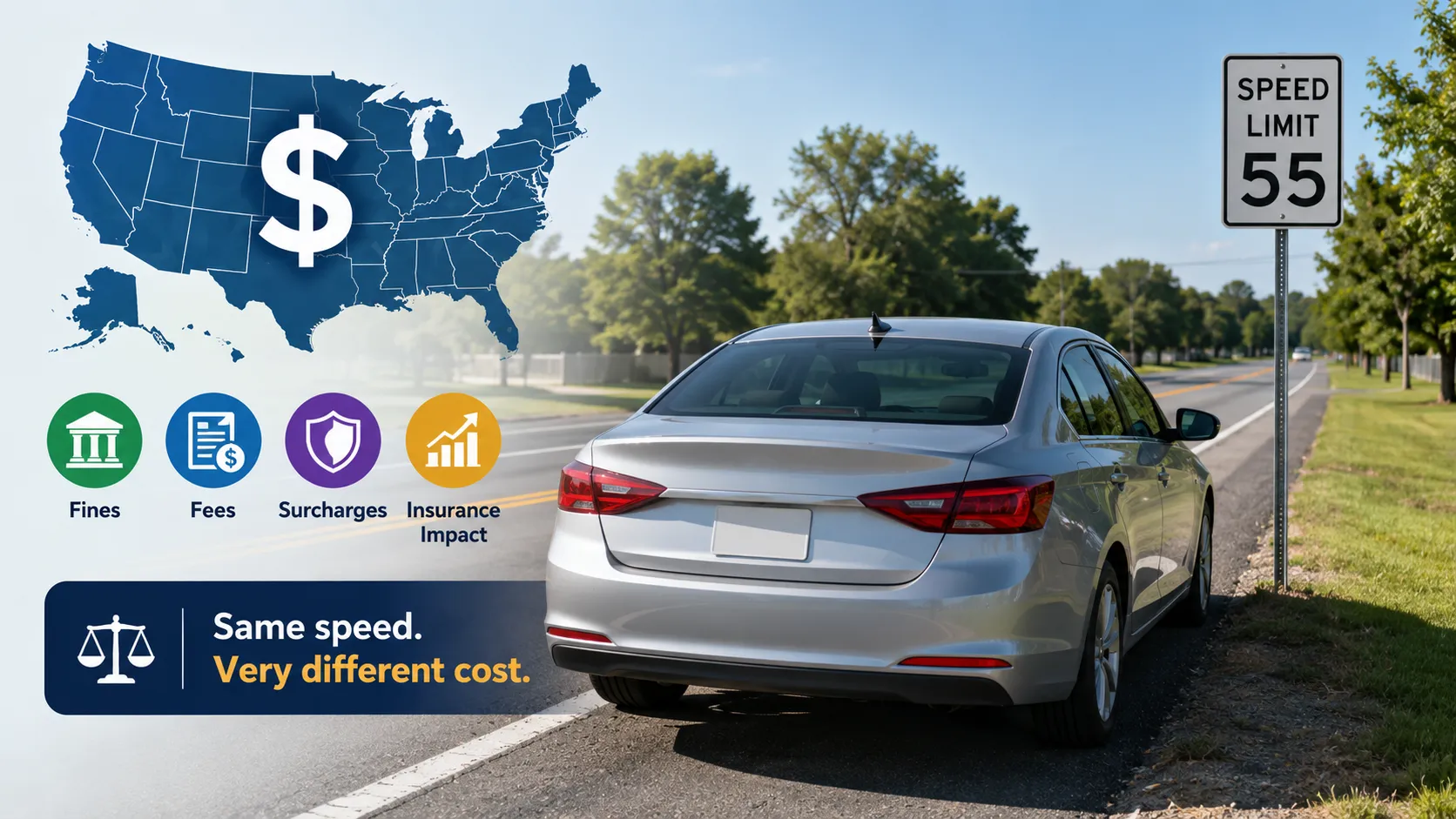
Speeding Ticket Cost by State: 2026 Fines, Fees & Points
There is no reliable table of “typical” speeding-ticket totals for all 50 states. The amount can change by court, speed, road, zone, and charge. Even two tickets in the same state can have unlike fines and fees.
To find your real cost, start with the court named on your ticket. Then check your state driving record rules and ask your insurer how a conviction could affect your price.
The court, state driver agency, and insurer each control part of your total cost.
Important: This article gives general information, not legal or insurance advice. Rules depend on the state, court, charge, license, vehicle, record, and policy. Follow the steps on your ticket and confirm your options with the court before you pay or enroll in a course.
Quick Answer: How Much Is a Speeding Ticket in Your State?
Do not rely on a national average or an unsourced state range. Check these four numbers:
- Court total: Ask the court for the fine, fees, and state or local charges.
- State cost: Check whether a conviction would add points or trigger an extra state fee.
- Course or court cost: Add any fee for traffic school, dismissal, a hearing, or legal help.
- Insurance cost: Ask your insurer whether the conviction would change your premium and for how many renewals.
Use the exact court and code section printed on your ticket. An amount from a nearby county may not apply to your case.
| Cost to check | Who can confirm it | What to ask |
|---|---|---|
| Fine and court fees | Court or clerk named on the ticket | What is the full amount for this ticket number? |
| Points and state fees | State driver licensing agency | What happens if this charge becomes a conviction? |
| Course or dismissal fees | Court | What will the court enter if I finish the program? |
| Insurance | Your insurer | Would this exact conviction change my price? |
For a fill-in cost worksheet, see how much a speeding ticket really costs.
What Counts as the Cost of a Speeding Ticket?
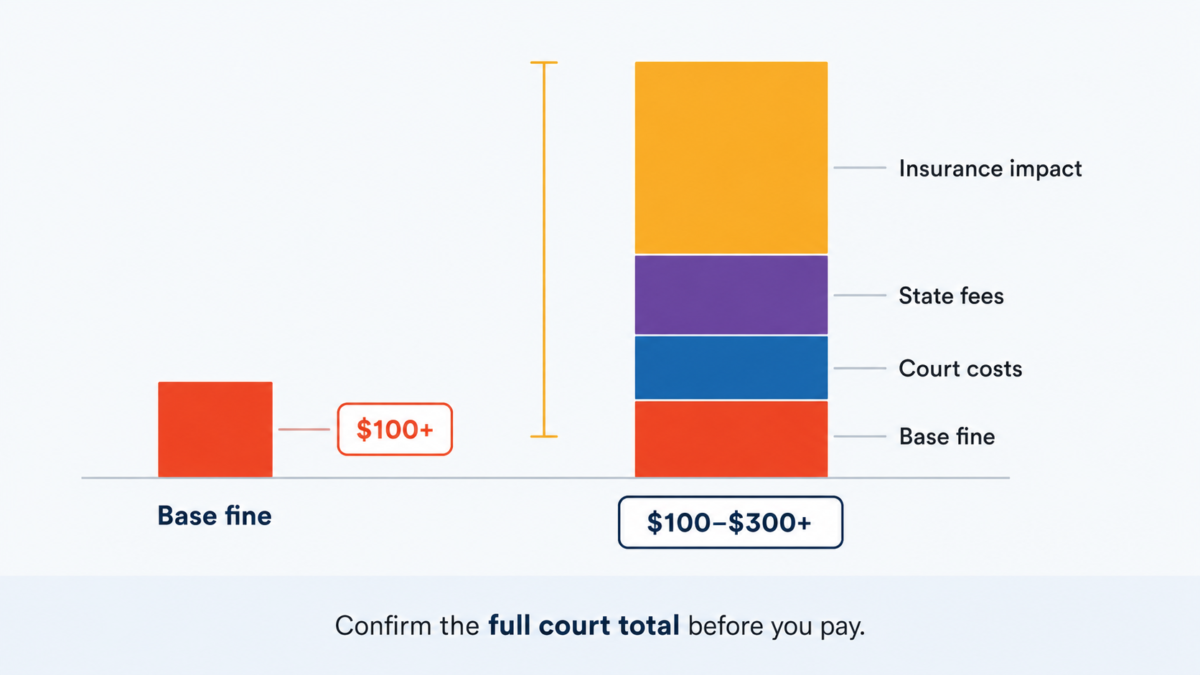
The listed fine may be only one part of the total.
Build your total from costs you can verify:
| Cost layer | What it covers | Where to verify it |
|---|---|---|
| Fine | The charge for the violation | Court portal or clerk |
| Court and state fees | Processing fees, assessments, or surcharges | Court’s itemized total |
| Driver-agency fee | An extra charge tied to points or another rule | State driver licensing agency |
| Course or legal cost | Traffic school, court program, or legal help | Court, approved provider, or written legal fee terms |
| Insurance change | A higher price or lost discount after a conviction | Your insurer and like-for-like quotes |
| Time and travel | Court, course, travel, or missed work | Your own records |
Keep one-time costs apart from yearly costs. If your insurer gives you an annual price change, use only the number of renewals the insurer identifies.
Verified State Examples
The examples below show why a single national price does not work. They are not personal court quotes. Each one is tied to a government source.
| State | Verified rule | What it can change |
|---|---|---|
| California | A local bail schedule may leave out state assessments and fees | The final court total can exceed the schedule |
| California | An eligible one-point ticket can receive confidential Traffic Violator School treatment once in an 18-month period | The ticket stays on the DMV record but is not reported to the insurer |
| Florida | Speeding not more than 15 mph over carries 3 points; more than 15 mph over carries 4 | Your point total |
| Georgia | A Super Speeder conviction adds a $200 state fee | An extra state bill after the local fine |
| New Jersey | Six or more points within three years trigger a $150 surcharge for the first six points, plus $25 for each extra point; the surcharge can be assessed each year for three years | A charge separate from the court fine |
| New York | Six or more points within 18 months trigger a three-year Driver Responsibility Assessment | An extra DMV charge |
| North Dakota | The official schedule changes the fee and points by speed band and speed-zone type | Both the court amount and points |
| South Dakota | The state uses a point system and can suspend a license at 15 points in 12 months or 22 in 24 months | License risk from the full record |
| Texas | The old Driver Responsibility Program ended in 2019; repeat-violation license action now uses conviction counts rather than DRP points | Four convictions in 12 months or seven in 24 months can lead to suspension |
| Utah | The 2026 Uniform Fine Schedule lists suggested fines and says when a court appearance is required | A schedule is guidance, not your case result |
| Virginia | Driving 20 mph or more over the limit, or faster than 85 mph, is reckless driving | The charge can be more serious than ordinary speeding |
These examples show the checks that matter. Your state may use its own fine schedule, point system, court program, or extra fee.
California: Check the Final Court Total
California shows why a base amount may not equal the amount due. Santa Clara County’s 2026 traffic bail page says its schedule does not show the full amount for many offenses because state assessments and fees can increase the final sum. It also says a judge may set bail that differs from the listed amount (Santa Clara County Superior Court — Traffic Bail Schedule).
California DMV also says a judge may offer Traffic Violator School for an eligible one-point ticket. If you finish the course correctly, the ticket stays on your DMV record but is not reported to your insurer. You can receive this treatment once in an 18-month period (California DMV — Traffic Violator School).
The court must confirm that you qualify. Do not enroll based only on a private school’s advertisement.
Florida: The Charged Speed Changes the Points
Florida assigns 3 points for unlawful speed not more than 15 mph over the limit and 4 points for more than 15 mph over. Unlawful speed that results in a crash carries 6 points (Fla. Stat. § 322.27(3)(d)).
Those figures do not tell you the court total. Use the court named on your ticket for the amount, then use the state point schedule to check the record effect.
If you are considering Basic Driver Improvement, ask the clerk what payment and course steps apply to your ticket before the deadline.
Georgia: A Super Speeder Fee Is Separate
Georgia adds a $200 state fee after a Super Speeder conviction. The rule applies at 75 mph or more on a two-lane road, or 85 mph or more on any Georgia road. The fee is added to the local fine and fees (Georgia DDS — Super Speeder FAQ).
Georgia DDS sends a notice after it receives the conviction. Follow that notice as well as the court’s steps.
New Jersey: Points Can Trigger Another Bill
New Jersey’s court fine is not the only number to check. If you receive six or more points within three years, the Motor Vehicle Commission charges $150 for the first six points and $25 for each extra point (New Jersey MVC — Surcharge Facts). That surcharge can be assessed each year for three years. Six surchargeable points can therefore result in three $150 assessments—a possible $450 total—if the points remain surchargeable (New Jersey MVC — Surcharges).
Ask the court for the amount due in the case. Then check your current MVC point total before you decide that the court payment is the full cost.
New York: A DMV Assessment Can Follow the Court Case
New York requires a Driver Responsibility Assessment when you receive six or more points within 18 months. At six points, the assessment is $100 each year for three years. Each point above six adds $25 per year. This bill is added to the court’s fines and surcharges (New York DMV — Driver Responsibility Assessment).
An approved Point and Insurance Reduction Program course does not remove the ticket, conviction, or points from your record. It can reduce the number of points used to calculate a suspension by up to four. New York DMV states that completing an approved course reduces the base rate of auto and motorcycle insurance premiums by 10% each year for three years. The reduction applies to the liability and collision premiums of a qualifying principal operator (New York DMV — Point and Insurance Reduction Program).
North Dakota: The Official Schedule Uses Speed Bands
North Dakota publishes a speeding fee and point chart. For zones of 65 mph or less, the chart starts at $20 and zero points for 1–5 mph over. The fee and points rise across higher speed bands. Zones above 65 mph use their own chart (NDDOT — Uniform Complaint and Summons Information).
This corrects a common mistake: North Dakota does use points for speeding. Use the row that matches both the charged speed and the speed-zone type.
South Dakota: “No Point System” Is Incorrect
South Dakota uses a point system. A driver can face suspension after reaching 15 points in 12 months or 22 points in 24 months (South Dakota DPS — Point System).
The point result depends on the conviction entered. Ask the court what charge would appear on your record, then check the state table.
Texas: Ignore Old Driver Responsibility Program Charts
Texas ended the Driver Responsibility Program on September 1, 2019. DPS says no new DRP surcharges are assessed and DRP points are no longer assigned (Texas DPS — Driver Responsibility Program Repeal FAQ).
Texas now uses conviction counts for its general repeat-violation rule. Four moving-violation convictions in 12 months or seven in 24 months can lead to a license suspension (Texas DPS — Traffic Offenses).
That does not erase the local fine or other license consequences. For an eligible case, Texas law lets a judge require a driving safety course after you make the required request and meet the conditions (Texas Code of Criminal Procedure, Art. 45A.352). A court may also charge the course-request fees allowed by another article (Texas Code of Criminal Procedure, Art. 45A.358).
Use the municipal or justice court named on the ticket for the exact amount and course steps.
Utah: A Fine Schedule Is Not a Personal Quote
Utah’s 2026 Uniform Fine Schedule lists a suggested fine and security surcharge and marks charges that require a court appearance. It is a guide for the courts; your ticket and court directions control your next step (Utah Courts — 2026 Uniform Fine Schedule).
Match the code section on your ticket to the table. Do not choose a row based only on a short description from a search result.
Virginia: High Speed Can Change the Charge
Virginia treats either of these as reckless driving by speed:
- Driving 20 mph or more over the limit
- Driving faster than 85 mph, even if you are less than 20 mph over
The two thresholds are independent under Virginia law (Va. Code § 46.2-862).
If the ticket names reckless driving or requires an appearance, do not compare it with an ordinary speeding-fine chart. Consider local legal advice.
How to Check the Cost in Any State: Five Steps
The Quick Answer identifies four costs. These five steps show you how to verify them.
1. Read the ticket
Write down the court, ticket number, code section, charged speed, posted limit, location, and deadline.
2. Get the itemized court total
Use the court portal or call the clerk. Ask for the fine, court fees, state charges, payment fee, and any required appearance.
3. Check the state record effect
Use your state driver agency. Ask how many points the conviction adds, how long the entry stays on your record, and whether it triggers an extra state fee or license action.
4. Ask what each court option changes
Do not ask only whether traffic school is “available.” Ask what the court enters after you finish it. The result may be dismissal, the court holding off on a guilty finding, confidential record treatment, a point change, or only an insurance discount.
For those differences, see whether traffic school removes a ticket.
5. Check insurance with your own information
A national percentage cannot tell you what your insurer will charge. The NAIC lists driving record among the factors used to price auto insurance and recommends comparing quotes with the same coverage and limits (NAIC — Consumer Auto Insurance).
Ask your insurer:
- Would this exact conviction change my premium?
- When would the change appear?
- How many renewals would use the conviction?
- Would I lose a discount?
- Would a court-approved course change the result?
For more detail, see car insurance increases after a ticket.
Pay, Take a Course, or Go to Court?

Compare both the cost and the record result before you choose.
| Option | Cost to verify | Record question to ask |
|---|---|---|
| Pay | Full court total and insurance change | What does payment enter on my record, and does it end my right to a hearing? |
| Take a course | Court fee, course fee, and payment terms | Will the court dismiss the charge, hold off on a guilty finding, keep it off the record insurers can see, or only change points? |
| Contest the ticket | Court cost, time, travel, and possible legal fee | What evidence and deadline apply? |
| Ignore it | Added court or license consequences | What happens if I miss the deadline? |
Use paying a ticket versus traffic school for a like-for-like comparison. If the charge is serious or the evidence may be wrong, review when fighting a speeding ticket makes sense.
Frequently Asked Questions
What state has the most expensive speeding tickets?
There is no reliable permanent ranking. The total depends on the charge, court, fees, speed, zone, record, and insurance policy. Compare official court totals for the same charge instead of comparing unsourced state averages.
Why can the total exceed the listed fine?
The listed fine may not include every court fee, state assessment, local charge, or later driver-agency bill. Ask the court for an itemized total and check whether your state sends a separate assessment.
Does a state fine schedule show what I will pay?
Not always. Some state charts show suggested amounts. Others leave out added assessments or fees. Match the code section and ask the court for the current total.
Does a state without ordinary speeding points make the ticket harmless?
No. A conviction can still appear on your driving record, affect your insurance, or count toward another state rule. Check the record result, not only the point number.
Can traffic school lower the total cost?
It can, but the result depends on the court program. You may still owe a fine, court fee, state charge, and course fee. Confirm the total and the record result before you enroll.
Should I pay immediately?
Read the court instructions first. Payment can affect your right to a hearing or the way the case ends. Some course choices also require payment as part of the process. Follow the rule for your court and ticket.
Where can I find the exact amount?
Use the portal for the court named on the ticket, or call that court’s clerk. A private calculator, search result, or another county’s amount may not match your case.
The Bottom Line
The real speeding-ticket cost is not a single state average. It is the court total, any state fee, course or legal cost, and insurance change that apply to your case.
Start with the ticket. Confirm the court amount, check the state record effect, and ask your insurer for your own price. That gives you a useful answer without relying on a range that may not fit your court or charge.
Related Reading
- Driver License Points: How the Point System Works
- How to Get a Speeding Ticket Dismissed: 7 Steps Before You Pay
- Speeding Ticket Points: How Many Points Does a Speeding Ticket Add?
- How to Keep a Ticket Off Your Driving Record
- How to Avoid Points on Your License
Sources
Sources reviewed August 20, 2026.
- Superior Court of California, County of Santa Clara — 2026 Traffic Bail Schedule
- California DMV — Traffic Violator School
- Florida Statutes § 322.27 — Driver License Point System
- Georgia Department of Driver Services — Super Speeder FAQ
- New Jersey Motor Vehicle Commission — Surcharge Facts
- New Jersey Motor Vehicle Commission — Surcharges
- New York DMV — Driver Responsibility Assessment
- New York DMV — Point and Insurance Reduction Program
- North Dakota Department of Transportation — Uniform Complaint and Summons Information
- South Dakota Department of Public Safety — Point System
- Texas Department of Public Safety — Driver Responsibility Program Repeal FAQ
- Texas Department of Public Safety — Traffic Offenses
- Texas Code of Criminal Procedure — Article 45A.352
- Texas Code of Criminal Procedure — Article 45A.358
- Utah Courts — 2026 Uniform Fine Schedule
- Code of Virginia § 46.2-862 — Exceeding Speed Limit
- National Association of Insurance Commissioners — Consumer Auto Insurance