


Tennessee Defensive Driving Course: Which Course Do You Need?

Taking a defensive driving course in Tennessee can help, but only if you take the right one for the problem in front of you. A course that removes speeding points, for example, may not meet a judge’s traffic-school order. Driver Improvement referrals and insurance discounts follow their own rules.
Before you pay to enroll, pin down the result you need. Starting there is the easiest way to avoid spending money on a class that does not count toward your ticket, state notice or insurance policy.
General information only: Last reviewed September 30, 2026. This is not legal advice about your ticket, court case, license, or insurance policy.
Quick answer: Tennessee does not have one universal defensive driving course. The right class depends on whether you need speeding-point removal, a court-approved course, a Driver Improvement referral, or an insurance discount.
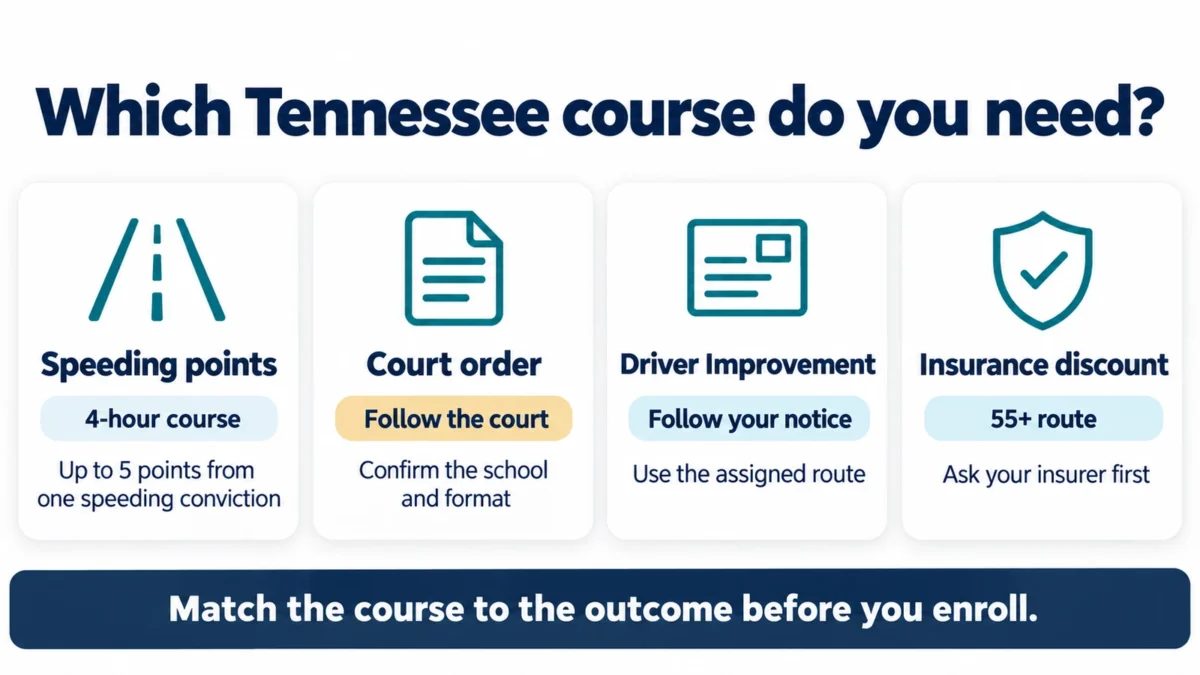
Choose why you need a course
| Your situation | What a course may do | Start with |
|---|---|---|
| You were convicted of speeding and want points removed | Remove up to five points from that speeding conviction if you meet the law’s rules | The state’s approved speeding-point course roster |
| A court told you to take traffic school | Meet a court requirement if the court accepts that course | Your court order and the court’s approved-school instructions |
| You received a Driver Improvement notice | Help meet the referral process | The notice and the Driver Improvement school list |
| You are seeking an insurance discount | Qualify for a limited mature-driver discount if your policy and history meet the law’s conditions | Your insurer, then an approved eight-hour course |
Course names can be misleading. “Defensive driving,” “traffic school,” and “Driver Improvement” may describe different programs, and a provider’s checkout page cannot decide what a judge, the state, or your insurer will accept.
Point removal: a four-hour course with a 90-day deadline
Tennessee has a point-removal rule for a person charged with speeding who is later convicted. If you finish a state-approved defensive driving course within 90 days of the conviction, the points charged for that speeding conviction are removed from the driving record. The limit is five points. The benefit applies to one speeding offense for each course finished and only once in four years. Tenn. Code Ann. § 55-8-207
Because the rule is narrow, it does not create course credit for every traffic violation or erase the conviction itself. The Tennessee Department of Safety and Homeland Security says the course is four hours and notes that the conviction remains on the record. Tennessee speeding-point guidance
Plan from the conviction date
The 90 days run from the conviction, not from the ticket date, sign-up date or course purchase. Put that date on your calendar before you enroll. Leave room to finish the class and keep proof you finished.
Tennessee also has a reporting rule for this route. The school must upload the certificate through the state website within 30 days after you finish and tell you how removal works. That is the school’s duty. It does not extend your 90-day window. Tenn. Code Ann. § 55-10-207
If the court allowed you to pay the fine and costs instead of appearing, you may still be able to sign up for the course. Tenn. Code Ann. § 55-10-207(f) Read your court paperwork closely and ask the court before relying on a course for your case.
Before you enroll
- Confirm that the offense was speeding and that a conviction occurred.
- Confirm the course appears on the Department of Safety roster for speeding-point removal.
- Check the conviction date and the once-in-four-years limit.
- Save your receipt and proof you finished.
- Check your driving record later rather than assuming the points disappeared immediately.
For a wider explanation of how point systems work, see Driver License Points: How the Point System Works and How to Get Points Off Your License: What Works by State.
If a court ordered traffic school, let the court set the rules
A Tennessee court may order a defensive driving course as part of handling a traffic offense. The law lets a court order the course in addition to, or in place of part of, a penalty in the cases it covers. It does not promise that taking a course will dismiss every ticket. Tenn. Code Ann. § 55-10-301
The court-ordered route works differently. Start with the wording of the order, then confirm that the court accepts an online course before signing up. For a court-referred course, the completion certificate goes to the referring court unless the state tells you to send it elsewhere. Court-ordered traffic-school guidance
Questions to ask the clerk or court
Ask these questions before paying:
- Does the court allow a course for this charge and this disposition?
- Is there an approved-school list for this county?
- Is an online course accepted, or does the order require a certain format?
- By what date must I finish?
- Who receives the certificate, and must I file anything myself?
Keep the answer with your order. A course can be part of a court outcome without changing every other consequence of a conviction. If your main question is whether to fight, pay or appear on a ticket, start with What to Do After Getting a Traffic Ticket before treating school as the answer.
CDL and commercial-vehicle cases need extra care. Section 55-10-301 has exclusions for some CDL holders and nonparking offenses involving a commercial motor vehicle. Do not assume a court-school option applies; ask the court or a licensed attorney about the charge and license status.
Driver Improvement is not voluntary point removal
If you receive a Driver Improvement notice, you are in a state licensing process, not the usual speeding-point course. Tennessee law lets the state use a hearing, suspension, or course referral when a record shows a need for improvement or rehabilitation. Tenn. Code Ann. § 55-50-505
The state describes an adult point notice at 12 or more points in any 12-month period, and a juvenile process beginning at six or more points in any 12-month period for an event that occurred while the driver was under 18. Those are screening rules, not a reason to sign up for any class on your own. Driver Improvement guidance
If you receive a Driver Improvement letter, use the directions and dates on that letter. Tennessee’s eight-hour roster is not the same as the four-hour speeding-point roster. The roster shows which schools are approved for live-stream classes. Don’t assume a self-paced online course counts for a Driver Improvement referral. Eight-hour school roster
Insurance discounts: a limited route for regular operators over 55
Tennessee law requires a premium cut on a vehicle whose regular operators are over 55 and have finished an approved eight-hour classroom or online course, but the insurer sets the amount it finds actuarially justified. The law does not set one statewide percentage. The cut lasts three years, subject to the law’s timing rules. Tenn. Code Ann. § 56-7-1107
The discount has limits. It does not apply to every fleet vehicle or vehicle used for commercial purposes. It also leaves out some drivers with recent at-fault crashes, motor-law violations, suspensions or revocations, as well as court-required defensive training. Your insurer can tell you whether your policy qualifies and what proof it needs.
Ask the insurer these questions before buying a class:
- Do I qualify for the Tennessee course discount?
- Does my recent driving history affect whether I qualify?
- Which approved eight-hour courses and formats do you accept?
- When should I send the certificate, and when would the reduction begin?
For the broader insurance question, read How Traffic Violations Affect Car Insurance Rates.
Before choosing online or classroom, check the route
An online class is not always the same as another online class. Tennessee rules allow an approved four-hour course in a classroom or online for traffic school, while the insurance law allows an approved eight-hour classroom or online course for its mature-driver discount. The length and purpose still have to match the route.
For a court case, the court still decides whether an online course meets its order. For a Driver Improvement referral, follow the format and school instructions in the notice. If a school advertises one course for every Tennessee problem, pause and check the route before enrolling.
Check the course page against your paperwork:
- The course length: four hours or eight hours.
- The state roster or court list that names it.
- Whether the class is live, livestreamed, classroom-based or self-paced.
- How the school reports that you finished.
- Whether you must send the certificate yourself.
Do not rely on a course description that says only “state approved.” That can be tied to one legal purpose. Ask, “Approved for what?”
What to keep after you finish
Keep the course certificate, receipt, course name, finish date and any email showing where the school sent the record. These can help if a court, state office or insurer cannot find the result right away.
For speeding-point removal, check your driving record after the school has had time to report that you finished. For court traffic school, confirm that the court received what it needs. For an insurance discount, send the certificate only as your insurer directs and check when any premium change will appear. A finished course and a recorded outcome are not the same thing.
Before you pay, match the paperwork to the course
Before you sign up for a Tennessee course, gather the ticket, conviction record, court order, state notice or insurer note that explains why you need it. Match that paper to the right route. Check the approval list, course length, format, deadline and who gets the certificate. Then keep your records until the result appears in your court file, driving record or policy.
The right Tennessee defensive driving course is the one that matches the result you need. A four-hour speeding course may help with points from an eligible speeding conviction, while a court order, Driver Improvement notice, or insurance request can call for another path.
Related Reading
- Traffic School by State: Ticket, Point and Insurance Rules
- Driver License Points: How the Point System Works
- How to Get Points Off Your License: What Works by State
- What to Do After Getting a Traffic Ticket
- How Traffic Violations Affect Car Insurance Rates
Sources and references
- Tenn. Code Ann. § 55-8-207
- Tenn. Code Ann. § 55-10-207
- Tenn. Code Ann. § 55-10-301
- Tenn. Code Ann. § 55-50-505
- Tenn. Code Ann. § 56-7-1107
- Tenn. Comp. R. & Regs. 1340-03-07
- Tenn. Comp. R. & Regs. 1340-01-04
- Tenn. Comp. R. & Regs. 1340-01-10
- Tennessee Department of Safety and Homeland Security: Traffic School
- Tennessee Department of Safety and Homeland Security: Court Ordered Traffic Schools
- Tennessee Department of Safety and Homeland Security: Driver Improvement Points
- Tennessee Department of Safety and Homeland Security: Eight-Hour School Roster
Last updated: September 30, 2026.