
California Traffic School: 18-Month Eligibility Guide
California traffic school may keep one eligible conviction confidential, but only when the court authorizes it and you complete the process on time. Registering for an online class by itself does not resolve a ticket. You must deal with the court named on the citation, pay the required court amount, use a DMV-licensed school, and finish by the court’s deadline.
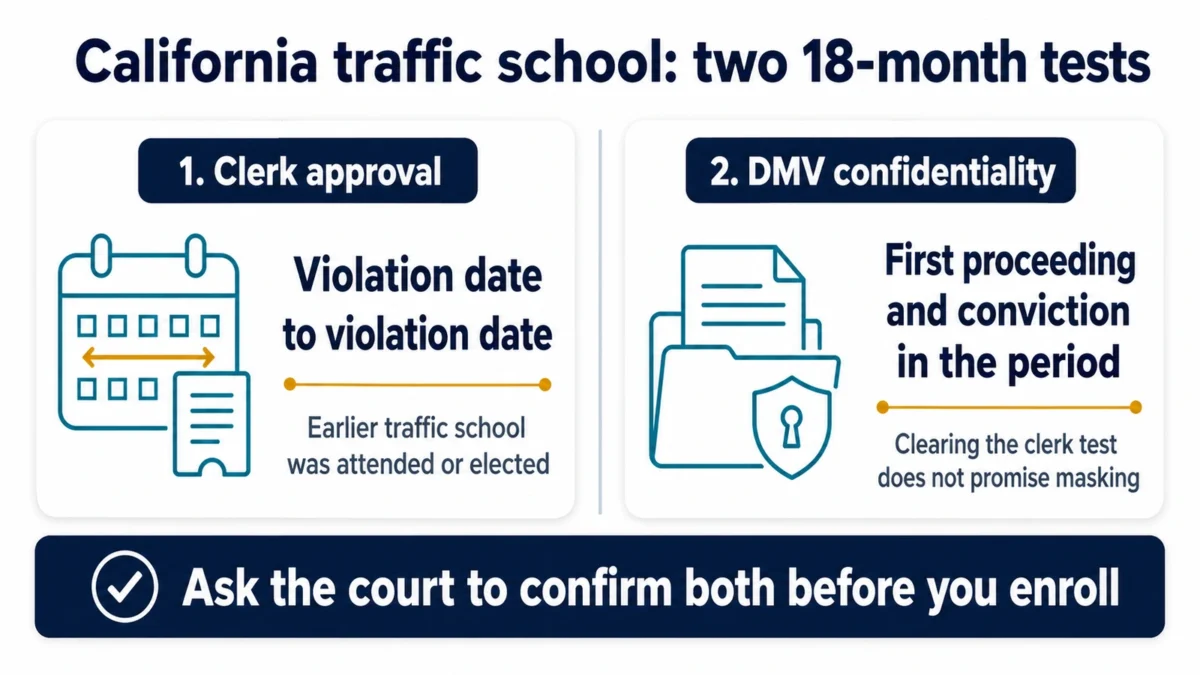
The rule that causes the most confusion is the 18-month limit because California applies two related tests. Rule 4.104 uses violation dates to decide whether a clerk may approve traffic school. Vehicle Code section 1808.7 separately limits DMV confidentiality to the first proceeding and conviction in an 18-month period. Clearing the clerk’s test does not, by itself, promise that DMV will mask the conviction.
Quick answer: Check the new violation date against the earlier violation date for clerk eligibility. Then ask the court to confirm that the new case would be the first proceeding and conviction eligible for confidentiality in the applicable 18-month period. Do both checks before enrolling.
Rules verified: September 3, 2026, against California Rules of Court rule 4.104, California Courts Self-Help guidance, and California DMV traffic-school materials.
General information only: This guide explains California’s statewide framework. It is not legal or insurance advice. The superior court handling your citation controls your eligibility, payment, completion date, and case result.
What California traffic school actually does
Traffic school does not erase the event or make the court case disappear. Finish an approved course and the conviction stays on your DMV record. When Vehicle Code section 1808.7(a) applies, however, the record for the first qualifying proceeding and conviction in an 18-month period “is confidential.” The statute also says no violation point count is assessed under section 12810 when the conviction is confidential.
That distinction matters. “Confidential” or “masked” is more accurate than “dismissed,” “removed,” or “deleted.” California Courts explains that “the point from the ticket won’t show on your DMV record.” Its consumer guidance adds that insurers cannot see that confidential result or raise rates because of it. Section 1808.7 limits DMV’s use of the confidential record to statistical purposes, subject to disclosure to a court and the exceptions in subdivision (b).
The benefit applies to the eligible conviction handled through traffic school. It does not hide a collision, another conviction, an insurance claim, a lapse in coverage, or a second traffic-school conviction within the restricted period.
California traffic school has two 18-month tests
California Rules of Court rule 4.104(b)(2)(B) says a clerk may not grant traffic school when the new violation occurred “within 18 months after the date of a previous violation” for which you attended or elected traffic school. This is the clerk-approval test.
Vehicle Code section 1808.7(a) controls the record benefit. It makes the record confidential only for the “first proceeding and conviction” under section 1803.5 in an 18-month period. This is the DMV-confidentiality test.
The two tests serve different jobs:
- Clerk approval: Compare violation date to violation date under rule 4.104.
- DMV confidentiality: Confirm that the case is the first qualifying proceeding and conviction within the period under section 1808.7(a).
The California Courts self-help page simplifies eligibility to whether you have “gone to traffic school in the last 18 months.” That summary does not state either legal test precisely. Use rule 4.104 and section 1808.7, and ask the handling court to confirm both the approval and expected record result.
Count from violation date to violation date
For the clerk-approval test, use the dates the alleged offenses occurred. Do not substitute:
- the date you paid the first ticket;
- the date the court approved traffic school;
- the date you started or finished the course;
- the prior conviction date; or
- the issue date of a courtesy notice.
For example, suppose the earlier eligible violation occurred on January 10 and you completed traffic school in March. A new ticket’s eligibility is measured from the January 10 violation date, not the March course date.
Calendar-month boundaries can be easy to misread, especially when the dates are close. Do not estimate by counting “a year and a half” in your head. Put both violation dates in writing and ask the court to confirm clerk eligibility. Also ask whether section 1808.7 would make the new conviction confidential; the violation-date calculation alone does not answer that second question.
“Elected” matters even if the course was not completed
Rule 4.104 refers to a driver who “attended or elected to attend” traffic school for the prior violation. That means an unfinished earlier election may still affect a new request. Do not assume you are eligible merely because you never completed the first class or did not receive the confidential-record benefit.
If an old case was reopened, refunded, rejected, or never completed, ask the new court to check the official record and explain what it treats as the earlier election. A course provider cannot make that determination.
A judge may have discretion, but it is not a promised exception
Rule 4.104(c) separates what a clerk may approve from a judicial officer’s discretion in an individual case. Vehicle Code sections 41501(a) and 42005 supply the referral authority named in the rule. A request outside the clerk’s authority is not automatically granted by a judge. If your courtesy notice says you are ineligible but you believe unusual facts matter, ask the clerk how to request judicial consideration. Do not pay a school first and assume the judge must accept it.
California traffic school eligibility checklist
Passing the 18-month test is only one requirement. The charge, license, vehicle, point value, speed allegation, and case status also matter.
You need a valid driver’s license
The statewide clerk-approval rule applies when the defendant has a valid driver’s license. Court notices may use more specific wording based on the license shown on the citation. If you have an out-of-state license or recently changed license status, contact the court rather than relying on a provider’s sign-up page.
The ticket generally must be an eligible, reportable infraction
Rule 4.104 lets a clerk approve an 8-hour traffic violator school for a reportable infraction under Vehicle Code divisions 11 and 12—rules of the road and equipment. Sections 41501(a) and 42005 provide the referral authority. Exclusions follow.
Common nonqualifying categories include:
- a misdemeanor;
- a violation carrying more than one point under Vehicle Code section 12810, or at least one and one-half points under section 12810.5(b)(2);
- a violation related to alcohol or drug use or possession;
- a speeding allegation of more than 25 mph over the applicable limit;
- a violation of Vehicle Code section 22406.5 involving specified tank vehicles;
- a citation issued while operating a commercial vehicle as defined by Vehicle Code section 15210(b); and
- a failure to appear under Vehicle Code section 40508(a) that has not been adjudicated and paid, or an unpaid civil assessment under Penal Code section 1214.1.
Correctable equipment violations, often called “fix-it tickets,” may follow a correction-and-dismissal process instead. The California Courts guide says, “Some tickets don’t qualify for traffic school,” and gives a broken taillight and alcohol- or drug-related tickets as examples. Read each count on a multi-charge citation because one count’s eligibility does not automatically decide another’s.
More than 25 mph over the limit blocks clerk approval
The wording is more than 25 mph over, not “25 mph or more.” A clerk is not authorized to approve traffic school when the citation alleges a speed exceeding the limit by more than 25 mph. The actual charge and alleged speed control; a school advertisement cannot change them.
A judge may consider an individual request under the court’s discretionary authority, but approval is not guaranteed. Ask the court what procedure applies rather than enrolling on the strength of a provider’s eligibility quiz.
Commercial-license and commercial-vehicle rules are different
A violation committed in a commercial vehicle is not eligible for confidential traffic-school treatment. Under rule 4.104(c)(1), a driver with a Class A, Class B, or commercial Class C license may ask for traffic school after a violation in a vehicle requiring only a noncommercial Class C or Class M license. Even if the court permits attendance, the conviction “must not be reported as confidential.” Vehicle Code section 1808.10 further requires that conviction to remain reportable for federal and insurance purposes.
Vehicle Code section 1808.7(b) also makes the conviction record nonconfidential if you hold a California commercial driver’s license, hold an out-of-state commercial license under 49 C.F.R. Part 383, committed the violation in a commercial motor vehicle, or face a conviction worth more than one point under section 12810.
If you hold or recently held a commercial license, confirm the record consequence with the court before deciding that the course provides the benefit you expect.
Start with the court, not a traffic-school website
The courtesy notice or court case portal should indicate whether traffic school is offered and provide a response date. If the notice has not arrived, use the official superior court site for the county shown on the citation or contact its clerk. Do not ignore the citation while waiting for a course seller to answer.
Before paying, ask the court:
- Is my exact violation eligible for clerk approval?
- Does the record show a prior traffic-school attendance or election within 18 months?
- What plea or payment resolves the case through traffic school?
- What fine, bail, administrative fee, or other court amount is due?
- What is my completion deadline?
- How will the school report completion, and how can I confirm receipt?
- Does any failure-to-appear or civil-assessment issue need to be resolved first?
- If I hold a commercial license, what result will be reported?
Court charges are separate from the school’s tuition. Local court pages may display different administrative amounts, payment methods, convenience fees, and extension practices. Treat the handling court’s current instructions as controlling rather than copying a dollar figure or deadline from another county.
How to complete California traffic school
Step 1: Review the citation and court notice
Write down the court, case or citation number, violation date, response date, alleged code section, alleged speed, vehicle type, and license class. Compare the new violation date with the earlier violation date if you previously elected traffic school.
Step 2: Decide how you want to handle the ticket
Traffic school usually requires you to resolve the charge and pay the court rather than continue contesting it. If you believe the ticket is wrong or want a trial, understand those choices before entering a plea or paying. California’s rule says an otherwise eligible defendant is not automatically disqualified merely for pleading not guilty or going to trial, but any later request is considered by the judicial officer based on the individual case.
Our traffic school vs. court guide explains the general decision points. For advice about a particular charge or defense, speak with a qualified California attorney.
Step 3: Request traffic school from the court
Use the court’s official portal, form, mail procedure, phone process, or clerk window. Pay the amount the court requires and keep the approval, receipt, and completion date. Do not confuse a school’s enrollment confirmation with the court’s permission.
If paying the full amount would cause hardship, review California Courts’ MyCitations and ability-to-pay guidance before making a final election. California Courts warns that procedural choices can affect the options remaining in a case, so contact the court if you want both traffic school and a fine reduction.
Step 4: Choose a currently DMV-licensed school
Use the official California DMV Traffic School List. Search by instruction type, language, business name, address, city, ZIP code, county, or license number. DMV warns: “You cannot attend or register for traffic schools through our website.” Contact the school directly.
Before checkout, confirm:
- the school’s current DMV license listing;
- online, classroom, or home-study format;
- total tuition and optional charges;
- identity-verification and final-test requirements;
- refund and retake terms;
- customer-support availability; and
- electronic completion-reporting process.
Rule 4.104(b)(1) describes the program as an 8-hour traffic violator school. The DMV’s approved-course outline (OL 613) also requires a final test. Extremely fast-course promises should not replace a current DMV license check or the school’s written completion terms.
Step 5: Finish before the court’s deadline
California does not give every reader one universal deadline through the statewide self-help page. The court assigns the completion date. Some county courts commonly allow about 90 days, but you must use the date in your own case rather than treating 90 days as a statewide guarantee.
Start early enough to correct a name, license-number, payment, or reporting error. Ask the court before the deadline if you need an extension; extensions and fees are court-specific and are not automatic.
Step 6: Confirm electronic reporting and case closure
DMV says licensed schools submit completions through the Traffic Violator Course Completion database. Completions “will be available to the designated courts a day after they are submitted.” The school should also give you a completion receipt.
Keep the receipt, but do not stop there. Check the official court case portal or contact the clerk after allowing reasonable processing time. Confirm that the court received the completion and that the case received the expected traffic-school disposition. A course completed on time can still create trouble if the identifying information was wrong or the court never matched the report to the case.
Mistakes that can cost you the confidential result
Avoid these common process failures:
- counting 18 months from the previous class date instead of the violation date;
- overlooking an earlier election because the course was never finished;
- enrolling before the court approves traffic school;
- choosing a school from an advertisement instead of the DMV license list;
- assuming every one-point-looking ticket qualifies;
- treating a local court’s fee or deadline as statewide;
- waiting until the final days to start the course;
- assuming a completion receipt proves the court closed the case; or
- expecting confidential treatment after a commercial-license or commercial-vehicle case without checking the special rules.
Frequently asked questions
Is California traffic school once every 18 months?
There are two rules. For clerk approval, compare the new violation date with the earlier violation date for which you attended or elected traffic school. For DMV masking, section 1808.7 limits confidentiality to the first qualifying proceeding and conviction in an 18-month period. Ask the court to confirm both.
Does traffic school dismiss a California ticket?
For current California record treatment, “masked conviction” is more precise. The conviction remains on the DMV record but may be held confidential for an eligible noncommercial driver, and the usual point is not charged for negligent-operator purposes.
Can I take traffic school if I was exactly 25 mph over the limit?
Rule 4.104 blocks clerk approval when the alleged speed is more than 25 mph over the limit. Other eligibility rules still apply, and the court—not the school—makes the decision.
Can I take an online California traffic school?
Yes, DMV licenses traffic violator schools offering different instruction types, including internet programs. Select a current license listing from the DMV search and make sure the court has approved your request before enrolling.
Does the school send my certificate to the court?
Licensed schools electronically report completion through the DMV system, and the court accesses that report. Keep your receipt and independently confirm that the handling court received and processed it.
What if the courtesy notice says I am not eligible?
Contact the court to verify why. The notice may reflect the 18-month rule, the charge, point count, alleged speed, license class, vehicle type, or case status. Ask how to seek judicial consideration if you believe the clerk-level result does not account for your circumstances.
The bottom line
California traffic school works only when the driver, violation, timing, and paperwork all qualify. Check the violation dates for clerk approval and the proceeding-and-conviction limit for DMV confidentiality. Then verify the charge, obtain court approval, use a current DMV-licensed school, finish before the assigned date, and confirm that the court received the completion.
The order is simple: court first, licensed course second, confirmation last. Following that sequence gives you the best chance of receiving the confidential-record treatment the program is designed to provide.
Drive Wise. Spend Less. Stay Safe.
Related Reading
- Compare traffic school with going to court
- Decide whether to pay a ticket or choose traffic school
- Understand what traffic school changes on your driving record
- Compare traffic-school rules across states
- Review the steps that may help get a speeding ticket dismissed
Sources
- California Courts — Rule 4.104, Procedures and eligibility criteria for attending traffic violator school
- California Vehicle Code § 1808.7 — confidentiality and point treatment
- California Vehicle Code § 1808.10 — commercial-license reporting after traffic school
- California Courts Self-Help Guide — Traffic school
- California Courts Self-Help Guide — MyCitations
- California DMV — Traffic Violator School
- California DMV — Traffic School List
- California DMV — Approved Traffic Violator School Course Outline (OL 613)
Last updated: September 4, 2026.