

Maryland Defensive Driving Course: Choosing the Right Program

For an MVA Driver Improvement Program referral, start with Maryland’s official DIP provider list. If you want an insurance discount, ask your insurer which course it accepts before paying.12
Those two checks can lead to different classes. A course advertised for Maryland drivers may sound suitable without answering the question that matters to you: will it satisfy the requirement or qualify for the benefit you need?
This guide helps you work from your paperwork to the right program, check the format and cost, and follow up after completion. It also explains why a course certificate should not be treated as a promise of fewer points or a dismissed ticket.
General information only: Last reviewed October 3, 2026. This guide is not legal or insurance advice about your individual case. Follow your MVA instructions and any court order that applies to you.
Start with the reason you need a course
Find your referral letter, court papers, or insurance renewal notice before comparing classes. If you have more than one reason for taking a course, write each one down.
| Your situation | Where to start | What to confirm |
|---|---|---|
| MVA sent you a DIP referral | Your referral and the MVA’s DIP provider list | The required program, format and completion date |
| A court directed you to take a course | The order and the court contact named in your papers | The exact course terms and how to provide proof |
| You want an insurance discount | Your insurance company or producer | Whether your policy qualifies and which course is accepted |
| You want points removed | Your driving record and MVA’s points guidance | Whether you are dealing with an error, an attendance requirement or another record issue |
The first three routes come from Maryland’s DIP instructions, its court-assignment statute and insurance consumer guidance. MVA separately says points are not removed on request.[dip]3[insurance]4
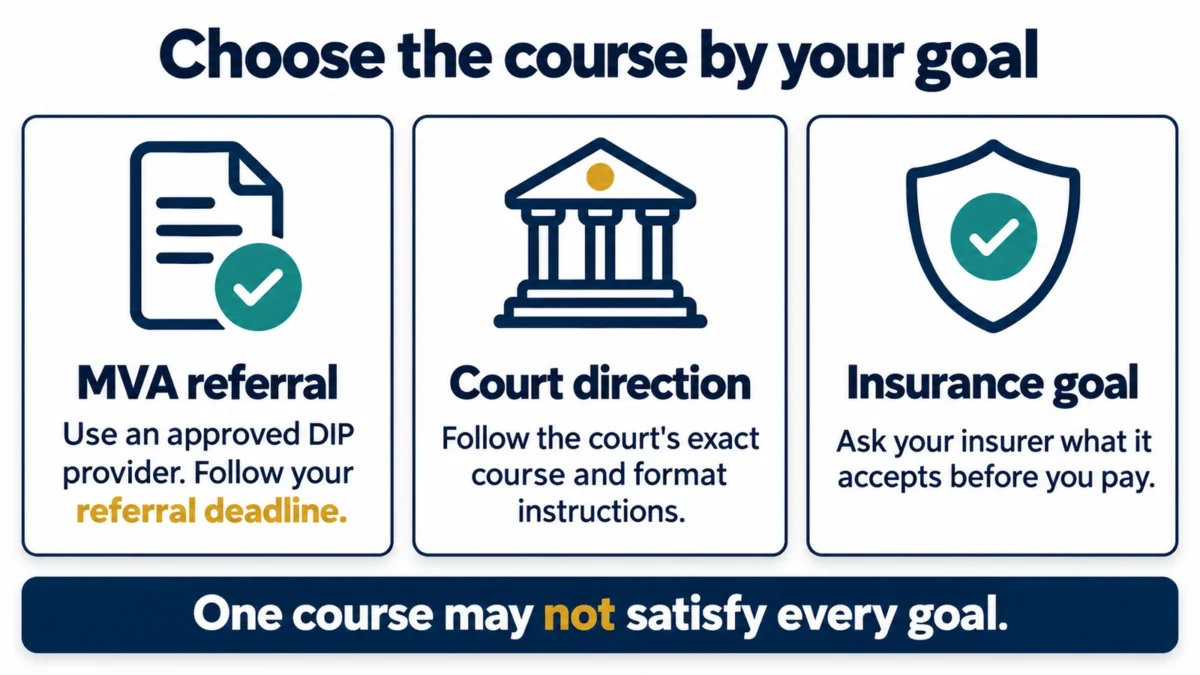
For example, you might have a DIP referral and also want to save on insurance. Ask the insurer about the exact MVA-listed course you are considering. Keep its answer with your referral. Treat the two goals as separate checks until both have been confirmed.
What Maryland’s Driver Improvement Program is for
Maryland calls its course the Driver Improvement Program, or DIP. Its purpose is driver rehabilitation. Transportation §16-212 allows MVA to run the program and decide what it teaches. Under subsection ©(2), a court may order you to attend after a conviction for one or more moving violations.[authority]
The program can also be required because of your point total or provisional-license history. These rules have conditions that a short course advertisement may leave out.
Points can trigger required attendance
Under §16-404(a)(2), reaching five points within a two-year period requires DIP attendance. One exception applies to Class A, B or C license holders. If they give MVA evidence it accepts that they are professional drivers, they may not be called in until reaching eight points.5
That exception depends on evidence MVA accepts. It is not a blanket exemption for anyone who drives for work. If you think it applies, ask MVA how your record is being handled rather than disregarding a referral.
There is also a separate suspension rule for provisional drivers under 18 who reach five or more points in 12 months.6 Read all letters about your license. A course referral may be only one part of what you need to address.
A provisional license changes the first-offense rule
Section 16-213©(1) requires DIP for a first qualifying offense. The offense must be a moving violation committed while you held a provisional license and were not yet eligible for a full license. You must also have been convicted or granted probation before judgment for it.7
Probation before judgment, often shortened to PBJ, is expressly included in that attendance rule. If your court result was PBJ, check any MVA correspondence instead of assuming no course can be required.
For a parent helping a young driver, keep the court result and MVA letter together. Ask about the student’s license status, age and permitted course format when arranging the class.
Find an approved DIP provider before comparing prices
Use the Driver Improvement Program page on MVA’s website and follow its provider-list link to myMVA. Maryland’s regulation allows the program to be conducted by MVA or an approved private provider.[dip]8
Search for the provider’s actual name. If a website sends you to a different registration company, ask which approved provider will issue and report your completion. Save the answer before entering payment details.
A useful question is: “I have an MVA DIP referral. Is this the specific program you will report to MVA for that referral?” Add your age and provisional-license status if relevant. If a court is also involved, ask the court contact about the same course.
Compare the full arrangement, not just the advertised price. Check the class date, final-test arrangements, cancellation terms, support contact and total charge. You want a course you can actually finish in time, with someone available to resolve a registration or reporting problem.
This guide does not rank providers or recommend a particular paid course. Start from the agency’s current list, then compare the providers that fit your instructions and schedule.
Can you take a Maryland DIP online?
Maryland treats live virtual classes and self-paced online courses differently. MVA’s January 6, 2026 bulletin says a virtual class has an instructor teaching in real time. An online course lets you work without that live teacher. This online form of remedial course needs its own approval.9
That distinction matters when you see an “online” button. Find out what you are actually booking: a scheduled video class, independent lessons, or a combination of lessons and a separate test.
Check the final test and the rule for younger drivers
The regulations use the term alternate format for an approved program taught with electronic learning tools. COMAR 11.12.09.04G(6) places its final test in an MVA-approved classroom setting. Under C(5) and G(8), provisional license holders younger than 18 must take classroom DIP and cannot use the alternate format.10
MVA’s bulletin on virtual instruction, which also covers remedial programs, allows live classes that meet its terms. Other rules still apply. The bulletin does not spell out how each kind of remote test fits the classroom rule. We therefore cannot confirm that a given course lets you finish every step from home.[virtual]
Ask where you will take the test and whether the course is approved for your age and license status. If the school says every step is remote but cannot explain its approval, check with MVA before paying. For a court-directed course, check the court’s format instructions too.
A live video class also needs a suitable place to participate. The bulletin calls for students to be visible on camera throughout class and able to interact with the instructor.[virtual] Plan for a quiet location and a working camera rather than trying to join between other commitments.
Course length, fees and passing the test
MVA’s public DIP page describes a four- to eight-hour class.[dip] Use that as the agency’s published description, then ask the provider for the full schedule, including any separate coursework and testing. If an advertised session is shorter, ask MVA to confirm how the offering meets its requirements before relying on that schedule.
Providers may set a reasonable course fee under COMAR 11.12.09.05B(1). The same regulation sets different payment timing: classroom fees are collected at enrollment; alternate-format fees are collected after the curriculum and before the final test.11
Request an itemized total. Ask whether it includes testing and whether a retest or rescheduling would cost extra. Keep the refund terms with your receipt. A low initial price is hard to compare if you do not know what remains to be paid.
For DIP completion, the regulation requires at least 80% on the final test and bars a same-day retake after a failed attempt.12 Leave room in your schedule for a later attempt rather than booking against the last available day.
Use the deadline on your referral letter
MVA instructs you to finish by the date printed at the top right of the DIP referral letter. If the letter is missing, use MVA’s contact link to request a duplicate.[dip]
Put the completion date in your calendar, then choose a class and test appointment that leave time to deal with a problem. Check any court deadline separately. If the dates or instructions seem inconsistent, contact the issuing offices with both documents available.
Bring government-issued photo identification. The regulation also requires the applicable MVA assignment letter at classroom enrollment or at final testing for the alternate format.13
If you cannot finish on time
Contact MVA promptly. Its DIP guidance says that if extenuating circumstances prevent you from attending, an acceptable explanation with supporting documentation can lead to rescheduling and a new referral letter.[dip] Send the explanation through the official contact route and retain what you submitted. A request alone is not confirmation that the date changed.
Under §16-206(a)(2), MVA may suspend your license if you fail to attend a required program. Subsection (d)(1) provides for written notice and a chance to request a hearing. MVA’s DIP page says it will suspend driving privileges when you miss the referral deadline.14[dip]
If you receive a suspension notice, read that notice as well as the course letter. Ask MVA what you need to do about both the class and your license status.
Will a course remove points or dismiss a ticket?
Do not buy DIP as a promised point subtraction. MVA’s current points guidance says it does not remove points on request. The point-trigger statute requires attendance; it does not award a course-completion point credit.[points][threshold]
If the problem is an incorrect entry, MVA advises getting your record, reviewing the conviction details and contacting it with supporting documents, which may include court records.[points] Identify the entry you dispute so that your question is about correcting that record, rather than buying a class to make it disappear.
A pending ticket calls for a court decision. Maryland Courts lists the available responses to a payable citation, including payment, a qualifying payment-plan request, a waiver-hearing request or a trial request. Signing up for a course is not listed as a substitute for responding.15
If someone suggested taking a class before court, ask what purpose it would serve in your case. If a judge has already ordered one, follow that order and confirm how proof should be submitted. Neither a course seller’s description nor possession of a certificate tells you the court’s disposition.
For broader background, see how point-removal options differ by state. Use Maryland’s official instructions for the action you take here.
Ask your insurer about a discount before enrolling
The Maryland Insurance Administration says a driver safety or education course may earn a discount. It tells you to ask your company or producer which courses it accepts.[insurance] This advice is not a promise of the same savings for every driver.
Give the insurer the provider name, exact course title and format. Ask for answers you can use to compare the cost with the potential savings:
- Is a course discount available for my policy and the driver taking the class?
- Do you accept this specific course, including its delivery format?
- What would the savings be, when would they begin, and how long would they last?
- What proof do you need, and where should I send it?
Get the answer in writing. If the insurer cannot confirm savings, decide whether you still want the course for another reason. Keep an MVA-required class on its own timetable while you ask about a discount.
Once the insurer has your proof, ask when the change will appear. Check your next policy documents against its answer. Our traffic school insurance discount guide can help you ask why a quoted discount and the total bill do not seem to match.
Check the result after you finish
MVA says the provider gives you a completion certificate and separately reports your completion. Keep your copy.[dip]
COMAR gives the provider 24 hours to report completion electronically. For an MVA assignment, that update must be sent before MVA can lift the suspension or restore driving privileges.16 This does not promise that your license will be valid within 24 hours.
Check your name, license number and completion date on the certificate before filing it away. If the course was required because of a license action, ask MVA to confirm your current status before driving. If a court or insurer needs proof, follow its submission instructions as a separate step.
If something appears missing, start with the provider: ask when it sent the report and whether the identifying information was correct. Then contact MVA with the certificate and those details. Save the responses until the issue is settled.
Questions to settle before you book
I already took a class. Should I ignore a new referral?
No. Contact MVA with your certificate and the new letter. Ask whether the earlier completion satisfies this assignment and whether anything else is needed. This guide does not promise that a class taken for one purpose will satisfy a later referral.
Can one course meet both a court order and an MVA referral?
Check both sets of instructions before selecting it. Give the court contact the course details and compare its answer with the MVA referral. Keep both confirmations so you know where to send proof and which dates apply.
What if I am living outside Maryland?
MVA’s DIP page directs drivers who are temporarily living out of state, or who have moved away, to the National Safety Council to find a program nearby. After completing it, you send your completion form to MVA’s DIP unit by fax or mail. Before you pay, check that the course you book is one NSC points you to, and keep a copy of whatever you send.[dip]
Choose the course, then confirm completion
Open MVA’s DIP page with your referral beside you. Use the official provider-list link, settle the format and testing questions, and book against the date in your paperwork. After class, keep your certificate until you have checked the result with each office that needs it.
Related Reading
- How defensive driving courses work
- Traffic school rules by state
- How point-removal options differ by state
- How traffic school insurance discounts work
- Options before a ticket reaches your record
Sources
- Maryland Motor Vehicle Administration, Driver Improvement Program, provider-list link, completion instructions, missed-class and out-of-state sections. Agency operational guidance, not proof of an individual provider’s approval or a guaranteed license outcome.
- Maryland General Assembly, Transportation Section 16-212, particularly (a), (b) and (c)(2).
- Maryland General Assembly, Transportation Section 16-404(a)(2), attendance threshold and professional-driver exception.
- Maryland General Assembly, Transportation Section 16-404(d), separate suspension rule for provisional licensees under 18.
- Maryland General Assembly, Transportation Section 16-213(a)(3), (c)(1), offense definition and first-offense DIP requirement.
- Library of Maryland Regulations, COMAR 11.12.09.01, program administration and approved private providers.
- MVA, Distance Learning/Virtual Instruction, January 6, 2026 bulletin. The bulletin distinguishes live virtual instruction and asynchronous online programs and preserves other regulatory requirements.
- Library of Maryland Regulations, COMAR 11.12.09.02B(3), alternate-format definition, and COMAR 11.12.09.04C(5), G(6), G(8), classroom and alternate-format restrictions. Read with the virtual bulletin; no provider-specific fully remote approval is asserted.
- Library of Maryland Regulations, COMAR 11.12.09.05B(1)-(3), provider fees and collection timing.
- Library of Maryland Regulations, COMAR 11.12.09.04F(3), final-test score and retest restrictions.
- Library of Maryland Regulations, COMAR 11.12.09.04F(1)(a)-(b), identification and assignment-letter requirements.
- Maryland General Assembly, Transportation Section 16-206(a)(2), (d)(1), suspension authority, written notice and hearing request.
- MVA, Driver’s License Points, FAQs on point removal, obtaining a record and correcting errors.
- Maryland Courts, Traffic Citation Information, payable-citation response options. The draft does not extend those choices to must-appear charges or promise a particular disposition.
- Maryland Insurance Administration, How to Get the Most for Your Insurance Dollar, PDF page 2, defensive education courses. General consumer guidance; no policy-specific eligibility, discount amount or duration is asserted.
- Library of Maryland Regulations, COMAR 11.12.09.04C(6), D(3), F(1)(d), reporting and the completion update required before removal of the related suspension or reinstatement.
Last updated: October 3, 2026.