

Texas Defensive Driving for Ticket Dismissal: Eligibility and Documents

Check the citation, eligibility rules, and court packet before enrolling in a Texas driving safety course.
Using Texas defensive driving for ticket dismissal takes more than finishing an online class. Your court must accept the request, the driver and charge must qualify, and the correct documents must reach the court on time.
Start with an eligibility and paperwork audit. Check the citation, license, course history, and alleged offense before paying for a class. Then ask the named court for its current request packet.
Quick answer: You generally must request the driving-safety dismissal from the court on or before the answer date, enter the required plea, show financial responsibility, and establish eligibility. After approval, complete a TDLR-approved course and file the uniform completion certificate, the required driving record or court-retrieval authorization, and the statutory affidavit within the court's 90-day period.
Rules verified: September 2, 2026, against Texas Code of Criminal Procedure Chapter 45A, current Texas Department of Licensing and Regulation guidance, and Texas Department of Public Safety driver-record instructions.
General information only: This article explains the statewide framework. It is not legal advice. The justice or municipal court named on your citation controls your case, forms, payment method, and filing instructions.
First, separate eligibility from completion
Texas law calls this a driving safety course dismissal. Drivers and course providers often call the same process “defensive driving.” The label matters less than the sequence.
There are two separate checkpoints:
- Request checkpoint: You ask the court to use the procedure and provide the required plea, eligibility statements, license information, financial-responsibility evidence, and payment.
- Completion checkpoint: After the court allows the request, you complete an approved course and return the certificate, record, affidavit, and any court-specific items.
Enrollment is not court approval. A provider cannot extend the answer date or decide eligibility.
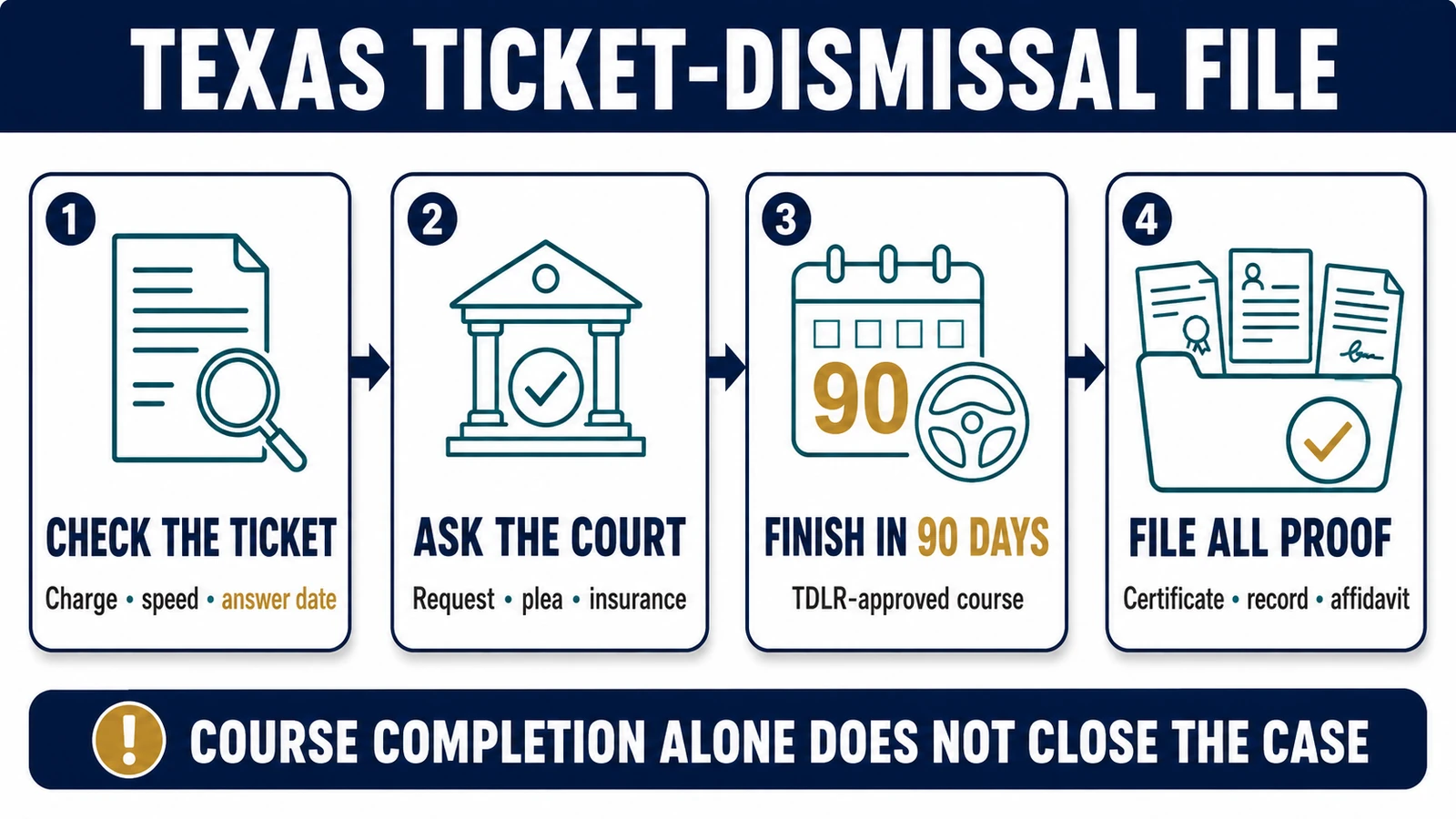
Texas dismissal requires four stages: check the ticket, ask the court, finish the approved course within 90 days, and file every required document.
Texas ticket-dismissal eligibility checklist
Use these checks before registering. A “yes” does not bind the judge, but a “no” is a reason to contact the court.
| Check | What to verify | Best evidence |
|---|---|---|
| Court and timing | The request will reach the named court by the answer date | Citation plus court receipt or confirmation |
| License status | You hold the required Texas license or permit, or fit the military-family exception | Current license/permit and any court-requested affidavit |
| Age and charge scope | If you are under 25, check whether the charge is a moving violation handled by that court | Birth date, charge code, and court review under Article 45A.351(b) |
| CDL status | You do not hold a CDL and did not hold one when the offense occurred | License and truthful court filing |
| Course history | No approved driving-safety or motorcycle course was completed in the 12 months before the new offense date | DPS record plus affidavit |
| Charge | The exact offense falls within the route and is not excluded by Article 45A.353 | Citation code and court review |
| Speed | The allegation is below both statutory speeding cutoffs | Alleged speed and posted limit on citation |
| Work zone | The offense was not in a construction or maintenance work zone with workers present | Check whether the citation states on its face that workers were present; ask the court |
| Financial responsibility | You can provide acceptable proof under Texas law | Court-accepted insurance or other proof |
Check the answer date before everything else
Article 45A.354(a) requires the citation to warn, in substance, that you “may be able to require that this charge be dismissed” by completing a course and will lose that right if you fail to notify the court by the appearance date. Check the citation for that advisory as well as the date.
Article 45A.352(a)(4) makes the answer date the ordinary request deadline. You may request in person or through counsel. You may also send a written request by certified mail, return receipt requested, if it is postmarked by that date. A court may designate an email address or online portal.
Do not assume a general court inbox counts. Buying a course or record does not preserve the deadline.
If the citation did not carry the required advisory, Article 45A.354(b) says the right may be exercised until the notice is given or the case reaches final disposition. Raise a missing advisory with the clerk; do not treat it as permission to ignore the case.
Article 45A.352(c) also lets a court grant a later request before final disposition, but only notwithstanding the 12-month condition in (a)(3) and the deadline-and-plea condition in (a)(4). It does not override the CDL bar, excluded charges, or speed limits. This route is discretionary and may carry “a fine set by the court” up to the maximum fine for the offense under Article 45A.358(a)(2). Treat the printed answer date as the working deadline.
Confirm the license requirement
The ordinary statutory path applies to a defendant with a Texas driver's license or permit. The law includes a limited exception for a U.S. military member on active duty, the member's spouse, or a dependent child.
If you use the military-family exception without a Texas license, you need another affidavit about courses completed in another state during the preceding 12 months. Ask the court for its required wording.
An out-of-state license is not enough on its own. Unless you fit the military-family exception, call the court before you enroll.
Stop if you hold or held a CDL
Article 45A.351(c) excludes you if you “hold[] a commercial driver's license” or held one when the offense occurred. The exclusion turns on CDL status, not whether the cited trip was personal.
If you have current or recent CDL history, disclose it and ask the court about other options.
Count 12 months backward from the new offense date
The relevant question is whether you completed an approved driving safety course or motorcycle operator training course in the 12 months before the date of the new offense.
For example, suppose the new ticket lists an offense date of October 15, 2026. A qualifying course completed on November 1, 2025 falls within the preceding 12 months. A course completed before October 15, 2025 may fall outside that window, subject to the court's verification and all other rules.
Use exact dates. The court checks a DPS record and an affidavit covering course activity that may not appear there.
Match the exact charge to the statute
The rule covers traffic offenses a justice or municipal court handles. It does not cover every charge—Article 45A.353 takes some back out.
Article 45A.351(b) also widens the scope for a defendant younger than 25. For that age group, the subchapter applies to an offense within the court's jurisdiction that involves operating a motor vehicle and is classified as a moving violation. The exclusions and other eligibility conditions still apply.
Article 45A.353 excludes “a violation of Section 545.066, 550.022, or 550.023, Transportation Code; a serious traffic violation; or an offense to which Section 542.404, Transportation Code, applies.” Those cross-references cover passing a school bus, specified duties after a collision, the serious-traffic-violation definition in Transportation Code § 522.003, and the work-zone rule.
For the work-zone exclusion, Transportation Code § 542.404 requires workers to have been present and the notice to appear to state that fact on its face. Check what the citation actually says and ask the court to review it.
Use the precise code on the citation. If it involves a crash, school bus, work zone, or unusual fact, ask the court before buying a course.
Apply both speeding cutoffs
Under Article 45A.352(a)(5), the ordinary statutory right is unavailable if the alleged speed was:
- 95 mph or more, or
- 25 mph or more above the posted speed limit.
These are separate tests. A driver alleged to have traveled 94 mph in a 65 mph zone fails the second test. A driver alleged to have traveled 95 mph in an 80 mph zone fails the first.
Use the alleged speed written on the citation, not your recollection of the speedometer. If the figures or charge description are unclear, ask the clerk how the court reads the allegation.
Verify every charge in a multi-charge stop
For offenses committed on or after September 1, 2025, current Article 45A.352(b) allows one successful course to support dismissal of multiple charges from the same criminal transaction when each charge independently qualifies.
It does not combine unrelated stops or make an excluded offense eligible. Get written confirmation of every count placed into the procedure.
Build the request packet before you submit it
Court forms differ, but most request packets draw from the same statewide requirements.
Citation and case details
Keep a clear copy of every page of the citation. Record:
- court name and contact information;
- citation or case number;
- offense date and answer date;
- exact charge code and description;
- alleged and posted speeds, when applicable; and
- any work-zone, school-zone, CDL, or collision notation.
Use the court's number format. Check every digit before filing.
Required plea and request
The ordinary Article 45A.352 request includes a guilty or no-contest plea. If you may contest the allegation, do not enter a plea merely to hold a course spot.
Use the court's official form. Read it before signing, then save the filing and delivery proof.
Driver's license or permit copy
Provide the license or permit copy the court requests. Make sure it is readable and matches the case name.
If the military-family exception applies, ask for the court's specific license and affidavit instructions. Do not assume a military ID by itself replaces every statutory item.
Evidence of financial responsibility
You must show proof of insurance. Article 45A.352(a)(6) calls it evidence of financial responsibility under Transportation Code Chapter 601. The court decides what document it will accept for the filing.
Make sure the proof is current, readable, and tied to the driver or vehicle as required. A payment receipt may not show coverage.
Eligibility affidavit
Expect to swear to facts affecting eligibility. At completion, Article 45A.356 requires an affidavit stating that you were not taking another course under the dismissal subchapter on the request date and had not completed a course that was not shown on the driving record within the preceding 12 months.
Use the court's affidavit form. Read it, answer truthfully, sign as directed, and keep a copy.
Court payment
Court payment is separate from course and record fees. Article 45A.358 permits an administrative reimbursement fee of up to $10 for an ordinary request and for each eligible same-transaction charge.
Ask for the exact total and accepted payment method. Do not infer the amount from another county's website. If you are weighing this request against contesting the charge, our traffic school vs. court guide explains the general tradeoffs.
What belongs in the completion packet
Once the court approves the request, Article 45A.356 generally gives 90 days to complete the course and present the required evidence.
Uniform course-completion certificate
Complete a currently TDLR-approved course. Check the uniform certificate at once for name, citation, court, and date errors.
A receipt, progress screen, or provider email does not replace the certificate unless the court says it does.
Type 3A record—or confirmation that the judge will retrieve it
Texas DPS's record-types page marks Type 3A, the certified list of all accidents and violations: “This record is acceptable for Defensive Driving Course (DDC).” Type 2A, the certified three-year history, carries the opposite note: “This record is not acceptable for Defensive Driving Course (DDC).” The uncertified types carry no acceptance note—do not substitute one.
Order through the official Texas DPS driver-record service only if the court tells you to supply the record. Under Article 45A.359(b), the judge may retrieve it through the state portal and charge the Transportation Code § 521.048 record fee plus the portal fee. Article 45A.359(d) says that amount is added to the other fees under the subchapter.
Online ordering requires information from the most recently issued card, including its audit number, plus identity and payment details. The online service provides a PDF to print after payment. The mail route is the slow route, so build delivery time into the 90-day window.
Affidavit and court-specific proof
Include the course-history affidavit and every item in the approval order, such as the order itself, payment proof, or a cover sheet.
Use the court's filing method. Provider reporting does not prove the court received your full packet.
A practical document-control system
Create one paper or digital folder for the case. Use simple filenames that sort in sequence:
01-citation02-court-request03-license-and-insurance04-payment-receipt05-court-approval06-course-certificate07-type-3a-record08-affidavit09-filing-confirmation10-dismissal-confirmation
Add a note with the answer date, the court's 90-day deadline, and the date you actually submitted each packet. Preserve confirmation numbers, certified-mail receipts, portal screenshots, and clerk emails.
This folder helps if a document is misrouted and keeps the record or affidavit from being forgotten.
What dismissal changes
When you satisfy every requirement, Article 45A.356(c)(1) directs the court to “remove the judgment and dismiss each eligible charge.” Article 45A.357(a) then controls the record: “A charge that is dismissed under this subchapter may not be part of a person's driving record or used for any purpose.”
Under Article 45A.356(c)(2)–(3), the court reports the completion and its date to DPS for your driving record. It also states whether the course was taken under this subchapter “to provide information necessary to determine eligibility to take a subsequent course.” That is how the 12-month rule gets checked next time. It is not the same as posting the dismissed charge as a conviction.
Article 45A.356(d) also says the deferral order ends liability under a bond given for the charge. If you posted a bond, confirm how the court records that termination.
Article 45A.357(b) says an insurer may not cancel your policy or raise your premium because you completed the course or obtained a dismissal under this subchapter. That protection is specific; other incidents, convictions, claims, or policy changes can be treated separately. For the broader record distinction, see how traffic school affects a ticket record.
Texas also repealed its former Driver Responsibility Program in 2019. This procedure is about dismissal and record treatment, not removing points from a current Texas point balance.
The certificate alone does not close the case. Confirm that the court accepted the proof and dismissed each eligible charge.
Five paperwork failures to avoid
- Starting before approval: A completed class does not cure a late or ineligible request.
- Ordering Type 2A: DPS marks Type 3A acceptable for DDC and Type 2A unacceptable.
- Using the wrong dates: Compare the old completion date with the new offense date.
- Ignoring another charge: Each count must qualify, even under the same-transaction rule.
- Filing only the certificate: The record or retrieval and affidavit also matter.
Frequently asked questions
Is Texas defensive driving automatic for an eligible ticket?
No. The court must find that the request and statutory conditions are satisfied.
Can I request defensive driving by email?
Only through an address the court designates. A message to a general staff address may not qualify.
Do I need my driving record when I first ask?
Not necessarily. It is completion evidence, and the judge may retrieve it. Follow the court's packet before ordering.
Can I use a Type AR record instead of Type 3A?
Type 3A is the record type DPS marks as acceptable for defensive-driving use. Type AR carries no such note. Do not substitute a type on your own—ask the court if its order appears to call for something else.
What if my certificate has an error?
Contact the provider promptly and notify the court if the correction could affect your deadline. Do not alter the certificate yourself.
What happens if the packet is late or incomplete?
Article 45A.356 provides for notice and a show-cause hearing. Without a timely response or good cause, the court enters an adjudication of guilt and imposes sentence. Contact the court as soon as a problem appears; extra time is not automatic.
The bottom line
Texas defensive driving for ticket dismissal is a document-controlled court process. Screen the driver, the exact charge, the alleged speed, the 12-month history, and the answer date before enrolling. Then separate the request packet from the completion packet and save proof of every delivery.
The course certificate is essential, but it is not the finish line. The safest finish is written or docket confirmation that the court received the full packet and dismissed every eligible charge.
Drive Wise. Spend Less. Stay Safe.
Related Reading
- Texas driving safety course and court steps
- Should you choose traffic school or court?
- Does traffic school remove a ticket from your record?
- Compare traffic-school rules by state
- How a defensive driving course works
Sources
- Texas Code of Criminal Procedure, Chapter 45A, Subchapter H — Driving Safety or Motorcycle Operator Course Dismissal
- Texas Department of Licensing and Regulation — SB 296 Driving Safety or Motorcycle Operator Training Course Dismissal
- Texas Department of Public Safety — How to Order a Driver Record
- Texas DPS Online Driver Record Service — Record Types
- Texas Legislature — Senate Bill 296, 89th Regular Session
Last updated: September 2, 2026