

Vermont Defensive Driving Course: Benefits, Points, and Course Selection

A Vermont defensive driving course may help you refresh your skills or earn a discount your insurer agrees to offer. It does not give you an automatic right to fewer points or a dismissed ticket.19
Vermont law lets a judge or hearing officer waive point assessment in limited cases. That is a different path from earning a credit by taking a class.2
Start with the result you need and the person who decides whether the course counts. A certificate shows that you finished the class. You still need to check what that means for your goal.
General information only: This guide explains Vermont’s published rules and practical course-selection checks. For advice about your own ticket or license, consult an attorney or the responsible agency.
Which goal are you trying to accomplish?
| Your goal | What to establish first | Useful starting point |
|---|---|---|
| Lower your insurance bill | Whether your insurer accepts the exact course for your policy | Your insurer or agent |
| Deal with a civil traffic ticket | Your response deadline and the procedure applicable to your complaint | Vermont Judicial Bureau |
| Avoid point assessment | Whether the statutory waiver conditions apply and whether the decision-maker grants it | Section 2501(b), discussed below |
| Meet a driver retraining order | Which DMV-authorized course is required and whether the judge may waive penalty and costs | DMV and the referring court; Sections 721-723a, discussed below |
| Improve driving skills | Whether the lessons address what you want to practice | The provider’s syllabus and format |
| Meet a work requirement | Which training your employer requires | Your supervisor or fleet manager |
Start with the contact in the table. The shortest class may not meet your needs, even if it is convenient and well taught.
Can a course reduce points in Vermont?
Vermont’s point-system law does not give you a general credit for taking a class. Under Section 2503, points remain assessed for two years from the conviction date.17
That two-year rule applies to points. It does not promise to erase the conviction from every record or tell you how far back your insurer will look. Ask about the record or policy you want to change.
At least 10 points within two years from moving-violation convictions triggers a duty for the Commissioner to start suspension proceedings. Section 2506 provides notice and, if you request one, a hearing to verify conviction records.1
If DMV sends you a suspension notice, deal with it right away. For a points suspension, DMV lists two reinstatement steps: serve the full suspension term and pay the Driver Control (reinstatement) fee. You must also receive written notice of reinstatement from DMV before driving. Other suspensions may require tests, court requirements, medical clearance, or ordered alcohol courses. Follow the requirements for your suspension type; a private course certificate does not take their place.8
Vermont does have a limited point-assessment waiver
A Superior judge or Judicial Bureau hearing officer may waive point assessment for a moving violation when it is in the interests of justice and all five conditions are met:
- No points were assessed against your driving record within five years of the moving violation.
- No more than three points were assessed within 10 years of the moving violation.
- The offense carries no more than three points under Section 2502.
- You were not operating a commercial motor vehicle, as defined in Section 4103, at the time.
- The violation did not cause bodily injury to another person or damage to another person’s property.2
Even if you meet all five conditions, the judge or hearing officer can choose not to grant a waiver. Taking a class is not one of the listed conditions.2
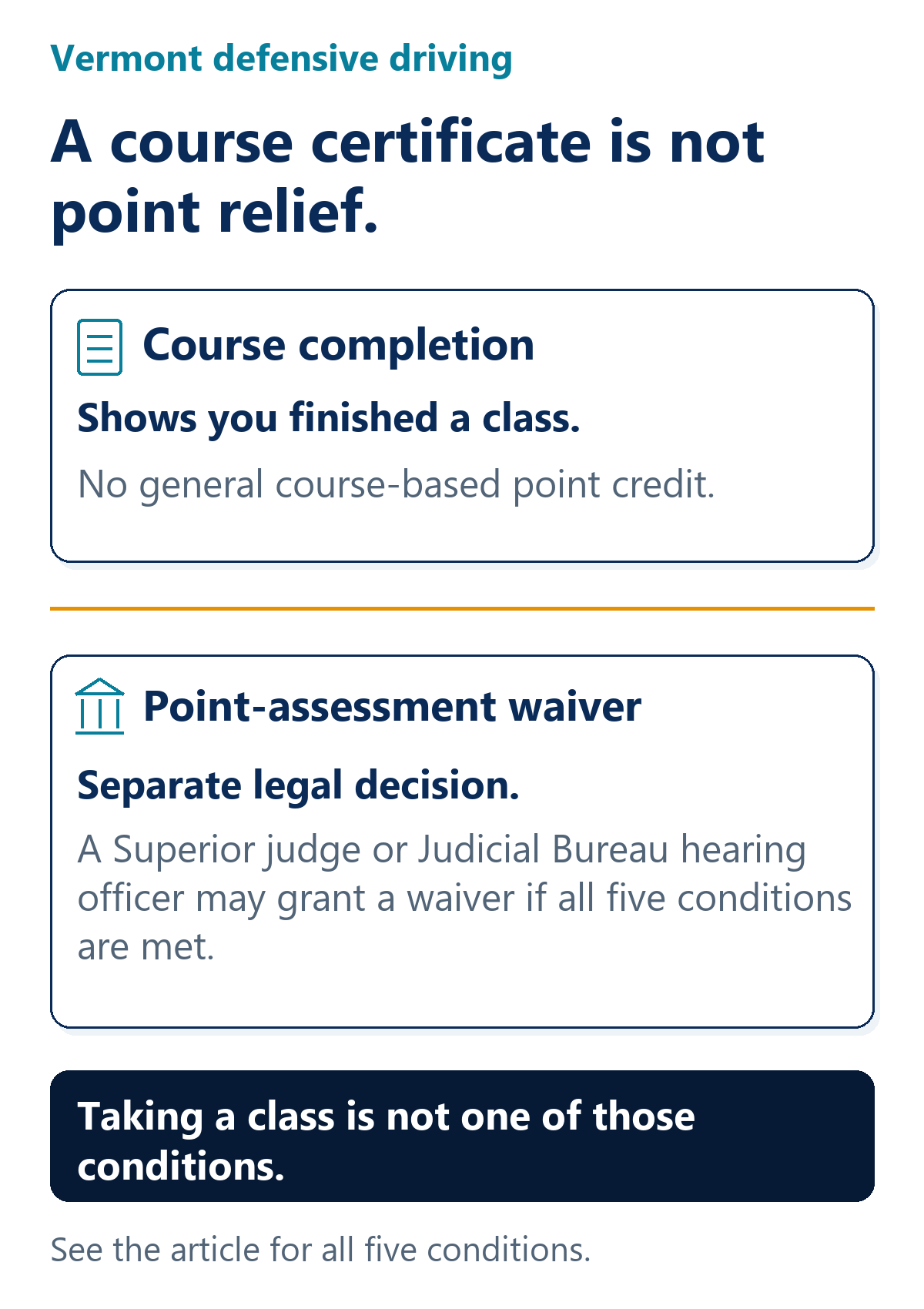
Ask the Judicial Bureau how to present a waiver request in your case. If you need advice on whether to seek a hearing, get legal help before you choose a plea. A class certificate is not a promise of a waiver.
DMV driver retraining may affect penalty and costs
Vermont has a separate driver retraining law. Under Section 721, the DMV Commissioner may require you to attend, at your own expense, a course defined and established by DMV. The Commissioner may act under the licensing chapter or on a judge’s recommendation.3
Section 722 applies after a conviction for a moving motor-vehicle violation under Title 23, Chapter 13, subchapters 1-5. The judge may recommend retraining to the Commissioner in writing and delay sentencing while awaiting a reply. If the Commissioner orders retraining, the judge may delay sentencing further for up to 90 days.4
The section refers to a judge and sentencing; it doesn’t say whether a Judicial Bureau hearing officer can use it for a civil ticket.4
After satisfactory completion, the judge may impose the penalty and costs or waive all or part of them, based on the facts of the case. The court must still report the conviction immediately. This provides possible relief from penalty and costs; it does not dismiss the conviction or create a course-based point credit.41
The Commissioner may authorize a retraining program under Section 723(b). Section 723a also permits DMV to operate a course itself. These laws establish authority, not a current directory of available classes. If you are referred, ask DMV and the court which course satisfies the order and where to send proof.56
Will traffic school dismiss a Vermont ticket?
The statewide civil-ticket guide does not offer a general traffic-school dismissal path. It tells you how to answer the complaint, choose a plea, and attend a hearing if you deny the charge.9
Under 4 V.S.A. Section 1105(b), you have 21 days from the date the complaint is issued to request a hearing or state that you will accept the penalties without one. The statute provides a $20 failure-to-answer fee.10
Buying a class does not answer your ticket. Read its instructions and deal with the response first. You can compare classes once you know whether one serves your goal.
For the point-system law, a Judicial Bureau finding counts as a conviction whether it comes from an admission, no contest, a hearing, or a default judgment. Paying is not a way to keep a moving violation outside that system.1
If someone has specifically directed you to take a course, get the requirement and expected result in writing. Ask:
- What is the exact course or provider?
- Is online instruction acceptable?
- What is the completion deadline?
- Who receives the certificate, and how?
- What will happen after the proof is accepted?
A specific course requirement does not mean every Vermont ticket has a course option. The school can explain its own class. It cannot decide what the Judicial Bureau will do with your case.
Why you may see both 20 and 21 days online
The Judiciary’s shorter Traffic Violations page says to deliver the plea and fine within 20 days. Its detailed Civil Violation Complaints page uses 21 days, consistent with the statute’s 21-day answer period.11910
Use the law’s answer period and your ticket instructions to find the deadline. If the paperwork is unclear, call the Judicial Bureau right away. Send your response early so you do not have to rely on the last day.
Can you get an insurance discount?
Ask your insurer about the benefit before you sign up. AARP says its course may qualify you for a discount, but limits can apply. It tells you to ask your agent for details.12
Vermont’s Department of Financial Regulation tells you to ask about discounts your company offers. Its guide mentions accredited driver education for young drivers. That is not proof of a course discount for every adult driver.13
H.526 proposed requiring insurers to give a discount to an insured who finishes a State-approved driver safety or defensive driving course. It was referred to the House Committee on Commerce and Economic Development on January 6, 2026, and was not enacted before the 2025-2026 session ended. It gives you no right to a discount.14
For your own policy, ask the insurer to confirm the following before you pay:
| Question | Why the answer matters |
|---|---|
| Do I qualify under this Vermont policy? | A provider’s general savings message does not answer your policy question. |
| Do you accept this exact course and delivery format? | Similar course names can conceal different products. |
| How many dollars would it save over the applicable period? | You need a dollar benefit to compare with your cost. |
| When would the benefit begin and end? | Timing affects whether the class is worthwhile. |
| What proof do you need, and where do I send it? | The certificate must reach the person processing the benefit. |
| Would a recent violation affect eligibility? | Your driving circumstances may change the answer. |
Save the written reply and the exact course name. If the agent says the company sometimes accepts a class, ask whether that applies to your policy before you count on savings.
How to choose a course without relying on an approval badge
Choose by purpose first. Then compare the format, lessons, and total cost. This guide has no verified statewide list of courses for point reduction. The examples below are places to look for training, not proof of a ticket or point benefit.
For a discount your insurer has confirmed: get its list of accepted courses first. Then compare class times, language, access needs, how you get proof, help, and refund terms. A cheap class that your insurer will not accept does not help you save.
For your own skills: look for lessons that address your concerns. You might want help with scanning at junctions, staying focused, or using your car’s new features. Think about how you learn best. Would you rather study online at your own pace or have a teacher who can answer questions?
For work: use the employer’s specified training. For example, VTrans describes PMA defensive-driver training recommended for its personnel. That workplace page does not establish an open public ticket-dismissal program.15
Examples of places to investigate
AARP Smart Driver is one place to look for refresher training. Its site offers online sign-up and says to ask your agent about a discount. Check the Vermont course choice and terms before you sign up.12
DriveSafe Online markets one-hour and six-hour courses to Vermont drivers. The same page says a ticket may be dismissed if you pass its course and pay any required fines, and tells you to ask the court first. Vermont’s published civil-ticket procedure offers no general course-dismissal option, so treat that as marketing, not a Vermont rule. The provider also pitches its six-hour course for specific insurance or court requirements and tells readers to check acceptance. Those descriptions do not establish Vermont legal approval.169
Neither example is ranked above the other. Compare courses that serve your goal, and ask each school for the full price. This guide does not promise a set price, a discount rate, or court acceptance for either course.
If a page says “approved,” ask who approved it, which course they approved, and what it counts toward. A sample certificate does not answer those questions. Neither does a page with Vermont in its title.
Section 723(b) is where Vermont law gives DMV power to authorize retraining programs; confirm that the course satisfies your order rather than relying on a general approval badge.5
What should you verify after completion?
Keep the certificate and receipt with any instructions you were given. Then check the result you wanted:
- Insurance: ask whether the insurer received the proof and applied the agreed benefit. Review the policy documents when the change takes effect.
- A documented course requirement: confirm that the recipient accepted your proof and that any remaining steps are complete.
- Voluntary skills training: choose a few lessons to put into practice. If a concern remains, consider instruction that addresses it directly.
The school’s email shows that you finished its class. To check the result, ask the insurer, employer, or agency that needed the proof.
Before you spend money
For a Vermont civil ticket, start with the complaint and the Judicial Bureau’s response instructions. For points or a suspension notice, start with DMV and the applicable legal procedure. For insurance savings, get acceptance and the dollar benefit from your insurer first.
Get the expected result in writing, then compare the classes that meet those requirements.
Related Reading
Sources
- Vermont General Assembly — Title 23, Chapter 25, Sections 2500 and 2502-2506.
- 23 V.S.A. Section 2501 — Motor vehicle point system, subsections (a) and (b).
- 23 V.S.A. Section 721 — Authority to require driver retraining.
- 23 V.S.A. Section 722 — Recommendation of a court.
- 23 V.S.A. Section 723 — Supervision, particularly subsection (b).
- 23 V.S.A. Section 723a — Operation of course by Department of Motor Vehicles.
- 23 V.S.A. Section 2503 — Recording assessments.
- Vermont DMV — License Suspensions & Related Programs.
- Vermont Judiciary — Civil Violation Complaints.
- 4 V.S.A. Section 1105 — Answer to complaint; default.
- Vermont Judiciary — Traffic Violations.
- AARP Smart Driver — Course selection and insurance applicability.
- Vermont DFR — Consumer’s Guide to Auto Insurance, page 6; revised May 22, 2019.
- Vermont General Assembly — H.526 status, bill as introduced, and Senate Journal, May 29, 2026 — final adjournment.
- VTrans — Defensive Driving.
- DriveSafe Online — Vermont course descriptions.
Last updated: October 10, 2026