
New York PIRP vs. a Traffic Ticket: What the Course Does Not Change
Last reviewed: August 30, 2026

New York PIRP does not dismiss a traffic ticket, change a plea, cancel a fine, or erase a conviction from your driving record. It is a separate DMV-approved course with limited point-counting and insurance benefits.
That distinction matters before you enroll. If a ticket is still open, you must respond through the court or Traffic Violations Bureau named on the ticket. Taking PIRP does not pause that process or answer the charge for you.
This guide separates the two tracks so you can protect the ticket deadline first, then decide whether PIRP serves a different purpose.
General information only: This article is not legal advice. Traffic procedures and consequences depend on the charge, forum, record, license type, and facts. Consider speaking with a New York traffic attorney when the potential consequences are material.
New York PIRP vs. a Traffic Ticket: Quick Answer
| Question | Answer |
|---|---|
| Does PIRP dismiss the ticket? | No. The court or TVB decides the ticket case. |
| Does it change a guilty plea or conviction? | No. A PIRP sponsor has no authority to change the disposition. |
| Does it remove convictions or points from the record? | No. Convictions and points remain displayed. Eligible point reduction changes how DMV counts certain points for administrative action. |
| Does it cancel the fine or surcharge? | No. Payment obligations come from the case disposition. |
| Does taking the course answer the ticket? | No. You must follow the response instructions and dates on the ticket or official notice. |
| Can PIRP still help after a conviction? | It may provide a limited DMV point-counting benefit and a separate insurance reduction if all rules are met. |
New York’s rule is unusually direct. 15 NYCRR § 138.13(a)(4) prohibits a sponsor or delivery agency from implying that PIRP erases or masks information from a driving record. It requires course communications to explain that PIRP may prevent certain DMV administrative actions based on accumulated points, while all traffic convictions remain displayed on the driving record.
DMV states the limit even more plainly: “Completing a PIRP course does not remove a violation, conviction, or the number of points from your driving record.”
Think in Two Separate Tracks
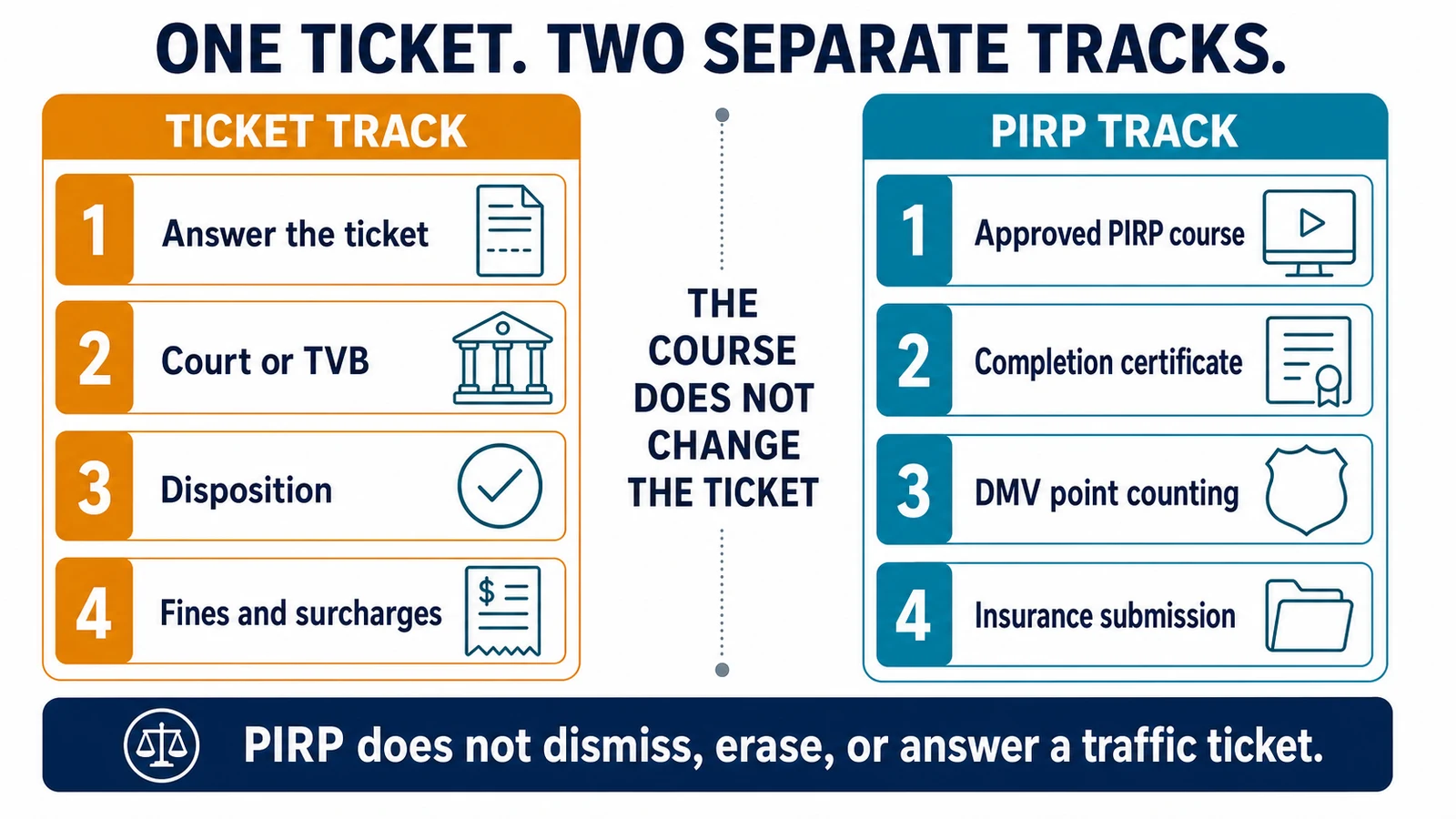
The simplest way to avoid a costly mix-up is to keep the ticket track and the PIRP track separate.
Track 1: The traffic-ticket case
This track begins when the ticket is issued. Depending on the forum and charge, it can involve:
- reading the charge, return date, and response instructions;
- entering the permitted plea or response;
- communicating with the court, TVB, prosecutor, or an attorney where applicable;
- attending a conference, hearing, or trial if required;
- receiving a dismissal, conviction, amended disposition, or other authorized result; and
- paying any fine, mandatory surcharge, or other amount ordered.
New York DMV’s statewide traffic-ticket guidance explains that tickets issued outside New York City are processed by the city, county, town, or village court where the alleged offense occurred. Noncriminal moving violations issued in New York City’s five boroughs are handled by DMV’s Traffic Violations Bureau. Follow the instructions for the forum printed on your ticket.
Track 2: The PIRP course and its benefits
This track begins when you select and complete a current DMV-approved Point and Insurance Reduction Program course. It can involve:
- confirming that the exact course is currently approved;
- completing the required program;
- receiving the completion certificate;
- waiting for the sponsor’s completion reporting to DMV; and
- submitting the certificate to the insurer when seeking the insurance benefit.
The New York DMV PIRP page describes the course benefits and their limits. Neither completion nor the certificate crosses into Track 1 and changes the ticket disposition.
What PIRP Does Not Change
It does not dismiss the ticket
PIRP is not New York’s version of automatic ticket dismissal. A course provider cannot withdraw the charge, enter a plea, negotiate with the prosecutor, or direct the court or TVB to close the case.
If someone advertises “take this course and your New York ticket disappears,” stop and verify the exact claim. It conflicts with the state rule against suggesting that course completion erases or masks driving-record information.
It does not replace your response
Starting or finishing a course is not a plea and is not an appearance. It does not extend a date printed on the ticket.
The consequence can be serious. DMV warns that a New York driver license will be suspended if the driver fails to answer a moving-violation ticket. A PIRP enrollment or completion certificate does not stop that process.
Use the ticket itself to identify:
- the court or TVB handling the matter;
- the charge and ticket number;
- the allowed response method;
- the return, appearance, or response date; and
- where to direct questions.
Do not wait for a PIRP certificate before answering an open ticket.
It does not erase the conviction or points
The course’s point benefit is easy to misread. Eligible point reduction may change the number DMV counts when evaluating certain administrative action. It does not delete the convictions or point entries from the driving record.
15 NYCRR § 138.13(a)(17)(i) says reduced points remain on the record but are not counted by DMV when it determines further administrative actions against the license. For the current 18-month PIRP window, the separate 24-month DMV lookback, and worked examples, use the New York PIRP point-reduction guide.
It does not reduce a future violation to zero
PIRP is not a bank of credits that you can apply to the next ticket. DMV applies the benefit under its eligibility and date rules. A later conviction is not automatically neutralized because you previously completed a course.
It does not replace fines, surcharges, or assessment notices
The ticket disposition controls the sentence and court-ordered amounts. New York Courts explains that a guilty plea can bring a fine and mandatory surcharge. Points may attach for a moving violation, and some traffic infractions can carry jail exposure. PIRP does not waive a court-ordered amount.
The Driver Responsibility Assessment is a separate DMV fee triggered by specified convictions or point accumulation. DMV says it is in addition to fines, penalties, or surcharges for a traffic conviction. Do not assume a course certificate replaces an assessment or payment notice.
This page does not claim that PIRP does or does not change the Driver Responsibility Assessment calculation. The official sources reviewed did not resolve that narrower question.
It does not prevent a mandatory suspension or revocation
DMV states that completing PIRP does not prevent a mandatory suspension or revocation. If you already have a suspension or revocation notice, follow that notice and get individualized help rather than relying on the course’s general point benefit.
It does not guarantee an insurance outcome for the ticket
PIRP’s insurance reduction and a conviction-related premium change are separate. You may qualify for the course reduction and still face another premium increase. One does not necessarily cancel the other.
Before estimating the benefit, confirm that your course is approved and that you are the vehicle’s principal operator. The New York PIRP insurance discount guide explains which base-rate components may qualify, how certificate timing works, and what to ask your insurer. Do not use PIRP as proof that a conviction will have “no insurance impact.”
Which Step Comes First After You Receive a Ticket?
Protect the ticket track first because it carries a stated response date.
1. Read the entire ticket
Confirm the charge, location, forum, identifying information, and response instructions. Check whether the matter is assigned to a local court or TVB.
2. Calendar the date exactly as written
Do not substitute a deadline found in a blog post. Different forums and notices can use different procedures. Keep a copy of the ticket and any envelope or electronic notice.
3. Decide whether you need legal advice
Consider individualized advice before choosing a plea when the ticket could affect your license, employment, commercial driving, immigration matter, existing case, or an already high point total. A court clerk can explain procedure but generally cannot choose a plea or legal strategy for you.
4. Submit the permitted response and save proof
You must use a response method authorized for that ticket. Save confirmation numbers, receipts, mailed copies, and messages. If you do not receive an expected acknowledgment, contact the listed forum.
5. Evaluate PIRP separately
Once the ticket response is protected, ask what job you want PIRP to do:
- reduce the number of eligible points DMV counts for certain administrative purposes;
- seek the qualifying insurance base-rate reduction; or
- refresh defensive-driving knowledge.
For course format, approval, certificates, and the overall decision, see the New York PIRP course guide.
Four Common Scenarios
You have an open ticket and have not entered a plea
Respond to the ticket first. You may research PIRP at the same time, but course enrollment does not preserve your rights or satisfy the response requirement.
You pleaded guilty or were convicted
The disposition is now part of the ticket track. PIRP will not reverse it. The course may still offer its limited point-counting and insurance benefits if you qualify.
You completed PIRP before receiving the ticket
Do not treat the earlier course as protection against the new charge. The ticket still requires its own response, and a later violation is not automatically reduced to zero points.
A prosecutor, court, or attorney mentions a course
Ask what exact course is meant and what role it plays. A court-directed program, condition of a negotiated disposition, employer course, and DMV-approved PIRP course are not automatically interchangeable. Get the requirement and expected proof in writing when possible.
Questions to Ask Before Paying for a Course
- Is this exact program on New York DMV’s current approved PIRP list? Use the DMV-approved PIRP sponsor comparison as a starting point, then recheck the current DMV list.
- Am I taking it for DMV point counting, an insurance reduction, a court-related requirement, or general education?
- Does the person requesting the course require a particular provider, format, completion date, or certificate?
- Who receives proof: DMV, the insurer, the court, an attorney, an employer, or more than one recipient?
- What does the course not change about the open ticket?
Clear answers prevent a common failure: buying the right-sounding course for the wrong purpose.
When to Stop and Get Individual Help
Pause before relying on general guidance if:
- the ticket alleges a misdemeanor, DWI/DWAI, reckless conduct, or another serious charge;
- you hold a CDL or were driving a commercial vehicle;
- your license is from another state;
- you already have several recent convictions or a suspension notice;
- the ticket could affect a job, professional license, or immigration matter;
- you missed a response date; or
- the court, prosecutor, employer, or insurer gave instructions that appear to conflict.
Contact the court or TVB for procedural information. For advice about your plea, defenses, or consequences, consult a qualified New York attorney.
Frequently Asked Questions
Does defensive driving get a ticket dismissed in New York?
Not through PIRP itself. A DMV-approved PIRP course provides limited point-counting and insurance benefits. It does not direct a court or TVB to dismiss a ticket.
Will PIRP take the ticket off my driving record?
No. New York’s regulation says course advertising may not imply that completion erases or masks record information. Traffic convictions remain displayed.
Can I take PIRP before court?
You can complete an approved course if you qualify, but doing so does not answer the ticket, preserve a deadline, or guarantee a better disposition. Address the court or TVB instructions separately.
If PIRP reduces four points, do four points disappear?
No. Eligible points remain on the record. The benefit changes how DMV counts qualifying points for certain administrative actions, subject to the applicable date window and other limits.
Does the judge have to accept my PIRP certificate?
Do not assume so. Vehicle and Traffic Law § 399-c routes PIRP approval and its insurance benefit through the DMV commissioner and Insurance Law; it does not establish a court-disposition benefit. If a court or prosecutor requests course proof, follow that forum’s exact instructions.
Should I plead guilty and then take PIRP?
That is an individualized legal decision, not a course-enrollment question. Review the charge and possible consequences before selecting a plea. Seek legal advice when the stakes are significant.
The Bottom Line
New York PIRP can be useful, but it stays in its lane. It may change how DMV counts eligible points and may provide a separate insurance benefit. It does not dismiss the ticket, change the plea, erase the conviction, cancel money owed, or replace a response deadline.
Handle the ticket through the named court or TVB. Then evaluate PIRP for the separate benefit you actually need.
Related Reading
- Choose a New York PIRP course
- Understand New York PIRP point reduction
- Compare DMV-approved PIRP sponsors
- Check the New York PIRP insurance discount
- See how traffic school differs from court
Sources
- New York DMV — Point and Insurance Reduction Program
- New York DMV — Plead To or Pay New York City TVB Traffic Tickets
- New York DMV — Traffic Tickets in New York State
- New York DMV — Driver Responsibility Assessment
- 15 NYCRR Part 138 — DMV official compilation
- New York Vehicle and Traffic Law § 399-c
- New York Courts — What happens if I plead guilty?
Last updated: August 30, 2026