


Arizona Defensive Driving School: Ticket Eligibility, Deadline, and Fees
An Arizona traffic citation may come with a defensive-driving option, but the course is not a general-purpose way to clean up a driving record. It is a court diversion path for one eligible violation, with a 12-month frequency limit and a completion deadline tied to your scheduled court date.
Pause before paying the citation or choosing a school. Read the instructions from the court named on your ticket, confirm that the violation qualifies, and use the Arizona Judicial Branch’s preliminary eligibility check. A certified school still conducts the fuller court-database check. If you enroll based on an assumption and later turn out to be ineligible, completing a course does not create a right to dismissal.
For an eligible driver who successfully completes the program, the usual outcome is valuable: the court dismisses the covered citation, and the Arizona Motor Vehicle Division does not include it on the driving record. Commercial driver license holders have a narrower path and a different record outcome, so they should use the separate CDL section below.
Quick answer: You may qualify if the citation lists an eligible moving violation, you have not used defensive-driving diversion for a violation within the preceding 12 months, and the case did not involve death or serious physical injury. You must finish no later than seven days before the court date. Only one eligible violation may be dismissed. Follow your court’s exact instructions.
Rules verified: August 30, 2026, against current Arizona statutes and Arizona Judicial Branch guidance.
General information only: This guide explains Arizona’s statewide defensive-driving framework. It is not legal or insurance advice. Follow the current instructions from the court named on the citation and confirm eligibility and price before paying.
Do not enroll yet if any of these apply
Contact the court before registering if:
- Your court date is fewer than seven days away.
- The citation includes criminal speeding under A.R.S. § 28-701.02.
- More than one violation appears on the citation and you are unsure which one is eligible.
- The incident resulted in death or serious physical injury.
- You hold a commercial driver license.
- The violation does not appear on the Arizona Judicial Branch’s eligible-violation list.
- You previously used defensive-driving diversion and the two violation dates may be less than 12 months apart.
- A judge ordered you to attend in person.
These conditions do not all mean the same thing. Some are hard eligibility stops. Others mean the court—not a school or a general eligibility article—must decide what happens next.
What Arizona defensive driving actually does
Arizona’s program is best understood as prevention, not point removal.
For the ordinary eligible driver, successful completion leads to two linked results under A.R.S. § 28-3394:
- The court dismisses the citation covered by the course.
- MVD does not include that citation on the driver’s record.
That is different from taking a class after points have already posted and asking MVD to subtract them. Arizona defensive-driving diversion does not provide a general post-conviction point-reduction benefit.
It does not erase every trace of the event. Citation evidence may still be used in another civil or criminal proceeding. The narrower promise is clear: an eligible driver who completes diversion receives the dismissal and driving-record treatment described by statute.
If you are comparing state approaches, our traffic school by state guide explains why a course can dismiss a citation in one state, mask a conviction in another, and have no ticket-disposition effect elsewhere.
Arizona defensive-driving eligibility checklist
Use this as a screening checklist, not as a substitute for the court’s decision.
1. Confirm the violation is eligible
Arizona law covers qualifying civil traffic moving violations and related local ordinances. Check the exact code on the citation against the Judicial Branch’s public list of eligible violations. A code marked CM is eligible only with the express permission of the presiding judge of the court that has jurisdiction over the citation.
Do not assume that every traffic charge qualifies because the ticket mentions defensive driving. Check the exact violation code shown on the citation.
2. Apply the 12-month rule to the violation dates
Arizona measures the repeat-use restriction from the date of the earlier violation—not the earlier course-completion date.
A.R.S. § 28-3392(B) says a person is “not eligible to attend … again within twelve months from the day of the last violation.” The comparison is violation date to violation date.
For example, suppose your earlier eligible violation occurred on September 10, 2025. A new violation dated September 5, 2026 is still within 12 months. The fact that you completed the earlier class later in September does not move the starting date.
Use the Judicial Branch’s preliminary eligibility checker when you have the citation information. Its own warning is direct: “This eligibility checker is not a complete eligibility check.” If the result says eligible, contact a certified school for the full court-database check. Enter information exactly as it appears on the license and citation.
3. Make sure the incident did not involve death or serious physical injury
Diversion is unavailable when the traffic violation resulted in death or serious physical injury. A court can still order defensive-driving education as part of a sentence, but that is not dismissal through diversion.
4. Identify the one violation you want covered
Current Judicial Branch guidance says an eligible driver may attend to have only one violation dismissed.
If a citation lists two or more charges, do not assume that one course disposes of the entire citation. Ask the court which violation, if any, may be designated for defensive-driving diversion and what must happen with the remaining charges.
5. Check whether a special rule applies
Two groups need extra care:
- A driver cited for criminal speeding under A.R.S. § 28-701.02 needs the court’s permission.
- A CDL holder must satisfy the narrow noncommercial-vehicle conditions and receives a different record outcome.
The ordinary online eligibility flow cannot promise either result on its own.
Your real deadline is seven days before court
Current Arizona Judicial Branch guidance says the course must be completed no later than seven days before your scheduled court date.
Treat that as a completion deadline, not an enrollment target. Registering seven days before court leaves no room to finish. A course may require identity checks, document review, testing, or a restart after a failed online identity check. Court instructions may also impose additional steps.
A safer planning sequence
- Find the court name, violation code, violation date, and court date on the citation.
- Check the violation and your 12-month history.
- Read the cited court’s instructions.
- Resolve any need for the presiding judge’s permission or an extension.
- Select a Supreme Court-certified school that serves the court.
- Confirm the complete price and refund policy before paying.
- Finish early enough to correct a reporting or identity problem before the deadline.
Under A.R.S. § 28-3395(B)(7), the Arizona course may not exceed 4.5 hours, including testing, review, and grading. That short duration does not make last-minute enrollment safe. The administrative deadline, rather than seat time, is the constraint that matters.
What if you need an extension?
Arizona has two extension paths, and the court named on the citation determines which one applies.
If your court is on the authorized list
The Arizona Judicial Branch publishes the current court-approved extension list. It identifies courts that allow certified schools to grant extensions on their behalf and gives the permitted extension period.
If your court appears there and you are not already inside the seven-day window, contact a certified school and follow its instructions.
If your court is not on the list
Contact the jurisdictional court directly. A school cannot grant an extension for an unlisted court, and the Arizona Supreme Court does not grant traffic-citation extensions.
If you are already within seven days
Contact the court directly even if it normally allows school-issued extensions. Current Judicial Branch guidance says a school cannot grant an extension on the court’s behalf once you are within seven days of the arraignment date.
An extension is not automatic. Until the court or an authorized school confirms it, work from the date printed on your citation.
How much does Arizona defensive driving cost?
There is no responsible statewide one-price answer. Use the Judicial Branch’s Cost to Attend School route: select `/drive/Cost-to-Attend-School/
| Cost component | Who controls it | What to know |
|---|---|---|
| Court diversion fee | Presiding judge under A.R.S. § 28-3396 | Varies by court. Current county tables say their displayed fees are effective April 1, 2026; for citations received earlier, contact the jurisdictional court for the correct amount. |
| State fee | A.R.S. § 28-3397 and § 12-114 | Fixed statewide in the current Judicial Branch county tables. Use the published table amount; do not infer a statutory decomposition from this article. |
| State surcharge | A.R.S. § 28-3396 | Fixed statewide. Section 28-3396 requires a “forty-five dollar surcharge,” matching the current county tables. |
| School fee | The certified school | The state tables do not publish this amount. Contact the school and compare its disclosed charge and service costs. |
Additional charges may apply, including notary, collection, or other service fees. Before registering, ask for the complete amount that applies to your court and citation—not just the school’s advertised course fee.
Two-lookup fee worksheet
Record these inputs before comparing schools:
- Court or jurisdiction: __________
- Citation-received date: __________
- Scheduled court date: __________
- Lookup 1 — current county table and court row:
- Court diversion fee: $__________
- Published State Fee: $__________
- Published State Surcharge: $__________
- Lookup 2 — selected certified school:
- School fee: $__________
- Other disclosed fees: $__________
- Estimated total: $__________
- Official fees verified on: __________
Label the result as an estimate until the certified school confirms the checkout total. The current county tables state: “The fees shown are effective as of April 1, 2026.” For a citation received before that date, contact the jurisdictional court named on the citation for the correct amount.
For perspective on why diversion costs should be compared with the whole citation outcome—not merely a headline course price—see our guide to speeding-ticket costs by state.
Online or classroom: which format should you choose?
Arizona permits both online and classroom defensive-driving courses. A judge may specifically order in-person attendance; if that happens, choose a classroom course that satisfies the order.
For everyone else, format is a practical choice rather than a different legal benefit. Ask:
- Is the school currently certified by the Arizona Supreme Court?
- Does it serve the court listed on your citation?
- Can you complete the course comfortably before the deadline?
- How does the online identity-verification process work?
- What happens if you fail an identity check or course test?
- What is the complete price after all disclosed fees?
- What is refundable before the course starts, and what becomes nonrefundable after it begins?
- How can you confirm that completion was successfully reported?
Use the Judicial Branch’s certified-school search rather than a generic web result. Certification and court-service availability matter more than a provider’s advertising position.
Special rules for CDL holders
Arizona does not impose a blanket “CDL holders can never attend” rule. Current A.R.S. § 28-3392 provides a narrow path when all of these are true:
- The driver holds a CDL.
- The cited violation is otherwise eligible.
- The driver was operating a vehicle that required a Class D or Class M license.
- The vehicle was not being used for commercial purposes.
- The driver meets the other applicable eligibility rules.
The outcome differs from the ordinary driver outcome.
The CDL outcome is governed by A.R.S. § 28-3394.01. The court forwards the judgment to MVD, and MVD includes the civil traffic violation on the driver’s record. The statute prevents MVD or another Arizona agency from using the violation to decide whether the license should be suspended or revoked. After successful completion, the court may not impose the civil penalty for the covered citation.
For private-passenger motor vehicle liability insurance, § 28-3394.01 directs the insurer to treat the citation like a dismissed citation. An insurer covering a commercial motor vehicle may still consider it for underwriting and rating of the commercial-vehicle policy.
The Judicial Branch also says “no points are assessed to the driver’s record” after successful completion. That agency guidance and the statute address different features: the judgment remains on the record, while the Judicial Branch says points are not assessed. Confirm the current MVD treatment if that distinction affects a CDL decision.
That distinction is why CDL holders should not rely on an article or school advertisement that simply says “ticket dismissed” or “kept off your record.” Contact the court and confirm how the current statute applies to the vehicle and use involved in the citation.
What about criminal speeding?
Criminal speeding under A.R.S. § 28-701.02 is not part of the automatic civil-moving-violation path. Arizona law says a court may allow attendance, subject to the statutory restrictions.
That word matters: permission is discretionary. Do not enroll in the expectation that completing a class will force dismissal. Follow the court’s process and obtain the required authorization first.
Other criminal traffic violations should not be assumed eligible merely because § 28-701.02 has a specific discretionary rule. When the charge is criminal, individualized legal advice may be appropriate; this guide provides general program information only.
Three mistakes that can cost you the diversion option
Mistake 1: Using the course-completion date for the 12-month calculation
Arizona uses violation dates. The Judicial Branch says eligibility is “based on the date of your current violation not on the date you last attended.” Compare the prior qualifying violation date with the current violation date.
Mistake 2: Treating the court date as the day the course is due
The public rule is completion no later than seven days before court. If the deadline is close, contact the court rather than assuming a school can extend it.
Mistake 3: Comparing only the advertised school fee
The official total contains four components, and additional fees may apply. Open the current county table, find the cited court, and contact that court for a citation received before the table’s effective date. Then obtain the school fee directly from the school.
What successful completion does not guarantee
Even when you qualify, defensive-driving diversion does not:
- Remove points that were already posted for another case.
- Dismiss every violation on a multi-charge citation.
- Guarantee permission for criminal speeding.
- Give a qualifying CDL holder the ordinary no-record outcome.
- Replace Traffic Survival School ordered or required for a different reason.
- Resolve fines, deadlines, or charges that are outside the designated diversion violation.
- Prevent citation evidence from being used in every other civil or criminal proceeding.
For a broader explanation of the difference between dismissal, masking, prevention, and point reduction, read does traffic school remove a ticket from your record?.
Frequently asked questions
Can Arizona defensive driving remove points already on my license?
No. The program does not subtract points already on the record. For an ordinary eligible case, the court dismisses the covered citation and MVD leaves it off the driving record. Because that citation does not post, points from it do not post. This is prevention, not point removal. A qualifying CDL case follows the separate record rules explained above.
How often can I take Arizona defensive driving?
You cannot use the diversion program again within 12 months from the date of the last violation for which you were authorized to attend. Compare violation dates, not course dates.
Can one course dismiss two violations on the same citation?
Current Arizona Judicial Branch guidance says only one eligible violation may be dismissed. Ask the court how to address any remaining charges.
Is the Arizona defensive-driving course four hours?
A.R.S. § 28-3395(B)(7) sets a maximum of 4.5 hours, including testing, review, and grading. A school’s format may organize that time differently.
Can I finish on my court date?
No. Current Judicial Branch guidance requires completion no later than seven days before the scheduled court date. Your court’s exact instructions control.
Can a school extend my deadline?
Only for a court that appears on the current authorized-extension list, and not once you are inside the seven-day window. Otherwise contact the jurisdictional court.
Does a CDL holder’s citation stay off the record?
No. Under the narrow CDL path, the judgment is reported to MVD and included on the record. Other statutory protections apply, but it is not the ordinary no-record result.
Will Arizona defensive driving lower my insurance rate?
Not as a general statewide benefit. Arizona’s diversion statutes do not promise ordinary drivers a voluntary-course premium discount. Section 28-3394.01 gives a qualifying CDL case specific treatment for private-passenger liability insurance, but commercial-vehicle insurers may still consider the citation. Ask the insurer before taking a course for an insurance reason.
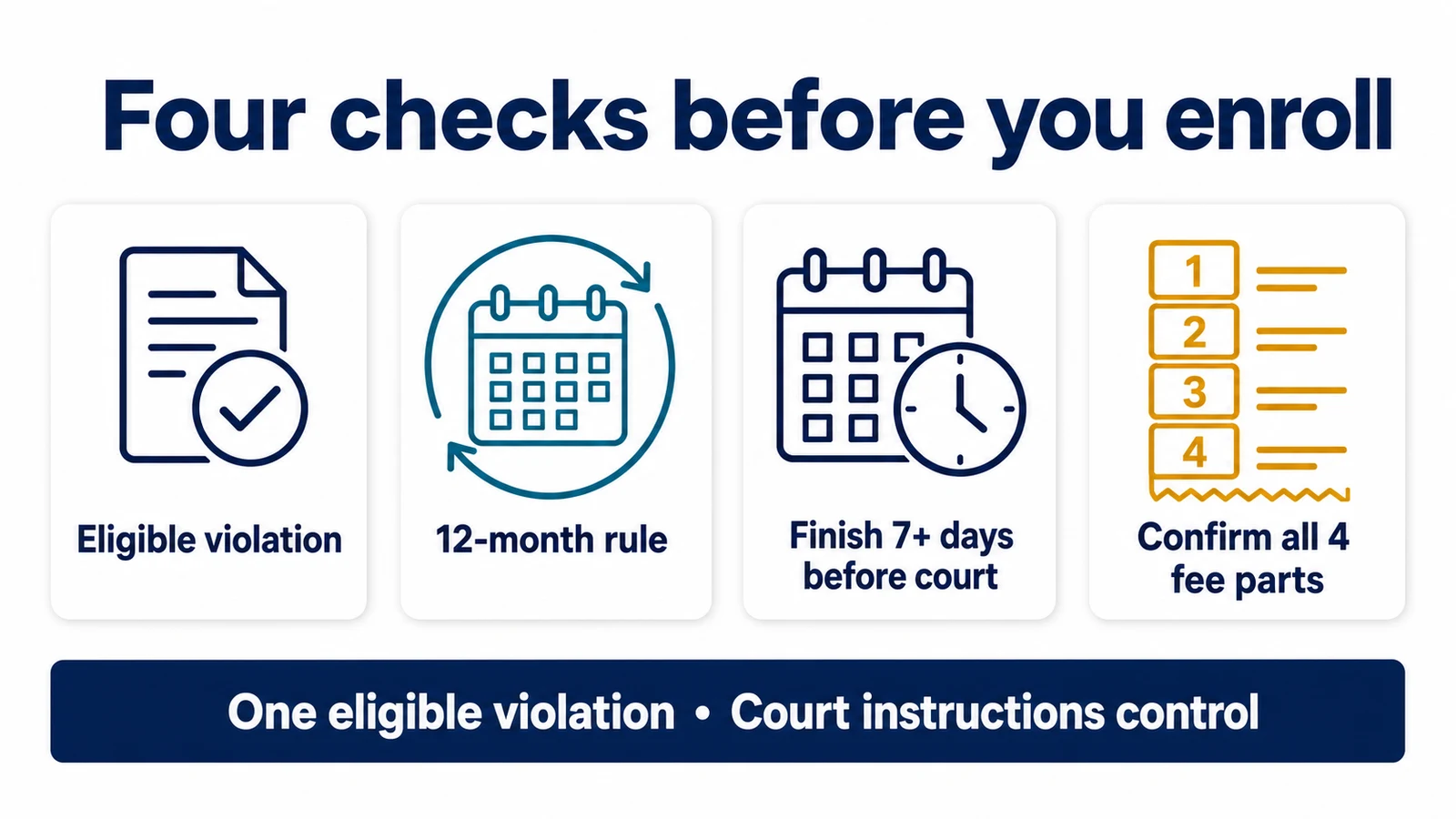
Confirm four things before you enroll
Arizona defensive-driving diversion can be a clean solution to one eligible citation, but only when the timing and case details line up. Before paying, confirm:
- The exact violation is eligible.
- The two relevant violation dates satisfy the 12-month rule.
- You can complete at least seven days before court—or you have a confirmed extension.
- The quoted total includes all four official fee components and any additional charges.
Then choose a Supreme Court-certified school that serves your court and finish early enough to handle a reporting or identity problem. The safest course is the one that satisfies the actual court instructions, not simply the first result in a search.
Related Reading
- Arizona Defensive Driving for Ticket Dismissal: Who Qualifies?
- Arizona-Certified Defensive Driving Schools Compared
- Traffic School by State: Rules, Costs, and Options
- Does Traffic School Remove a Ticket From Your Record?
- How to Keep a Ticket Off Your Record
Sources
- A.R.S. § 28-3392 — Defensive driving school; eligibility
- A.R.S. § 28-3394 — Successful course completion
- A.R.S. § 28-3394.01 — Commercial driver license holders
- A.R.S. § 28-3395 — Supreme Court authority and duties
- A.R.S. § 28-3396 — Court diversion fee and $45 surcharge
- A.R.S. § 28-3397 — Additional state fee
- A.R.S. § 12-114 — Court-authorized diversion surcharge
- Arizona Judicial Branch — Defensive Driving Schools
- Arizona Judicial Branch — List of Eligible Violations
- Arizona Judicial Branch — Preliminary Eligibility Checker
- Arizona Judicial Branch — Court Approved Extensions
- Arizona Judicial Branch — Cost to Attend School
Last updated: August 30, 2026