
California Traffic School vs Fighting or Paying a Ticket
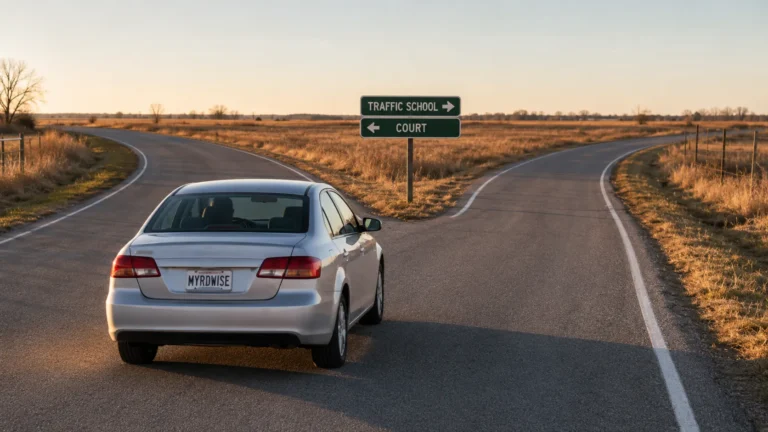
Choosing California traffic school vs fighting a ticket is not simply a choice between taking a class and going to court. Paying without traffic school generally resolves the case as a conviction. Traffic school may keep one eligible conviction confidential if the court approves it and you finish on time. Fighting the ticket preserves the possibility of a not-guilty result, but traffic school after a guilty finding becomes a decision for the judge rather than an automatic fallback.
That last point changes the risk calculation. California rules say an otherwise eligible driver does not lose consideration for traffic school merely by pleading not guilty or going to trial. They do not promise that the judge will grant the request afterward.
Quick answer: Choose traffic school when you appear eligible, accept the conviction-based resolution, and value the potential confidential-record benefit more than contesting the charge. Fight when you have a specific factual or legal reason to dispute the ticket and accept that post-trial traffic school is discretionary. Pay without traffic school only after checking whether the conviction may add a point or affect insurance.
Rules verified: September 4, 2026, against California Courts traffic guidance and California Rules of Court rules 4.104, 4.105, 4.107, and 4.210.
General information only: This guide is not legal or insurance advice. The superior court handling your citation controls your choices, deadlines, payment requirements, traffic-school eligibility, and final case result. Consult a qualified California attorney for advice about a defense or a serious charge.
Start With the Three Different Outcomes
The three paths do not aim at the same result.
| Path | What you ask the court to do | Best possible result | Main tradeoff |
|---|---|---|---|
| Pay without traffic school | Resolve the charge through payment or bail forfeiture | Case closes without a class or trial | The result is treated as a conviction for eligible Vehicle Code offenses |
| Request traffic school | Accept the traffic-school disposition and complete an approved course | One qualifying conviction may be confidential and avoid the usual negligent-operator point count | You still pay the required court amount, a court traffic-school fee, and course tuition |
| Fight the ticket | Enter a not-guilty plea and ask the court to decide the charge | Dismissal or a not-guilty finding | You spend time preparing, face an uncertain result, and cannot assume traffic school will be granted if found guilty |
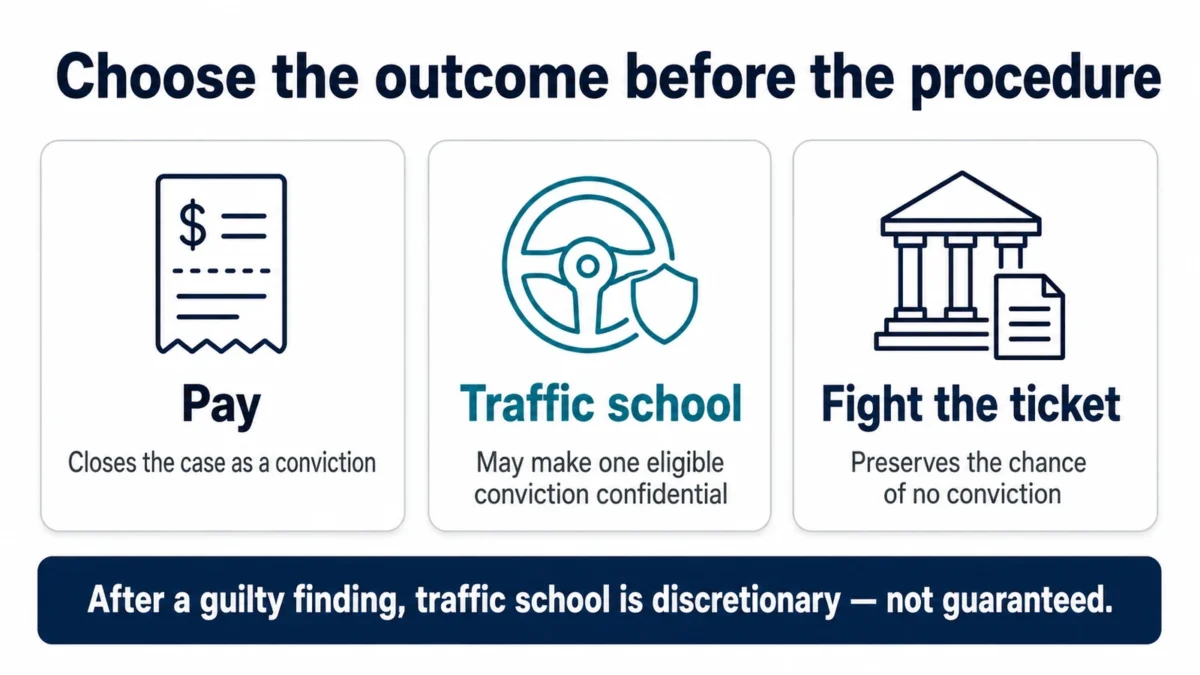
None of these paths is universally cheapest. Compare the complete consequence, not only today’s payment. Include court charges, course tuition, time, evidence strength, possible DMV record treatment, and any insurance exposure.
What Paying the Ticket Means in California
California Courts says that if you do not fight a ticket and pay it—often described as forfeiting bail—the payment is treated as a conviction. For a reportable moving violation, that can place the conviction and its point consequence on the DMV record.
Paying may be sensible when:
- you do not dispute the charge;
- the violation does not carry the record consequence you are trying to avoid;
- traffic school is unavailable or offers no useful confidentiality benefit in your situation; and
- you understand the total amount and can meet the deadline.
Do not use a payment screen as a research tool. Before submitting payment, read the court notice and the official court portal for the county named on the citation. Confirm whether the transaction is plain payment, a traffic-school request, an installment agreement, or something else. A completed payment can close options that were available beforehand.
If the citation is correctable—a “fix-it ticket”—the better route may be correction and proof rather than any of the three paths discussed here. If the charge is a misdemeanor, alcohol- or drug-related, collision-related, or otherwise serious, do not rely on this infraction decision guide.
What California Traffic School Does—and Does Not Do
California traffic school does not erase the ticket or produce a not-guilty finding. The conviction remains in DMV’s records. When Vehicle Code section 1808.7 applies, the first qualifying proceeding and conviction within the statutory period is confidential, and the usual point is not counted under section 12810.
California Courts explains the practical benefit as keeping the point from being visible to insurers. The safer wording is masked or confidential conviction, not “dismissed ticket.” The benefit does not hide a collision, insurance claim, another conviction, or every event that an insurer may consider.
Traffic school is strongest as a decision path when all of these are true:
- the court confirms that the charge and driver are eligible;
- you are within both applicable 18-month limits;
- you accept resolving the ticket as a conviction rather than contesting it;
- you can pay the court-required amount and separate course tuition;
- you can finish a DMV-licensed course before the assigned deadline; and
- the confidential-record outcome matters to you.
The complete eligibility screen belongs in our California traffic school guide. Do not enroll merely because a course seller says you qualify. Ask the court first.
When Fighting a California Ticket May Make Sense
Fight the ticket when you genuinely dispute the charge and have a concrete reason to ask the court for a not-guilty finding. That reason might involve what the officer could observe, whether the cited vehicle or driver was correctly identified, whether reliable photos or video contradict the allegation, or whether the prosecution can prove an element of the charged offense.
“I do not want the point” is a consequence, not a defense. Begin by reading the exact code section on the citation and organizing admissible evidence. A defense that depends on a legal interpretation, a high-stakes license issue, or a serious charge is a reason to consult a lawyer rather than copy an online script.
California generally offers two trial routes for eligible traffic infractions.
In-person court trial
At a court trial, you enter a not-guilty plea and a judge or commissioner hears the case; there is no jury. You may speak, present evidence and witnesses, and respond to the officer’s evidence. Request the trial by the due date shown on the citation or court notice.
Rule 4.105 generally requires courts to let an infraction defendant appear for arraignment and trial without first depositing bail, subject to listed exceptions. The statewide self-help guide notes that local scheduling methods vary and some courts offer remote proceedings.
Trial by written declaration
A trial by written declaration lets you contest an eligible ticket in writing. You submit form TR-205, your statement, and supporting evidence. The officer may submit a written statement, and a judge decides from the written record.
The ordinary procedure generally requires the full bail deposit with the papers. California Courts notes an exception for courts using MyCitations for a declaration trial. Follow the handling court’s current instructions rather than assuming the exception applies.
If you lose a standard written-declaration trial, you may request a new trial, called a trial de novo, within 20 calendar days after the court mails form TR-215. California Courts warns that a declaration trial handled through a court’s MyCitations process does not provide that trial-de-novo option; the remaining review route may instead be an appeal. Confirm the procedure before filing.
Can You Fight First and Ask for Traffic School Later?
Yes, you may ask—but approval is not guaranteed.
Rule 4.104(c)(2) says an otherwise eligible defendant is not made ineligible for traffic school by pleading other than guilty or exercising the right to trial. The judicial officer must consider a request based on the individual case. The court has discretion to grant or deny it and does not have to state a reason.
This creates two separate questions:
- Were you eligible before trial? The driver, violation, license, alleged speed, prior traffic-school history, and other statewide criteria still matter.
- Will the judge approve traffic school after a conviction? That is an individual discretionary decision, not the same clerk-level process available before trial.
If you plan to contest the ticket but would want traffic school after a guilty finding, prepare for that possibility before the trial. Bring or have available the information that shows your eligibility, and ask the handling court when and how a post-trial request should be made. Do not assume silence in a written submission preserves the request.
Important: “Fighting does not automatically disqualify you” is not the same as “traffic school remains guaranteed.” Base your decision on that narrower rule.
A Five-Step Decision Check
1. Identify the charge and deadline
Record the court, citation or case number, violation date, response date, alleged code section, alleged speed, license class, and vehicle type. Check whether an appearance is mandatory. Protect the earliest date while you compare paths.
2. Separate a defense from a hoped-for break
Write one sentence explaining why you believe the charge cannot be proved. Then list the evidence that supports it. If you cannot identify either, you may still plead not guilty, but you should recognize that the decision rests on hope rather than a documented defense.
3. Verify traffic-school eligibility and expected benefit
Ask the court whether it can approve your exact case and whether successful completion is expected to receive confidential treatment. California uses a clerk eligibility test based on violation dates and a separate statutory confidentiality limit. A commercial license, commercial vehicle, repeat use, higher-point charge, excessive alleged speed, or unresolved failure-to-appear issue can change the answer.
4. Compare total cost and time
For traffic school, include the court amount, the court’s traffic-school administrative fee, course tuition, and completion time. For a trial, include evidence preparation, possible bail requirements for the chosen procedure, time away from work or family, and the consequences if found guilty. Do not invent an insurance dollar estimate; ask your insurer or agent how a visible conviction could affect your policy.
5. Confirm what the action will close
Before clicking Pay, submitting a MyCitations request, entering a plea, or filing trial papers, ask the court what choices remain afterward. Save the notice, confirmation, receipt, submitted forms, and final disposition.
Do Not Use MyCitations in the Wrong Order
California Courts’ MyCitations guidance contains an unusually important sequencing warning. A request to lower the fine can give up the later ability to fight the ticket or correct a fix-it ticket. If you want traffic school, ask for it before requesting a fine reduction; some courts may allow the traffic-school request inside MyCitations.
If payment is the obstacle, the court may be able to lower the fine, allow more time, create a payment plan, or permit community service. The statewide forms route includes form TR-320 when MyCitations is unavailable. Financial hardship does not mean you should ignore the response date or surrender another option accidentally.
Use this order:
- Decide whether you want to fight or correct the ticket.
- If not, ask whether you want and qualify for traffic school.
- Then request an ability-to-pay decision or payment arrangement using the court’s instructions.
Common Decision Mistakes
- Paying before checking whether payment will be entered as a conviction.
- Treating traffic school as a dismissal rather than a confidential conviction.
- Buying a course before the court authorizes attendance.
- Fighting solely because an officer might not appear.
- Assuming a not-guilty plea guarantees traffic school as a fallback.
- Missing a deadline while researching options.
- Choosing a written declaration without understanding the bail requirement and review route.
- Requesting a fine reduction before deciding whether to fight, correct, or request traffic school.
- Using another county’s fee, deadline, or filing procedure.
- Ignoring the ticket because the courtesy notice did not arrive.
California Ticket Decision Examples
Eligible driver who accepts the citation
A driver receives an ordinary one-point moving violation, does not dispute what happened, has no conflicting traffic-school history, and wants to reduce the chance that the conviction will be visible to an insurer. After the court confirms eligibility and expected confidentiality, traffic school may offer the clearest path.
Driver with evidence contradicting the charge
A driver has reliable video and witness evidence that directly conflicts with a required part of the allegation. Contesting may be reasonable because only a dismissal or not-guilty finding avoids the conviction altogether. The driver should still learn how the court handles a post-trial traffic-school request, without treating approval as promised.
Driver who cannot afford the full amount
A driver agrees with the citation but cannot pay everything at once. The first question is still whether traffic school is wanted and available. The driver can then use MyCitations or the court’s ability-to-pay process in the order California Courts describes, rather than paying without school or giving up options unintentionally.
Frequently Asked Questions
Is California traffic school better than fighting a ticket?
It depends on your goal. Traffic school may protect the confidentiality of one eligible conviction but does not erase it. Fighting preserves the possibility of no conviction, but the result is uncertain and post-trial traffic school remains discretionary.
Does paying a California ticket mean I am guilty?
California Courts explains that paying or forfeiting bail instead of fighting is treated as a conviction for the ticket. Check the specific court transaction before paying, especially if traffic school or correction may be available.
Will I lose traffic-school eligibility if I plead not guilty?
Not automatically. Rule 4.104 says an otherwise eligible defendant is not made ineligible by a not-guilty plea or trial. If you are convicted, however, the judge decides whether to approve traffic school in the individual case.
Can I request traffic school in a written declaration?
Ask the court how to preserve and present the request. The statewide rule requires individualized judicial consideration after a contested case, but procedures can differ. Do not assume that a course request is implicit in your declaration.
Do I have to pay before fighting the ticket?
An in-person infraction trial generally may proceed without a prior bail deposit under rule 4.105, subject to exceptions. A standard trial by written declaration ordinarily requires bail first. The handling court’s notice controls the filing method and amount.
What happens if the officer does not appear?
Do not build the entire decision around that possibility. The court controls what happens, and the officer may appear or file a declaration. Prepare a real defense and comply with every deadline.
Choose the Outcome Before the Procedure
Start with the outcome you are trying to protect. If you accept the citation and qualify for a confidential conviction, traffic school may be the practical choice. If you have specific evidence or a legal reason to dispute the charge, a trial may be worth the uncertainty. If you pay without traffic school, do it only after understanding the record consequence and the choices that payment ends.
The safest sequence is: read the charge, preserve the deadline, verify eligibility, compare consequences, then act through the court.
Drive Wise. Spend Less. Stay Safe.
Related Reading
- Check California traffic-school eligibility and the two 18-month tests
- Learn what California traffic school hides from insurers
- Compare traffic school with going to court
- See the broader cost comparison between paying and traffic school
- Understand how a visible ticket may affect car insurance
Sources
- California Courts — Guide to traffic tickets
- California Courts — Traffic court trial
- California Courts — Trial by written declaration
- California Courts — Rule 4.104, traffic-school procedures and eligibility
- California Courts — Rule 4.105, appearance without deposit of bail
- California Courts — Rule 4.210, trial by written declaration
- California Courts — MyCitations
- California Courts — If you cannot afford your traffic ticket
- California Vehicle Code § 1808.7
Last updated: September 5, 2026.