


Illinois Defensive Driving Course: Eligibility, Benefits, and Approved Options

The right Illinois defensive driving course depends on why you need it. Court traffic safety, under-21 remedial education, and the over-55 insurance course are separate paths with different approval and completion rules.
Start with the notice, court order, or insurance goal that brought you here. Then use this guide to identify the right lane before you choose a course or pay a fee.
By MyRoadWise | Reviewed September 12, 2026
General information only: This guide explains the verified statewide rules at a high level. It is not legal or insurance advice. Follow your court or Illinois Secretary of State notice, and confirm policy questions with your insurer.
Quick answer: Which Illinois course path applies to you?
Illinois does not have one defensive driving product that handles every ticket, point, license, and insurance issue. Match your reason for taking a course to the authority that controls the result.
| Your situation | Course lane | Who controls it | What to do first |
|---|---|---|---|
| You are seeking court supervision for a minor traffic offense | A court-approved traffic safety program may be part of supervision | The circuit court in a county covered by Illinois Supreme Court Rule 529(b) | Read the court’s local instructions before enrolling |
| You are under 21 and your suspension notice requires remedial education | Graduate to Safety Driver Remedial Education | Illinois Secretary of State | Use the approved-provider list linked from the SOS remedial page |
| You want points removed after a conviction | Illinois does not offer a course that drivers can choose to take to remove points from a driving record | Illinois Secretary of State | Do not buy a course on a promise that SOS will subtract points |
| You are over 55 and want a liability premium reduction | NSC Defensive Driving Course or an SOS-approved crash-prevention course | Illinois law, the Secretary of State, and your insurer | Ask your insurer what reduction and proof apply to you |
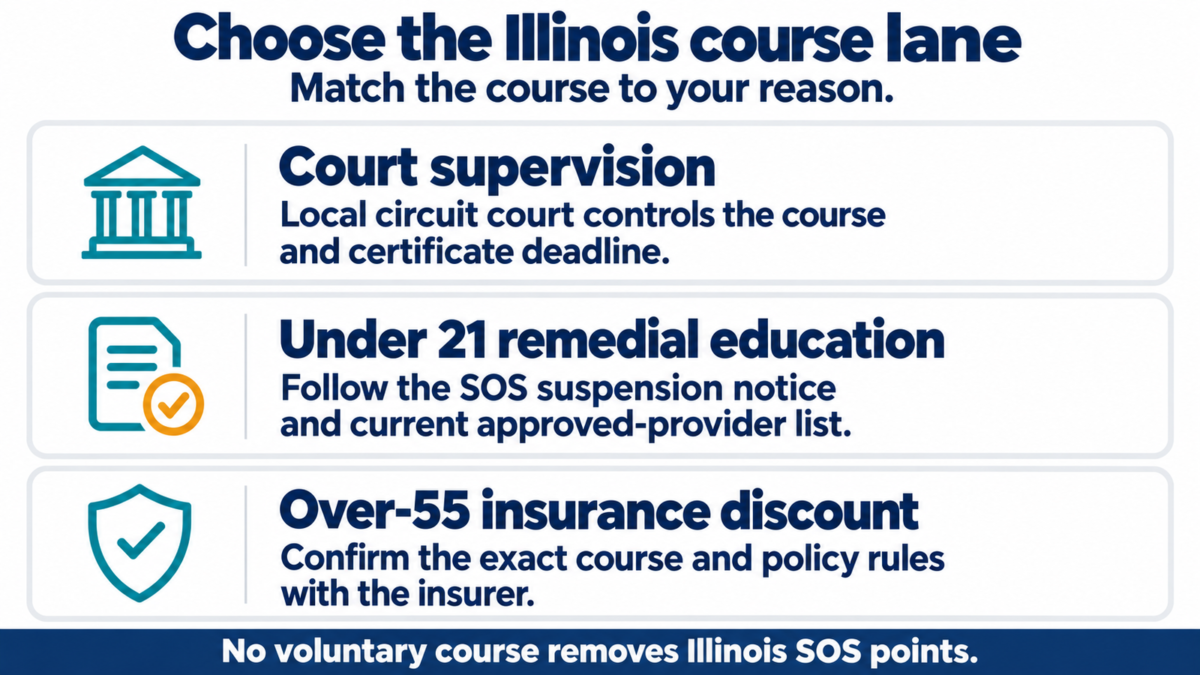
These lanes are not interchangeable. A court traffic safety program is not the SOS under-21 remedial course. Neither should be confused with the over-55 insurance course.
Court traffic school is tied to supervision, not a statewide right
Illinois Supreme Court Rule 529(b) creates a limited court-supervision route for certain written guilty pleas. In counties designated by the Conference of Chief Circuit Judges, a circuit court may use a rule or order to authorize supervision for a minor traffic offense handled under Rule 529(a).
The court’s local rule or order may include successful completion of a court-approved traffic safety program. Rule 529 does not require every covered court to include a course. It also does not give every driver a statewide right to enroll and receive supervision. (Illinois Supreme Court Rule 529(b))
This distinction matters when a website markets “Illinois traffic school” as if the same offer works statewide. The Rule leaves the use of supervision and a traffic safety program to the designated county and its circuit court rule or order.
What to check before you choose a court course
Use the papers and instructions for your case. Confirm:
- Whether the court offers the Rule 529(b) supervision path for your minor traffic matter.
- Whether a traffic safety program is part of the conditions in your case.
- Which course the court approves.
- The date by which you must finish.
- Who files the completion certificate and how you can confirm timely filing.
Do not start with a provider’s general promise. Start with the court that controls the case. A course can be useful only if it matches the court’s instructions.
A future Illinois ticket-and-supervision guide will cover that court decision in more depth. This pillar stays focused on choosing among course types.
The certificate deadline can decide the court outcome
Finishing the court-approved class is only one step. Your proof must also be filed by the date the supervision order ends.
If the certificate is late, Rule 529(b) says the court must summarily revoke supervision and enter a conviction. The course provider may file it for you. Even so, you remain responsible for making sure it is filed on time. (Illinois Supreme Court Rule 529(b))
Treat course completion and certificate filing as two separate tasks:
- Save the completion certificate or confirmation.
- Follow the court’s filing instructions.
- If the provider says it files for you, ask how to confirm that happened.
- Keep proof of submission with your court papers.
- Treat the end date as a firm filing deadline.
Example: completion without confirmed filing
Suppose a driver finishes the assigned class on time. The provider says it sends certificates to the court. The driver does not check whether the court got this one.
Rule 529(b) still makes the driver responsible for timely filing. Follow the court’s steps and confirm receipt. Do not assume the provider finished the last step.
What successful court supervision means
Illinois law puts off a judgment while the supervision term is open. At the end, the court checks whether the defendant met all the terms. If so, the court must discharge the defendant and dismiss the charges.
The law calls that result a discharge and dismissal without an adjudication of guilt. It is not termed a conviction for legal bars imposed because of conviction of a crime. (730 ILCS 5/5-6-3.1(e)–(f))
Keep the limit in that wording. It does not settle every record, sealing, insurance, or license question. Nor does the class alone cause dismissal. The result rests on the court’s order and success with all its terms.
Check every term, not just the class. Keep the order, course receipt, proof that you finished, filing proof, and any notice that shows how the case ended.
Under 21? Follow the SOS remedial notice
Illinois has a separate class for some drivers under 21. The Secretary of State says two or more moving convictions within 24 months will lead to a license suspension. It lasts at least 30 days. The length varies with how serious the offenses are. (Illinois SOS Remedial Education Program)
The suspension notice tells the driver whether a remedial course is required as part of reinstatement. When the notice requires it, the course is the Graduate to Safety Driver Remedial Education course.
This is not an optional class bought to improve a driving record. It is required for reinstatement when the notice says so.
What the Graduate to Safety requirement includes
When the requirement appears on the suspension notice:
- You must complete the course through an approved remedial education provider.
- The course fee will not exceed $100.
- Failure to attend and complete the course prevents reinstatement of driving privileges.
Those conditions come from the SOS remedial program page. (Illinois SOS Remedial Education Program)
The SOS posts a PDF titled Approved Graduate to Safety Driver Remedial Education Providers. As of this article’s review date, the list was last revised 06-10-2026. The list can change. Check the date stamp on the copy you open when you are ready to enroll. Do not rely on an old copy or a third-party list. (SOS approved remedial providers PDF)
Steps for an under-21 remedial assignment
- Read the suspension notice and identify whether remedial education is required.
- Open the current SOS approved-provider list.
- Choose a listed provider that can meet the notice requirements.
- Keep your registration and completion records.
- Confirm that you have met the course requirement before seeking reinstatement.
- If the suspension is six months or longer, appear in person at a driver services facility at the end of the suspension to re-apply for a license or instruction permit. You must take all required tests and pay the issuance fee and any outstanding fees. This step is separate from and in addition to the Graduate to Safety course. Finishing the course alone does not complete the process.
Do not swap in a general driving class because its name sounds close. The SOS page requires an approved Graduate to Safety provider for this route.
An Illinois course does not automatically remove SOS points
Illinois does not offer a course that drivers can choose to take to remove points from a driving record.
Illinois rules tie points to reports of convictions. When a court reports a traffic conviction, Driver Services enters it on the driving record by type. The Illinois Offense Table then sets the number of points for a conviction that earns points. (92 Ill. Adm. Code 1040.20(a))
That is a points system based on convictions. It is not a voluntary course that takes points off. Do not buy a class based on an ad that says it removes a set number of Illinois points.
Court supervision works in a different way. If you meet all its terms, it may end in discharge and dismissal as explained above. Do not call that “taking a class to erase points.” The court controls supervision. The SOS rule explains how conviction reports lead to points.
For general background on how state point systems work, use the live driver-license-points guide listed in the Internal-Link Map.
Over 55? Check the Illinois insurance course path
Illinois has another course path for an insured over age 55. Under 215 ILCS 5/143.29(a), auto liability rates and premiums must include a reduction set by the insurer after the insured finishes either:
- the National Safety Council’s Defensive Driving Course; or
- a motor vehicle crash-prevention course, including an eLearning course, that the Illinois Secretary of State finds meets or exceeds the standards of the NSC Defensive Driving Course’s eight-hour classroom safety instruction program.
The insurer sets the reduction. The law does not set a fixed statewide minimum percent. (215 ILCS 5/143.29(a))
An ad that promises one set percent for every Illinois policy goes beyond this rule. Ask your insurer what would apply to you before you choose a course.
How long the premium reduction lasts
The reduction lasts three years from the date you finish the course if you qualify. The insurer may start it on the last effective date of the policy or at the next renewal. The chosen timing must give savings as though it ran for the full three years.
You are responsible for giving the insurance company the information it needs to decide eligibility. (215 ILCS 5/143.29(a)–(d))
The rate cut does not apply to a fleet or commercial vehicle without a regularly assigned principal operator. It also does not apply to a broadly averaged group policy. The main driver cannot get the rate cut if the Illinois SOS suspended or revoked their license in the past 36 months. The rate cut also does not apply to a vehicle already charged a higher premium because of the insured’s own past claims. A motor vehicle law conviction blocks the rate cut until the main driver has gone one full year with no crash or violation. The driver may then get the cut for the last two of the three years. (215 ILCS 5/143.29(e)(1)–(4))
Before enrolling, ask your insurer:
- Does this exact course qualify under my policy?
- What reduction would the insurer apply?
- When would it start?
- What information will the insurer need from me?
- How should I submit the SOS completion letter?
- Do any of the fleet, driving-record, license-history, claim-history, or group-policy exclusions apply to me?
A future Illinois insurance guide will cover policy details. This page gives the route, age rule, insurer-set amount, and three-year window you need to choose a lane.
How completion reaches you
Illinois rules give the provider and the SOS separate jobs. The provider tells the SOS when a driver finishes an approved crash-prevention course. The SOS then sends the driver a letter of completion. The driver may give that letter to the insurer to seek the liability premium reduction. (50 Ill. Adm. Code Part 8000, Section 8000.100)
Do not confuse this letter with the Rule 529 court certificate. They belong to different programs and go to different decision-makers.
How to avoid enrolling in the wrong Illinois course
Use this order: reason, authority, approval, and proof.
1. Name your reason
Write down the result you need:
- comply with court supervision;
- satisfy an under-21 SOS remedial requirement; or
- seek an over-55 liability premium reduction.
If your goal is SOS point removal, pause. Illinois does not offer a course that drivers can choose to take to remove points from a driving record.
2. Identify who controls the result
For court supervision, follow the circuit court’s instructions. For under-21 reinstatement, follow the SOS suspension notice and approved-provider list. For an insurance reduction, confirm the course and expected result with your insurer.
3. Verify the exact course
A provider may sell several courses with names that sound alike. Match the course to the right lane. A familiar name does not prove that one course can stand in for another.
If the name does not match, stop and ask. A low price will not make the wrong class fit your case.
4. Confirm the completion route
Ask who reports completion, what you receive, and what you must submit. For Rule 529(b) supervision, you remain responsible for timely certificate filing even if a provider may file. For the over-55 insurance route, Part 8000 provides for an SOS letter that you may present to the insurer.
5. Keep a small proof file
Keep the notice or order, your sign-up record, proof that you finished, filing proof, and any reply. This small file helps you check whether the right office got the right paper.
Make a course check sheet before you pay
A short check sheet can keep the three paths from getting mixed up. Put the name of the court, SOS office, or insurer at the top. Add the name of the class that your paper or policy calls for. Do not change that name to one used in an ad.
Next, write the result you seek in one plain line. It may be a term of court supervision, an SOS step for a young driver, or a cut in what you pay for auto liability cover. This line helps you ask the right person the right question.
For a court case
Keep your court papers next to the check sheet. Write down whether the court says a class is part of the order. If it is, ask for the exact class name and the date by which proof must be filed.
Also write down who plans to file the proof. If the school says it will do so, leave a blank for the date the court gets it. That blank is a cue to check. The Rule still puts the duty to make sure it is filed on you.
Do not mark the task done when the class ends. Mark it done when you have met the court’s steps and checked the filing as the court directs.
For an SOS notice
Copy the class name from the notice. If it calls for Graduate to Safety, use the live SOS list to find a school. Note the date shown on the list you use. A saved list may not be the list that is in force when you sign up.
Keep the notice with your course record. When the class is done, use the notice to check what else you must do before you seek the right to drive again. The class is one step in the path set out for you.
For an insurance goal
Ask your insurer about the exact course before you pay. Write down whether the course fits the over-55 rule, what rate cut the insurer would use, and when it would start. The state law does not give you one set percent to copy into the sheet.
Leave space for the facts the insurer asks you to send. Also note how it wants the SOS letter. When the letter comes, keep a copy and send it by the method the insurer gave you.
Use names, dates, and proof
For each call or chat, write the date, the office or firm, and the answer. If you get a web link, save it with the sheet. If an answer is not clear, ask the office that controls the result to state what it needs.
This check does not change a court order, SOS notice, or policy rule. It gives you one place to track the facts that do control your choice. It can also show a mismatch before you spend money on the wrong class.
Frequently asked questions
Can anyone take traffic school to dismiss an Illinois ticket?
No statewide right to enroll is shown here. Rule 529(b) lets courts in designated counties use supervision for some minor traffic cases. A local rule or order may include a court-approved safety class. Ask the court about your case before you enroll.
Does Illinois defensive driving remove points from my license?
No. Illinois does not offer an SOS course that drivers can choose to take to remove points from a driving record. Illinois assigns points from conviction reports under its Offense Table. Court supervision is a separate path, not point removal after a conviction.
What happens if my court course certificate is late?
Under Rule 529(b), a late certificate means summary revocation of supervision and entry of a conviction. You remain responsible for filing on time even if the provider may file for you.
Is Graduate to Safety the same as court traffic school?
No. Graduate to Safety is the SOS course used when an under-21 suspension notice requires it for reinstatement. Court traffic safety belongs to the supervision path under Rule 529(b).
How much can the under-21 remedial course cost?
The Illinois SOS says the required Graduate to Safety course fee will not exceed $100. Use a provider from the current SOS approved list.
Is the insurance reduction available at age 55?
The statute says over age 55. It also leaves the amount to the insurer and sets no fixed percentage floor. Ask the insurer to confirm eligibility and the expected reduction before you enroll.
How long does the over-55 insurance reduction last?
It lasts three years from the date a qualified insured finishes the course. The insurer has the timing choices noted above. You must give the insurer the facts it needs to check your eligibility.
Choose by purpose, not by course name
Illinois has several kinds of driving courses. Court traffic safety, the SOS under-21 class, and the over-55 insurance course do different jobs.
Open the notice, order, or policy question that led you here. Check who controls the result, which course is approved, when it is due, and where proof must go. For court supervision, watch the certificate filing date.
Your next step: identify your lane in the quick-answer table, then confirm the exact course with the court, SOS list, or insurer that controls the result.
Related Reading
- Compare traffic school rules by state
- How defensive driving courses work
- Check whether an online traffic school is legitimate
- Understand driver license points
Sources
All sources were accessed September 12, 2026. These official materials support only the Illinois rules summarized in this draft.
- Illinois Courts — Illinois Supreme Court Rule 529, Written Pleas of Guilty in Minor Traffic Offenses. https://illinoiscourts.gov/resources/ec494e9e-5765-42ec-9368-9432fc096c7d/file
Authority role: controlling court rule. Supports designated-county supervision, the optional court-approved traffic safety program, and the certificate-filing consequence and responsibility. - Illinois General Assembly — 730 ILCS 5/5-6-3.1, Incidents and Conditions of Supervision. https://www.ilga.gov/legislation/ilcs/fulltext?DocName=073000050K5-6-3.1
Authority role: controlling statute. Subsections (e)–(f) support discharge, dismissal, no adjudication of guilt, and the limited “not termed a conviction” rule after successful supervision. - Illinois Secretary of State — Remedial Education Program. https://www.ilsos.gov/departments/drivers/driver-education/remedialdred.html
Authority role: administering agency. Supports the under-21 two-convictions-in-24-months suspension rule, minimum suspension, notice-based Graduate to Safety requirement, approved-provider condition, fee cap, and reinstatement consequence. - Illinois Secretary of State — Approved Graduate to Safety Driver Remedial Education Providers. https://ilsos.gov/content/dam/departments/drivers/driver_education/remedialproviders.pdf
Authority role: official list publisher. Supports the location of the approved-provider list. The opened PDF was marked Revised 06-10-2026; check the current list before enrollment. - Illinois Joint Committee on Administrative Rules — 92 Ill. Adm. Code 1040.20, Illinois Offense Table. https://www.ilga.gov/commission/jcar/admincode/092/092010400000200R.html
Authority role: controlling regulation. Supports entry of court conviction reports on the driving record and assignment of points through the offense table. - Illinois General Assembly — 215 ILCS 5/143.29. https://www.ilga.gov/documents/legislation/ilcs/documents/021500050K143.29.htm
Authority role: controlling insurance statute. Supports the over-55 course path, insurer-determined reduction, eligible course types, three-year period, insurer timing option, and insured’s duty to provide eligibility information. - Illinois Joint Committee on Administrative Rules — 50 Ill. Adm. Code Part 8000. https://www.ilga.gov/Agencies/JCAR/EntirePart?titlepart=05008000
Authority role: controlling administrative rules. Section 8000.100 supports provider notification to SOS and the SOS letter of completion for the insurer.
Last updated: September 12, 2026