

Michigan Defensive Driving Course: What the Basic Driver Improvement Course Can Do

Michigan offers one statewide course for drivers who have been ticketed. The state calls it a Basic Driver Improvement Course, or BDIC. This course is not for everyone. You cannot sign up on your own. The Secretary of State decides who qualifies and sends a letter to drivers who meet the eligibility rules.
The short answer
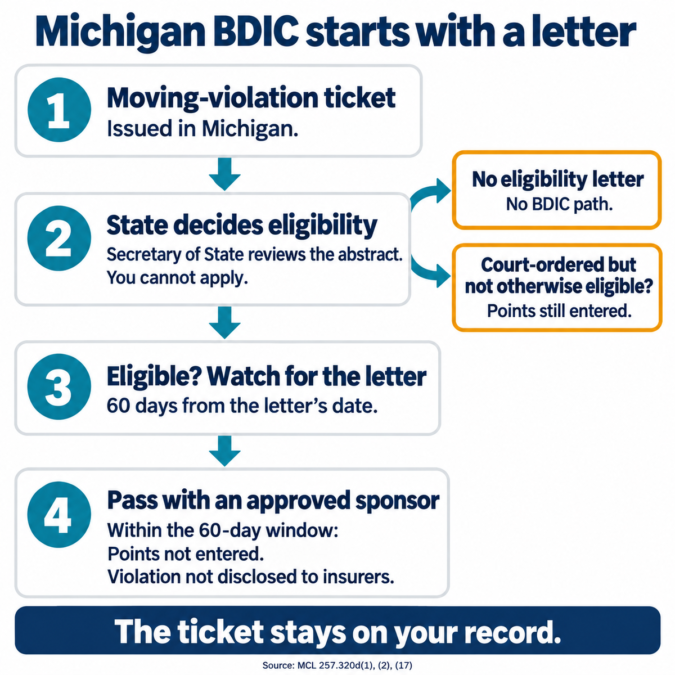
If the Secretary of State has sent you a letter saying you are eligible, and you complete an approved course within 60 days, the state will add your ticket to your driving record but will not post the points. The Secretary of State also will not make information about that violation available to insurance companies.
That is the whole benefit. BDIC is not a point reduction. It is not a dismissal. Your ticket stays on your record. Courts can still see it. Under MCL 257.320d(1), the effect is that the points from one moving violation are not entered and the violation itself is not disclosed to insurers.
You may use this benefit only once in your lifetime. If the Secretary of State has not sent you a letter, you are not eligible.
Is this a point reduction?
No. Michigan law has no mechanism that deducts, removes, or expunges points once they are on your record.
BDIC keeps the points from being entered in the first place. The ticket itself is added to your record and stays visible to courts. Points that were already on your record before this ticket remain there. BDIC does not lower your existing point total.
Who decides eligibility
You cannot apply. Under MCL 257.320d(2)(a), the Secretary of State determines eligibility when it receives the abstract of a moving violation. If the Secretary of State finds you eligible, it will notify you by first-class mail at the last known address on your license and tell you how and when you must complete the course.
If you have not received a letter, check your address on file with the state. If your address has changed, update it. Do not enroll in a course expecting it to qualify for BDIC unless the Secretary of State has notified you in writing.
The 60-day clock
The deadline is 60 days from the date of the Secretary of State’s eligibility letter. You must enroll and complete the course inside that window. The course sponsor reports your result to the Secretary of State electronically.
If the sponsor does not provide notice of successful completion within the 60 days, the Secretary of State will enter the points under MCL 257.320d(2)(c). Michigan law does not permit extensions.
You may try the course as many times as you need within the 60 days. Some sponsors have their own policies on retakes and may charge a fee each time. But you can pass BDIC only once in your lifetime. If you pass and later receive another ticket that would otherwise be eligible, you cannot take BDIC again.
Who is ineligible
Under MCL 257.320d(3), you are ineligible if any of the following apply:
- The violation occurred while you were operating a commercial motor vehicle, or you were licensed as a commercial driver while operating a noncommercial motor vehicle.
- The violation is a criminal offense.
- The violation carries four or more points.
- The violation is a violation of section 626b, 627(9), 627a, or 682.
- You were cited for more than one moving violation from the same incident.
- Your license was suspended under section 321a(2) in connection with the violation.
- You previously successfully completed a basic driver improvement course.
- You have three or more points on your driving record as of the date the ticket was issued.
- Your license is restricted, suspended, or revoked, or you were not issued a Michigan license.
The Michigan Secretary of State describes the point bar as more than two points on your record when the ticket was issued. That measurement date comes from the state’s BDIC eligibility page, not the statute.
The once-per-lifetime rule
If you have already successfully completed BDIC, you are barred from taking it again. Under MCL 257.320d(3)(g) with (6), the database that enforces this bar is kept for the life of the individual.
This is not the same as failing the course and trying again. If you fail the exam, you may retake it within your 60-day window. The lifetime bar applies only if you have passed BDIC before.
If a judge ordered you to take the course
If you are not otherwise eligible under the statute, a court order does not bring point protection. The Secretary of State will still enter the points.
Under MCL 257.320d(17), a court may order you to complete the Basic Driver Improvement Course even if you do not meet the eligibility rules. But if you are not otherwise eligible, the points will still be entered.
The point protection in MCL 257.320d(1) expressly does not apply to someone who completes a court-ordered course but is not otherwise eligible. If a judge ordered you to take BDIC, ask the court whether the order carries any point protection before you assume it will keep points off your record.
What happens after you pass
The course sponsor reports your result to the state by computer. You do not file anything with the state or the court. Some sponsors give you a paper copy for your own records. That paper is not required by the state or the court, per the state’s BDIC FAQ.
If you pass, the state will add the ticket to your driving record but will not post the points. Neither the ticket nor the points will be shown to insurance companies. The ticket stays visible to courts.
Drivers with a probationary license may still face a driver review and license sanctions even after finishing BDIC.
Fines and court costs still stand
All court costs, fines, and fees related to your ticket remain payable. BDIC affects only whether the points are posted and whether the ticket information is made available to insurers. It does not erase the ticket, change the conviction, or reduce what you owe the court.
Course requirements and cost
Under MCL 257.320d(7) with MCL 257.3a(a), (c), (d), an approved BDIC must meet or exceed the curriculum standards in the Defensive Driving Course Instructor Manual, Eighth Edition, published by the National Safety Council. The course must include at least four hours of instruction and may be offered online or in a classroom.
Sponsors may charge a fee of not more than $100. Each sponsor sets its own price within that ceiling. There is no standard or typical fee.
To pass, you must complete a written exam. The sponsor reports your score to the Secretary of State.
Where to find an approved sponsor
The Secretary of State publishes lists of approved online and classroom sponsors on its BDIC page. You must use an approved sponsor. Courses from sponsors not approved by Michigan will not count.
Contact a sponsor directly to confirm enrollment procedures, fees, retake policies, and course format before you pay.
The insurance question
The Secretary of State will not disclose your ticket or points to insurers if you pass BDIC. That is the extent of what the law guarantees.
Some drivers want to know whether finishing BDIC will earn them an insurance discount. That is a different question. Michigan insurance law permits, but does not require, an insurer to use completion of an accident prevention education course as a rating factor under MCL 500.2111(2)(d)(i). That course must include a minimum of eight hours of classroom instruction.
BDIC is a four-hour course. It may be completed online. On its face, a four-hour BDIC does not meet the eight-hour classroom instruction requirement in the insurance statute. No Michigan law mandates that insurers give a discount for BDIC, and no statute sets a discount percentage.
If you want to know whether completing BDIC will lower your premium, ask your insurer in writing before you enroll. Get the insurer’s answer confirmed in writing.
Points and your driving record
Under MCL 257.320(1)(d), the state uses a two-year window to trigger a license recheck. A driver who has 12 or more points within two years may be called for review. A separate six-point trigger, also measured within two years, applies to points charged for exceeding the speed limit by more than 1 but not more than 5 miles per hour.
The statute does not say points expire or fall off. The state’s How to Read the Michigan Driving Record guide says points stay active on the record for two years. The guide also says that once the two-year mark is reached, the points field no longer shows them, and that if you passed BDIC for a ticket, points will not show at all.
Check your own driving record to see your current point total. Do not rely on a guess.
Under MCL 500.2111(3)(b), an insurer must not raise rates for a civil infraction under Chapter VI of the Michigan Vehicle Code for longer than the state carries points for that ticket on your motor vehicle record. That rule limits how long an insurer may add a surcharge. It does not control when points stop showing on your record or when they stop counting toward a recheck.
Courts and their own ticket-cancellation programs
Some Michigan courts let drivers take a safety course and will cancel the ticket if the driver passes. That is a separate program from BDIC. The court will require a paper as proof you finished.
This comes from the Michigan Secretary of State’s BDIC FAQ. Not every court offers this option. The rules, deadlines, and allowed tickets vary by court.
If your court offers a cancel program, ask the court which course it accepts, what the deadline is, and whether finishing it will dismiss your ticket. Do not assume BDIC qualifies for a court program. The two programs are separate by law.
A practical checklist
- Check whether the Secretary of State has sent you a BDIC eligibility letter.
- If you have not received a letter, confirm your address is current with the state.
- Do not enroll in BDIC unless the Secretary of State has notified you in writing.
- If you are eligible, note the 60-day deadline from the date on the letter.
- Use only an approved sponsor listed on the Secretary of State’s BDIC page.
- Confirm the sponsor’s fee, retake policy, and format before you pay.
- If a judge ordered you to take the course, ask the court whether the order protects against points.
- Keep the eligibility letter, course completion records, and any written insurer confirmation.
- Pay all court fines, costs, and fees. BDIC does not cancel those.
- Do not expect BDIC to erase your ticket, lower existing points, or guarantee an insurance discount.
What this page does not cover
This page does not compare course sponsors. The state’s approved lists are behind a login gate and have not been reviewed for this guide.
This page does not list usual course prices. Sponsors set their own fees up to the $100 cap.
This page does not describe statewide ticket dismissal beyond the state’s note that some courts run their own separate programs. Ask your court about local options.
General information only: This page is not legal advice. It explains Michigan’s Basic Driver Improvement Course rules as they are published in state law and on official state pages. If you have questions about a specific ticket, court order, or insurance policy, contact the court, the Secretary of State, or your insurer.
Related Reading
- Traffic School by State: Ticket, Point and Insurance Rules
- How to Get Points Off Your License: What Works by State
- How Long Do Points Stay on Your License?
- Driver License Points Explained
- How to Keep a Ticket Off Your Record
Sources
- MCL 257.320d — Basic Driver Improvement Course eligibility, effect, deadline, and bars. Supports: Point non-entry and insurer non-disclosure under subsection (1); Secretary of State determines eligibility and notifies by mail under subsection (2)(a); 60-day deadline and point entry on miss under subsections (1) and (2)(c); nine statutory bars under subsection (3); once-per-lifetime bar and lifetime database under subsections (3)(g) and (6); court-ordered course carries no point protection for ineligible drivers under subsection (17); fee cap under subsection (7).
- MCL 257.3a — Basic driver improvement course definition. Supports: National Safety Council eighth-edition curriculum standard, minimum four hours of instruction, online or classroom delivery under subsections (a), (c), and (d).
- MCL 257.320 — Reexamination triggers. Supports: Two-year accumulation window of 12 or more points triggers reexamination under subsection (1)(d); a total of six or more points charged under section 320a(q) (exceeding the limit by more than 1 but not more than 5 mph) within the same two-year period also triggers reexamination.
- MCL 500.2111 — Automobile insurance rating factors and merit rating. Supports: Insurers may, but are not required to, use completion of an accident prevention education course with a minimum of eight hours of classroom instruction as a rating factor under subsection (2)(d)(i); an insurer must not merit-rate a Chapter VI civil infraction for longer than the Secretary of State carries points for that infraction under subsection (3)(b).
- Michigan Secretary of State — Basic Driver Improvement Course (BDIC) eligibility — Operational eligibility summary. Supports: More-than-two-points operational reading; ticket added to record but points not posted and neither shown to insurers; electronic sponsor reporting; no certificate filing required; all court costs, fines, and fees remain payable.
- Michigan Secretary of State — BDIC Frequently Asked Questions — Agency FAQ. Supports: Court-run safety-course cancellation programs are separate from BDIC and require a certificate.
- Michigan Secretary of State — How to Read the Michigan Driving Record — Record guide. Supports: Points remain active for two years and stop displaying once the two-year retention date is met; points do not display if BDIC was passed.
Last updated: September 24, 2026