

Can Traffic School Dismiss a Colorado Ticket? Local Court Options and Steps

Colorado traffic school can be part of a local agreement that leads to ticket dismissal, but taking a class does not automatically dismiss your ticket. Colorado Springs Municipal Court says Colorado has no statewide program in which a remedial class dismisses a citation. La Junta, however, publishes a local deferred-judgment route that requires traffic school for juveniles and dismissal after all conditions are met.34
The process depends on the court and the agreement offered in your case. For county traffic infractions, Colorado law lets a district attorney participate at their discretion to attempt a negotiated plea, deferred prosecution, or deferred judgment and sentence. It does not require the prosecutor to offer that route.1
This guide helps you identify the possible result, ask for the actual terms, and complete the steps that matter beyond the class. That can prevent a costly mistake: buying a course when your court offers a different benefit, or finishing the course while leaving another condition unmet.
General information only: This guide explains published Colorado law and local court procedures checked October 4, 2026. Your charge, court and offered agreement determine your options. It does not decide how you should plead.
First, find out what the court is offering
“Traffic school” tells you what you will do. It does not tell you what happens to the case afterward. Look for the disposition, meaning the court’s result for the charge.
| Possible route | What to establish before accepting it |
|---|---|
| Deferred judgment leading to dismissal | Which charge would be dismissed, what plea is required, and every condition you must meet |
| A reduced plea connected to a class | The final charge and its points, rather than assuming the ticket disappears |
| A class imposed after conviction | The sentence you must fulfill and any stated fine or sentence benefit |
Thornton explains that a deferred judgment and sentencing involves a guilty plea. If the terms are completed successfully, the plea is withdrawn and the case dismissed. Its court advisement says the prosecutor may offer the agreement and the judge must approve it.56
By comparison, Longmont’s published class option may improve the standard plea offer. Its page does not promise dismissal just for completing the class.7
Ask directly: “If I complete every condition, will this charge be dismissed, or will I be convicted of a different charge?” Get the answer before treating either route as a solution to your record concerns.
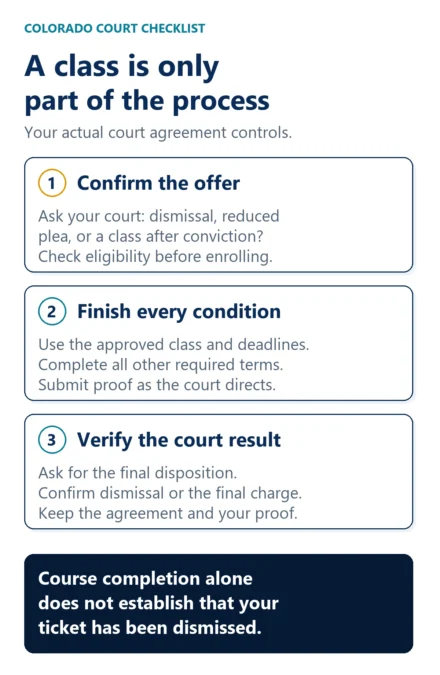
Your court agreement determines the requirements and possible result. Complete every condition and confirm the final disposition.
Local examples show why the agreement matters
These are examples of published procedures, not a list of every Colorado court offering a class or deferral. A program in the same city as your stop may still belong to a different court from the one handling your summons.
La Junta: dismissal comes after the full deferment
La Junta Municipal Court describes a deferred judgment and sentence as a city attorney’s offer for drivers who have not had previous traffic violations in the City of La Junta. It describes a six-month probationary period in which the driver pays all fines and court costs and gets no additional traffic tickets in the city. Juveniles also must take traffic school.4
The city says that after the period ends and all requirements are met, the court dismisses the ticket and does not report the violation to DMV, so points are not added. Those conditions belong to this local offer. They are not statewide eligibility rules, and the page does not say every adult must take a class.4
For a juvenile in that process, finishing the course early would still leave the rest of the six-month agreement to complete. The certificate alone would not establish that the case has been dismissed.
Thornton: a class may be one condition among several
Thornton’s current court policies describe possible deferred-agreement terms such as a class, community service and an administrative fee. Success withdraws the guilty plea and dismisses the case. If the judge finds noncompliance, a conviction can enter and further sanctions can follow.5
Read the proposed terms as a whole. A course requirement does not tell you whether community service, a payment or another condition also applies to your offer. Thornton’s description supports a deferred process; it does not establish that any course you choose earns dismissal.
Longmont: the published benefit is a possible reduced plea
Longmont says the prosecutor may offer a Traffic Safety Class option. Participation may bring a reduction of one point beyond the standard plea offer (which Longmont says is generally a two-point reduction from the original charge). The class does not reduce assessed fines and costs.7
That is useful to distinguish from La Junta’s stated dismissal result. In Longmont, ask what charge the proposed plea would leave and what its point value would be. Neither the number of course hours nor a provider’s “ticket dismissal” label answers that question.
Colorado Springs: classes can be part of sentencing or negotiations
Colorado Springs says it sometimes imposes traffic classes as part of a sentence after a finding of guilt. Its FAQ also says classes may be part of negotiations with the city attorney for a point reduction.3
An instruction to attend a class therefore needs context. Ask whether you are discussing an offer before disposition or fulfilling a sentence already imposed. The next step and possible result differ.
Step 1: identify the court and preserve your deadline
Use the court name, address, case number and appearance instructions on your summons. La Junta’s municipal court explicitly says it does not handle county-court summonses. Its local deferment description cannot answer eligibility for an Otero County Court case.4
Write down your first appearance date and any separate payment or response deadline. Contact the listed court promptly if you cannot tell which instruction applies. Ask how to discuss an available offer and whether you still must appear while that discussion is pending.
Course enrollment is not evidence that your appearance has been excused. Longmont, for example, expressly requires attendance at arraignment even when a driver participates in its class option.7
Keep the summons and the court’s response together. If you speak by phone, note the date and the instructions, then request the relevant written directions or form. Use the case number so the question is about your ticket rather than a general program description.
Step 2: check the payment choice before using a portal
Paying a ticket may commit you to the offered disposition. Lakewood’s municipal ticket portal specifically warns drivers interested in driving school not to pay first: once payment is made, the offer becomes final.8
Colorado Springs says paying the fine instead of appearing is a guilty plea and surrenders the defendant’s legal rights. Its FAQ directs defendants who do not wish to plead guilty to appear rather than pay.3
Those are local instructions. Work from your own court’s directions so that an inquiry about traffic school does not turn into a missed deadline. Ask what payment would mean in your case, when it is due, and what you must do to keep discussing another option.
If you already paid or a judgment has entered, tell the court that fact. Ask about the process that applies at that stage. Buying a class afterward is not a substitute for obtaining a court decision about the existing case.
Step 3: request the actual offer and check eligibility
Ask whether your charge and driving history qualify for a deferred agreement or another course-related offer. La Junta makes clear that a plea bargain is not a right. County traffic-infraction law likewise leaves a prosecutor’s participation in negotiations or deferral discussions discretionary.41
Have these details ready: the charge on the summons, any prior traffic cases, whether you hold a commercial license or permit, and whether the cited vehicle was commercial. Explain that you want to understand the available procedure rather than asking a course company to decide eligibility.
Useful questions include:
- Which charges, if any, would the agreement cover?
- Does my prior record affect the offer?
- Must I plead guilty, and who approves the agreement?
- When does the agreement start and end?
- Is traffic school required in my case, or is another condition being offered?
- What would the final charge or dismissal be if I comply?
Court staff can explain process information. Thornton expressly says its staff cannot give legal advice. If you need help deciding whether to accept a guilty plea, evaluating defenses, or understanding a commercial-license consequence, seek advice from an attorney before agreeing.5
Commercial drivers need a separate eligibility check
Colorado law bars a court from deferring judgment or allowing diversion that would prevent a covered traffic-control conviction from appearing on the record of a CDL holder or commercial-motor-vehicle operator. The statute covers violations in any type of motor vehicle.1
Federal law also prohibits masking covered CLP or CDL convictions on the CDLIS record, including violations committed in a personal vehicle. Its rule excepts parking, vehicle-weight and vehicle-defect violations; those federal exceptions do not themselves establish eligibility for a Colorado agreement.9
Disclose the commercial license, permit or vehicle before relying on a broad local webpage. A class cannot be promised as a workaround to these reporting restrictions.
Step 4: turn the agreement into a completion checklist
Once an offer is approved, use the agreement and court directions to list every condition. Where Colorado’s deferred-sentencing statute governs, it calls for a written stipulation and ties withdrawal of the guilty plea and dismissal to full compliance. Thornton also connects dismissal to successful completion of the agreement’s terms.25
Build a simple checklist with four columns: condition, due date, required proof, and recipient. Record the end of the agreement separately from the class deadline. They may involve different tasks.
For the course, obtain the exact provider or approval process, class name or level, delivery format, and certificate instructions. For payment, record the amount and recipient identified by the court. Add any community service, no-new-violation condition, further appearance or other requirement actually listed in your agreement.
Ask about the full cost before deciding. A class fee may be only one expense. La Junta’s described deferment includes fines and court costs, while Thornton identifies an administrative fee as a possible condition. Do not budget as though course completion cancels every payment.45
Match proof delivery to the court’s instructions
Longmont requires a further court appearance after completion and bringing the certificate to court. Juveniles must bring a parent or guardian. Its page also restricts presenting the certificate before the scheduled appointment or court date.7
An emailed certificate still needs to reach the court through the required process. Find out whether your court expects a hearing, an upload, mail, or another method. Confirm the certificate is received and accepted through the procedure you were given, and retain a copy.
If a class session or proof requirement will make a deadline difficult, contact the court before that deadline. Ask how to request an extension or an accepted alternative. Keep following existing directions until the court changes them; a provider’s course-access period is not permission to miss a court requirement.
Step 5: complete the remaining terms and confirm disposition
Keep receipts, certificates and other proof with the agreement until you can confirm the court’s result. Check each covered charge, especially if your ticket includes more than one. A dismissal for one count does not tell you what happened to another.
At the end of the agreement, ask how to obtain the final disposition and whether any further appearance or submission is required. If the promised result was dismissal, look for confirmation of dismissal rather than a course-completion notice. If the offer was a reduced plea, verify the final charge instead.
For the La Junta route, the city’s stated nonreporting benefit follows completion of the period and all requirements. If you are checking that result, ask the court about reporting and contact DMV about any record entry that appears inconsistent with the completed case.4
Keep record questions specific. This guide does not establish that a dismissal automatically removes every public case record, produces record sealing, or prevents any insurance change. Ask about those separate concerns without treating the word “dismissed” as an answer to all of them.
If you miss a condition, respond to the court
A deferred agreement can carry consequences beyond losing credit for the class. Thornton says a judicial finding of noncompliance can result in conviction and further sanctions. Under the state deferred-sentencing statute, a breach can lead to judgment and sentence on the guilty plea through the required hearing process.52
Respond to any notice and seek legal advice about the alleged breach. Preserve proof of what you completed, when you submitted it and any extension the court granted. Those records help you explain a completion or processing problem; they do not themselves decide whether the court will find a violation.
A court-ordered class after conviction is a different situation
Section 42-4-1717 allows a court to require driver improvement school after a covered conviction. Under subsection (1), completion may lead the court to suspend all or part of a fine or imprisonment sentence. That provision does not itself dismiss the conviction.1
For a minor under 18 convicted of a covered vehicle-law violation other than a traffic infraction, subsection (2) requires driver improvement school. The requirement can be additional to the penalty or a condition of probation or a suspended fine or sentence. Courts must make scholarship and financial-assistance information available to help with course costs.1
The distinction matters for parents: a juvenile course requirement under a local dismissal agreement and a statutory course requirement after conviction can lead to different results. Read which process the paperwork describes before expecting the certificate to clear the ticket.
Does the statewide points-waiver law dismiss a ticket?
No. Colorado’s driving-improvement points-waiver statute addresses license-suspension points for a conviction. It does not supply a court order dismissing the charge. A waiver claim and a local court agreement answer different questions.10
If your goal is dismissal, start with the court handling the case. If your concern is the separate licensing program or choosing a class accepted for a particular purpose, check current DMV instructions.
Before buying a class, get the actual offer and its result in writing. Finish every condition, preserve your proof, and keep the case on your checklist until the court confirms the final disposition.
Related Reading
- Steps for requesting ticket dismissal
- Deciding whether to fight a ticket
- What traffic school changes on your record
- Checking a course-related insurance discount
Sources
- Colorado Office of Legislative Legal Services, Colorado Revised Statutes 2026, Title 42, Sections 42-4-1708(3), 42-4-1717(1)-(2), and 42-4-1719; official HTM text.
- Colorado Office of Legislative Legal Services, Colorado Revised Statutes 2026, Title 18, Section 18-1.3-102(1)-(4); official HTM text.
- City of Colorado Springs, Municipal Court FAQ, Traffic section.
- City of La Junta, Municipal Court, jurisdiction, available options and Deferred Judgment & Sentence sections.
- City of Thornton, Court Policies & Information, Deferred Sentences and Giving Legal Advice.
- Thornton Municipal Court, Deferred Judgment and Sentencing advisement.
- City of Longmont, Traffic Safety Class.
- Lakewood Municipal Court, Ticket Case Search, payment warning.
- Electronic Code of Federal Regulations, 49 CFR 384.226 — Prohibition on masking convictions.
- Colorado Office of Legislative Legal Services, Colorado Revised Statutes 2026, Title 42, Section 42-2-127.1.
Last updated: October 4, 2026