
How to Get a Speeding Ticket Dismissed Before It Hits Your Record

Your speeding ticket might qualify for dismissal, a deferred program, confidential treatment, fewer points, or another court option. These results are different. What is available depends on the court, state law, charge, license type, driving history, and deadline.
Do not assume that paying—or refusing to pay—is the right first step. Read the ticket and the court’s instructions before you act. Paying can end the case in some courts. Other official programs, including Florida Basic Driver Improvement (BDI), can require payment when you choose the course.
This guide explains what ticket dismissal really means, how it differs from traffic school or point reduction, and the practical steps to take before your speeding ticket affects your driving record or insurance.
Related guides: What to Do After Getting a Traffic Ticket, How to Avoid Points on Your License, How to Keep a Traffic Ticket Off Your Record, Traffic School Insurance Discount, Car Insurance Increase After a Ticket
Quick Answer: Can You Get a Speeding Ticket Dismissed?
Sometimes. A court process can end in dismissal, a deferred result, confidential treatment, fewer points, or an insurance benefit. Traffic school does not work the same nationwide. Before you enroll or pay, ask the court exactly how the case will end.
The safest first step is to contact the court listed on your citation and ask:
“Am I eligible to request traffic school, defensive driving, deferred disposition, or another option to keep this speeding ticket off my record?”
Use this article as a general guide. Your citation, court notice, state DMV, and court clerk are the controlling sources for your specific ticket.
What Ticket Dismissal Actually Means
A dismissal means the court closes the cited charge without entering a conviction on it. The ticket can still appear in court, agency, or other records. Keep the final court result and check your driving record separately.
But not every traffic school outcome is a true dismissal. States use different systems, and the language can be confusing. A course may help you, but the result may be one of several different outcomes.
| Outcome | What it usually means | Does it eliminate every record? |
|---|---|---|
| Dismissal | The court closes the eligible charge after you complete required steps | No universal answer; it avoids a conviction on the dismissed charge, but citation or court records may remain. |
| Deferred disposition | The court delays judgment while you complete conditions | May lead to dismissal if you satisfy all conditions |
| Confidential treatment, where allowed | For example, an eligible California traffic-school case can stay on the driving record but be kept off the version insurers see. | No — government users allowed by law can still see it. |
| Point prevention or point reduction | Fewer or no points may count toward suspension, but the conviction or insurer’s rating record may be unchanged. | No |
| Insurance discount course | A safe-driving course may reduce premiums | No |
This matters because you might need one of several paths: dismissal, a deferred program, confidential record treatment, fewer points, or an insurance discount.
Dismissal vs. Traffic School vs. Point Reduction
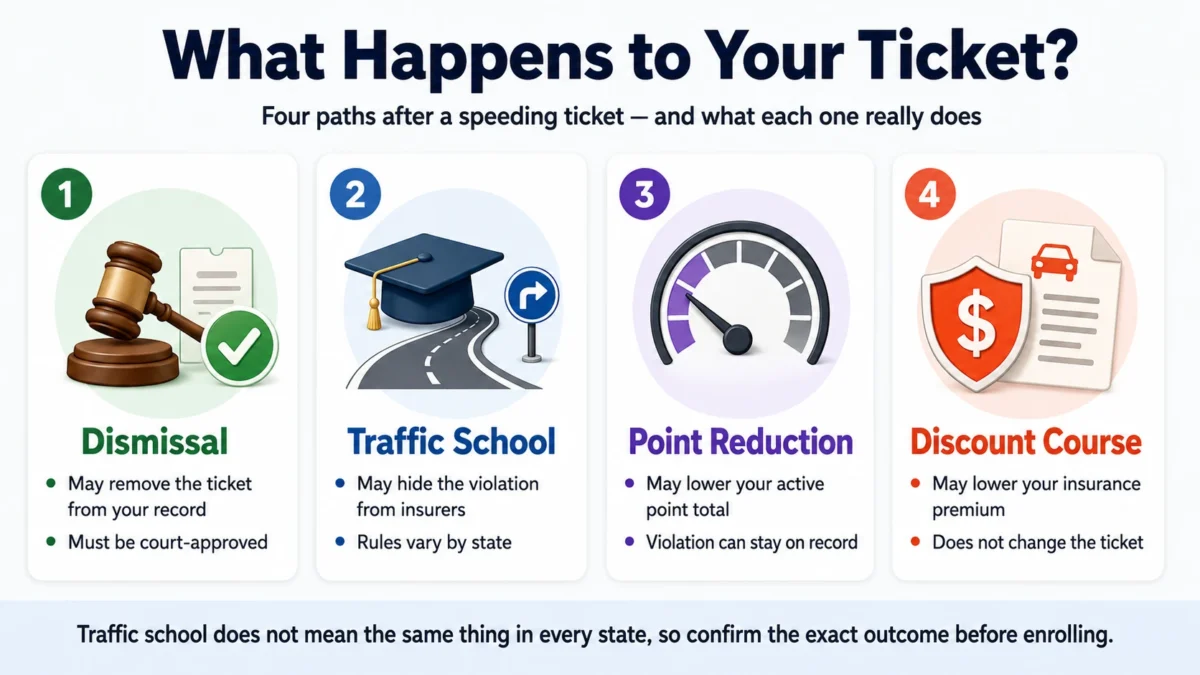
Before you choose a path, make sure you know what each option does.
Dismissal may be preferable when it avoids a conviction on the cited charge, but the practical value depends on the court record, DMV treatment, costs, eligibility restrictions, and possible insurance consequences.
Confidential record treatment is different. In California, an eligible noncommercial driver who completes traffic school can keep the point off the DMV record insurers see. The ticket is not fully dismissed.
Point reduction helps with DMV penalty calculations, but the violation may still appear on your record. New York is a clear example: the Point and Insurance Reduction Program can reduce active points for calculation purposes and provide an insurance reduction, but it does not remove the violation, conviction, or points from the record.
Insurance discount courses may reduce your premium, especially for mature drivers or voluntary defensive driving students, but they usually do not change the legal outcome of a speeding ticket.
The key question is not just, “Can I take traffic school?” The better question is, “What exactly will this course do to my ticket, points, and insurance record?”
Common Eligibility Factors—Not Nationwide Rules
These are recurring considerations, not a national eligibility test. The citation and official court program determine who qualifies.
1. The violation must usually be minor
Lower-range speeding tickets are more likely to qualify. Excessive speeding, reckless driving, school-zone violations, construction-zone violations with workers present, passing a stopped school bus, alcohol- or drug-related violations, and crash-related offenses often have stricter rules or may be excluded.
2. You usually cannot have used the option recently
Frequency limits differ. California generally uses an 18-month traffic-school interval. Florida lets you choose voluntary Basic Driver Improvement once every 12 months and eight times in your life. Florida law calls that choice an “election.” The San Antonio program below uses a 12-month limit. These are not nationwide rules.
3. Your license must be valid
A suspended, revoked, or invalid license can disqualify you. Commercial driver’s license holders often face separate rules, even if they were driving a personal vehicle.
4. The court must approve the option
Do not assume a course will count just because it is advertised as “ticket dismissal” or “traffic school.” Some courts require approval before you enroll. If you take the wrong course or start before approval, the court may reject your certificate.
5. You usually must act before the deadline
The deadline on your ticket is critical. Some courts give you little time to choose an option. Missing the deadline can mean extra fees, license trouble, or losing traffic school.
6. You usually must not simply pay the ticket first
Paying the fine may be treated as admitting guilt or resolving the case. If you want dismissal, traffic school, or a court-approved alternative, confirm your options before paying.
How to Get a Speeding Ticket Dismissed: 7 Steps
Step 1: Do not pay the fine until you understand your options
Do not pay until you understand what that payment does. It can end the case as a conviction or plea. But some official programs require fines, fees, costs, or bail when you choose the program. Follow the instructions from the court handling your ticket.
Step 2: Find the court deadline
Look for the response date, appearance date, due date, or deadline on the citation or court notice. This is the date by which you usually must pay, appear, request traffic school, request a hearing, or choose another available option.
Do not wait until the last day. Courts may need time to process a request, and online systems can have cutoff times.
Step 3: Contact the court listed on the citation
Call the court or check the official court website. Ask direct questions:
- Am I eligible to request dismissal, deferred disposition, or traffic school?
- Do I need court approval before enrolling?
- Which course providers are approved?
- What fees must be paid, and do they count as court costs rather than the fine?
- What is the deadline to finish the course?
- How should I submit the completion certificate?
- How do I confirm the case has been dismissed or handled correctly?
Write down the date, the person you spoke with, and the instructions you received.
Step 4: Confirm the exact result before choosing a course
Ask whether the course will result in:
- ticket dismissal,
- deferred disposition,
- no points,
- point reduction,
- confidential record treatment,
- insurance discount only, or
- another outcome.
This prevents the common mistake of taking a course that helps with insurance but does not protect your court or DMV record.
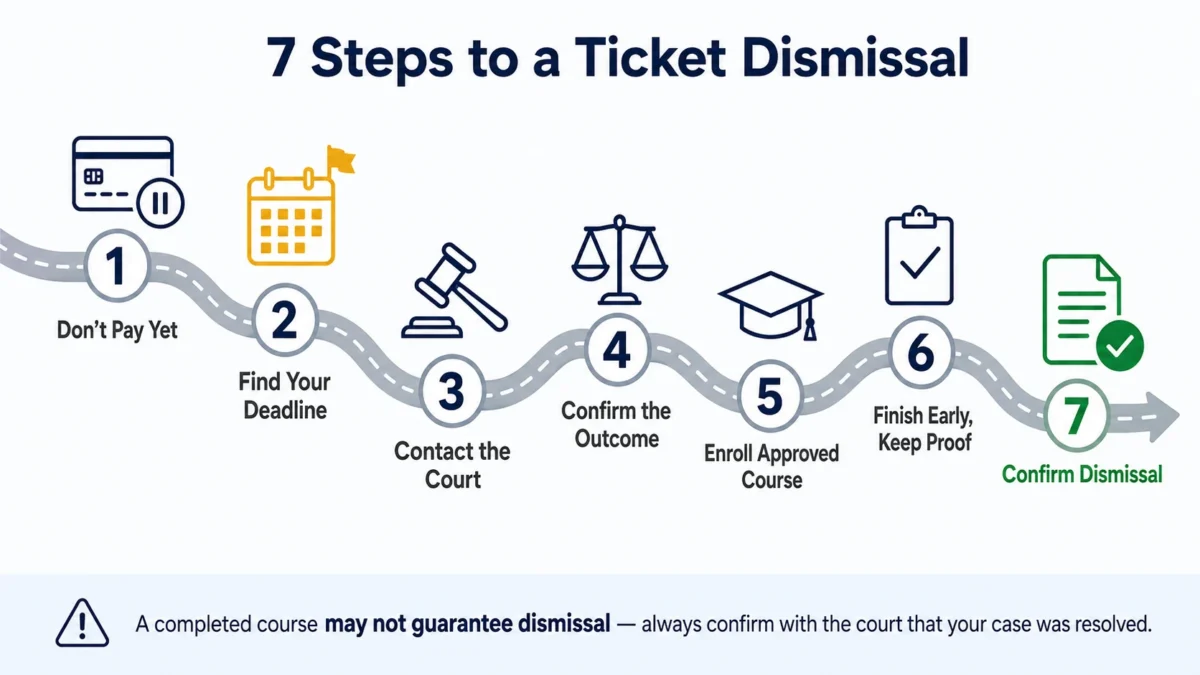
Step 5: Enroll only in a state- or court-approved course
Use the provider list from the court, DMV, or official state agency. Avoid choosing based only on price or ads. A cheap course is not useful if your court will not accept it.
If your court allows online traffic school, confirm whether the provider reports completion electronically or whether you must submit the certificate yourself.
Step 6: Finish the course early and keep proof
Course length, approval, reporting, and certificate-processing times vary. Enroll early enough to complete every required step and correct reporting problems before the court deadline.
Keep copies of:
- the approval order or court permission,
- payment confirmation,
- course registration receipt,
- completion certificate,
- delivery or upload confirmation, and
- any court confirmation that the case was dismissed or resolved.
Step 7: Confirm the final court outcome
Do not assume the ticket is dismissed just because the course is complete. Follow up with the court after submission and confirm that the certificate was received, processed, and applied to the correct citation.
If the court has an online case portal, check the case status and save a screenshot or confirmation number.
How Ticket Dismissal Differs by State
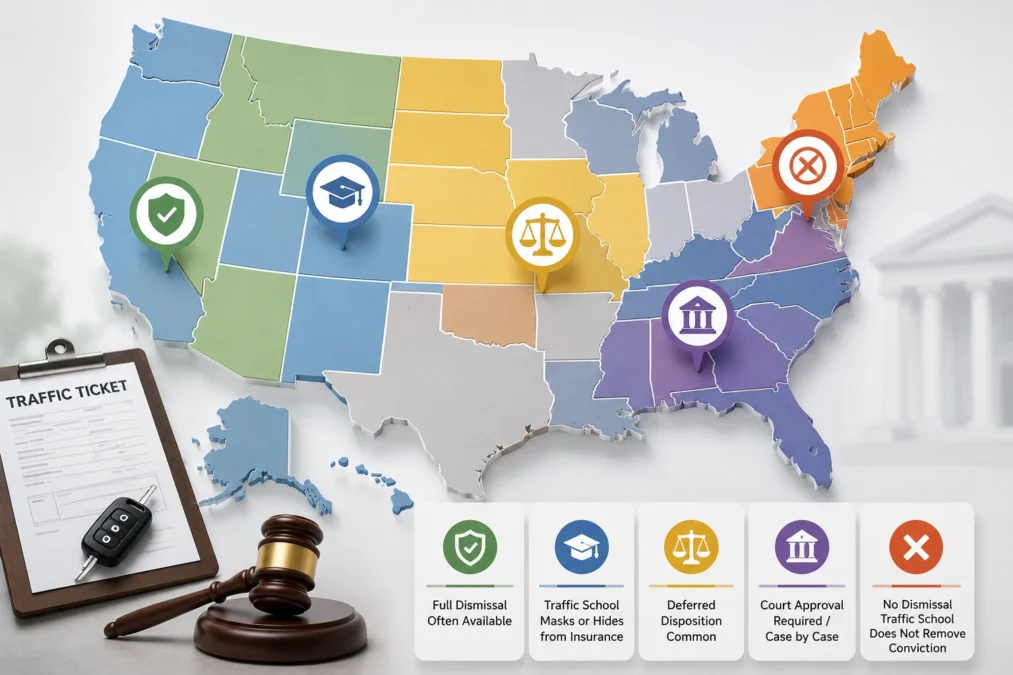
State rules differ significantly. The examples below show why you should verify the exact rule with your court before paying or enrolling.
Texas—San Antonio example
San Antonio provides one local example in which an eligible defendant may request a driving safety course to have a charge dismissed. Its municipal court says the defendant must plead guilty or no contest, pay court costs, and complete a Texas Department of Licensing and Regulation-approved course.
The cited San Antonio rules also require a valid Texas driver license, current insurance, no use of the course for ticket dismissal within the prior 12 months, no commercial driver’s license, and an alleged speed below 25 mph over the limit. Other Texas courts may use different procedures or restrictions, so confirm with the court handling the citation.
California
California traffic school is often misunderstood. The California Courts Self Help Guide explains that an eligible driver can use traffic school to keep a point off the driving record insurers see. The court notice should tell you whether traffic school is available. If you are unsure, contact the court.
For eligible noncommercial drivers in California, completing traffic school can keep the point from appearing on the DMV record visible to insurance companies. This is confidential treatment under California’s program, not full dismissal or a nationwide rule about insurer access.
Florida
Florida lets an eligible driver with a noncriminal moving violation choose a state-approved Basic Driver Improvement course. The option is not available to CDL or CLP holders or for a ticket received in a commercial vehicle. You can use the choice once every 12 months and eight times in your life (§318.14(9)).
Florida §318.14(9) does not set the deadline for choosing BDI. A separate rule gives a person who does not choose to appear in court 30 days from the ticket date to pay the fine or start a payment plan. Paying that way counts as admitting the violation and giving up the right to a hearing (§318.14(4)(a)–(b)). Ask the clerk when and how to choose BDI, pay, finish the course, and submit proof.
The law also excludes tickets for speeding 30 mph or more over the posted limit under the statutes named in §318.14(9). If you qualify and finish every step, the court withholds adjudication and the DMV does not add points. That is not the same as dismissal.
Georgia
Georgia’s Driver Improvement Program is a six-hour defensive driving course approved by the Georgia Department of Driver Services. DDS states that the course may be taken if court-ordered, for points reduction, to reinstate a license, to reduce insurance premiums, or for personal education.
Whether a Georgia course can produce dismissal in a particular speeding case is court-specific. Confirm the legal outcome with the court before enrolling.
New York PIRP is not a dismissal program
New York is not a ticket-dismissal state in the traffic school sense. The New York DMV states that completing a Point and Insurance Reduction Program course does not remove a violation, conviction, or the number of points from the driving record. It may reduce points for suspension-calculation purposes and may reduce insurance premiums, but the underlying conviction remains.
This is why New York drivers should not search only for “ticket dismissal.” The more accurate question is whether a plea reduction, hearing, attorney-negotiated outcome, or PIRP point/insurance reduction makes sense.
What Happens If You Miss the Deadline?
If you miss the response deadline without taking action, the consequences can be more serious than the original fine.
What happens next depends on the court and where your case stands. You could face:
- late fees,
- loss of traffic school or dismissal,
- a failure-to-appear mark,
- a default judgment or conviction,
- a license suspension or hold, or
- a higher insurance risk after the violation reaches your record.
If you already missed the deadline, contact the court immediately. Some courts may allow a late response, payment arrangement, hearing request, or other corrective step, but the longer you wait, the fewer options you may have.
Dismissal vs. Fighting the Ticket in Court
| Option | Best for | Main benefit | Main drawback |
|---|---|---|---|
| Course-based dismissal or traffic school | Eligible minor speeding tickets | May be more straightforward when eligibility and outcome are confirmed. | Only available for certain tickets and drivers |
| Deferred disposition | Courts that offer probation-like resolution | May avoid conviction if completed | Requires strict compliance with court terms |
| Fighting the ticket yourself | Incorrect citation, weak evidence, or factual dispute | Possible dismissal or reduction | Requires preparation and court time |
| Hiring a traffic attorney | Serious speed, CDL, out-of-state ticket, high insurance risk | Professional handling and negotiation | Costs more upfront |
| Paying the ticket | Low-risk ticket where no other option makes sense | Fastest resolution | May create a conviction or other final disposition; confirm before paying. |
For many eligible minor speeding tickets, a court-approved dismissal or traffic school path is simpler than fighting the ticket. But if the ticket involves a high speed, accident, CDL, license suspension risk, or a major insurance impact, speaking with a traffic attorney may be worth the cost.
When You Should Consider a Traffic Attorney
You may not need a lawyer for a simple traffic school request. Legal help can make sense if:
- you were cited for reckless driving or very high speed,
- the speed was high enough that your state might use a worse charge, make you appear in court, or block you from a course,
- you have a commercial driver’s license,
- the ticket happened out of state,
- you are close to losing your license,
- the ticket involved a crash or someone was hurt,
- you have multiple tickets,
- your insurance rate is already high, or
- your job depends on a clean driving record.
An attorney cannot guarantee dismissal, but they may identify options you would not find through the court website alone.
Speeding Ticket Dismissal Checklist
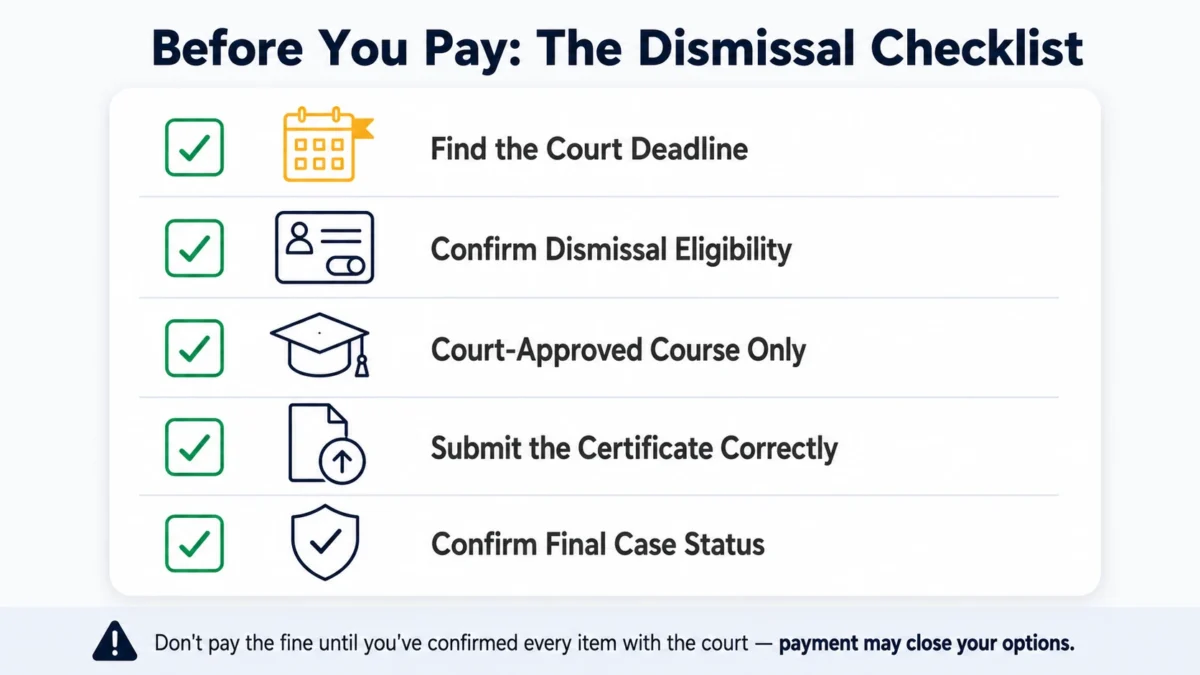
Before you decide what to do, complete this checklist:
- Read the citation and find the court deadline.
- Ask what paying actually does; some official programs include payment when you choose them.
- Confirm whether the court offers dismissal, deferred disposition, or traffic school.
- Ask whether the course prevents a conviction, keeps the record from insurers, prevents points, or only gives an insurance discount.
- Confirm whether court approval is required before enrollment.
- Use only a court- or state-approved course provider.
- Finish the course early.
- Submit the certificate using the required method.
- Keep proof of every step.
- Confirm the final case status with the court.
Frequently Asked Questions
Is traffic school the same as ticket dismissal?
No. In some courts, traffic school can lead to dismissal. In other states, it only keeps a point off the record insurers see, prevents points, changes a suspension calculation, or earns an insurance discount. Always ask the court what the course will do.
Can I get a speeding ticket dismissed after paying it?
Usually, it is harder after payment because payment may be treated as resolving the case or admitting guilt. Some courts may still have procedures to reopen or correct a case, but you should not count on that. Contact the court immediately if you paid before understanding your options.
Can I dismiss a speeding ticket if I was going 20 mph over the limit?
Maybe, but the chances are lower. Many courts exclude higher-speed violations from dismissal or traffic school eligibility. Some Texas court examples exclude speeding 25 mph or more over the limit. Your local court rule controls.
How long does the dismissal process take?
The course itself may take one day or several sessions, depending on the state and provider. The full process can take longer because you need court approval, certificate processing, submission, and final court confirmation.
Can I dismiss more than one speeding ticket at a time?
There is no nationwide rule. Many programs impose frequency or citation limits, but whether multiple pending tickets can receive relief depends on the court and program. Obtain instructions for each citation before choosing a course.
Will a dismissed speeding ticket show on a background check?
A dismissal means the dismissed charge should not be reported as a conviction, but the citation, court docket, dismissal, or third-party record may still be visible. Employment, CDL, immigration, and professional-licensing consequences require jurisdiction-specific advice.
Does dismissal prevent an insurance increase?
A dismissal may avoid a conviction-based surcharge, but it does not guarantee that the total premium will remain unchanged. Insurance treatment depends on what is reported and the insurer’s applicable rating rules.
Should I fight the speeding ticket or request traffic school?
If you are eligible for a course-based dismissal or point-protection option, that may be the simpler path for a minor ticket. If the citation is factually wrong, the speed was high, your license is at risk, you have a CDL, or the insurance impact could be large, fighting the ticket or consulting a traffic attorney may make more sense.
Your Next Move
Act before the ticket deadline and before making a payment you do not understand. Follow the court’s official instructions, including any payment required when you choose an approved program.
The key point is simple: traffic school is not one universal solution. One state might dismiss the ticket. Another might keep a point off the record insurers see. Another might reduce points without removing the conviction.
Your best protection is to confirm the exact court-approved path first, complete every step early, and verify the final case status in writing.
Sources
Sources reviewed August 19, 2026.