

Rhode Island Defensive Driving Course: Court Requirements and Insurance Savings

Choose a Rhode Island defensive driving course for the result you need. For a court order, start with the DMV and Community College of Rhode Island (CCRI); for the insurance benefit at age 55 or older, confirm approval of the accident-prevention course before paying. 1, 5
Start with the document that brought you here. A court order, a message from your insurer and an online course ad can point to very different tasks. The course name alone does not tell you what a certificate will accomplish.
General information only: Follow your court order and official registration instructions. Confirm insurance course approval and your policy’s terms before enrolling.
Which course should you take?
Use this table to find your next step. It does not let you replace the class in your order.
| Your purpose | Where to start | What to confirm |
|---|---|---|
| Court ordered defensive driving | DMV Driver Retraining, followed by CCRI scheduling | Assigned DDC level, deadline, payment and delivery format |
| Court ordered Colin Foote retraining | DMV Driver Retraining | The separate 60-hour course and community-service obligation |
| Insurance savings at age 55 or older | Insurer and DMV course-approval confirmation | Exact approved accident-prevention course, certificate eligibility and premium reduction |
| Dismiss a traffic ticket | Court named on your summons | Whether the separate good-driving-record process applies |
| General refresher or employer request | Your own training goal or employer | What completion evidence is required; avoid assuming a court or insurance benefit |
The official course rules, insurance law and dismissal law set out these separate routes. Check whether a class meets each purpose you have in mind. 1, 5, 7
Keep your order or insurer’s answer beside you when comparing courses. Match the exact program name, the required format and where to send proof. If a website gives only a general promise of “Rhode Island acceptance,” ask whether it meets your exact need.
How court-ordered defensive driving registration works
Start with the Rhode Island DMV Driver Retraining Office. The DMV handles sign-up for court-imposed classes; CCRI teaches them. You can mail the forms and payment to the DMV or use its booking page to plan an office visit. 1
Keep the order, payment and class sign-up in this sequence:
- Read the court’s assignment and identify the program named in it.
- Follow the DMV registration packet and payment instructions. Keep a copy and proof of payment.
- Watch for CCRI’s account and scheduling instructions.
- Use the assigned account to select the course made available to you.
- Save your class details, attend the assigned sessions and keep proof that you finished.
If your educational program results from an out-of-state conviction, you must send the Driver Retraining Office your paperwork from that state’s court. 1
CCRI creates your account and sends an email with a username and password link. Set your password, open the dashboard and check your profile. Browse classes and choose the course that CCRI has made available to you. Add it to the cart, agree to the policies and check out. The account gives access only to the course you need. 4
If you reach a course catalog before receiving your assigned account, go back to the official instructions. A class listing or checkout screen alone does not show that your case is ready for sign-up.
Before mailing anything, match the packet’s name, case details and course with your court papers. Save them in one folder. If a payment goes missing or you get the wrong class, you can show staff what happened.
How long does the course take, and what does it cost?
The DMV fee schedule lists defensive driving at $200. Its separate listed fees include $850 for Colin Foote, $125 for Alive @ 25 and $405 for alcohol education. Credit-card payments carry an extra service fee from the DMV’s third-party payment processor. 3
Course length needs a closer check. The DMV describes DDC as six hours. CCRI’s Defensive Driving FAQ assigns six hours for a first offense, eight for a second and fifteen for a third. Use your assigned program and ask staff to explain if the papers differ. 1, 2
Do not choose a course level by counting tickets yourself. Ask staff which assignment applies to your case, then confirm the full schedule. A single session shown on a calendar may not answer how many sessions your assignment requires.
Allow for every session when planning around work or travel. Ask what happens if an emergency makes you miss class, and check the terms for moving to a new date before you rely on that option.
Can you take the Rhode Island course online?
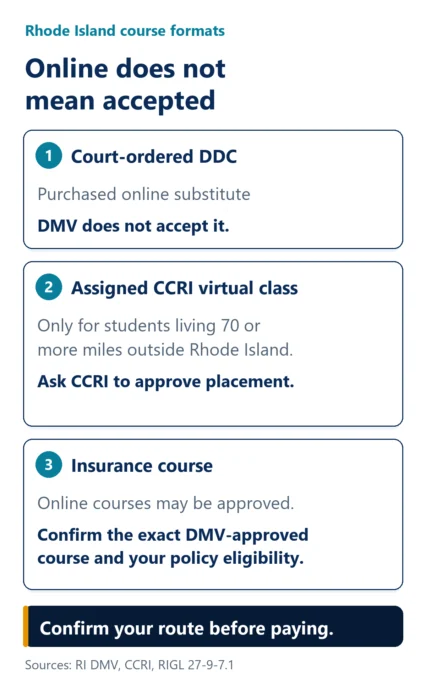
For sanctioned DDC, the DMV expressly rejects online programs purchased as substitutes. CCRI separately says its virtual defensive driving and alcohol education classes are available only to students living 70 or more miles outside Rhode Island. Ask CCRI to approve your placement before you plan to attend from home. 1, 2
One rule concerns replacing the class in your order. The other concerns a place in CCRI’s own virtual class. Neither gives you permission to buy a different self-paced course.
If you live far away, send your location and assignment details to program staff. Ask them to confirm the approved format, how to enroll and what proof will be recorded. Wait for that answer before buying a course elsewhere.
For insurance, the law permits approval of online, classroom or driving instruction. That permission does not establish approval of every course offered in those formats. Have the exact course checked for your insurance purpose. 5
How can a course reduce insurance costs?
Rhode Island law requires a lower premium for drivers 55 and older who meet its terms and pass a DMV-approved motor vehicle accident-prevention course. The law covers liability and physical-damage rating plans. It sets no single discount rate for all drivers. 5
To get the sponsor’s certificate, you must have no chargeable accidents or convictions within a three-year period. It lasts two years from the date it is issued, subject to that record condition. You must pass another course to renew or extend it. 5
Your insurer can still raise your premium or add an accident or conviction surcharge during those two years. The law excludes group policies that broadly average premiums for the group instead of setting them for each person. 5
Before paying, ask your insurer to answer these questions in writing:
- Does this exact course qualify for my Rhode Island policy?
- How is its DMV approval confirmed?
- Does my record meet the certificate conditions?
- Which coverages receive the reduction, and what is the dollar amount?
- When would the reduction begin, and where should I send proof?
- What will I need when the certificate expires?
If you are younger than 55, ask whether your insurer offers a separate voluntary course discount. The law for older drivers does not promise you the same benefit.
If you want to buy a class for insurance savings, compare its price with the savings your insurer quotes. For example, a hypothetical $40 class producing $15 in savings during the period you expect to keep the policy would not pay for itself during that period. Those figures are an example, not actual Rhode Island prices or savings. If a court orders a class, you have a duty to take it even if you save nothing on insurance.
Does taking a course dismiss your ticket or reduce points?
Do not buy a class to earn Rhode Island point credit. The official routes checked for this guide do not establish that benefit. The DMV can still suspend a license for traffic offenses that a court has found you committed with enough frequency to show disrespect for traffic laws and disregard for others’ safety. 1, 9
Rhode Island has a distinct process to seek dismissal based on a good driving record. You may request a hearing if you have held a license for more than three years and your issued violations are the first within the prior three years. You need proper proof, and the law has exceptions. Buying a class is not the stated test. 7
Exclusions include speeding more than 14 mph above the limit, certain accident-related violations and violations by CDL holders or committed in commercial motor vehicles. Read the full exclusions before requesting dismissal. 7
The Traffic Tribunal has an online request form. If your license is from another state, get a certified copy of your driving record from that state’s agency. The court does not accept a record from a third-party service. If the court has not received the abstract by the summons date, or you discover you do not qualify, the portal instructs you to appear. Check its current costs and payment instructions. 8
Use the court named on your summons to determine your next step. Do not replace a hearing response with a course certificate unless that court has instructed you to do so.
What if your order says Colin Foote or another program?
Colin Foote is a distinct course. Under Section 31-27-24, convictions for qualifying moving violations on four separate occasions within eighteen months require 60 hours of retraining and 60 hours of public community service. The law defines which violations count. It also permits other penalties, with specific findings about safety required before suspension or revocation. 6
A short DDC class will not replace that course. If your order names Alive at 25 or alcohol education, follow that program’s steps. CCRI lists them as distinct classes. 2
Give the class, service hours, payment, proof and any hearing or license task their own lines on your checklist. Mark each done when you have proof. One finished task should not hide another that is still open.
What should you do if instructions or deadlines differ?
Ask the right office to resolve the difference for your case. The DMV describes a registration packet within four weeks after court. CCRI’s page describes email information within four to eight weeks after payment, while its FAQ describes application processing within ten business days. These steps measure different things. They do not promise when you will finish class. 1, 2
The DMV page also gives conflicting walk-in instructions. Use its mail or reservation route, or confirm access before traveling. 1
The same page says extra time to finish the classes will be given after payment, but that statement appears in older class-resumption text. Get any extension confirmed in writing rather than treating a scheduling delay as a change to your court deadline. 1
When you ask for help, give the course name, case number, payment date and deadline in your papers. Explain what you need: a missing email, help with course hours, a class date or a place in a virtual class. Ask staff to put the next step and any change to your deadline in writing.
After class, keep your proof and ask how the court requirement or insurance benefit will be recorded. If your order limits your license, check with the office handling that limit before driving again.
Before enrolling, match the course to your order or insurance purpose, confirm acceptance and keep the answer with your paperwork. That is the most useful protection against paying for the wrong class.
Related Reading
- Traffic school rules by state
- Check online traffic school approval before paying
- How traffic school insurance discounts work
Sources
- Rhode Island DMV — Driver Retraining.
- Community College of Rhode Island — Driver Improvement.
- Rhode Island DMV — Adjudication Fees.
- CCRI — Password and Registration instructions.
- R.I. Gen. Laws Section 27-9-7.1 — Accident-prevention insurance reduction.
- R.I. Gen. Laws Section 31-27-24 — Multiple moving offenses.
- R.I. Gen. Laws Section 31-41.1-7 — Good-driving-record dismissal.
- Rhode Island Traffic Tribunal — Dismissal request portal.
- R.I. Gen. Laws Section 31-11-7 — License suspension authority.
Last updated: October 9, 2026