

Delaware Defensive Driving Course: Basic, Refresher and Approved Options

A Delaware defensive driving course can earn an insurance discount and a three-point driving-record credit, but the two benefits follow different rules. Choose a DMV-approved course, check whether you need basic or refresher training, and confirm how the result will reach your insurer and DMV. 7; 5.
You must take the course voluntarily to claim the insurance benefit. It applies to specific parts of your bill. The point credit does not automatically subtract three points from your record or resolve a ticket. Check these limits against the reason you want to take the class. 1; 2; 5.
General information only: This guide explains Delaware’s course rules. For a ticket, suspension notice or required class, follow the instructions from the court or DMV handling your case.
Start with your previous course and your reason for enrolling
If you are taking the class by choice, start with your course history. If you have a court or DMV notice, check what it says before you pay.
| Your situation | Where to start | What to confirm |
|---|---|---|
| You have never completed the Delaware course | A basic course | DMV approval, format, total price and insurance eligibility |
| Your initial course was at least 2 years 6 months ago, but no more than 5 years ago | A refresher course | Prior completion date and whether the discount will continue or restart after a lapse |
| Your last course was more than 5 years ago, or its details are uncertain | Ask the provider about basic enrollment | Do not buy refresher training based solely on its shorter length |
| DMV requires behavior modification/attitudinal driving | The separate BMC program | The approved class and deadline in your notice |
| A court has ordered a course | The court handling your case | Exact course, proof recipient and completion deadline |
DMV describes basic training as at least six hours and refresher training as at least three hours. Its FAQ places the refresher window after a first course between 2 years 6 months and 5 years. If you have taken several refreshers, give the provider your latest certificate and ask which enrollment fits your history. 5.
A certificate from another state should prompt that same conversation. Explain where you took the class and which Delaware benefit you want. A course with a similar name is not proof that it fits Delaware’s approved program.
Use DMV’s directory to find approved options
Delaware DMV has one list for classroom courses and another for online courses. Start there, then contact the listed provider for the course level, current schedule and enrollment terms. DMV specifically directs readers to providers for class dates, times and locations. Approved-course directory.
For example, the directory lists Delaware Safety Council in both formats, AARP classroom and online offerings, and A&A Safe2Drive online. These are examples of listed options, not a ranking or a claim that each has an available class today. Use the link or phone number in the list to find the right Delaware class.
Read any restrictions attached to the listing. DelDOT’s listed course is open only to its employees. Teen SmartDrive’s entry is for students ages 16-22 in the specified Delaware high-school or registered homeschool settings. Delaware Safety Council also has Spanish-language entries. A restriction on one offering does not establish a restriction on every approved course. 7.
Once you find a listed course, ask which level and language it uses. Check what device you need, how long you have to finish, when help is available, and how you will get your certificate. Read the terms for refunds and missed classes. Save the enrollment page and receipt so you can identify what you bought if a problem arises.
Some directory entries include a dollar amount in their names. Treat that as a listing label, then check the provider’s current checkout total. This guide does not use those names as verified prices or call one school the cheapest.
Online and classroom formats have different testing rules
An approved online course must have a final exam with at least 25 questions. You must score 80% or better to pass. Your driver-license number is required when signing up online. You must also fill out an affidavit confirming that you took the course yourself. Ask the provider about retakes and what happens if you cannot finish within its access period. 3.
The classroom rule sets minimum instructional time of six hours for basic and three hours for refresher. Each classroom instructional hour averages at least 50 minutes of curriculum presentation. Registration and any post-course testing do not count toward that instruction. DMV does not require a classroom post-course quiz, although a provider may give one. 3.
A classroom course can also meet live online. The rule requires a secure platform, visual proof that you attend, and a recording kept by the provider. That is distinct from a self-paced online course. If you want a live remote class, ask the listed classroom provider whether it currently offers that arrangement and what you need to participate. 3.
The insurance discount covers part of the bill
The basic-course discount is 10% of the premiums for three coverages: bodily injury liability, property damage liability, and personal injury protection (PIP). You must meet the program rules to claim it. Collision and comprehensive are not among the coverages named in Rule 607. Do not take 10% off your whole bill when working out the savings. 2.
Check how you own the vehicle and how it is rated. The car, motor home or motorcycle must be owned by one person, spouses jointly, or members of the same household jointly. It must be classified and rated as a private passenger car, motor home or motorcycle. The person who usually drives it must have a certificate showing that they took and passed the right approved course by choice. For a motorcycle, an approved motorcycle rider course also qualifies. They must have finished within the past 36 months when they apply. 2.
You do not have to be 55 or older for this program. But the law excludes a class ordered by a court or required by DMV due to a Title 21 violation. That does not count as taking a course by choice. A required class and a voluntary insurance course should therefore be discussed separately with your insurer. 1.
A household with several drivers may get a smaller basic discount
The full 10% basic discount requires all operators named on the policy as insureds to complete the course. If only some finish, the basic discount is smaller. Divide the number who finished by the total number of operators. Then multiply that fraction by 10%. 2.
For an illustration, suppose one of three operators completes basic training. The fraction is one-third of 10%, or about 3.33%. If the eligible coverage premiums total $900 a year, that calculation gives $30 in annual savings before other rating interactions. These are invented inputs, not an insurer quote.
Ask your insurer for the actual dollar effect before enrolling several family members. Have it identify the covered premiums, which drivers need certificates, and how the course discount interacts with other discounts. Rule 607 allows insurers to apply it as a multiplier or on an additive basis compatible with their rating system. 2.
Compare the quoted savings with the course’s total cost. Also consider whether a live class or self-paced option fits your schedule. A lower advertised fee is less useful if the course level is wrong or you cannot complete it under the provider’s terms.
Refresher timing determines whether savings continue or restart
If you received the basic discount, you can move to 15% with a refresher. Finish during the 180 days before the three-year expiration date. The 15% then starts at your next renewal. Count that window back from the prior course’s three-year expiration date. 2.
If you finish after the three-year period ends, the rule says your old 10% or 15% discount stops on the expiration date. Finish the refresher within two years after that date and you can get 15% from the day you finish. Taking it late can restart the savings. It does not fill the gap. 2.
DMV’s broader enrollment FAQ says a refresher after the first course can be completed from 2 years 6 months through 5 years after that course. The insurance regulation supplies the more specific effective-date rules within that period. Use the date on your certificate to work out the window, then ask the provider and insurer to confirm the dates that apply to your history. 5; 2.
For basic completion, the discount begins at policy inception or the first renewal following your application. Section 4.1 says it ends at the renewal following the expiration of three years since completion. Section 4.2 separately specifies the lapse date for late refresher completion. Ask the insurer to identify both the course expiration and the affected renewal in writing, especially if those dates differ. 2.
At the renewal immediately before the discount expires, your insurer must notify you that a refresher is needed within the rule’s timeframe to keep the discount. Track the completion date on your certificate as well; do not rely on that notice alone to plan your refresher. 2.
The three-point credit has limits
Delaware enters a three-point credit after you pass an approved defensive-driving course. The credit starts on the date you finish. DMV’s FAQ explains that it applies to future violations in certain situations rather than automatically deducting three points from the record. DMV also describes the course as valid for three years. 4; 5; 6.
The rule does not let you apply the credit retroactively once an action item is in effect. It also says DDC credits do not affect issuance of the eight-calculated-point advisory letter. If you already have a notice or suspension action, contact Driver Improvement at 302-744-2509 to learn what completion can do in your case. Do not plan around a course automatically reversing the action. 4; 5.
The DDC credit cannot be used when determining school-bus operator eligibility. That calculation uses full point values for the past three years. A commercial or school-bus driver should ask DMV about the relevant license and endorsement rules rather than treating the ordinary credit as protection against occupational consequences. 4.
A required behavior-modification course is a separate program
At 12 calculated points, Rule 2208 requires an approved behavior modification/attitudinal-driving course within 90 days after notification, unless DMV extends that period. Failure to comply, or choosing suspension instead, results in a mandatory two-month suspension under that provision. An ordinary voluntary DDC is not the class specified by this requirement. 4.
Use DMV’s separate BMC directory and your notice to arrange the required program. If the notice’s course name is unclear, contact DMV before booking.
For a traffic ticket, follow the court’s response instructions as well. The Justice of the Peace Court explains voluntary assessment and court-response options; enrolling in DDC is not one of those responses. If a court orders training, get the approved course and proof instructions from that court. 9.
Finish by checking the certificate and both recipients
Completion starts two follow-up tasks: making sure DMV records the course and applying to your insurer for the discount.
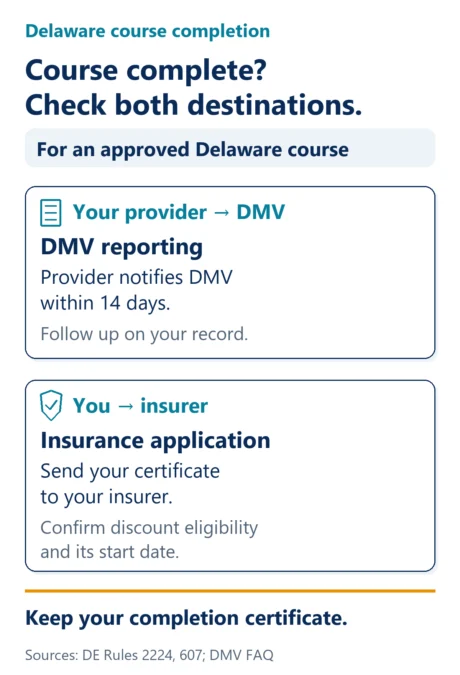
The course provider must notify DMV within 14 days after you pass. DMV’s FAQ describes electronic loading to the driving record within 48 hours. Ask your provider what it will submit and when, then follow up if the expected entry is missing. The FAQ’s shorter processing description is not a reason to discard your certificate. 3; 5.
If you present a valid Delaware driver license or DMV ID card, the provider must give you a free completion certificate. It must include your full name, completion date, provider, course name and the provider’s authorized signature. Check those details when you get it. If you later lose the certificate, DMV says to request a replacement from the provider, which may charge for that replacement. 3; 5.
Send the certificate to your insurer. Ask it to confirm the discount and the date it starts. The rule treats your completion certificate as conclusive proof for the discount. The insurer cannot demand other proof or old course certificates to apply it. A provider’s questions about which class you should take are separate from that insurer proof rule. 2.
Keep the certificate, submission confirmation and provider receipt until you can see the expected results. If the insurer refuses a qualifying benefit, ask for its reason in writing and contact Delaware’s Department of Insurance at 1-800-282-8611, the contact given in DMV’s course FAQ. 5.
Before paying, locate your last certificate or confirm that you need basic training. Then use DMV’s approved list and ask your insurer for the dollar savings and effective date. Those two checks will help you choose a course that fits the benefit you actually want.
Related Reading
- Traffic school rules by state
- How traffic school affects insurance
- Ways to get points off your license
Sources
- Delaware Code, Title 18, Section 2503(a)(6).
- 18 DE Administrative Code 607 — Motor Vehicle Accident Prevention Course Discount, Sections 3-5.
- 2 DE Administrative Code 2224 — Defensive Driving Course, Providers, and Instructors, Section 4.
- 2 DE Administrative Code 2208 — Driver Improvement Problem Driver Program, Sections 4.2-4.6.
- Delaware DMV — Defensive Driving FAQ.
- Delaware DMV — DUI, Points and Hearings FAQ, Point Credit and Driver Improvement sections.
- Delaware DMV — Approved Defensive Driving Courses.
- Delaware DMV — Behavior Modification/Attitudinal Driving Courses.
- Delaware Courts — Justice of the Peace Court Traffic FAQ.
Last updated: October 9, 2026