

Georgia Zero-Point Order: Can a Course Keep Points Off a Ticket?

A Georgia zero-point order can keep points from being assessed for a qualifying traffic violation when the court uses the approved defensive-driving procedure. O.C.G.A. § 40-5-57(c)(1)(C) states:
“A court may order a person to attend a defensive driving course approved by the commissioner pursuant to Code Section 40-5-83 for any violation for which points are assessed against a driver’s license under this subsection or may accept the attendance by a person at a driver improvement clinic approved by the commissioner pursuant to Code Section 40-5-83 after the issuance of a citation for such offense and prior to such person’s appearance before the court, in which event the court shall reduce the fine assessed against such person by 20 percent, and no points shall be assessed by the department against such driver.”
The ticket disposition still appears on the record. This procedure does not promise dismissal, record erasure, or unchanged insurance premiums.
Your practical first step is to contact the court listed on the citation before enrolling or paying to resolve the ticket. This guide helps you identify the right questions, organize your paperwork, and check that the result matches what the court approved.
General information only: This guide explains published Georgia procedures. A lawyer can advise you about a plea, contested charge, or possible suspension in your particular case.
Start with your ticket’s current stage
The right next action depends on whether your case is pending, the court has already ordered a course, or a disposition has been entered. Use this table to organize your next call. It is a preparation tool, not an eligibility determination.
| Your situation | What to establish | Your next action |
|---|---|---|
| Citation issued; no disposition yet | Whether the court will consider § 40-5-57(c)(1)(C) for this charge | Ask for the court’s request procedure before choosing a class |
| Court has ordered defensive driving | Whether the order specifically provides for zero points | Read the order and confirm the completion and submission deadlines |
| Course finished after the citation, before court | Whether the court will accept that course and certificate | Bring the original certificate and follow the court’s filing instructions |
| Ticket already paid or decided | What disposition was entered and whether further court action is available | Contact the court; do not assume sending DDS a certificate changes the judgment |
| Points already appear on your record | Whether there is a reporting issue or you need the separate DDS reduction process | Compare the record with the court disposition before choosing a remedy |
| License issued outside Georgia | What your licensing state will do with the Georgia disposition | Contact your home licensing agency and the Georgia court |
Keep the citation number beside you during the call. “Traffic school” may mean avoiding ticket points, reducing existing points, or seeking an insurance discount. Name the zero-point procedure under § 40-5-57(c)(1)(C) so the person answering knows what you are asking about.
What the court must consider
A violation that carries points
The statute addresses violations for which points are assessed under the subsection. It does not establish a general course-for-dismissal program covering every ticket. Identify the actual charge and code section rather than relying on a description such as “minor speeding.”
Use the DDS driver’s manual points table to understand the ordinary point value. Then ask the court how the charged offense fits this procedure. A ticket that carries no points already presents a different decision from one that ordinarily adds points.
Court acceptance or a court order
The law gives the court a choice: it may order approved attendance or accept qualifying attendance completed after issuance of the citation and before appearance. The fine and point benefits follow that procedure; buying a class does not compel the court to accept your request.
This distinction matters when a school says its class is “court approved.” A school’s approval and the court’s decision in your case answer different questions. Verify both before treating enrollment as a solution.
The five-year interval
Section 40-5-57(c)(1)(C) states:
“This plea may be accepted by the court once every five years as measured from date of arrest to date of arrest.”
Do not calculate that interval from your previous graduation date or the day you paid a fine.
If you used a similar benefit before, locate the old disposition and citation information. Ask the court to confirm which procedure was used and which dates control. “My last ticket was about five years ago” leaves too much uncertainty when the interval determines whether the option is available.
Prior attendance alone also does not identify the benefit. A class taken for insurance, existing-point reduction, or a court case may have produced different paperwork.
Zero points, dismissal, and point reduction are different outcomes
A zero-point disposition remains on the motor vehicle record under the governing statute. If your goal is to prevent a conviction or disposition from appearing at all, explain that goal before deciding how to handle the charge. Zero points does not answer the whole question.
Georgia also has a separate process under § 40-5-86 for reducing accumulated points through DDS. That process concerns points already assessed. It does not substitute for obtaining the court’s decision on a pending ticket.
| Outcome you want | What to clarify |
|---|---|
| Avoid points from the pending charge | Ask the court about the zero-point procedure |
| Challenge the charge or seek dismissal | Ask about the case process and obtain legal advice as needed |
| Reduce points already accumulated | Review the separate DDS point-reduction requirements |
| Avoid a premium increase | Ask your insurer how it treats the specific disposition |
For the existing-points route, start with DDS Points and Points Reduction. Keep the two requests separate in your notes so a certificate intended for court is not mistakenly treated as a completed DDS request.
Ask the court these questions before paying for a course
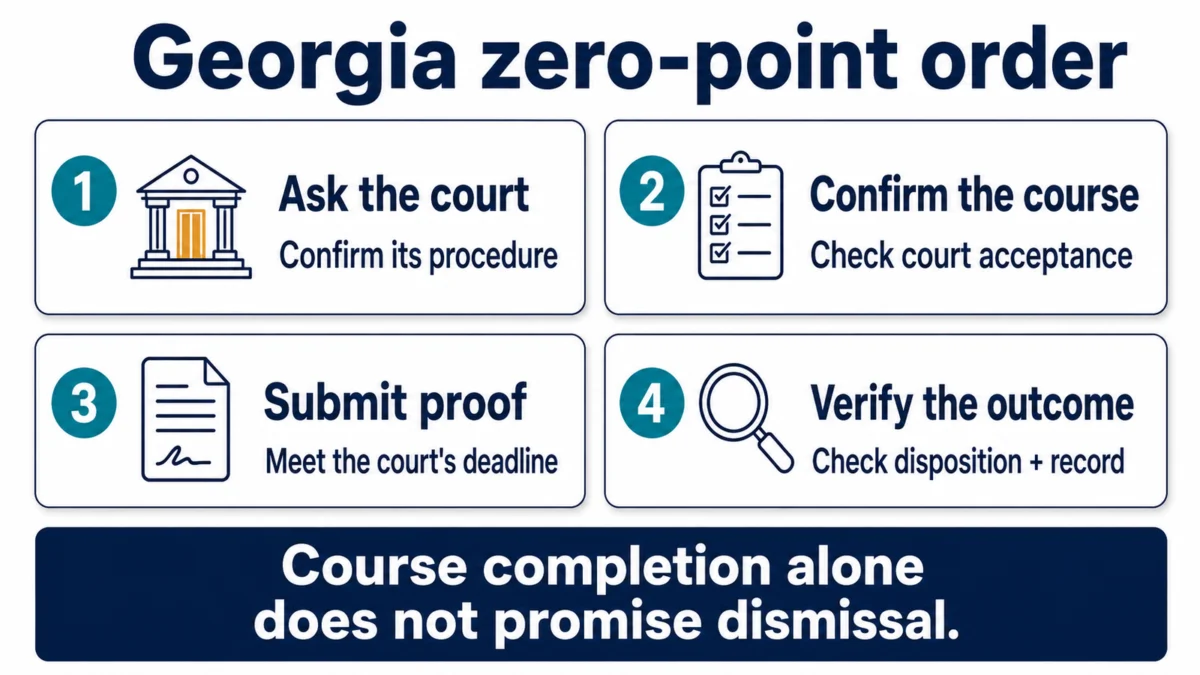
Court staff can explain filing and scheduling procedures. They may need to refer an eligibility or plea question to the appropriate court official or tell you to obtain legal advice.
You can use this opening:
“I have citation number ____ with an appearance date of ____. How do I ask the court to consider the zero-point procedure under O.C.G.A. § 40-5-57(c)(1)(C), and what course and certificate instructions apply?”
Record the answers to these questions:
- Request: Is there a form, appearance, or other step needed to request consideration?
- Timing: Should I complete the course before appearing, or wait for instructions in my case?
- Approval: How do I confirm the specific clinic and class format meet the requirements?
- Proof: Where and when must I present the original completion certificate?
- Attendance: Does submitting the certificate change any appearance requirement?
- Disposition: If accepted, how can I obtain a copy showing the result?
- Payment: What fine, costs, and payment deadline will apply?
Record the call date and office. Keep the written court instructions with your notes.
Do not assume an enrollment receipt extends your response date. If the available class falls after your deadline, contact the court before the deadline and ask how to proceed. Continue following the existing instructions unless the court changes them.
Choose the correct approved course
Section 40-5-83(a)(1) sets the course length:
“Clinics shall be composed of uniform education and training programs consisting of six hours of instruction designed for the rehabilitation of problem drivers.”
Start with the DDS certified-clinic directory, also linked from the DDS Defensive Driving Program FAQs. Tell the clinic that your purpose is a court zero-point request.
Before registering, confirm the clinic, date, format, price, and certificate arrangements. Save the enrollment terms.
Check remote classes carefully
The DDS FAQ, question 12, states:
“Certificates of Completion from online Driver Improvement courses are not accepted by the DDS for any purposes related to an individual’s driver’s license or driving privileges.”
The specific permission for a live remote classroom is in Rule 375-5-1-.09(9)(b), under “Location of Driver Improvement Clinic”:
“Instruction must be synchronous instruction allowing for real-time instruction and interaction in a specific virtual place, through a specific online medium, at a specific time.”
Subparagraph (9)(a) addresses emergency-policy development; (9)(b) permits remote classroom services; (9)(c) requires notification and prior DDS approval. An approved synchronous remote classroom has express permission under this rule. It is different from a self-paced online product.
For remote attendance, verify the particular clinic’s prior DDS approval and the court’s acceptance before paying. The rule establishes the permitted format; it does not establish any advertised clinic’s approval.
Rule 375-5-1-.04(1)(h) identifies the insurance-only certificate:
“Students who are taking a class for the purpose of insurance reduction only, without any requirement by any court, Department point reduction or reinstatement purpose, or out of state reinstatement, shall be issued a Certificate of Completion appropriately noted…”
The rule excludes that certificate from court use. An advertised price below $95 does not match DDS’s stated court-purpose fee. Resolve whether the offer is for a different purpose before buying; price alone does not prove what certificate the clinic will issue.
Allow time for completion and paperwork
Leave time before the submission deadline to receive the original certificate and correct any errors.
Read the attendance terms before committing. DDS warns that late arrival, absence, or early departure can require restarting the course at full cost. Choose a session you can attend completely, with travel or connection time allowed for the format you have verified.
How the 20% fine reduction affects your budget
The DDS Traffic Court Reference Manual, printed page 22, states:
“If the court orders or accepts a certificate of completion, the base fine shall be reduced by 20%.”
Do not assume the entire amount on a payment screen will fall by 20%.
Section 40-5-83(a)(1) controls tuition:
“Approved clinics shall charge a fee of $95.00 for a defensive driving course, except that such clinics may charge different fees of their own choosing if the person is not enrolling in such course pursuant to court order or department requirement.”
The DDS FAQ, question 17, applies the $95 fee to court-purpose classes. Confirm that enrollment purpose with the clinic.
For illustration, if the qualifying base fine is $300, a 20% reduction is $60, leaving a $240 base fine. Adding a $95 class produces $335 before other applicable charges. This is arithmetic using an invented base fine, not a quote from a Georgia court.
Ask for an itemized amount after the court decides your request. Keep base fine, other court charges, and tuition on separate lines; use the actual figures for your case rather than multiplying an estimated total by 0.8.
Submit proof and check the recorded result
The DDS points-avoidance instructions direct the defendant to present the original completion certificate to the court. Follow that court’s delivery instructions and retain a copy for yourself.
The court reports what it decided to DDS. The DDS electronic reporting guide, printed page 32, names position 391 the Court Points Avoidance Indicator. Its description states:
“Zero Points Court Order Issued per O.C.G.A. 40-5-57(c)(1)(c). Can only be granted one time to a particular driver every 5 years. No points assessed due to driver’s completion of improvement course(s). Do not send certificate to DDS.”
For this court route, your proof goes to the court; the court sends the result to DDS. The separate accumulated-point reduction process has different submission instructions.
After the court acts:
- Obtain written confirmation of what the court decided.
- Keep the certificate copy, submission confirmation, and payment receipt together.
- Ask the court when to check that its report has been sent.
- Review your DDS motor vehicle record through the services linked from DDS.
- Compare the listed violation and points with the court paperwork.
If something does not match, contact the court about its report and DDS about the entry. Have your citation number, disposition date, and copies ready.
No statewide processing-time promise is made here. Use the court’s reporting information to decide when to follow up, and check license status separately if suspension is a concern.
Situations that need an additional check
The 2021–2022 Traffic Court Reference Manual is the edition currently linked on DDS’s Manuals page. Printed page 23 states:
“The use of the zero points order will only avoid the assessment of points or a license suspension that is imposed based upon the assessment of points. It will not avoid a license suspension for an offense that is specifically listed as a mandatory suspension.”
Your charge and the court’s decision determine which consequence needs attention.
Drivers under 21: Section 40-5-57.1(a) includes conviction of:
“…any offense for which four or more points are assessable under subsection (c) of Code Section 40-5-57…”
It provides that the license “shall be suspended by operation of law.” Compare that with § 40-5-57(c)(1)(C):
“…no points shall be assessed by the department against such driver.”
The question for a Georgia traffic lawyer: Does the offense remain one for which four or more points are assessable even when the order prevents points from being assessed? This is a distinction in the statutory wording, not a settled eligibility conclusion in this guide.
Drivers under 18: Section 40-5-57.1(b) separately addresses:
“any person under 18 years of age who has accumulated a violation point count of four or more points under Code Section 40-5-57 in any consecutive 12 month period”
That is an accumulated-points trigger. Keep it separate from subsection (a)’s offense-based language. Subsection (e) measures age for an (a) suspension on the conviction date.
Out-of-state license holders: The manual states:
“Zero-Point orders should not be submitted for Out-of-State drivers. DDS does not assign points to the license of an out-of-state driver and cannot guarantee that the State of Record will honor the order or take the same actions based on it.”
There are no Georgia-assigned points on that out-of-state license for this procedure to prevent. A fine reduction is a separate Georgia court decision; do not assume it is available automatically. Your home licensing agency controls its own consequences. The same manual also explicitly says DDS will not forward a certificate or zero-point indication to that state. Contact your home agency about its requirements.
Commercial drivers: Obtain advice addressing your CDL and the exact charge before selecting a plea or course route. This article does not establish eligibility or protection from commercial-license consequences.
Insurance concerns: The statute keeps the disposition on the record. Do not translate a zero-point entry into a premium guarantee. Give your insurer the actual disposition when asking about its treatment.
Frequently asked questions
Can I take the course before asking the court?
The statute permits the court to accept approved attendance after citation issuance and before appearance. Acceptance remains the court’s decision. Confirming its procedure first can prevent paying for a class that does not serve your case.
Will an old course certificate work?
The pre-appearance route in § 40-5-57(c)(1)(C) specifies attendance after issuance of the citation. Do not assume a certificate from before this ticket qualifies. Give the court the actual dates if you already completed a class.
Is a zero-point order the same as pleading no contest?
The statute calls the course-based option “this plea” in § 40-5-57(c)(1)(C). The separate nolo contendere rule is in § 40-5-57(c)(1)(B), which refers to:
“A second or subsequent plea of nolo contendere, within the preceding five years…”
These are separate five-year limits in adjacent subparagraphs, both measured using arrest dates. The word “plea” does not make the course route the same as pleading no contest. Get advice on the proposed plea’s consequences for your age, license, and charge.
Does the court have to dismiss my ticket after I finish?
No. Section 40-5-57(c)(1)(C) provides a zero-point recorded disposition and fine reduction when its procedure applies. It does not promise dismissal for course completion.
What if the court declines my request?
Ask what deadlines and next steps still apply to the case. Preserve your documents and get legal advice if you need help choosing among the remaining options. Course completion does not let you disregard a payment or appearance requirement.
Finish with a documented court decision
The useful outcome is a court decision you understand, acceptable proof submitted on time, and a record that reflects the decision. The course is one part of that process.
Your next step: Find the citation number and court date, then use the questions above to confirm the court’s zero-point procedure. Once the route fits your case, verify the clinic and schedule the approved class with enough time to deliver the certificate.
Related Reading
- what keeping a ticket off your record means
- how driver license points work
- how violations can affect insurance rates
- course discount eligibility is a separate question
- what a defensive driving course involves
- Georgia driver improvement course requirements
Sources
- O.C.G.A. § 40-5-57: (c)(1)(B) nolo limit and (c)(1)(C) court course procedure.
- O.C.G.A. § 40-5-57.1: (a) under-21 offenses and (b) under-18 point accumulation.
- O.C.G.A. § 40-5-83: (a)(1) six hours and fee.
- O.C.G.A. § 40-5-86: separate accumulated-point reduction.
Section links above are Justia’s 2025 reproductions, not the official publisher. Sections 40-5-57, 40-5-83, and 40-5-86 were also compared with the project’s September 5 official-code capture. Section 40-5-57.1(a), (b), and (e) were read directly through the official Georgia code portal on September 6, 2026; the publisher stated currency through the 2026 Special Session. The navigation path and operative text are archived in the evidence log.
- Georgia DDS — Driver’s Manual, Section 10 Continued: points avoidance and original certificate to court.
- Georgia DDS — Defensive Driving Program FAQs: course administration and tuition.
- Georgia Secretary of State — Driver Improvement rules: .04(1)(h) and .09(9)(a)–(c).
- Georgia DDS — Traffic Court Reference Manual, 2021–2022: printed pages 22–23 (PDF pages 26–27), currently linked by DDS.
- Georgia DDS — GECPS Implementation Guide: printed page 32, Court Points Avoidance Indicator.
- Georgia DDS — Points and Points Reduction: separate accumulated-point procedure.
Last updated: September 6, 2026.