


How to Avoid Points on Your License
If you received a traffic ticket, you may still have options to avoid points on your license. The key is to act before the ticket becomes a conviction, because once points are added to your driving record, they can affect more than just your DMV status.
Most drivers focus on the fine first. But license points can last much longer than the ticket itself. They may raise your insurance rate, trigger DMV warnings or hearings, and eventually put your license at risk if you reach your state’s suspension threshold.
The good news is that points are not always automatic. Depending on your state, the violation, and your timing, you may be able to dismiss the ticket, complete traffic school, request a reduced charge, or take an approved point reduction course.
Quick Answer: How Do You Avoid Points?
The best way to avoid points is to prevent the ticket from becoming a conviction. Depending on your state and violation, that may mean completing an approved traffic school course, getting the ticket dismissed, fighting the citation, or asking the court to reduce the charge. If points are already on your record, a state-approved point reduction course may lower your active point total, but it usually does not erase the original violation.
How the Point System Works
Every state runs its own point system that assigns a numerical value to traffic violations. Minor violations usually add fewer points; serious violations add more. When your total reaches a threshold set by your state’s DMV or licensing agency, consequences can begin: warning letters, mandatory hearings, license suspension, or revocation.
Points are usually recorded from the date of conviction, not the date of the ticket. They stay on your record for a set period, often two to five years for many ordinary violations, depending on the state and the severity of the offense.
Example point values vary by state:
| Violation | Typical point range |
|---|---|
| Minor speeding | 1–2 points |
| Moderate speeding | 2–4 points |
| Running a red light or stop sign | 2–3 points |
| At-fault accident | 2–4 points |
| Reckless driving | 4–6 points |
| DUI or serious offense | 6+ points or immediate suspension |
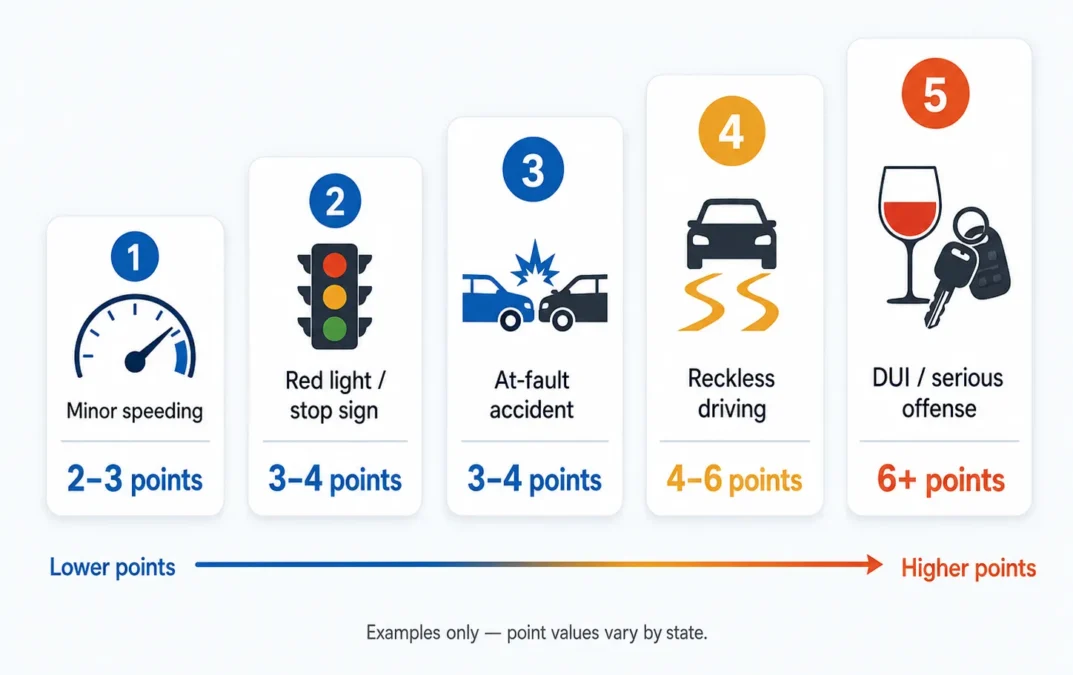
Your state’s DMV website lists the exact point values for each violation code and the thresholds that trigger license action. Do not rely only on a traffic school provider’s marketing page; confirm the rule with an official state or court source.
The Surest Way to Avoid Points: Avoid Violations
This sounds obvious, but it matters. The most reliable point strategy is preventing violations before they happen. The habits that reduce your violation risk are the same ones that reduce your crash risk: consistent following distance, speed adjusted for conditions, full stops, and distraction-free driving.
See defensive driving tips for the specific habits that have the most impact.
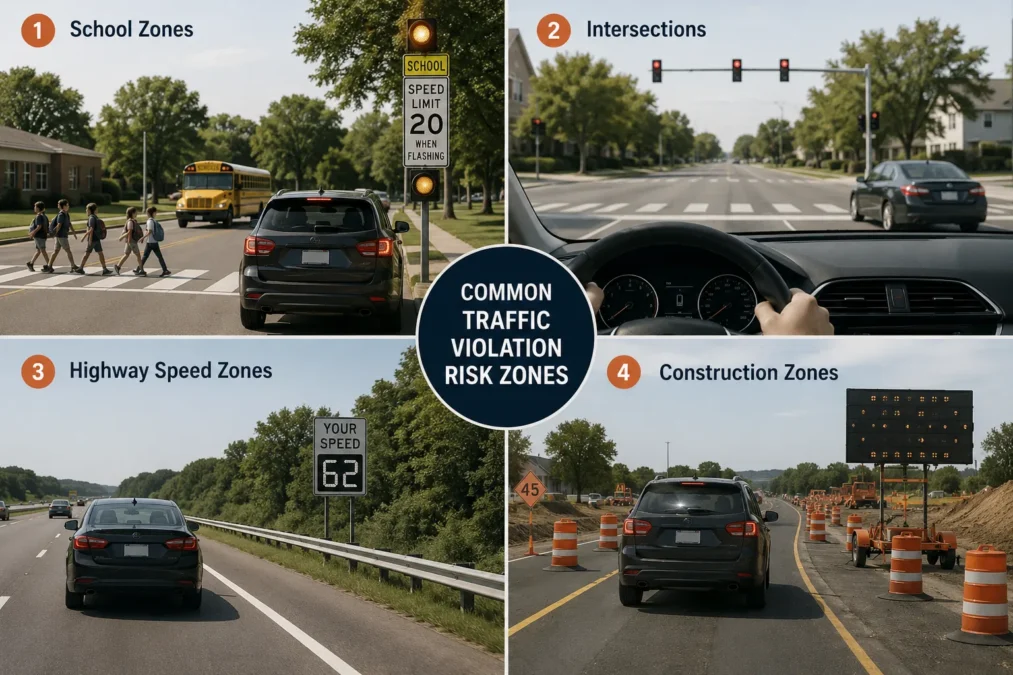
Where violations are most likely to occur:
- School zones and construction zones, where limits drop and enforcement often increases
- Intersections, where rolling stops, red-light violations, and failure-to-yield violations are common
- Highway speed traps, especially where speed limits change
- Familiar roads, where habit can override attention to posted signs
For speed-specific prevention—especially in school zones, work zones, and areas where limits change—use these practical habits for avoiding speeding tickets.
How to Avoid Points After You’ve Been Ticketed
If you have already received a citation, you may still have options before points go on your record. Timing is the main issue. Once the ticket becomes a conviction, dismissal options may no longer be available.
| Situation | Best option to check first | Possible result |
|---|---|---|
| Ticket received, no conviction yet | Dismissal or traffic school | No conviction and no points, if eligible |
| Ticket seems incorrect | Contest the citation | Dismissal or reduced charge |
| Higher-point violation | Attorney advice or court reduction | Lower-point charge or non-moving violation |
| Points already added | Point reduction course | Lower active point total, but violation may remain |
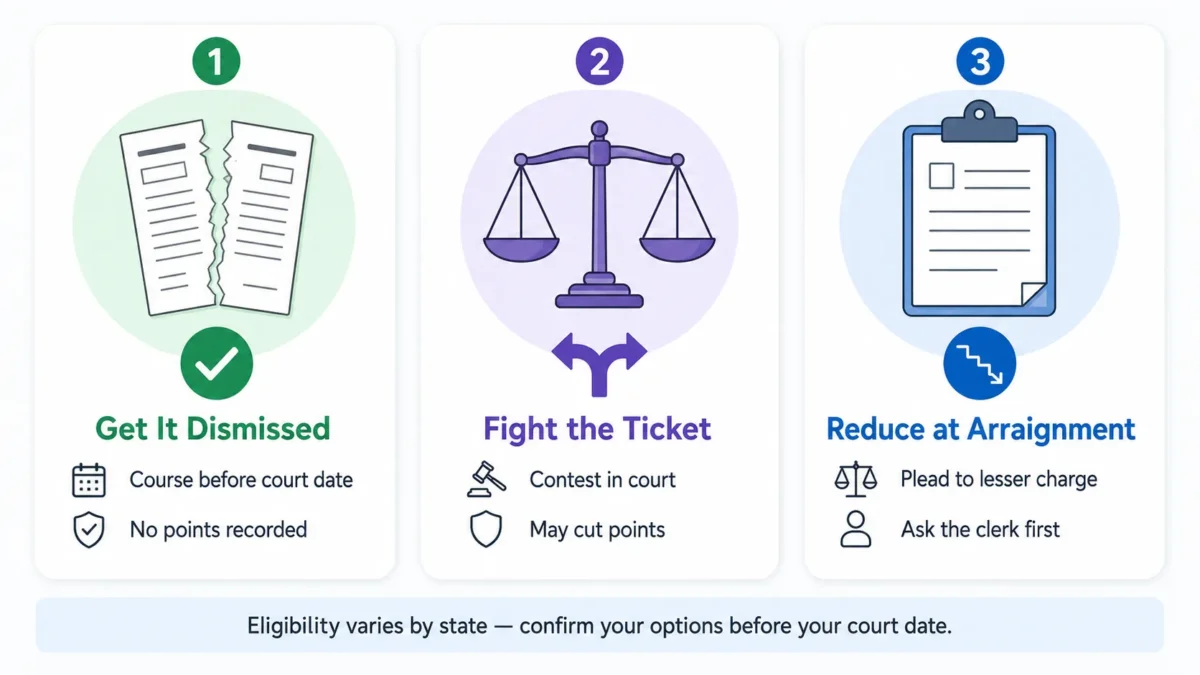
Option 1 — Get the ticket dismissed
In states or courts that allow it, completing an approved defensive driving or traffic school course before the court deadline can result in the ticket being dismissed. A dismissed ticket usually means no conviction and no points recorded for that violation.
This is often the highest-value option if you are eligible. Eligibility commonly depends on:
- The violation type, usually a minor moving violation
- Whether the violation involved alcohol, drugs, reckless driving, a crash, or a commercial vehicle
- Whether you used a dismissal option recently
- Whether the court approves the course before your deadline
See what to do after getting a ticket for the step-by-step process.
Option 2 — Fight the ticket
You can contest a traffic citation in court. If the ticket is dismissed, no points should be assessed for that citation. If the charge is reduced, fewer points may be assessed, or the violation may be changed to a non-moving violation.
For small fines and low-point violations, fighting may not be worth the time. But for violations that carry several points, possible suspension consequences, or a large insurance impact, the calculation changes.
Option 3 — Request a reduction at arraignment
Some courts allow drivers to plead to a lesser charge at arraignment. That could mean a moving violation reduced to a non-moving violation, or a higher-point charge reduced to a lower-point charge. This is not guaranteed, and the rules vary by court.
Before your court date, ask the court clerk, review the court website, or consult a traffic attorney if the violation is serious.
How to Reduce Points Already on Your Record
If points are already recorded, several states allow drivers to reduce the active point total through a state-approved defensive driving or driver improvement course. This is different from preventing the conviction in the first place.
Because eligibility, point credits, and limitations vary widely, review the options for reducing points already on your record before enrolling in a course.
How point reduction usually works:
- You complete a state-approved course, often four to eight hours
- The state subtracts or offsets a set number of active points for threshold purposes
- Most states limit how often you can use the option
- The original violation may still remain visible on your driving record
Point reduction is not the same as dismissal. Dismissal aims to prevent a conviction and points. Point reduction usually happens after a conviction and may reduce the point total used for license action, but it may not erase the violation itself.
That matters for insurance. Your insurer may still see the underlying conviction even if your DMV point total is reduced.
State Examples of Point Reduction and Traffic School Programs
Point rules, course eligibility, and court procedures change by state. Always confirm the current rule with your state DMV, court, or official course provider before paying for a course.
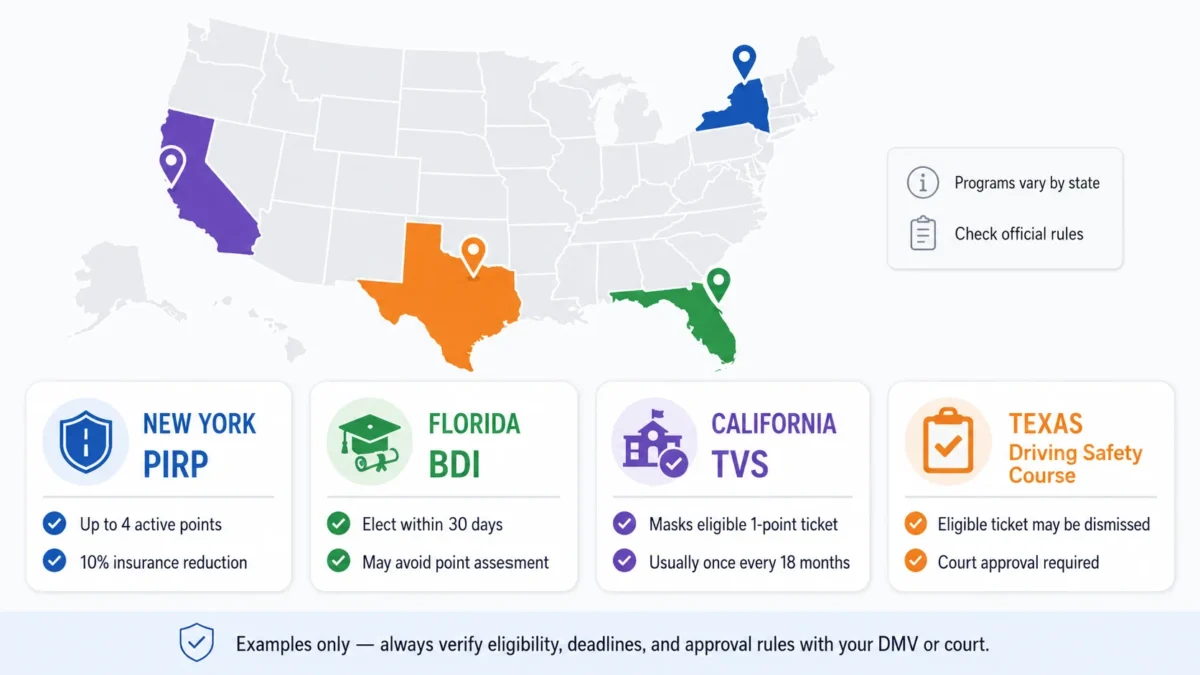
State examples:
- New York: The Point and Insurance Reduction Program (PIRP) may subtract up to four active points for suspension-calculation purposes and may qualify the driver for a 10% auto and motorcycle liability and collision insurance premium reduction for three years. The New York DMV states that PIRP does not remove the violation, conviction, or points from the driving record. Source: New York DMV PIRP.
- Florida: Basic Driver Improvement may prevent points from being assessed if an eligible driver elects the course within the required deadline and completes the court requirements. FLHSMV says drivers generally must elect school within 30 days of the citation. Source: FLHSMV Driver Improvement Schools.
- California: Traffic Violator School may keep an eligible one-point citation from being reported to insurance, but the citation remains on the driving record. California DMV says this option is generally available once in an 18-month period when offered by the judge. Source: California DMV Traffic Violator School.
- Texas: A driving safety course may help eligible drivers have certain traffic charges dismissed through the court, but the court must approve the request and eligibility depends on the violation. Source example: Frisco Municipal Court Driving Safety Course.
These examples are not a substitute for checking your own state and court rules. The same phrase, such as “defensive driving” or “traffic school,” can mean different things in different states.
How to Keep Your Record Clean Long-Term
Check your driving record regularly
Most drivers do not know what is on their record until their insurance renews and the rate goes up. Request your driving record from your state DMV or licensing agency at least once a year. Errors can occur, and catching them early gives you more time to dispute them.
Know your state’s point threshold
Many states begin sending warnings at lower point levels and start suspension-related action at higher thresholds. The exact number depends on the state and the time frame. If you are approaching your state’s limit, one additional violation could trigger a hearing, mandatory course, or suspension.
Do not let minor violations compound
Two minor violations in a short period can hurt more than one violation by itself. Insurers look at patterns, not only individual tickets. A second violation while the first is still in the lookback window may increase your risk profile.
Act before insurance renewal
If you receive a ticket, do not wait until your insurance renewal notice arrives. By then, the insurer may already have reviewed your driving record. Resolve the ticket, check course eligibility, and keep proof of completion before your policy renews.
Keep documents and certificates
Save traffic school certificates, defensive driving completion records, court notices, and proof of dismissal or reduction. If a court, DMV, or insurer later says it did not receive proof, documentation can help you correct the record.
Points vs. Insurance: Understanding the Difference
Your driving record and your insurance rate are related, but they are not identical.
| DMV points | Insurance impact |
|---|---|
| Used by the state DMV or licensing agency | Used by your insurance company |
| Can trigger warnings, hearings, or suspension | Can trigger surcharges or loss of discounts |
| Based on state point rules | Based on insurer rating rules |
| May sometimes be reduced by a course | May remain even when DMV points are reduced |
Some violations that add fewer DMV points may still cause a large insurance surcharge, depending on how your insurer classifies the violation. Your insurer’s rating table is separate from the state’s point system.
This means reducing DMV points through a course may or may not reduce your insurance surcharge. Ask your insurer how they treat course completion, ticket dismissal, and point reduction before assuming your premium will change.
See how traffic violations affect insurance rates after a ticket for more on the insurance side of this equation.
Frequently Asked Questions
How many points before my license is suspended?
It varies significantly by state. Many states begin license action somewhere around eight to twelve points within a rolling 12- to 24-month window, but the exact threshold can be lower or higher. Some states use warnings and hearings before suspension. Check your state DMV website for your specific threshold.
Do points expire?
Yes, in most states. Minor violation points often stop counting after a set period, while serious violations may remain longer. Once points expire or stop counting, they may no longer count toward suspension thresholds, but the violation itself may still appear on your record for insurance purposes.
Can I take a defensive driving course just to remove points proactively?
In some states, yes. In others, point reduction is only available after a conviction, or traffic school must be elected before the ticket becomes final. Check your state’s program rules before paying for a course.
Will removing points lower my insurance rate?
Not automatically. Your insurer may see the underlying violation even if your DMV point total is reduced. However, some states or insurers offer a separate discount for completing an approved course. Ask your insurer how course completion affects your policy.
What happens if I get too many points?
At lower thresholds, many states send a warning. At higher thresholds, they may require a hearing, mandate a driver improvement course, or suspend the license. Driving while suspended can create additional charges and more serious license consequences.
Is traffic school the same as point reduction?
Not always. In some places, traffic school can help prevent points before conviction. In others, a course reduces active points after conviction. The timing and legal effect depend on your state and court.
What This Means for You
Points are a lagging indicator. By the time they affect your suspension threshold or insurance renewal, the violation has usually already happened. The best strategy is to avoid violations through consistent defensive driving habits.
If you already received a ticket, act quickly. Before the court deadline passes, check whether dismissal, traffic school, or a reduced charge is available. If the ticket has already become a conviction, check whether your state offers a legitimate point reduction option.
To avoid points, the practical rule is simple: confirm the deadline, confirm the official course or court option, and get proof of completion before assuming your record is protected.