


Oregon Defensive Driving Course: Eligibility, Benefits, and Approved Options

An Oregon defensive driving course may help with a ticket or an insurance discount, but the course has to match the benefit you want. Court traffic school, distracted-driving fine relief, and the age-based insurance discount follow different rules. 1 3 6
That matters when a provider advertises an “Oregon-approved” class. Approval for an insurance course does not establish that your court will accept it for a citation. This guide helps you identify the right program, verify eligibility, and follow through after you earn the certificate.
General information only: This guide is not legal advice. Your court decides eligibility for its traffic-school program, and your insurer can explain how the age-based discount applies to your vehicle and policy.
Start with the outcome you need
Use your reason for taking the course to choose the first office to contact.
| Your situation | What a course may accomplish | Start here |
|---|---|---|
| You have a minor traffic citation | A local program may allow dismissal if the court approves you and you satisfy its conditions | The court named on the citation |
| You have a first qualifying mobile-device conviction | The court may suspend the fine; successful completion and court proof can lead to a sentence of discharge without a fine | The sentencing court |
| You are 55 or older and seeking an insurance discount | A qualifying DMV-approved accident-prevention course can support the statutory premium reduction | Your insurer, then DMV’s course list |
| A judge ordered you to take a course after conviction | Completion satisfies the ordered course requirement; the order may involve license sanctions | The court and its written order |
| You received a DMV Driver Improvement notice | DMV applies offense-count rules and license sanctions; buying a class is not a substitute for following the notice | DMV and the applicable administrative rule |
These are separate paths. Local dismissal depends on the referring court; mobile-device relief concerns the fine; the insurance path depends on age, vehicle use, other drivers, and course approval. 1 3 6 11 9
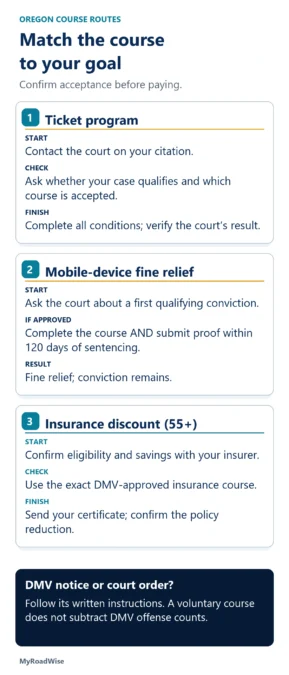
For a ticket, get your court’s permission first
Some Oregon courts offer traffic school for eligible minor violations. There is no universal offer you can assume applies to your case.
Union County Circuit Court, for example, says its traffic-school program may result in dismissal of minor traffic violations instead of a conviction on your record. It requires court approval and will not consider participation undertaken without that approval. 1
Deschutes County Circuit Court takes a different approach: its published traffic guidance says it does not offer defensive- or distracted-driver courses to reduce or avoid a fine. That statement applies to that circuit court; it is not a description of every court in Deschutes County. 2
The court’s name matters more than the place where the officer stopped you. A county can contain more than one court, and a program offered by one court may not be available in another. Start with the court printed on your citation, as Union’s instructions specifically tell readers to do. 1
What determines eligibility?
For Union’s program, the court considers the violation, prior moving-violation convictions within the last three years, and prior traffic-school participation within the last three years. It excludes citations for driving at least 100 mph, reckless driving, and listed serious driving offenses. CDL holders are also excluded, and some violations require further approval by a judge. 1
Those are useful examples of the questions a court may ask, not statewide eligibility rules. Another court’s lookback period, exclusions, or available outcome may differ.
When contacting your court, have your citation number ready and ask:
- Is this violation eligible for a traffic-school program?
- Does my driving history or previous course participation affect eligibility?
- What plea or application is required, and what rights would that choice waive?
- Which exact course and delivery format will you accept?
- What are the court fee, course fee, deadline, and proof-submission requirements?
- If I finish every condition, will the result be dismissal, fine relief, or something else?
Ask about the school option before choosing how to resolve the citation. Union describes online payment for eligible citations as entering a no-contest plea and paying the citation in full; it describes traffic-school approval separately. 1 If you are considering contesting the charge, get the court’s procedural information before making a plea or payment decision.
Once the court approves you
Keep the approval and program instructions together. Match the course title on the registration page to the course the court accepted, and confirm whether you or the provider must send the certificate.
Enrollment, completion, and court processing are three separate steps. A certificate shows that you finished a class. The court still has to determine whether you met its conditions and enter the appropriate result. Ask how you can verify that result rather than relying on a provider’s statement that the ticket is “handled.”
A mobile-device course can remove the fine, while the conviction remains
Oregon has a specific course option for a person’s first qualifying conviction for operating a vehicle while using a mobile electronic device. Under ORS 811.507(8), the court may suspend the fine associated with the first-conviction Class B violation in subsection (5)(a). The first-conviction offense that contributes to a qualifying accident is Class A under subsection (5)(b), so it is outside that particular fine-suspension provision. 3
The court’s initial decision is discretionary. You cannot create the benefit by purchasing a distracted-driving course on your own.
If the court grants the option, the statute requires you to do both of these within 120 days of sentencing:
- Complete an ODOT-approved distracted driving avoidance course at your own expense.
- Provide proof of completion to the court. 3
The second step is part of the deadline. Finishing on time but leaving the certificate in your email inbox does not meet the requirement to provide proof.
Once the statutory requirements are successfully completed, the court must enter a sentence of discharge that does not include a fine. If they are not completed, the statute directs the court either to grant an extension for good cause shown or impose the fine. An extension is something the court grants, not something a provider can promise. 3
ODOT expressly explains that this program does not remove the violation from the driving record. It is fine relief, not traffic-school dismissal. 4
Choose the distracted-driving course the court accepts
The governing administrative rules allow approved courses online or in a classroom. They require at least 90 minutes of instruction and demonstration of comprehension of at least 80% of the course content. The provider must promptly issue a completion certificate to successful participants. 5
ODOT directs drivers interested in a course to contact the agency that issued the citation and explains that the judge chooses the provider at the judge’s discretion. Use the court’s approved course directions, even if you find a cheaper class under a similar name. 4
One deadline detail is easy to miss: ODOT’s course overview says “within 4 months,” while its important notes specify 120 days of sentencing. The statute specifies 120 days of sentencing. Ask the court for your exact due date and submit proof early; calendar months are not a reliable substitute for that day count. 3 4
The insurance discount starts at 55, with additional conditions
Oregon’s age-based course discount is a statutory benefit for qualifying drivers and vehicles. ORS 742.490(1) requires covered rate filings to provide an appropriate premium reduction for liability, personal injury protection, or collision coverage when the conditions are met. 6
Age alone is not enough. The law requires:
- The covered vehicle’s principal operator to be an insured person 55 years of age or older.
- That principal operator to have successfully completed an ODOT-approved motor vehicle accident-prevention course within the applicable time window.
- No person under 25 to regularly operate the vehicle.
- The vehicle not to be classified for underwriting purposes as used for a business. 6
If the qualifying person principally operates two or more vehicles, the statutory discount applies to only one. No more than one premium discount under this provision may be applied to one vehicle. 6
For example, a 62-year-old principal operator who completes an approved class still needs to check the vehicle’s other regular drivers. If a 22-year-old regularly operates it, that vehicle does not meet the under-25 condition for this statutory benefit. This example concerns eligibility, not an estimate of what an insurer will charge.
Three years or two years depends on your age when taking the course
The statutory duration is three years after successful completion if you were younger than 70 when taking the course. It is two years if you were 70 or older when taking it. 6
The course also has to fit the policy-period timing requirement: completion must be no more than three years before the beginning of the discounted policy period for the younger-than-70 group, or no more than two years before it for the 70-or-older group. 6
Use your age at the time of the course when asking about those periods. Someone who took the class at 69 should not automatically apply the two-year rule merely because a birthday occurs during the discount period.
An insurer may require, as conditions of maintaining the reduction, that the insured have no at-fault accident and not be convicted of, or plead guilty or no contest to, a moving traffic violation. 6 A completion certificate therefore does not guarantee that the discount will remain in place regardless of subsequent driving history.
Ask for the dollar amount before enrolling
The statute requires an appropriate reduction; it does not set a universal percentage. Ask your insurer which coverages qualify, the dollar savings, the applicable vehicle, and when the reduction would begin. 6
Also ask how to submit the certificate and when another course would be needed. ORS 742.494 requires the course organization to issue a certificate and the participant to present it to the insurer to qualify. 6
To decide whether the class is worthwhile, compare the total course cost with the insurer’s quoted savings over the period for which you qualify. Use the insurer’s actual figures rather than a provider’s advertised savings percentage.
Find approved insurance options through DMV
DMV publishes Motor Vehicle Collision Prevention Courses, Form 735-7457, identifying approved courses for the age-based insurance path. The list includes online options, including AARP’s Driver Safety Program / Smart Driver Course and AAA’s RoadWise Driver course, alongside other approved programs. 7
Use that official list as a starting point rather than treating a brand name as universal approval. Check the exact course and format, then confirm your vehicle and policy eligibility with the insurer. A provider may sell several courses with different purposes.
The approval rule for motor vehicle accident-prevention courses requires a minimum of six hours of instructional time. Required subject areas include defensive-driving techniques, motor vehicle laws, and the effects of medication, fatigue, alcohol and drugs, sensory limitations, and aging on driving ability. 8
That six-hour requirement belongs to this accident-prevention course rule. It should not be applied to the separate 90-minute distracted-driving course or assumed to govern every local court program.
A punishment course does not qualify for the statutory age-based discount
Under ORS 742.496, a person cannot receive this statutory discount if the approved course is taken as punishment specified by a court or other government entity for a moving traffic violation. 6
That exclusion can matter even if you are over 55 and the same provider offers an approved insurance course. Course approval and your reason for attendance are separate eligibility questions.
Explain any court or government direction to your insurer before paying for a class for insurance purposes. If the insurer offers some other voluntary benefit, get its terms directly; do not describe that separate offer as the statutory age-based entitlement.
DMV Driver Improvement uses offense counts
Oregon’s Adult Driver Improvement Program operates through counts of driver improvement offenses rather than a course-based point-credit system. Under OAR 735-072-0020, a driver improvement offense is a preventable accident or a conviction for an offense on the referenced DMV list. 9
For adult drivers, OAR 735-072-0027 provides these thresholds:
| Offenses within the 24 months immediately before DMV’s record review date | Adult program action |
|---|---|
| Three | A 30-day restriction on driving from midnight to 5 a.m., with an exception for travel between home and work or driving for employment |
| Five | A 30-day suspension of driving privileges or the right to apply for privileges |
The rule also addresses later offenses and contains conditions governing when restrictions are imposed. Drivers under 18 fall under a separate provisional program with different rules. 9
This is why “no point reduction” should never be read as “no license consequences.” The DMV process can restrict or suspend driving privileges. The rules do not provide a voluntary course credit that subtracts those counted offenses. 9
If a notice arrives, follow its instructions and any available review procedures. Buying a generic defensive-driving course does not establish that the DMV action has been lifted. Verify your driving status directly with DMV before resuming driving after a suspension. 10
If a judge ordered a course after conviction
Court-ordered defensive driving can be a condition imposed after a traffic-offense conviction. Under ORS 809.270, a judge may set a completion deadline and use suspension or restriction of driving privileges to enforce the requirement. That authority is in addition to other authorized penalties. 11
The practical task is to satisfy the order. Ask the court which course it accepts, how proof must be delivered, and what is required to end any related restriction or suspension. The statute provides for court notification to DMV when restrictions end or reinstatement follows a suspension. 11
Completion of that assignment should not be described as automatic dismissal of the underlying conviction. It also raises the punishment-course exclusion for the age-based insurance discount discussed above. 11 6
Before paying, match the course to the paperwork
Keep one small file containing your citation or notice, course approval, due date, payment receipts, and completion certificate. For an insurance class, include the insurer’s eligibility and discount instructions.
Check the registration page for the exact program name. “Traffic school,” “mature driver,” and “distracted driving avoidance” are not interchangeable descriptions of the same benefit. If the provider’s promise differs from your court’s instructions or the insurer’s eligibility explanation, resolve that difference before enrolling.
After completion, send proof to the recipient your program requires and keep evidence of delivery. Then verify the outcome with that recipient: the court’s case disposition, the insurer’s applied reduction, or DMV’s recorded license status. Keep your certificate until you confirm that the result has been processed.
MyRoadWise — Drive Wise. Spend Less. Stay Safe. Start with the court named on your citation or the insurer covering your vehicle, and get the course accepted for your specific purpose before you pay.
Related Reading
- Is Online Traffic School Legit? 7 Smart Checks Before You Pay
- Does Traffic School Remove a Ticket From Your Record?
- Traffic School by State: Ticket, Point and Insurance Rules
Sources
- Union County Circuit Court — Traffic Citations, “Can I take Traffic School?” and plea/payment instructions.
- Deschutes County Circuit Court — Traffic Violations, “Defensive and Distracted Driver Courses.”
- Oregon Revised Statutes, Chapter 811, ORS 811.507(5)(a)-(b) and (8), text operative before January 1, 2027.
- ODOT — Distracted Driving, distracted-driving avoidance course guidance and important notes.
- Oregon Administrative Rules, Chapter 737, Division 20, OAR 737-020-0020 and 737-020-0030.
- Oregon Revised Statutes, Chapter 742, ORS 742.490(1)-(2), 742.492, 742.494, and 742.496.
- Oregon DMV — Motor Vehicle Collision Prevention Courses, Form 735-7457.
- OAR 735-014-0000 — Standards for Approval of Motor Vehicle Accident Prevention Courses, subsections (1), (3), (4), and (7).
- Oregon Administrative Rules, Chapter 735, Division 72, OAR 735-072-0020, 735-072-0023, 735-072-0027, and 735-072-0041.
- Oregon DMV — Suspensions, Revocations and Cancellations, driving status and reinstatement guidance.
- Oregon Revised Statutes, Chapter 809, ORS 809.270(1)-(4).
Last updated: October 6, 2026