


Mississippi Defensive Driving Course: Eligibility, Benefits, and Approved Options

A Mississippi defensive driving course can help an eligible driver keep a traffic violation off the public driving record or qualify for an older-driver insurance discount. The course must fit the benefit you want: the court controls the traffic-safety violator course, while the insurance benefit requires a Department of Public Safety-approved accident-prevention course.12
Start with your ticket or insurance policy before comparing classes. A course advertised for Mississippi is not, by itself, proof that it will count for your case or policy.
General information only: This guide explains Mississippi course options. It is not legal advice. Ask the court handling your citation about your case and ask your insurer about your policy before paying for a course.
Choose the course by the result you need
The first decision is whether you are trying to resolve a ticket, comply with a court order, or reduce an insurance premium. Those purposes have different rules.
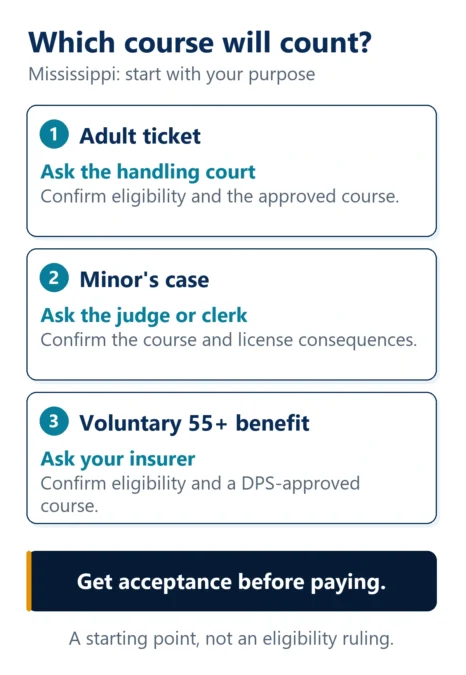
| Your situation | What the course can do | Where to start |
|---|---|---|
| You want the adult traffic-safety violator option | An eligible driver who follows Section 63-9-11 can obtain the specified dismissal and public-record benefit; court-use records remain | The court named on the citation |
| You are a minor whose case falls under Section 63-1-55 | The judge may suspend the license in lieu of conviction and may require a defensive driving course | The judge or court clerk; ask about the license consequence |
| You are an insured principal operator age 55 or older seeking a voluntary insurance benefit | An approved accident-prevention course can qualify you for the statutory premium reduction on specified coverages | Your insurer, then the DPS-recognized course |
| You already have a court order requiring a class | Completion addresses the class requirement in that order; the legal outcome depends on the applicable provision and order | The referring court |
The first two rows come from different statutes. The insurance course is separate again, and the statutory insurance benefit does not apply when the course is taken as punishment imposed by a court or other government entity for a moving violation.132
A provider’s “point reduction” label does not establish a Mississippi course benefit. The court program described here changes the treatment of a qualifying case. It is not an automatic credit against unrelated violations already on your record.1
The adult court program has eligibility rules beyond “first ticket”
Mississippi Code Section 63-9-11(3) establishes a traffic-safety violator course option for a person not covered by the separate minor provision in Section 63-1-55. The eligible charge must be a misdemeanor under Chapter 3, 5, or 7 of Title 63. That scope matters: a class marketed for ticket dismissal does not make every traffic charge eligible.1
For a Mississippi driver, the statute requires a valid Mississippi license or permit. It also requires all of the following:
- No conviction for a violation under those chapters within the three years before the current offense. The statute excludes convictions entered before October 1, 2002, from the prior-offense calculation.
- No successful completion of this traffic-safety violator course shown on the public or nonpublic DPS record in the three-year period before the offense.
- An affidavit addressing the prior-conviction requirement, confirming that you are not currently taking another course under this section, and confirming that no completed course remains unrecorded.
- Payment of the applicable fine, court costs, legally required assessments, and the additional $10 fee for electing this option.1
You also pay the course provider’s fee. A dismissal through this program therefore does not mean that the ticket becomes free.1
The repeat-use condition is easy to oversimplify. Three years since a previous class is only part of the inquiry. The conviction history, the current offense, and any course still being taken or awaiting entry on the record also matter. Give the court a complete history rather than relying on a provider’s checkout questionnaire.
CDL holders and out-of-state drivers
Section 63-9-11(4) excludes a holder of a commercial driver’s license issued under Mississippi’s Commercial Driver’s License Law from the subsection (3) benefit. The exclusion applies even when the violation occurred in a personal vehicle. If you hold an out-of-state CDL or otherwise have commercial-driving obligations, disclose them to the court and obtain case-specific eligibility guidance.1
An out-of-state resident has a separate accommodation under subsection (3)(c): a substantially similar program may be completed in the person’s home state, province, or country, provided the other requirements are met. The valid license or permit must be one issued by that home jurisdiction. Have the Mississippi court confirm the course you plan to use before registering.1
The 90-day and 45-day deadlines belong to different routes
The adult program does not give every participant the same completion period. Section 63-9-11 distinguishes a deferred plea from a conviction following a not-guilty plea.1
| Adult route | How it begins | Course period | Result after the statutory conditions are satisfied |
|---|---|---|---|
| Guilty or no-contest plea with acceptance withheld | An eligible defendant presents the request in person or by mail postmarked on or before the appearance date on the citation | 90 days allowed through the court’s deferral | The court dismisses the prosecution and closes the case after proof of successful completion is entered |
| Not-guilty plea followed by conviction | The eligible convicted defendant requests the course option | 45 days allowed through suspension of the sentence | The court sets aside the conviction, dismisses the prosecution, closes the case, and expunges the conviction record on its own motion |
Both routes require at least four hours of a court-approved course at the defendant’s expense. Both retain the nonpublic record required for court eligibility checks.1
If you are asking about the deferred-plea route, the statute permits the plea and request in person or in writing. Ask the clerk which form and filing method the court uses. Mailing rules are specific: the request must be postmarked on or before the appearance date on the citation. Sending a message to a provider does not make that request to the court.1
Get the actual completion and proof-filing dates from the court. The 90-day period is not a reason to ignore the earlier appearance date or a required filing. The 45-day route is not a general grace period available to anyone who has already paid a ticket.
Choosing a plea can affect more than course enrollment. If you are deciding whether to contest the charge, obtain legal advice about that decision instead of selecting a plea solely to buy a class.
A minor’s case can involve a license suspension
Section 63-1-55 describes a different option for a minor who is dependent on and subject to the care, custody, and control of a parent or guardian. After a qualifying traffic conviction or guilty plea, a judge may hold the minor’s license in court custody for up to 90 days in lieu of the otherwise applicable penalties. The docket entry is a suspension in lieu of conviction, and the statute says that action is not a conviction.3
The judge may also require a judge-approved defensive driving course as a condition of the suspension. Court costs and the driver-education penalty assessment may be imposed at the judge’s discretion.3
This provision excludes the offenses listed in Section 63-1-51(1)(a) through (e), violations of the Implied Consent Law, and violations of the Uniform Controlled Substances Law. It does not create a simple promise that every driver under 21 can take one class and continue driving with a dismissed ticket.3
Local instructions need careful reading. Picayune publishes separate under-21 and adult course documents. Its under-21 notice describes a first-offense dismissal process, while the statutory minor provision reproduced in the Judicial College manual describes suspension in lieu of conviction. Ask the court which provision it is applying and what the judge’s order requires, including whether your license will be suspended.43
For a parent arranging the class, the practical questions are the legal basis, the approved course, the suspension terms, and the deadline for proof. A course certificate alone does not establish permission to drive.
The 55-and-older insurance benefit requires a voluntary approved course
Mississippi Code Section 63-15-46 requires an appropriate premium reduction for the liability, personal injury protection, and collision coverages when the covered vehicle’s principal operator is an insured person age 55 or older who successfully completes a DPS-approved motor vehicle accident-prevention course. It is not a fixed percentage of every charge on the entire policy.25
The statutory benefit lasts three years after successful completion. The insurer may require, as conditions of maintaining it, that the insured avoid an at-fault accident and avoid a moving-violation conviction, guilty plea, or no-contest plea.2
One exclusion affects anyone hoping to use a ticket class twice: under Section 63-15-46(5), the section does not apply if the approved course is taken as punishment imposed by a court or other governmental entity following a moving violation. Ask the insurer about the reason for attendance as well as the course name.2
Confirm the amount before estimating savings
The published statute uses “appropriate reduction” and presumes an insurer’s discount appropriate unless credible data shows otherwise. The DPS page reproducing the section contains mixed “appropriate” and “ten percent” wording. The clean statutory text uses an appropriate reduction, so obtain your policy’s actual discount from the insurer rather than budgeting for an automatic 10%.25
Ask which coverages receive the discount, how much the premium changes, when the change begins, and what documentation is needed. Also ask how to remain eligible when the three-year period ends. An insurer’s dollar estimate lets you compare the course cost with the expected savings without applying a percentage to coverages that do not receive it.
DPS specifically directs older drivers to the AARP Smart Driver course, advises checking insurer requirements before taking it, and tells graduates to provide the completion certificate to the insurance company. That is a useful starting option, not a guarantee that any AARP-branded class will satisfy a court order.6
Drivers outside the statutory age and principal-operator conditions can ask their insurer whether a separate voluntary discount is offered. The statutory 55-and-older benefit should not be described as a universal discount for every Mississippi driver.2
Approved options depend on who will accept the certificate
For an adult ticket case, the court approves the course. Section 63-9-11 requires at least four instructional hours and also sets curriculum, workbook, effectiveness-analysis, and instructor-qualification requirements. Four hours advertised on a sales page do not establish court approval.1
For the statutory older-driver insurance benefit, DPS approves the accident-prevention course. Section 63-15-46 assigns DPS the minimum-hours decision and requires a written test. The adult court program’s four-hour minimum should not be copied into every insurance-course description.2
| Option or source | What the official source establishes | What you still need to confirm |
|---|---|---|
| AARP Smart Driver, linked by DPS | DPS directs older drivers to this insurance-course option | The exact course and format, your insurer’s eligibility requirements, and the discount amount |
| Judge’s Traffic School, listed by Picayune | Listed as an online traffic-safety course in Picayune’s course document | Your own court’s acceptance, the selected product, and your case eligibility |
| Golden Triangle Driving Academy, listed by Picayune | Listed with online and in-person formats | The format your court accepts, the available class, and proof-filing arrangements |
| Another course proposed to your court | Picayune allows unlisted courses to be submitted for review; approval is not guaranteed | Approval from the court handling your case before enrollment |
The Picayune entries are local examples from its court document. They are not a statewide provider list, a ranking, or proof of insurance-course approval. Picayune reserves the right to reject certificates that do not meet its requirements.7
Picayune’s adult notice also describes the outcome differently from the statute: it says the violation will not be dismissed, while Section 63-9-11(3)(b) directs dismissal after compliance. Ask the court which outcome it will record before you enroll.71
For online enrollment, get acceptance of both the provider and the delivery format. Then check the practical terms: the total charge, any certificate fee, the time needed, the final assessment, refund conditions, and how proof reaches the receiving office. Choose a course whose schedule leaves time to correct a certificate or filing problem.
Finish the paperwork after you finish the class
For the adult deferred-plea route, the statute ties dismissal to proof of successful completion entered with the court. Keep a copy of the certificate and confirm receipt with the clerk. For the post-conviction route, confirm the order setting aside the conviction and the expungement action as well as completion of the class.1
Picayune’s course document specifies that the certificate show the participant’s full name, course title, provider name, completion date, and total instructional hours. Use that as an example of what to check, then follow the requirements of your own court.7
Ask for the case disposition so you can see the result the court recorded. Mississippi’s adult program retains a private, nonpublic DPS record for court eligibility checks; Section 63-9-17 specifies ten years of retention. The three-year repeat-use rule is not the same as that retention period.8
For an insurance course, send the certificate to your insurer as DPS instructs. Check the updated policy or bill and ask about any missing adjustment. Keep the certificate with the insurer’s response so you have the completion date and the approved benefit together.6
The next useful step is to get acceptance in writing: your court’s directions for a ticket case, or your insurer’s course and discount requirements for a voluntary insurance class. Pay for the course once those terms match the result you need.
Related Reading
- Traffic school rules by state
- What traffic school changes on your record
- How a course discount affects your premium
- Steps before paying a speeding ticket
Sources
- Mississippi Code Section 63-9-11(3)-(4), reproduced in the Mississippi Judicial College’s Municipal Court Judges and Clerks Manual, final update for July 1, 2026, PDF pages 351-353. Enacted text: 2005 HB1130, Section 6. Accessible section-level fallback: Justia, 2025 Section 63-9-11.
- Mississippi DPS Driver Service Bureau, AARP Driver Safety Program and Section 63-15-46.
- Mississippi Code Section 63-1-55, reproduced in the Mississippi Judicial College’s 2026 Municipal Court Judges and Clerks Manual, PDF page 358. Accessible section-level fallback: Justia, 2025 Section 63-1-55.
- Picayune Municipal Court, Traffic Safety Course Information — Minors (Under 21), revised February 17, 2026. Both local notices are linked from the court’s Forms & Documents page.
- Mississippi Code Section 63-15-46, clean text brought forward in 2013 SB2192, Section 1; current 2025 code reproduction.
- Mississippi DPS Driver Service Bureau, Drivers 55 & older may qualify through AARP Smart Driver.
- Picayune Municipal Court, Traffic Safety Course Information — Adults (21 and Over), revised February 17, 2026; PDF page 1 for the conflicting dismissal wording and page 3 for the local course list and certificate requirements.
- Mississippi Code Section 63-9-17(5), reproduced in the Mississippi Judicial College’s 2026 Municipal Court Judges and Clerks Manual, PDF page 354; 2005 HB1130, Section 7. Accessible section-level fallback: Justia, 2025 Section 63-9-17.
Last updated: October 7, 2026