


Washington Defensive Driving Course: Suspension, Tickets and Insurance

A ticket or suspension notice can make an online driving course look like a quick fix. Before you enroll, though, you need to know what Washington will accept the course for.
Washington has no driver point system, so a course cannot remove points. A qualifying safe-driving course is required for reinstatement after certain suspensions and may help end one early. Court deferral is a separate process. Eligible drivers age 55 and older also have a distinct course-based insurance benefit.
This guide explains those differences, where to find approved courses, and what to check before paying. Start with the notice or benefit that applies to you, then choose the course that meets that specific requirement.
What can a Washington defensive driving course do?
| Your goal | What to know | Where to start |
|---|---|---|
| Remove license points | Washington does not use a driver point system. | Read the violation or suspension notice instead of looking for point reduction. |
| Meet a suspension requirement | A DOL-recommended safe-driving course is required before reinstatement under RCW 46.20.2892. | Check the law named in your DOL notice. |
| End a qualifying suspension early | Course completion may help when the legal conditions are met. | Confirm eligibility and how DOL will receive completion. |
| Get a ticket dismissed | A court may grant a deferral and later dismiss the infraction if its conditions are met. | Contact the court listed on the ticket. |
| Reduce insurance premiums | A separate approved accident-prevention course qualifies eligible insureds 55 and older for a premium reduction. | Check with your insurer and use DOL’s senior-course information. |
These are separate processes. The suspension rules come from RCW 46.20.2892, court deferrals from RCW 46.63.070, and the older-driver insurance benefit from RCW 48.19.460.
A course advertised as “defensive driving” is not automatically suitable for all three purposes.
Does Washington have license points to remove?
No. Washington’s current accumulation rules count qualifying violations and occasions rather than assigning a point total that a course can reduce. The state’s former point-system and point-accumulation rules were repealed, as shown in the official WAC disposition record.
That does not mean tickets are harmless. DOL still tracks violations, and qualifying accumulation can lead to suspension. Think in terms of what appears on your record and which rule applies, rather than how many points a class might erase.
For example, if a course advertisement promises “point reduction,” ask what Washington requirement the actual course satisfies. The useful question is whether DOL, your court, or your insurer accepts it for your purpose.
When does DOL require a safe-driving course?
Under the traffic-infraction accumulation rule, DOL must impose a 60-day suspension when its records show moving-violation traffic infractions on:
- Three or more occasions within one year, or
- Four or more occasions within two years.
Multiple infractions issued during or resulting from one traffic stop count as one occasion. DOL explains this grouping on its accumulation-of-traffic-tickets page.
Suppose one stop produces two qualifying infractions. That stop counts as one occasion for this rule, not two. Separate qualifying stops count separately. This example explains the counting method; it does not determine whether a particular ticket qualifies.
DOL must also send a warning at two qualifying occasions in one year or three in two years. Before reinstatement under this section, the driver must complete a safe-driving course recommended by DOL. These requirements appear in RCW 46.20.2892.
Read your notice before enrolling. A warning, a pending suspension, and a suspension already in effect call for different next steps.
Can completing the course end a suspension early?
It can help with a qualifying suspension under RCW 46.20.2892. After DOL provides notice of a pending suspension, course completion can lead to termination before the 60-day period expires, subject to the law’s conditions.
DOL must receive notice of completion. Finishing the lessons or holding a certificate is not the same as confirming that DOL has received and applied the record. The early-termination opportunity is available only once every five years. DOL’s explanation
If the suspension has not started
Under WAC 308-104-028, DOL checks for pending or existing suspensions caused by accumulated traffic infractions. It terminates the most recently added qualifying suspension when the five-year condition is met.
For a pending-only suspension, WAC 308-104-028(3) says DOL will: “Not impose relicensing requirements if a person only has a pending suspension.” Still, confirm that DOL has processed the course and verify your driving status before relying on the change.
If the suspension has already started
You must meet any applicable reinstatement requirements and licensing fees. For an active suspension resulting from a traffic-infraction finding, RCW 46.20.311 requires proof of financial responsibility for the future; DOL’s accumulation page identifies an SR-22 insurance certificate.
The law bars a reissue fee for a suspension under RCW 46.20.2892. That exception does not mean every other licensing obligation disappears. Ask DOL what remains outstanding in your case.
Probation still follows
A one-year probation period follows the suspension, including when it ends early. A moving-violation traffic infraction committed during probation triggers an additional 30-day suspension, consecutive to any suspension already being served. The course-based early-reinstatement provision does not apply to that probation violation. RCW 46.20.2892
Before driving, confirm your license status with DOL. A course does not establish that every suspension or other licensing requirement on your record has been cleared.
How to choose an approved Washington course
For the accumulation suspension, start with DOL’s approved safe-driving course providers. Its list includes in-person, virtual, and self-paced online options.
Choose the exact listed course for your purpose. A school may sell several programs, and a familiar provider name is not enough to identify the right one.
Check these details before paying
Ask the provider:
- Is this the course listed by Washington DOL for an accumulation suspension? Give the course’s full name and explain what your notice says.
- How is it delivered? Confirm whether it is self-paced, a scheduled virtual class, or an in-person session.
- What is the total price? Ask about certificate, reporting, rescheduling, or other charges before comparing options.
- How long does completion take? Check access limits, class dates, assessments, and any completion requirements.
- Who reports completion to DOL? Ask what the provider sends, what you must submit, and how long reporting takes.
Some listed offerings are labeled four-hour courses. The directory does not establish one duration for every provider. Confirm the specific program rather than assuming every Washington course follows the same schedule.
Price matters, but so does whether you can finish and have completion recorded in time. A low advertised price is not useful if the program is wrong for your notice.
Keep a completion record
Save the enrollment confirmation, receipt, completion certificate, and any reporting confirmation. Use the same identifying information required by your notice and check it for mistakes.
If a provider says it reports completion, ask how you can confirm the report was sent. If your notice requires action from you, complete that step too. Contact DOL if your status does not reflect the expected change.
For example, finishing on Friday evening does not establish that DOL has already updated your record. Plan around receipt and processing, not just the time you finish the course.
What if I want DOL to review the suspension?
If you want DOL to review an accumulation-of-infractions suspension, act promptly. DOL’s guidance says to request review within 15 days of the date on your suspension letter and to use the form included with it.
Submit early, follow the deadline and filing instructions on your notice, and keep proof of submission. Follow the deadline printed on your notice rather than calculating your own from the mailing date. If the deadline is close, unclear, or appears to have passed, promptly ask DOL or a licensed Washington traffic attorney to determine the applicable deadline and available options. The governing review provisions include RCW 46.20.245 and WAC 308-111-040.
This DOL review is separate from responding to the court about the ticket. Keep each notice and its instructions together so that completing one process does not cause you to overlook the other.
Can a course get a Washington ticket dismissed?
Taking a course does not create a statewide right to ticket dismissal. Washington courts have a separate deferred-finding process under RCW 46.63.070.
At a requested contested or mitigation hearing, a court may defer findings for up to one year and set conditions. At a mitigation hearing, it may instead defer entry of its order. If the deferral conditions are met and no further traffic infraction has been determined against the driver during the period, the court may dismiss the infraction.
The court decides whether to grant the deferral and whether dismissal is appropriate. Neither result is automatic.
Check eligibility and court instructions
The statute limits deferrals to one moving-violation deferral within seven years and, separately, one nonmoving-violation deferral within seven years. It excludes CDL holders, drivers operating a commercial motor vehicle at the time, and the specified negligent-driving infraction involving a vulnerable-user victim.
Respond to the traffic-infraction notice within 30 days of its date. Follow the court’s hearing instructions if seeking a deferral. The court may assess administrative costs. RCW 46.63.070
Before buying a class for a court matter, ask the court what it requires and which course, if any, it will accept. Keep any order and completion deadline in writing. Do not assume that a course selected for DOL will satisfy a court condition.
If you are deciding whether to contest the allegation or seek a deferral, a Washington traffic attorney can explain the options for your case.
Insurance discounts for drivers 55 and older
Washington has a separate accident-prevention course benefit for eligible insureds age 55 and older. It should not be confused with the safe-driving course required for an accumulation suspension.
Under RCW 48.19.460, qualifying courses must meet DOL criteria and have a minimum of eight hours. The premium reduction applies for two years to covered personal automobile liability and physical-damage insurance, with underinsured motorist coverage excluded.
Insurers writing the covered insurance must allow an appropriate reduction for eligible people. The statute does not specify one universal discount percentage. RCW 48.19.470
How to claim the benefit
Start with DOL’s approved senior collision-prevention courses. Online options are available. Before enrolling, ask your insurer:
- Does this exact course qualify for my policy?
- Which coverages receive the reduction, and what will the savings be?
- How should I submit the certificate?
- When will the reduction appear, and how will renewal eligibility be handled?
The sponsoring agency issues a certificate after successful completion; it provides the basis for qualifying for the discount. RCW 48.19.480
To remain eligible, participants must take an approved course every two years. RCW 48.19.490
Compare the insurer’s quoted savings with the course’s total cost. For example, ask for the expected dollar reduction over the benefit period rather than assuming a percentage applies to your entire bill.
If you are under 55, do not assume this age-based law applies. Ask your insurer about any separate voluntary course benefit before paying for a class to save on insurance.
What if my notice describes a different suspension?
Washington also has a separate traffic-offense-frequency framework under RCW 46.20.291(3) and WAC 308-104-025. That rule sets a 60-day suspension at six or more traffic offenses in one year or seven or more in two years and addresses hearings.
This is a separate rule; check which rule your notice cites. The course-based early-termination mechanism discussed above belongs to RCW 46.20.2892; do not assume it applies to another suspension.
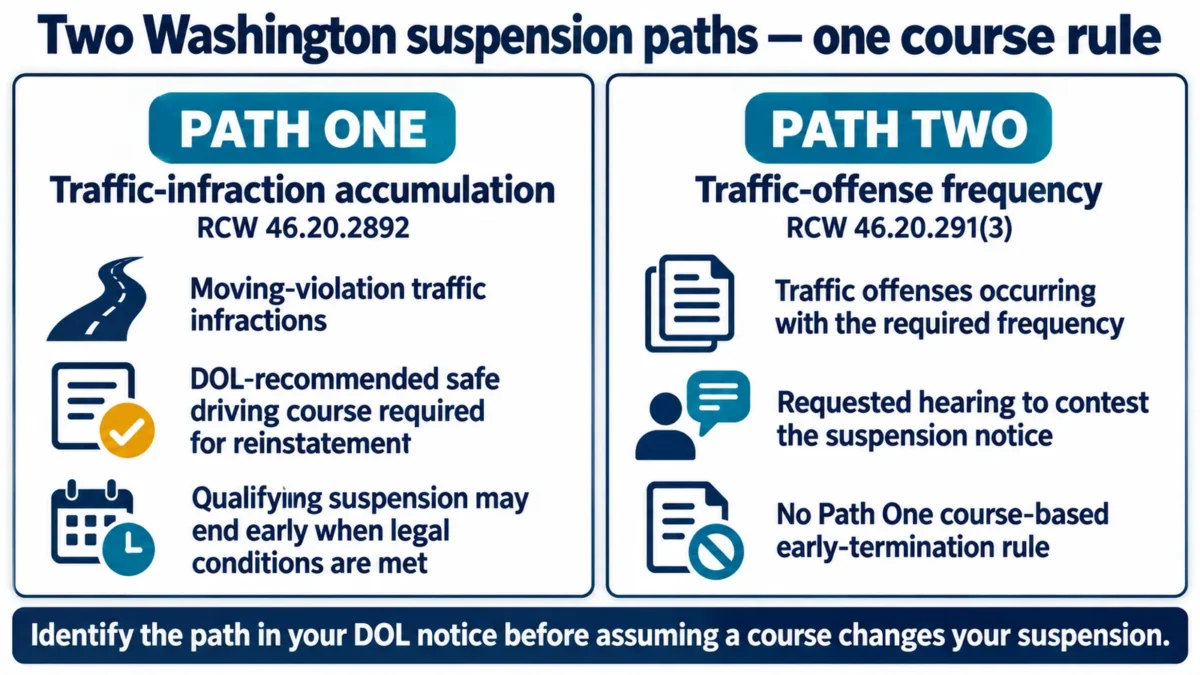
If your record has more than one suspension, ask DOL which action course completion would affect and what would remain. This is especially important when the wording on your notice differs from the accumulation rule described here.
Frequently asked questions
Can I take a Washington defensive driving course online?
Yes, online courses appear on DOL’s lists, but the list you need depends on your purpose. Use the safe-driving provider list for an accumulation suspension and the senior collision-prevention list for the age-based insurance benefit. Confirm court acceptance separately for a court matter.
Will the course erase my ticket?
Do not treat a completion certificate as a dismissal order. The suspension-course process and court deferral are separate. Check the court’s decision to determine the outcome of the ticket, and check with DOL about your license status.
How much does a course cost?
Check the current price of the exact accepted course. Ask about the full charge, refund terms, and reporting arrangements. This guide does not quote a statewide course price because choosing the correct program comes before comparing provider offers.
Can one course satisfy DOL, the court, and my insurer?
Do not assume so. Get confirmation from each organization whose requirement or benefit you want to satisfy. Save those answers before enrolling, especially if a provider offers several Washington programs.
Can I drive as soon as I finish?
Do not use course completion alone as proof that you may drive. Confirm that DOL has received the necessary record, processed the applicable change, and cleared any remaining requirements affecting your driving privilege.
Choose the course that matches your situation
A Washington defensive driving course has specific uses. Start with your DOL notice if suspension is the issue, your court if you are seeking a deferral, or your insurer if you want the older-driver premium benefit.
Before enrolling, confirm the exact course, who must receive completion, and what you must do afterward. Keep the records and verify the result. Then put the training to work: leave room to react, manage your speed, and give the road your full attention.
Related Reading
- How traffic school rules differ by state
- How driver license points work elsewhere
- Options for keeping a ticket off your record
- How violations can affect insurance rates
- Questions to ask about a traffic school insurance discount
Sources and References
- Washington Department of Licensing: Accumulation of traffic tickets, approved safe-driving course providers, and driving safety for seniors.
- Washington State Legislature: RCW 46.20.2892, using the amendment by 2025 c. 175 effective April 1, 2026, and WAC 308-104-028 for the course and suspension framework; RCW 46.20.311 for the financial-responsibility requirement.
- Washington State Legislature: RCW 46.20.245 and WAC 308-111-040 for administrative review; RCW 46.63.070 for court deferrals.
- Washington State Legislature: RCW 48.19.460, 48.19.470, 48.19.480, and 48.19.490 for the older-insured premium reduction and certificate requirements.
- Washington State Legislature: Chapter 308-104 disposition for former point-system rules; WAC 308-104-025 for the separate traffic-offense-frequency framework.
Last updated: September 29, 2026