


NJ Defensive Driving Course: Points, Insurance Discounts & Approved Options

An MVC-approved NJ defensive driving course may reduce your current point total by two and help you qualify for a car insurance discount. It is voluntary, and each benefit has its own eligibility and reporting rules. MVC Driver Programs [1]
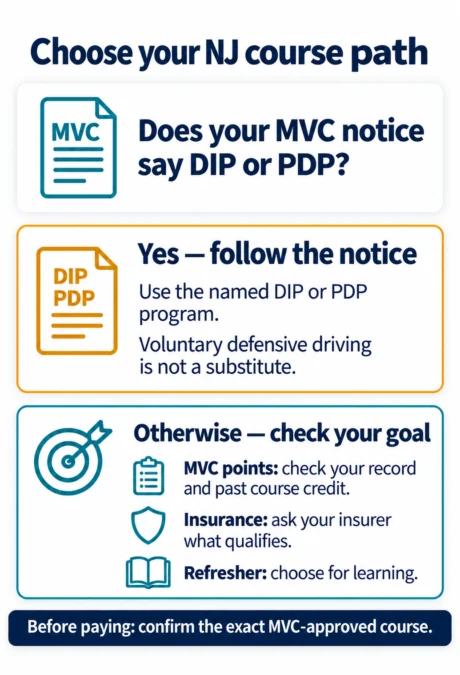
If an MVC notice names the Driver Improvement Program (DIP) or Probationary Driver Program (PDP), start with that notice. The voluntary defensive driving course does not substitute for either remedial program. MVC remedial programs [1]
General information only: This page explains the current statewide framework. It is not legal or insurance advice. Confirm the exact course, your record, any MVC notice, and your policy terms with the responsible agency or insurer before paying.
Start with the result you need
The course has two main benefits, but they use different rules and reporting paths.
| Your goal | What the course may do | What to check first |
|---|---|---|
| Reduce MVC points | Provide a two-point credit, no more than once in five years | Points must be on your record when you finish; check past course use and the exact MVC-approved course; the credit does not lower surcharge points |
| Lower your car insurance cost | Support a rate reduction on a qualifying private-passenger policy | Whether your insurer accepts the course and what its approved rate rules provide |
| Refresh your driving knowledge | Provide voluntary safety instruction online or in a classroom | Course approval, format, assessment rules, and support |
| Respond to an MVC program notice | Nothing unless the notice actually identifies the voluntary course | Whether the notice says Defensive Driving, DIP, or PDP |
MVC describes the voluntary course, point-credit conditions, and remedial programs on its Driver Programs page [1]. The insurance route follows N.J.A.C. 11:3-24.2 through 24.5 [4].
What an NJ Defensive Driving Course Can Do
New Jersey MVC publishes separate lists of approved online and classroom providers. Start with the MVC directory [1] and match the exact New Jersey course before paying.
When you complete a qualifying course, two outcomes may be available:
- MVC point credit: the approved course may reduce your point total by two, subject to the five-year limit.
- Insurance rate reduction: a qualifying course may support a reduction under your insurer’s New Jersey rate rules.
The provider reports completion to MVC. Your insurer may require you to notify it and provide separate proof.
The course is also open as voluntary training. You do not need to be seeking a point credit or insurance savings to take an approved class. N.J.A.C. 13:21-24.10(a) [3]
Point credit: Two points, no more than once in five years
Successful completion of an approved course may provide a two-point credit, no more than once in any five-year period. MVC says you must have points on your driving record when you complete the course. MVC point-credit guidance [1]; N.J.A.C. 13:21-24.2(a) [3]
The credit lowers your MVC point total, not the separate total used for surcharges. MVC says the two-point reduction does not reduce a surcharge point total. It also does not cancel a suspension MVC has already proposed for excess points. MVC surcharges [2]; N.J.A.C. 13:21-24.2(d) [3]
Check the record MVC currently shows and any earlier defensive-driving credit before enrolling. If points from a pending ticket have not appeared, ask MVC how the completion condition applies to your record before paying solely for a point benefit. If you have a suspension or remedial-program notice, follow the instructions and any directions issued through that process.
For broader context on point totals and deductions, read how driver license points work and ways to get points off your license.
If you want a driving refresher
An approved course can still make sense when you are not seeking a formal benefit. Look at the teaching format, device requirements, available help, and assessment rules.
If no point or insurance outcome matters to you, choose for learning quality and convenience instead of marketing claims about savings.
Insurance savings depend on your policy
Qualifying private-passenger auto rate rules must include a defensive-driving reduction. That does not promise the same percentage for every driver or a discount on the entire bill. N.J.A.C. 11:3-24.3(a)-(b) [4]
The policy and course must qualify
The rule addresses qualifying private-passenger automobile coverage and excludes vehicles insured under a commercial policy from its definition. Confirm both the exact course and the policy with your insurer. N.J.A.C. 11:3-24.2 [4]
The course-taker must be the named insured, a principal operator of a car insured under the policy, or an occasional operator whose driving experience is used to rate the policy. On a multi-car policy, the reduction applies only to the vehicle or vehicles you principally drive or are assigned to, with one reduction per car. It does not automatically cover every car on the policy. N.J.A.C. 11:3-24.4(a)-(b) [4]
Five percent is a benchmark, not a universal promise
New Jersey’s rule says the reduction should be a minimum of five percent on the base premiums for bodily injury liability, property damage liability, personal injury protection, and collision, before expense fees. An insurer may justify a different percentage. Ask for a dollar estimate for your policy. N.J.A.C. 11:3-24.3(b) [4]
The normal period is three years
The reduction begins with the next policy period after course completion and normally runs for three years. It is applied or removed at new-business inception or renewal, not mid-term. N.J.A.C. 11:3-24.4(c)-(d) [4]
Points or certain suspensions can affect the next policy period
If you accumulate four or more motor-vehicle points between course completion and the next new-business or renewal effective date, the insurer will not apply the reduction at that date. The same rule applies if your license is suspended during that period for a reason listed in N.J.A.C. 11:3-35.4(e)1. Ask the insurer whether your suspension falls within those listed reasons. A reduction is applied or removed at new-business inception or renewal, not mid-term. N.J.A.C. 11:3-24.4(c)2-(d) [4]
You may have to ask for it
Your insurer may require notice and proof. Ask what it accepts, then check the declarations page at the next policy period to confirm the reduction appears. N.J.A.C. 11:3-24.5(a)-(b), 24.3(c) [4]
For the general relationship between courses and premiums, see how traffic school insurance discounts work.
Can You Take an NJ Defensive Driving Course Online?
Yes. MVC publishes approved online and classroom provider lists [1].
Approval belongs to the exact New Jersey course – not simply to a familiar company name, a search advertisement, or a page using the words “NJ defensive driving.” Open the MVC list immediately before registration and follow the listed destination.
Approved online and DVD courses also operate under state assessment rules. Successful completion requires a proficiency exam with a minimum score of 80 percent. A provider may allow up to two retakes after sufficient course review; those retakes are not a guaranteed entitlement. N.J.A.C. 13:21-24.3(a)(5)(iv) [3]
If a provider page describes its assessment differently, pause and ask how the product satisfies the New Jersey rule. Do not assume a generic course, another state’s course, or a similarly named product qualifies.
Check the course before you pay
- Open MVC’s current provider list. Confirm whether you want an online or classroom option.
- Match the exact course. Make sure the listed destination leads to the New Jersey defensive driving product you intend to buy.
- Check the full price. Review the final checkout amount and any optional certificate, audio, record, or rush-service charges.
- Read the course rules. Check the assessment, retake, completion, device, accessibility, support, and refund terms.
- Save the transaction record. Keep the receipt, completion confirmation, and certificate.
- Verify each expected result separately. Check the MVC record for a point result and the policy documents for an insurance result.
A low advertised fee is useful only if the approved product fits the result you need.
For a national overview of why course rules vary, read Traffic School by State. You can also review how an online traffic-school course establishes legitimacy.
Defensive Driving vs. DIP vs. PDP
New Jersey uses three different program names that are easy to mix up.
| Program | Basic role | What the reader should do |
|---|---|---|
| Defensive Driving Course | Voluntary course that may support point and insurance benefits | Choose a current MVC-approved course after confirming your goal |
| Driver Improvement Program (DIP) | Separate MVC remedial program for experienced or non-probationary drivers | Follow the MVC notice; do not substitute an ordinary defensive driving course |
| Probationary Driver Program (PDP) | Separate MVC remedial program for probationary drivers | Follow the MVC notice; do not substitute an ordinary defensive driving course |
If your notice says DIP or PDP, use the remedial-program route provided by MVC [1] and follow any further directions issued through that process.
What Happens After You Finish?
Keep your certificate and completion confirmation, but use the right path for each benefit.
- For MVC: the course provider reports successful completion. MVC says the provider notifies it with proof of completion within 7-10 business days. That is a provider-reporting benchmark, not a promise that your point record will be updated by then. MVC does not accept the defensive-driving completion certificate from the driver license holder for this reporting path. MVC reporting guidance [1]
- For insurance: ask the insurer what proof it requires. You may need to notify the company and send the certificate or other documentation. N.J.A.C. 11:3-24.5 [4]
Confirm the point record and the policy result separately. Keep your certificate and completion confirmation until both expected results have been processed.
Frequently Asked Questions
How many points can an NJ defensive driving course reduce?
Successful completion of an approved course may provide a two-point credit, no more than once in five years. MVC says points must be on your record when you finish. MVC point-credit guidance [1]
Can I take the course online?
Yes. Confirm the exact provider and New Jersey course on MVC’s approved list [1] before paying.
Does New Jersey require an insurance discount?
Qualifying private-passenger auto rate rules must include a defensive-driving reduction. You still need to meet the course, driver, vehicle, and policy conditions. N.J.A.C. 11:3-24.2-24.4 [4]
Is the insurance discount always five percent?
No. The rule allows an insurer to justify a different percentage. Ask what its approved rate rules provide for your policy. N.J.A.C. 11:3-24.3(b) [4]
Who reports the course to MVC?
The provider reports successful completion. MVC says it does not accept the certificate from the driver license holder for this point-credit reporting path. MVC reporting guidance [1]
Is defensive driving the same as DIP or PDP?
No. Defensive driving is voluntary. DIP and PDP are separate MVC remedial programs, and the voluntary course is not a substitute for either one. MVC program distinctions [1]
Your next step
Start with the MVC provider list [1], then ask your insurer for the benefit and proof requirements under your policy before paying.
Related Reading
- How driver license points work
- Ways to get points off your license
- How traffic school insurance discounts work
- Traffic School by State
- How an online traffic-school course establishes legitimacy
- How a defensive driving course works
- Traffic school compared with the court process
- How long points stay on your license
- How to decide whether to fight a speeding ticket
- How speeding-ticket points work
Sources
- New Jersey MVC – Driver Programs and approved defensive-driving providers
- New Jersey MVC – Surcharges
- New Jersey Office of Administrative Law – Public Access to the New Jersey Administrative Code – N.J.A.C. 13:21-24.2(a) and (d), 13:21-24.3(a)(5)(iv), and 13:21-24.10(a), covering point credit, proposed point suspensions, online/DVD assessment, and voluntary enrollment
- New Jersey Administrative Code – defensive-driving insurance rules, via OAL public access – N.J.A.C. 11:3-24.2 through 24.5, covering qualifying coverage, rate reductions, application, and proof
On the OAL page, open the New Jersey Administrative Code and search the cited Title 13 and Title 11 sections by number. The public code interface may not preserve a direct link to each section.
Last updated: October 12, 2026